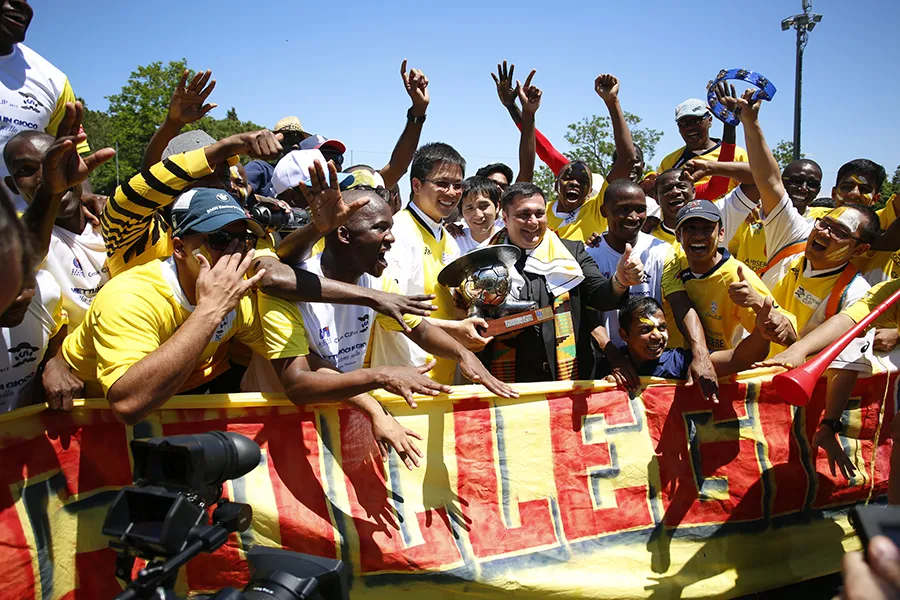
Vatican City, May 31, 2017 / 04:00 pm (CNA/EWTN News).- Upon winning the Vatican's annual soccer championship last week, the victorious team honored Christians in Egypt who have faced increasingly brutal persecution in recent years.
“I would like to dedicate this trophy to our friends from the Coptic Church,” said Deacon Sama Joan Romeo of Cameroon, the team captain of the Urban Lions.
Catholic seminarians and clergy drew soccer teams from the pontifical universities and colleges of Rome May 27 for the 13th annual Clericus Cup competition.
The competition's press officer, Felice Alborghetti, said the competition should be considered a “world cup” because players from five continents and 66 countries are on the teams, which went through four qualifying rounds to reach the finals.
“In the final we have at least 20 countries (represented),” he told the EWTN news show Vaticano. “There are a lot of Europeans, Spaniards, Rumanians, Germans, a Croatian and a Hungarian player.”
African players are heavily represented on the team from the Pontifical Urban University, nicknamed “The Lions of Africa.” They hail from countries including Uganda, Cameroon, Tanzania and Botswana.
“All the world is playing in the field, not so much to highlight the word of soccer, as that of the Gospel,” Alborghetti said.
Over 400 players competed, but the May 27 finals came down to two teams: one from the Pontifical Gregorian University, called “Gregoriana,” the other from the Pontifical Urban University, the “Urban Lions.”
Classmates and fans of the teams gathered to show support in the bleachers around a field in view of St. Peter's Basilica. Some wore painted faces and played guitars. The rectors of both schools cheered on their teams.
Monsignor Nuno da Silva Gonçalves, rector of the Pontifical Gregorian University, reflected on the nature of the competition.
“We're very committed to supporting our own team,” he told Vaticano. “Our university is trying to give thorough training programs, with a global and academic reach – which is very important to us – but also human and spiritual training and sport is part of this thorough approach.”
The players have also “sacrificed a lot to be here,” said Monsignor Vincenzo Viva, rector of the Urban College. “We mustn't forget that it’s the exam period now at the university, so they've really made a great effort.”
Amid the festivities, the final match of 2017 began with a serious moment of prayer. Then the opening whistle blew.
The Urban Lions took advantage, scoring the first goal. With high passions, the bleachers roared. There were fouls and penalties. Then a corner kick led to a second goal for the Urban Lions.
They took the match, and the Clericus Cup, with a 2-0 win.
“We came here and we knew we could win because last year we almost won the cup, and anyway it was a great match and a match of brotherhood,” said Antonio, an Angolan a seminarian from the Urban College. “This is the joy of being here and taking part in all this.”
Pour Porbumbi, a Kenyan seminarian at the same college, noted the fans' effort to sing and sing so that their team could play well.
Deacon Sama Joan Romeo added that the team is “not playing for honor or for any glory, we are just playing for friendship, for fraternity for our spiritual goals.”
The win marks the third time the Urban College's team has won a Clericus Cup.
If you value the news and views Catholic World Report provides, please consider donating to support our efforts. Your contribution will help us continue to make CWR available to all readers worldwide for free, without a subscription. Thank you for your generosity!
Click here for more information on donating to CWR. Click here to sign up for our newsletter.

Pope Francis prays during Christmas Mass in St. Peter’s Basilica on Dec. 24, 2023. / Vatican Media
Vatican City, Dec 24, 2023 / 18:00 pm (CNA).
Below is the full text of Pope Francis’ homily for the Solemnity of the Nativity of the Lord, delivered on Dec. 24, 2023, in St. Peter’s Basilica.
“A census of the whole earth” (cf. Lk 2:1). This was the context in which Jesus was born, and the Gospel makes a point of it. The census might have been mentioned in passing, but instead is carefully noted. And in this way, a great contrast emerges. While the emperor numbers the world’s inhabitants, God enters it almost surreptitiously. While those who exercise power seek to take their place with the great ones of history, the King of history chooses the way of littleness. None of the powerful take notice of him: only a few shepherds, relegated to the margins of social life.
The census speaks of something else. In the Scriptures, the taking of a census has negative associations. King David, tempted by large numbers and an unhealthy sense of self-sufficiency, sinned gravely by ordering a census of the people. He wanted to know how powerful he was. After some nine months, he knew how many men could wield a sword (cf. 2 Sam 24:1-9). The Lord was angered and the people suffered. On this night, however, Jesus, the “Son of David”, after nine months in Mary’s womb, is born in Bethlehem, the city of David. He does not impose punishment for the census, but humbly allows himself to be registered as one among many. Here we see, not a god of wrath and chastisement, but the God of mercy, who takes flesh and enters the world in weakness, heralded by the announcement: “on earth peace among those whom he favors” (Lk 2:14). Tonight, our hearts are in Bethlehem, where the Prince of Peace is once more rejected by the futile logic of war, by the clash of arms that even today prevents him from finding room in the world (cf. Lk 2:7).
The census of the whole earth, in a word, manifests the all-too-human thread that runs through history: the quest for worldly power and might, fame and glory, which measures everything in terms of success, results, numbers and figures, a world obsessed with achievement. Yet the census also manifests the way of Jesus, who comes to seek us through enfleshment. He is not the god of accomplishment, but the God of Incarnation. He does not eliminate injustice from above by a show of power, but from below, by a show of love. He does not burst on the scene with limitless power, but descends to the narrow confines of our lives. He does not shun our frailties, but makes them his own.
Christmas Mass in St. Peter’s Basilica on the night of Dec. 24, 2023. Vatican Media
Brothers and sisters, tonight we might ask ourselves: Which God do we believe in? In the God of incarnation or the god of achievement? Because there is always a risk that we can celebrate Christmas while thinking of God in pagan terms, as a powerful potentate in the sky; a god linked to power, worldly success, and the idolatry of consumerism. With the false image of a distant and petulant deity who treats the good well and the bad poorly; a deity made in our own image and likeness, handy for resolving our problems and removing our ills. God, on the other hand, waves no magic wand; he is no god of commerce who promises “everything all at once”. He does not save us by pushing a button, but draws near us, in order to change our world from within. Yet how deeply ingrained is the worldly notion of a distant, domineering, unbending, and powerful deity who helps his own to prevail against others! So many times this image is ingrained in us. But that is not the case: our God was born for all, during a census of the whole earth.
Let us look, then, to the “living and true God” (1 Thess 1:9). The God who is beyond all human reckoning and yet allows himself to be numbered by our accounting. The God, who revolutionizes history by becoming a part of history. The God who so respects us as to allow us to reject him; who takes away sin by taking it upon himself; who does not eliminate pain but transforms it; who does not remove problems from our lives but grants us a hope that is greater than all our problems. God so greatly desires to embrace our lives that, infinite though he is, he becomes finite for our sake. In his greatness, he chooses to become small; in his righteousness, he submits to our injustice. Brothers and sisters, this is the wonder of Christmas: not a mixture of sappy emotions and worldly contentment, but the unprecedented tenderness of a God who saves the world by becoming incarnate. Let us contemplate the Child, let us contemplate the manger, his crib, which the angels call “a sign” for us (cf. Lk 2:12). For it truly is the sign that reveals God’s face, a face of compassion and mercy, whose might is shown always and only in love. He makes himself close, tender, and compassionate. This is God’s way: closeness, compassion, tenderness.
Pope Francis brings a figure of the Christ child over to the nativity scene inside of St. Peter’s Basilica at the end of Mass. Vatican Media
Sisters and brothers, let us marvel at the fact that he “became flesh” (Jn 1:14). Flesh: the very word evokes our human frailty. The Gospel uses this word to show us that God completely assumed our human condition. Why did he go to such lengths? Because he cares for us, because he loves us to the point that he considers us more precious than all else. Dear brother, dear sister, to God, who changed history in the course of a census, you are not a number, but a face. Your name is written on his heart. But if you look to your own heart, and think of your own inadequacies and this world that is so judgmental and unforgiving, you may feel it difficult to celebrate this Christmas. You may think things are going badly, or feel dissatisfied with your limitations, your failings, your problems, and your sins. Today, though, please, let Jesus take the initiative. He says to you, “For your sake, I became flesh; for your sake, I became just like you”. So why remain caught up in your troubles? Like the shepherds, who left their flocks, leave behind the prison of your sorrows and embrace the tender love of the God who became a child. Put aside your masks and your armor; cast your cares on him and he will care for you (cf. Ps 55:22). He became flesh; he is looking not for your achievements but for your open and trusting heart. In him, you will rediscover who you truly are: a beloved son or daughter of God. Now you can believe it, for tonight the Lord was born to light up your life; his eyes are alight with love for you. We have difficulty believing in this, that God’s eyes shine with love for us.
Christmas Mass in St. Peter’s Basilica on the night of Dec. 24, 2023. Vatican Media
Christ does not look at numbers, but at faces. However, who looks at him amid the many distractions and mad rush of a bustling and indifferent world? Who is watching? In Bethlehem, as crowds of people were caught up in the excitement of the census, coming and going, filling the inns, and engaged in petty conversation, a few were close to Jesus: Mary and Joseph, the shepherds, and then the Magi.
Let us learn from them. They stood gazing upon Jesus, with their hearts set on him. They did not speak, they worshiped. Tonight, brothers and sisters, is a time of adoration, of worship.
Worship is the way to embrace the Incarnation. For it is in silence that Jesus, the Word of the Father, becomes flesh in our lives. Let us do as they did, in Bethlehem, a town whose name means “House of Bread”. Let us stand before him who is the Bread of Life. Let us rediscover worship, for to worship is not to waste time, but to make our time a dwelling place for God. It is to let the seed of the Incarnation bloom within us; it is to cooperate in the work of the Lord, who, like leaven, changes the world. To worship is to intercede, to make reparation, to allow God to realign history. As a great teller of epic tales once wrote to his son, “I put before you the one great thing to love on earth: the Blessed Sacrament… There you will find romance, glory, honor, fidelity, and the true way of all your loves on earth” (J.R.R. TOLKIEN, Letter 43, March 1941).
Brothers and sisters, tonight love changes history. Make us believe, Lord, in the power of your love, so different from the power of the world. Lord, make us, like Mary, Joseph, the shepherds, and the Magi, gather around you and worship you. As you conform us ever more to yourself, we shall bear witness before the world to the beauty of your countenance.
Pope Francis prays at his General Audience in the Vatican’s Paul VI Hall, Feb. 2, 2022. / Daniel Ibañez/CNA.
Washington, D.C. Newsroom, Feb 2, 2022 / 10:36 am (CNA).
Pope Francis prayed for the Burmese people and for the success of the upcoming Winter Olympics during his general audience on Wednesday.
He first provided a brief catechesis on St. Joseph and the communion of saints Feb. 2, saying that “Even when we rely fully on the intercession of a saint, or even more so that of the Virgin Mary, our trust only has value in relation to Christ. As if the path toward this saint or toward Our Lady does not end there, no. Not there, but in relationship with Christ. He is the bond, Christ is the bond that unites us to him and to each other, and which has a specific name: this bond that unites us all, between ourselves and us with Christ, it is the ‘communion of saints’.”
Devotion to the saints, he said, is “simply talking to a brother, a sister, who is in the presence of God, who has led a righteous life, a model life, and is now in the presence of God. And I talk to this brother, this sister, and ask for their intercession for the needs that I have.”
He shared a prayer to St. Joseph he has recited daily for 40 years, and which he said came from a late 18th century prayer book of the Sisters of Jesus and Mary: “Glorious Patriarch Saint Joseph, whose power makes the impossible possible, come to my aid in these times of anguish and difficulty. Take under your protection the serious and troubling situations that I commend to you, that they may have a happy outcome. My beloved father, all my trust is in you. All my trust is in you. Let it not be said that I invoked you in vain, and since you can do everything with Jesus and Mary, show me that your goodness is as great as your power. Amen.”
After his catechesis, Pope Francis issued appeals for prayers on a multitude of international issues.
“For a year now, we have been watching the violence in Myanmar with sorrow. I echo the appeal of the Burmese bishops for the international community to work for reconciliation between the parties concerned,” said Pope Francis.
Myanmar, which is also called Burma, is home to a small Catholic population. Despite their small numbers, Catholics have played a sizeable role in the protests throughout the country since a military coup seized power last year.
“We cannot look away from the suffering of so many brothers and sisters. Let us ask God in prayer for consolation for this tormented population,” he said. “To him we entrust our efforts for peace.”
Pope Francis noted that the 2022 Winter Olympics begin on Thursday, Feb. 4, and that the Paralympic Winter Games are set to commence on March 4.
“I warmly greet all participants. I wish the organizers every success and the athletes the very best,” he said.
The pope added that the “universal language” of sports can serve as a way of building “friendship and solidarity between individuals and peoples of all cultures and religions.” He said that he is hopeful “that the Olympic Games may bring about a more fraternal world.”
The feats of disabled athletes, said Pope Francis, provide an example that “helps everyone to overcome prejudices and fears” and help to “make our communities more welcoming and inclusive.”
“This is the real gold medal,” he said.
“I also follow with attention and emotion the personal stories of refugee athletes. May their testimonies help to encourage civil societies to open up with ever greater confidence to all, leaving no one behind.”
During the Summer Olympics in Tokyo, a 29-member team of refugee athletes competed under the Olympic flag. However, the Refugee Olympic Team will not be competing at the considerably-smaller Winter Olympics.
“I wish the great Olympic and Paralympic family a unique experience of human brotherhood and peace: blessed are the peacemakers,” he said.
On Feb. 4, the world will acknowledge the second-ever “International Day of Human Brotherhood.”
It is a reason for satisfaction that the nations of the entire world are joining in this celebration, aimed at promoting interreligious and intercultural dialogue, as also called for in the Document on Human Brotherhood and for World Peace and Common Coexistence, signed on 4 February 2019 in Abu Dhabi, by the Grand Imam of Al-Azhar, Muhammad Aḥmad al-Tayyib, and by myself,” said Pope Francis.
“Brotherhood,” said the pope, “means reaching out to others, respecting them and listening to them with an open heart.”
Pope Francis hopes that in the future, “concrete steps will be taken together with the believers of other religions, and also with people of good will, to affirm that today is a time of brotherhood, avoiding fuelling clashes, divisions, and closures.”
“Let us pray and commit ourselves every day so that we can all live in peace, as brothers and sisters,” he said.
Pope Francis speaking to participants of an Italian youth camp on August 5, 2022 / Vatican media
CNA Newsroom, Aug 5, 2022 / 07:13 am (CNA).
Pope Francis told young Catholics on Friday that Jesus is not just a moral precept but a person and a g… […]
Leave a Reply