

Synodality remains a featured project of the contemporary Church under the papacy of Pope Leo XIV. But it remains to be seen what Leo plans on doing with it, and so the debates and controversies surrounding it remain an ongoing aspect as well of this thing called “synodality”.
In what follows, I want to focus on one aspect of synodality still up in the air as to its precise meaning—an ambiguity that is itself indicative of the vague definitional world within which synodality lives. It is the repeated assertions of the strongest proponents of the “new synodal Church” that synodality, in great measure, represents the Church transitioning from a Church of “top down” pronouncements into a Church that “listens”.
The attempted revamping of Catholic morality
But what does this mean precisely? What, exactly, is a “listening Church” and what, exactly, is it that a “listening Church” does that a non-listening Church does not do? Are we to further surmise that prior to this synodal project, the Church was not sufficiently “listening” to the “people of God”? And if so, in what concrete ways did this insufficiency to listen manifest itself in her pastoral life?
When pressed for answers to these questions, the synodal advocates deflect away from definitional clarity. They seem to be saying, to paraphrase Forrest Gump, that “listening is as listening does.” But one sees certain “tells” as to what they mean when they link “listening” to a greater emphasis upon a deeper attentiveness to the “concrete lived experiences” of the faithful. Which, in turn, leads to a greater emphasis upon “accompaniment” for those faithful whose lived experiences are embedded within “complex concrete circumstances”.
Once again, there is the not-so-subtle implication that the pre-synodal Church was not sufficiently attentive to those lived experiences. We see, for example, frequent references to the need to avoid “one size fits all” pastoral approaches in which the Church presumes that her moral norms—e.g., the commandment not to commit adultery—are inviolable and that prohibitions against such moral acts harbor no exceptions, regardless of circumstances. Presumably, such a posture is coldly indifferent to those who find themselves in “messy and complicated circumstances”. Therefore, what is necessary, so the argument goes, is a greater posture of listening to determine whether mitigating circumstances are so great as to constitute a need for a more accommodationist posture under the law of pastoral gradualness.
There is a sense in which this is thoroughly unproblematic. The Church’s traditional moral theology has always held that there are three criteria for adjudicating the morality of any act: the moral object, the motives, and the circumstances surrounding the act. Pastors, for centuries, have applied these criteria to the penitents, and usually with sensitivity and pastoral mercy. Not always, of course, but it is a profound calumny of the past to imply that before synodality and a “listening Church” emerged, pastors were mostly a pharisaical group of insensitive clericalists. After all, was not the rise of forms of moral theological casuistry precisely an attempt at granting a broad latitudinarian presumption of diminished moral culpability for all manner of alleged sins?
One cannot help but get the sense that the proponents of a “listening Church” mean something other than this. They apparently want a complete revamping of the Church’s moral theology that begins with “lived experience” as the presumptive primary criterion for adjudicating the morality of an act, rather than the moral commandments and the admonishment to “avoid evil and do the good”. What seems new in this current push for a listening Church is an inversion of the criteria for a moral act that leads inexorably to a pastoral praxis that eviscerates the concept of intrinsically evil acts under the weight of a million idiosyncratic and morally mitigating circumstances.
This becomes even more apparent when one realizes that the reform of moral theology called for by Vatican II was carried out by thinkers including Germain Grisez and Servais Pinckaers, to cite but two examples. The Council in no way called for the repudiation of the Church’s traditional reliance upon natural law thinking. Rather, it called for that approach to be grounded more explicitly in scripture and the Fathers. To that end, Grisez (whom I studied under) grounded the moral commandments in natural law but gave it a more explicitly Scriptural foundation in what he called the “modes of responsibility”, which he developed out of the moral norms contained in the Sermon on the Mount. And Pinckaer redeployed natural law with a greater emphasis on the moral life as grounded in the development of various virtues, which is a very Thomistic move.
My point is that it is not as if the Church has been moribund and hidebound, clinging to outdated scholastic manuals, while ignoring the “lived circumstances” of the faithful. Rather, there has been a dynamic and robust development of moral theology, at once faithful to the traditional moral commandments while developing new pastoral pathways for discernment.
Listening to who? Where? How?
Historical context here is important. Alongside these developments in moral theology, there arose a new approach, loosely called “proportionalism”, with such thinkers as Bernard Häring, Charles Curran, and Richard McCormick developing the idea that moral acts are almost completely determined by the circumstances and motives of those involved, and with an eye toward the foreseen “consequences” of those acts. This formed the foundation for the rise of massive dissent from Humanae Vitae and indeed all of the Church’s teachings on sexuality.
With some exceptions, there was a concomitant rise in the dismissal of the idea of intrinsically evil acts, since no act can be judged in advance to be immoral until each of the relevant circumstances and potential consequences of an act is factored in. And it is precisely this denial of intrinsically evil acts that prompted Pope St. John Paul II to issue his encyclical on moral theology, Veritatis Splendor.
Returning to synodality and the emphasis upon a listening Church, we must not analyze the proposals of its adherents in a historical vacuum, as if the past sixty years of moral theological debate never happened. Indeed, it was Pope Francis who held up Bernard Häring as a “model” for how moral theology is to be done. I hasten to add that Pope Francis was not necessarily endorsing proportionalism, and as with so many other aspects of his papacy, his exact meaning was unclear. Nevertheless, he said what he said, and it is further evidence that the old debates were still framing the discussion and the backdrop to the new synodal way.
In other words, the proposals for a more listening Church cannot be read as involving a pristine, new way of thinking that was entirely devoid of connections to this history of theological debate. Those, including myself, who questioned certain aspects of the synodal way, and who criticized the ambiguities of Amoris Laetitia, and who called for a greater magisterial clarity on these matters, were not, and are not, little more than old guard reactionary cranks and “anti-Francis” dissidents who need to be put in their place. Many Cardinals and theologians of impeccable scholarship were among those seeking greater clarity. And that is because they understood the historical context of the debate and saw the telltale signs of a proportionalist undertow in the rising tide of the synodal listening Church.
(Do not rush in with the rejoinder that it is wrong to see such proportionalist leanings in Pope Francis. Regardless of his personal views, he empowered many thinkers who clearly evince such leanings and often without apology. The debate cannot be swept so neatly under the rug, and if one is going to promote such thinkers, then one must expect pushback.)
And the entire emphasis upon the “new and improved listening Church” is not exempt from this criticism. Especially because it is simply impossible for the Church to “listen” to 1.4 billion Catholics, spread across the globe in all kinds of different cultural, linguistic, ethnic, and demographic groupings. And given this impossibility, one is justified in questioning the process of “curated listening”, utterly lacking in transparency, wherein selected individuals and couples are invited to give “witness” to their “lived experiences”. Who selected them and why? What criteria were involved? What theological/ideological lenses were allowed to do the refracting in post-synodal documents?
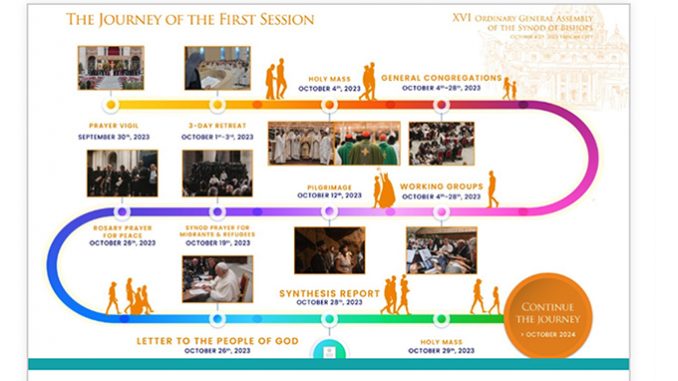
Worldwide, only about 1% of Catholics bothered to attend the various “listening sessions” of the Continental phase in the lead-up to the first Synod on synodality. But their input via answers to unscientifically developed questions has been touted as an example of the Holy Spirit speaking to the Church through the people of God. This is, in a word, rubbish. And it has the distinct odor of manipulation.
Furthermore, this manipulation seems geared toward the favored conclusion that a listening Church is one open to a “development of doctrine” on nearly all issues. And despite the admonition of Pope Francis to the contrary, all of this “listening” seems oriented toward a more parliamentary proceduralism, where the Church is viewed as an endless debating club with settled doctrines treated as “one party line” among many, and which thus stand open to reversal, now repackaged as the mere consequence of “listening to the Holy Spirit via the people of God”.
By implication, those who oppose this process are now viewed as enemies of the Holy Spirit who are stuck in a “fundamentalist” mindset of intransigent absolutes. This sleight of hand, in which listening to the “lived experiences”, is equated simplistically with the ipsissima verba of the Holy Spirit. It blithely and somewhat insouciantly ignores the many ways in which human beings can deceive themselves.
A more traditional moral theology stood for the supremacy of conscience, but also held that consciences can be grossly malformed, even if sincerely so, and that such malformations arise most often precisely out of the bad effects of those same “concrete circumstances of lived experience.” Human beings in “difficult situations” are capable of deep rationalizations for why their situation is “unique” and one of those liminal situations that cry out for accommodation.
Failure is not an option; it’s inevitable
But in the new “listening Church” such malformed consciences are treated as a kind of prelapsarian eruption of unvarnished truths, in an almost oracular fashion, to be taken at face value and never questioned lest one be accused of being deaf to the voices of the people. Some might say that I am exaggerating here and engaging in rhetorical hyperbole.
But I think not. Proportionalism was bad enough, but the emphasis upon “listening” to lived experience as the barometer for all theology going forward is something far more dangerous. It is a quasi-gnostic bypassing of the dreaded “institutional Church” with all of its pharisaical “rules” and “outdated” deontological moral norms in favor of the pristinization of conscience as an oracular voice within us that comes directly from God in spiritual immediacy and which, therefore, trumps everything in the bulbous and lumpy world of “mere doctrines”.
And just as in gnosticism, not all “experiences” are treated as being equal, with some being favored as more “illumined” than others. In the Church of “Todos! Todos!” those inner voices most illumined by the spirit of modernity are to be listened to and “included”, but not the voices of those retrograde reactionaries who love the old Mass, the old devotions, and all the old doctrines. We must listen to the pained voices of the “LGBTQ+” experiencers. But not to the pained voices of those who long for non-banal liturgy.
In short, non-transparent and curated listening is no listening at all. And nobody’s “lived experience” is a prelapsarian and non-problematic, privileged oasis of the Holy Spirit. In that light, synodalism and the listening Church will fail to the extent that they refuse to address the deeper existential crisis the Church faces today.
If you value the news and views Catholic World Report provides, please consider donating to support our efforts. Your contribution will help us continue to make CWR available to all readers worldwide for free, without a subscription. Thank you for your generosity!
Click here for more information on donating to CWR. Click here to sign up for our newsletter.


For all its extravagant wordcount, too much of synodality seems to serve as bubble-wrap to categorically exempt the homosexual lifestyle from the concrete clarity of moral theology, and in this way also to fully sidestep “Humanae Vitae” altogether.
The mentioned encyclical, “Veritatis Splendor” (1993), appeared not before, but a full thirty years after the Council, and walking in step (!) with the “Catechism of the Catholic Church (1992/1994: “a fruit of the Council”).
VERITATIS SPLENDOR(VS) on moral absolutes:
“…the fact that only the negative commandments oblige always and under all circumstances [!] does not mean that in the moral life prohibitions are more important than the obligation to do good indicated by the positive commandments. The reason is this: the commandment of love of God and neighbor does not have in its dynamic any higher limit, but it does have a lower limit [!], beneath which the commandment is broken.
“Furthermore, what must be done in any given situation depends on the circumstances, not all of which can be foreseen; on the other hand there are kinds of behavior which can never, in any situation [!], be a proper response—a response which is in conformity with the dignity of the person [….] As we have seen, Jesus himself reaffirms that these prohibitions allow no exceptions [!]: ‘If you wish to enter into life, keep the commandments….You shall not murder, You shall not commit adultery, You shall not steal, You shall not bear false witness'(Mt 19:17-18)” (VS, n. 52).
“Moreover, the very progress of cultures demonstrates that there is something in man which transcends those cultures [!]. This ‘something’ is precisely human nature: this nature is itself the measure of culture [!] and the condition ensuring that man does not become the prisoner of any of his cultures, but asserts his personal dignity by living in accordance with the profound truth of his being” (VS, n. 53).
The NATURAL LAW AND MORAL ABSOLUTES are not an expendable theological opinion, but now are explicitly part of the Magisterium of the Church:
“This is the first time, in fact, that the Magisterium of the Church has set forth in detail the fundamental elements of this [‘moral’] teaching, and presented the principles for the pastoral discernment necessary in practical and cultural situations which are complex and even crucial” (VS, n. 115). And, “The Church is no way the author or the arbiter of this norm” (VS, n. 95).
The 1960ish Bernard Haring et al are old news. Backwardist.
“too much of synodality seems to serve as bubble-wrap to categorically exempt the homosexual lifestyle from the concrete clarity of moral theology.”
Agreed, and I’m wondering who this is all really for. Is it about the church being “welcoming,” or are closeted gay clergy looking to change church teaching so they no longer need to hide their true identity? Maybe a bit of both?
It certainly isn’t about helping gay people get their souls healed.
Cardinal Mueller’s comment about the time we live in:
“The martyrs in the first three centuries after Christ (from the beginnings until Emperor Diocletian’s attempt at the total extinction of Christianity) bear resemblances to the desire for the destruction of Christianity by the atheistic and anti-human ideologies of National Socialism and Communism, and even to political (but pseudo-religious) Islamism and the neo-socialist wokism of our days.”
I have great sympathy for you, Mr. Chapp. Listening is indeed difficult. Most especially for those who are used to speaking. It must be even harder to have to hear from the uniformed and treat their opinions with the respect you would expect for your own. I pray that God gives you the grace to persevere.
Chapp writes: “But in the new “listening Church” such malformed consciences are treated as a kind of prelapsarian eruption of unvarnished truths, in an almost oracular fashion, to be taken at face value and never questioned lest one be accused of being deaf to the voices of the people.”
What the synodalistas are promoting is a Catholic moral theology akin to a ouijia board.
I found this perspective helpful and in accord with my own observations made at a distance as a non participant. What I find frustrating – and about in this article too -, is a lack of a solution. I can and do whine too, but feel clouded out of doing more, whatever that is.
John Paul: sometimes the best you can do is to speak Truth.
Yes, ‘“Synodality” is rubbish and manipulation.
And yes, it does exist for one purpose only, to establish the evil of sexual immorality, and the priority of homosexuality, and to “queer the Church”
Manipulation is the way of “the groomer,” and the groomer’s prerequisite to continue abusing others, abusing themselves, abusing their office, and overthrowing “The Way and The Truth and The Life,” that is, overthrowing Jesus Our Lord and Savior.
“Synodality” is the way of “de-capitating The Body of Christ.” (the image warned against by Fr. Robert Imbelli).
This is why “the way of Synodality” is heralded by the idolatry of Pachamama, which was promoted by the Pontiff Francis, and (as we all now are free to acknowledge), was preformed some years prior by then-Rev. Robert Prevost, who is elected to succeed the Pontiff Francis and continue “the way of Synodality.” These men violated the 1st Commandment, because it is the necessary desensitizing offense before erasing the 6th Commandment.
They hold and teach that the 6th Commandment is “inadmissible.”
“Synodality” is “the way of the liar.”
“The liar” has a title in Hebrew: his title is “ha-satan.”
Chris, thank you for pointing out the scandalous and idolatrous acts by the Pachamama popes. We are in for some heavy weather with the Pevost papacy.
Chapp in précis form cuts to the quick in analyzing the Listening feature of Synodality, as it references preset conclusions: circumstances, intent, consequences in the analysis of a moral act to be considered prior to declaring an otherwise intrinsically evil act to actually be evil.
Leo XIV did mandate ‘serious’ listening to the spirit for answers. Assuring his audience that God will provide the answers – to which way we are to go.
Pope Leo is committed, to what extent remains to be seen, to carry out the Francis I new paradigm program of loosening the hawsers to the Barque.
Ours is listening to what Leo has to say – whether he will allow the dissolution of intrinsically evil acts or in effect return to affirming Apostolic Tradition. As John Paul II taught in line with Aquinas a moral act must be ordered to God.
That required ordering means there are principles of moral behavior that cannot be compromised.
A man’s culpability may be lessened due to intense passion – although the evil act remains evil. Therefore, we cannot set reasoned preconditions by which we may remove the evil of that intrinsically evil act.
I remember just after my ordination, Germain Grisez said to me: “You’re a cleric now”. And then he went on to say a few things about the return of the Old Clericalism that he saw happening and hoped that I would work against that return. I didn’t know what the heck he was talking about. 20 years later, I know exactly what he was talking about. However, the conditions were just not there back then for me to understand what he was saying, nor to see the value in actually listening to him–as if years of experience could actually teach me something I don’t already know. Dr. Joseph Boyle was another person who helped me to see the importance of taking others’ objections and challenges very seriously and not being too confident in the way matters appear at any given point in time. They both had an appreciation for the limits of human knowing that was not quite there in their early years–nor in mine.
The more I listen to my fellow clerics, the more I see why so many have a hard time with Synodality. They were not taught to listen, but to pontificate, that they had all the answers, that the laity had nothing of any real significance to teach them, and their education in the seminary was for the most part made up of courses that operate on a certain level of abstraction. They had very little exposure to psychology, and so counselling for many of them simply meant quoting the Catechism.
My experience is that the matters that concern the average parishioner are not abstract “moral issues”; they are matters that clerics are not comfortable with because they feel lost, for the lives of the laity are so different than the lives of clergy, so much busier, far more stressful, overwhelming, complicated and full of uncertainty, while so many of my young colleagues in Holy Orders live what the laity would see as semi-retired lives.
We’ve got a lot of listening to do. Just sit down and talk to those who leave and won’t return, and you’ll get a sense that there are matters that are outside the abstract bubble of moral problem solving.
Well said. Listening is indeed hard. Good news it is a muscle and can get stronger if one works at it.
@Thomas James. Maybe the Gospel examples of John the Baptist and Christ are sufficient even for the moderns you deal with. The Baptist called on people to repent. Not aware of any listening sessions. I don’t sense Christ was preaching by listening. Both relied on evangelizing with the Word, the Truth, and the Way.
Some examples of Jesus listening to people may help you Windswept House. These are my favorites;
• The Woman at the Well (John 4): Jesus sat down with the Samaritan woman, listened to her life story and theological questions, and engaged her with deep personal compassion rather than rushing past her social standing.
• The Road to Emmaus Disciples (Luke 24:19–21): After His resurrection, Jesus walked alongside two grieving, confused disciples, asked them what they were discussing (“What things?”), and let them pour out their heartbreak and dashed hopes before opening the Scriptures to them.
• Blind Bartimaeus (Mark 10:46–52): Amid a noisy crowd trying to silence the blind beggar, Jesus stopped, called him over, and asked, “What do you want me to do for you?”—listening to his direct plea for mercy and sight.
• Martha and Mary (Luke 10:38–42): Jesus listened to Martha’s anxious concerns about household tasks while also creating space for Mary to sit and listen to His own words.
(Thanks to AI for help with the list)
Loving encounters with the downtrodden and the broken reflect the glory of Christ, but they are not quite the same as the growing ecclesial tyranny of secularity rationalized with “listening” used as a euphemism.
The best, and probably the only, great movie made about Our Lord was Franco Zeffirelli’s, Jesus of Nazareth. The most moving encounter scene for me was Jesus meeting the blind man.
The Lord listens to the cry of the poor (Psalm 34).
Clerics should listen. That doesn’t mean they should agree.
When priests oversimplify things or tell people the truth doesn’t really require them to do or not do something (or just neglect to tell them), they aren’t listening well – they haven’t learned enough to help the person with their problem, they’ve merely lied and said there isn’t one, or ignored it. That’s worse than quoting the catechism.
A lot of the trouble with priests doing nothing beyond quoting the catechism is that their seminary stunk, and they really need to start educating themselves.
Father, just proclaim the Truth. Listening is passive. The great saints were not known for their listening but for proclaiming the Truth which is to say the kerygma.
Many great saints were actually known for listening. Take Padre Pio as one example among many.
Karen weighs in (as usual)
Good points, Thomas James, but is there still more….
Four points, in the interests of dialogue:
FIRST, has the listening thing died of a thousand cuts, or at least a half dozen? Succumbing to the der Synodal Weg redefinition of a “synod of bishops” as a congregational gathering (more from Benedict, below); the Hollerich Factor (things can be true and false at the same time); divide-and-conquer of non-amnesiac perspectives onto roundtables; infiltration of an open-door “style” by agendas aborting the inborn natural law; the replacement of so-called abstract stuff with an paradigm-shift/invertebrate process (the 2024 Instrumentum Laboris self-congratulates the synod/synodal/synodality process 228 times and mentions Veritatis Splendor not even once); and selective listening: poisoning the well was seating photo-op Fr. James Martin but conspicuously not Courage International).
SECOND, about a legitimate and needed “ecclesial assembly,” and probably the “Ecclesial Assembly” of 2028 (correctly no longer a so-called “synod”)—decades ago, Ratzinger/Benedict XVI already used this term when he reflected on the loss of the “ecclesial assembly”—or communio— during at Trent. The clarification of Catholic teaching, and restoration of the sacramentally ordained priest as more than a seeming “cult-minister” (his words) but as a bearer of sacramentality through Holy Orders, tended toward an unfortunate “separation” of the laity from the clergy—the loss of communio—”the problem of the laity, which arose at this time and still haunts us today” (“Successio Apostolica,” as Chapter 2 in Ratzinger, “Principles of Catholic Theology,” Ignatius, 1982/Ignatius 1987).
THIRD, the overripe task before the Church and Pope Leo XIV is how to better integrate the “hierarchical communion” nature of the Catholic Church (Lumen Gentium, Ch. 3 with the included Explanatory Note) with a more communal sense of the “universal call to holiness” (also Lumen Gentium)? So far, the significant moving parts include the restoration of the Consistory of Cardinals (discontinued under Pope Francis) and hopefully a more chastened sense of an “ecclesial assembly.”
FOURTH, before all the recent hoopla, yours truly participated in a really good Archdiocesan Pastoral Council (2001-2004), possible the only one in the country during the eruption of the Sexual Abuse Scandal. The archbishop and auxiliary bishop and two later bishops were among the body of twenty-five, and yet the distinction between the Apostolic Succession and the Lay members also remained intact.
So, now, as the likely Ecclesial Assembly in 2028 reflects how we did at the synods (“What did you do during the war, daddy”?), we might compare a few double-speak outcomes or whatever with questions asked by this layman, in the back bleachers, two years prior to the so-called synods: https://www.catholicworldreport.com/2019/02/19/quo-vadis-where-are-the-bishops-and-laity-of-old/
The synod project is a Trojan horse trying to find another way bring leftist ideology into the Church. It is an attempt to flatten the apostolic nature of the Church, just as bludgeoning the Latin Mass is an attempt to flatten the liturgy. If leftist Catholics want to be heard, go to Confession.
It is sad that you reduce life in Christ to confession of sins only. You may not have anything to contribute outside of the confessional, but others do. How does it help your sanctification to silence your brothers and sisters in Christ?
“You may not have anything to contribute outside of the confessional, but others do.”
If your comment history here is a representative sample of your “contributions”, you aren’t one of those “others”.
Thank you, Larry, for your always insightful and deep theological analyses.
It’s certainly important that we listen to others and their needs but our Father commanded us first to listen to his Son during His Transfiguration. And the first thing His Son told us in what may have been the first Gospel was to “repent.” (Mark: 1,15). Never seem to hear about our need to repent from the synodalers. Apparently that would be insensitive to our “concrete living experiences.”
In yesterday’s Lectionary reading from 2 John the Holy Spirit commanded us to ignore those progressives who want to go beyond the teachings of Christ. Happy to ignore the Lavender Mafia and their synodaling acolytes.
If synodality is supposed to transform the Church from a top-down approach into a bottom-up approach, it is ipso facto heretical.
“Every good endowment and every perfect gift is from above, coming down from the Father of lights with whom there is no variation or shadow due to change.” James 1
We have nothing good that comes from anywhere else than the top. All attempts to alter doctrine or morals based on the lived experience of the laity or the ideas of the academics or the ecclesiastical politics of bishops is opposed to the good that comes to us from God – i.e. they are evil.
Even things with good aspects are best avoided when there is poison mixed in, uncorrected and unchecked. If synodality continues in this way, it will be nothing more than a black spot in the history of the Church and in the legacy of those who participate.
The bishops who remain silent seem to be acting on ideas like “the Church moves slowly over centuries” or “the gates of hell will not prevail”, when they ought to consider Ezekiel: “If I say to the wicked, O wicked man, you shall surely die, and you do not speak to warn the wicked to turn from his way, that wicked man shall die in his iniquity, but his blood I will require at your hand”.
There are no promises regarding the gates of hell prevailing over individual souls, including those of bishops. Their business is not the preservation of the Church, but the salvation of souls. That moves quickly, over a few decades, and the formation of a child is 12 years or less.
The issue for the Church is going to center on two criteria both from Amoris Laetitia. Validity of divorce and remarriage in context of permitting reception of the Eucharist. The other, the irregular unions specifically referring to homosexual unions.
Arguments can be forecast on the basis of the proportionate greater good, for example whether reconciliation of remarriage outside the Church and irregular unions unites communities as benefits both the parties and the Church as a whole. A means of addressing lived experiences, mitigating circumstances, the ‘wounded’ dimension of a struggling humanity.
Whereas Christ called us to a higher, sanctifying standard in becoming more like him in accepting the Cross through the sanctifying gift of grace, which is precisely why there is the inexplicable lacuna of mention of grace in Chapter 8 Amoris Laetitia. A marked distinction regarding the Mystical Body, either becoming more like the world or more like Christ.
Thank you Mr. Chapp.
I am coming to the conclusion that the reason I don’t understand synodality is because it is incoherent. If its advocates cannot explain it in simple, non-jargon terms then I conclude that they themselves don’t understand it or there is a hidden agenda. I am not being willfully obstinate, just recognizing a pattern I have seen many times.
With regard to “listening”: how do the listeners know how to evaluate what they are listening to? Out of 1.4 billion speakers, surely some of them are wrong. How is one to tell? Seems like there is need of fixed principles after all. What are they and who decides what they are? The traditional answer is the Church as we have received it from the apostles. Are the synodality people proposing a different structure or process? I really can’t tell.
In these confused and frightening times, we need clarity and inspiration, not another “uncertain trumpet”.
I find it neigh impossible to speak an abstract truth to, “experienced truth”. An example: I sent an article to a friend about the politician Talarico, which article pointed out his support for ,”transgender care”; in fact, he said that not to support a,”transgender” child was child abuse.
Her angry response that was that she admired Talarico for his courage, and, she had a transgender grandchild that she and her family loved dearly and that she doesn’t want to hear anything from me again. Case closed!
It would not help if I told her (I’m cut off anyway) I worked in 21 hospitals, attended four universities, was in the Peace Corps, in the military, trained in two very large mental hospitals, and had never met a transgender in my first 60 years; that was my, “lived experience”.
So, I can’t express an abstract truth, nor my experience of truth. What’s a body to do?
My experience working with enthusiastic committed groups (including religious) inside and outside the church is reflected in the above example, thus my non-participation in any synod process. So far.