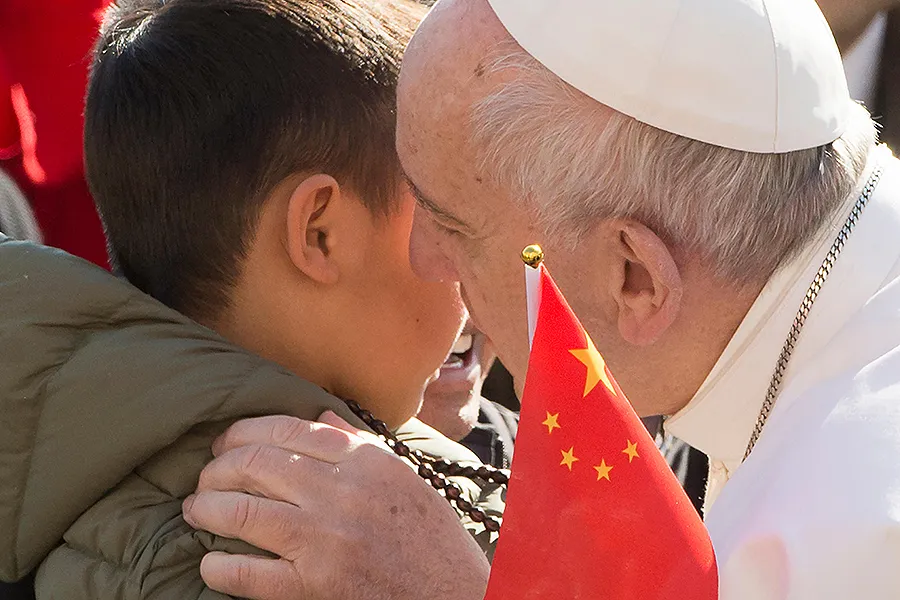
Vatican City, Mar 15, 2017 / 03:01 pm (CNA/EWTN News).- Pope Francis greeted and blessed a group of pilgrims from China who broke protocol and approached him during the Wednesday general audience.
The group of faithful, some of whom approached the Holy Father on their knees, held Chinese flags and amid sobs, asked for him to bless a statue of Our Lady of Fatima they had carried into Saint Peter's Square.
At first, some Swiss Guards tried to prevent the pilgrims from approaching the pontiff, but Francis quickly stopped them and shared a few moments with the pilgrims.
Among the pilgrims there were some children whom the Pope spent a few minutes with.
China only allows Catholic worship services for the Chinese Patriotic Catholic Association, which is subordinate to the Chinese Communist Party, and rejects the authority of the Vatican to appoint bishops or to govern them.
The Catholic Church faithful to the Pope is not completely clandestine, although it faces constant opposition.
Diplomatic relations between China and the Vatican were broken in 1951, two years after the communists came to power and expelled foreign clerics.
For some years the Holy See has been working on an accord for the reestablishment of diplomatic relations with China, a rapprochement encouraged by Pope Francis.
In August 2014, while he was on his way to South Korea, the Holy Father sent a telegram to the President of China to express his best wishes when his plane was over Chinese airspace.
The fact that the Pope had received permission to fly over Chinese airspace was considered a small step forward. Pope John Paul II had to avoid the airspace of this country during his trips to Asia.
If you value the news and views Catholic World Report provides, please consider donating to support our efforts. Your contribution will help us continue to make CWR available to all readers worldwide for free, without a subscription. Thank you for your generosity!
Click here for more information on donating to CWR. Click here to sign up for our newsletter.

Vatican City, Mar 20, 2017 / 09:48 am (CNA/EWTN News).- On Monday, the Vatican released the official program for Pope Francis’ two-day visit to Portugal in May, where he’ll celebrate the centenary of the Fatima Marian apparitions and make a… […]
Vatican City, Apr 12, 2018 / 08:21 am (CNA/EWTN News).- In the preface to a book on his economic thought, Pope Francis has written that the Gospel is not an unattainable ideal, but something that the whole Church should seek, especially where there is … […]
Pope Francis greets Archbishop Rino Fisichella in the Vatican’s Clementine Hall, Sept. 17, 2021. / Vatican Media.
Vatican City, Sep 17, 2021 / 07:30 am (CNA).
Pope Francis said on Friday that he instituted the new ministry of catechist with the hope that it would help to “awaken this vocation.”
Addressing participants in a meeting organized by the Pontifical Council for Promoting the New Evangelization on Sept. 17, the pope referred to his decision to formally institute the new lay ministry in May.
Vatican Media.
He said: “We must insist on indicating the heart of catechesis: the risen Jesus Christ loves you and never abandons you! We can never tire or feel we are being repetitive about this first proclamation in the various stages of the catechetical process.”
“This is why I instituted the ministry of catechist. They are preparing the rite for the, I quote, ‘creation’ of catechists. So that the Christian community may feel the need to awaken this vocation and to experience the service of some men and women who, living the celebration of the Eucharist, may feel more vividly the passion to transmit the faith as evangelizers.”
Vatican Media.
The pope established the new ministry through the apostolic letterAntiquum ministerium (“Ancient ministry”) on May 11.
While catechists have served the Church since New Testament times, an instituted ministry is a type of formal, vocational service within the Catholic Church.
Vatican Media.
The newly instituted ministry of catechist is for lay people who have a particular call to serve the Catholic Church as a teacher of the faith.
In the apostolic letter, the pope said that the Vatican Congregation for Divine Worship and the Discipline of the Sacraments would “soon publish” the Rite of Institution of the new ministry.
Vatican Media.
In his address, the pope noted that last Sunday he celebrated the closing Mass of the International Eucharistic Congress in Budapest, Hungary.
He said that catechesis “can be effective in the work of evangelization if it keeps its gaze fixed on the Eucharistic mystery.”
“We cannot forget that the privileged place of catechesis is precisely the Eucharistic celebration, where brothers and sisters come together to discover ever more the different forms of God’s presence in their lives,” he said.
Vatican Media.
Speaking in the Vatican’s Clementine Hall to Catholics responsible for catechesis in Europe, the pope fondly recalled the two catechists who prepared him for First Communion.
“I felt a great respect, even a feeling of thanksgiving, without making it explicit, but it felt like veneration,” he said.
“Why? Because they were the women who had prepared me for my First Communion, together with a nun. I want to tell you about this experience because it was a beautiful thing for me to accompany them to the end of their lives, both of them. And also the nun who prepared me for the liturgical part of Communion: she died, and I was there, with her, accompanying her. There is a closeness, a very important bond with catechists…”
Referring to the Directory for Catechesis, released in June 2020, he said that catechesis should not be understood as “an abstract communication of theoretical knowledge to be memorized as like mathematical or chemical formulas.”
“It is rather the mystagogical experience of those who learn to encounter their brothers and sisters where they live and work, because they themselves have met Christ, who has called them to become missionary disciples,” he said.
He then referred to his address on Monday in St. Martin’s Cathedral, Bratislava, in which he encouraged Slovakian Catholics to draw inspiration from Sts. Cyril and Methodius, who translated the Bible into the Slavonic language.
He told catechists in Rome: “They beat new paths, invented new languages, new ‘alphabets,’ to transmit the Gospel, for the inculturation of the faith.”
“This requires knowing how to listen to the people, to listen to the peoples to whom one is proclaiming: listening to their culture, their history; listening not superficially, already thinking of the pre-packaged answers we carry in our briefcase, no! To truly listen, and to compare those cultures, those languages, even and above all the unspoken, the unexpressed, with the Word of God, with Jesus Christ, the living Gospel.”
“And I repeat the question: is this not the most urgent task of the Church among the peoples of Europe? The great Christian tradition of the continent must not become a historical relic, otherwise, it is no longer ‘tradition.’”
He continued: “Tradition is either alive or it is not. And catechesis is tradition, it is trador [in Latin], to hand down, but as living tradition, from heart to heart, from mind to mind, from life to life. Therefore: passionate and creative, with the impetus of the Holy Spirit.”
“I used the word ‘pre-packaged’ for language, but I fear catechists whose heart, attitude, and face are ‘pre-packaged.’ No. Either the catechist is free, or he or she is not a catechist. The catechist lets herself or himself be struck by the reality he or she finds, and transmits the Gospel with great creativity, or is not a catechist. Think about this well.”
Leave a Reply