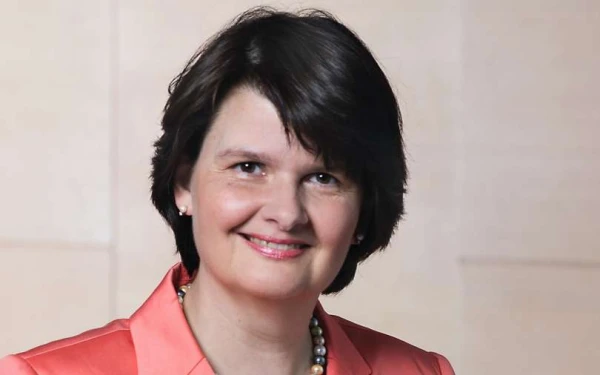
CNA Staff, Jun 24, 2020 / 03:25 pm (CNA).- The president of the leading Catholic women’s organization in Germany has declared her support for “reproductive rights” – including, “as a last, terrible resort” abortion – and for an initiative supported by the International Planned Parenthood Federation.
Maria Flachsbarth has been president of the German Catholic Women’s Federation (KDFB) since 2011. The Catholic mother of two and member of parliament for the Christian Democratic Union is also a member of the Central Committee of German Catholics, the lay organization coordinating the controversial “Synodal Process” with the German bishops’ conference.
Speaking to CNA Deutsch, CNA’s German-language news partner, on June 19, a spokeswoman for the Federal Ministry for Economic Cooperation and Development – for which Flachsbarth works as Parliamentary State Secretary – confirmed that Flachsbarth is committed to her support for “She Decides,” an initiative supported by Planned Parenthood.
Planned Parenthood international affiliates form the largest global network of abortion providers.
The spokesperson praised Planned Parenthood, saying the organization has made “a major contribution to reducing the high maternal mortality rate in developing countries through medical support for mothers and children during pregnancy and birth.”
In Flachsbarth’s view, the SheDecides initiative is committed to “protecting girls and women from suffering, enabling them to live in health and dignity and offering them opportunities for education and a self-determined life,” the spokesperson also told CNA Deutsch.
This also includes access to “basic sexual and reproductive health services and self-determination over one’s own body.”
The spokesperson added that SheDecides aims to protect women from the consequences of “unsafe abortions.”
“For this purpose, access to a medically safe abortion is offered under the laws and regulations applicable in the country, as well as help with complications after an unsafe abortion,” she said.
“As a member of the German Bundestag, as Parliamentary State Secretary and also in my honorary office as President of the KDFB, I have always been committed to the protection of life, especially in the particularly sensitive phases at the very beginning and at the very end. Abortion is never a means of family planning. In individual cases it can be a last, terrible resort”, Flachsbarth told CNA Deutsch through the spokeswoman.
A similarly worded statement published June 19 on her website reiterated Flachsbarth’s position.
The Catechism of the Catholic Church says that: “Since the first century the Church has affirmed the moral evil of every procured abortion. This teaching has not changed and remains unchangeable. Direct abortion, that is to say, abortion willed either as an end or a means, is gravely contrary to the moral law” (No. 2271).
Pope Francis has repeatedly decried abortion and other attacks against human life, including in his enclycical Laudato si. In 2018 he compared the abortion of sick or disabled children to a “Nazi mentality.”
In April 2019, the Holy See’s representative to the United Nations told the UN Commission on Population and Development that the insistence on a “right to abortion” detracted from the commission’s efforts to address the real needs of mothers and children.
“Suggesting that reproductive health includes a right to abortion explicitly violates the language of the ICPD, defies moral and legal standards within domestic legislations and divides efforts to address the real needs of mothers and children, especially those yet unborn,” said Archbishop Bernardito Auza.
In September 2019, representatives of 19 countries, including the Holy See and the United States, told the United Nations that there is no “international right to abortion” and that “ambiguous” terms such as “sexual and reproductive health” should be removed from official documents.
Flachsbarth’s support for Planned Parenthood has been criticized by other party members of the Christian Democratic Union. In an interview with the newspaper Tagespost, CDU politician Hubert Hüppe accused Flachsbarth of being a “protagonist of the abortion lobby”.
Hüppe also called on the German bishops to intervene, saying they had a duty to do so. Otherwise, the bishops would themselves lose credibility, should the “open support” by the KDFB president remain without consequences.
To date, no German bishop has publicly commented.
The Central Committee of German Catholics’ president, Thomas Sternberg – another CDU politician – told CNA Deutsch June 22 that he was “in complete agreement” with Flachsbarth, and that, in fact, they reject abortion, despite Flachsbarth’s support for the SheDecides initiative and for Planned Parenthood.
He said: “From my point of view, this debate makes it clear how far away we are from the general conviction and view that abortion is about killing people. The way it is discussed as a purely women’s rights issue is a sad sign of a lack of awareness of the value of unborn life.”
Sternberg, who in 2018 spoke out against a proposed relaxation of Germany’s abortion laws, said there is “no contradiction” between his position and Flachsbarth’s.
“The ZdK has always vehemently stood up for the protection of life. In Germany we have a legal regulation according to which abortion without medical or criminological indication is illegal. But we also know that we can only protect the life of the unborn children together with an unintentionally pregnant mother or a mother in distress and not against her,” Sternberg said
To protect life, he said, it is necessary to offer “encouragement for responsible parenthood” and concrete help, he added.
Under a 1995 law, women seeking an abortion in Germany must seek counseling, after which can they receive a certificate enabling them to obtain an abortion up to the 12th week of pregnancy.
In 1999, the Vatican ordered the German bishops to withdraw from the state counselling system over concerns that it compromised the Catholic Church’s unequivocal opposition to abortion. At the time, the Church ran more than 200 of the country’s 1,600 pregnancy counseling centres.
Sternberg told CNA Deutsch that the counseling regulation provided “protection” for unborn life.
He emphasized that both he and his predecessors had supported this regulation “even in the face of a strong social and political headwind,” “because we want to prevent abortions and can prevent them in many cases.”
He said: “At the same time we know that unfortunately abortion cannot be prevented in every crisis pregnancy case — Maria Flachsbarth speaks of this when she says that abortion can be a ‘last, terrible way out’ for a woman in individual cases. However, it is absolutely clear to us that abortion is not one of the means of family planning.”
Through education and information, he said, “women must be empowered to be able to decide on the number of children they will have and also on their future life.”
SheDecides was founded by Dutch politician Lilianne Ploumen in response to President Donald Trump’s 2017 decision to reinstate the Mexico City policy. Under that policy, foreign non-governmental organizations may not receive U.S. federal funding if they perform or promote abortions as a method of family planning.
SheDecides has won support from at least 60 countries, as well as dozens of NGOs. Within six months the initiative received pledges worth $300 million.
 […]
[…]



Leave a Reply