


 By
By 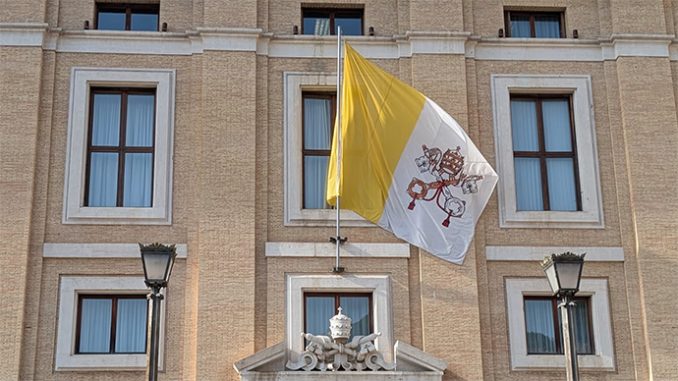
Pope Leo XIV has replaced the Vatican constitution promulgated by Pope Francis, eliminating a reference to the “munus petrinum,” or Petrine office, as the basis of the pope’s authority over Vatican City State.
The new Fundamental Law of Vatican City State, promulgated by Pope Leo and already in effect, represents considerably more than an update to the legal framework approved by Pope Francis in 2023.
Unlike the previous law, the new text makes a significant change to the way the foundation of the pontiff’s authority over the Vatican city-state is understood.
The constitution promulgated by Pope Francis stated that the pope exercised sovereign powers over Vatican City “by virtue of the Petrine office,” an expression referring to his sacred mission as the successor of St. Peter to guide, safeguard, and maintain the unity of the Church.
In practice, the formulation linked the pope’s temporal authority to his status as the successor of the apostle to whom Christ entrusted the keys of the Church.
“Francis introduced an anomaly that asserted that his powers as head of state derived from being the successor of Peter,” historian of Christianity Giovanni Maria Vian told ACI Prensa, the Spanish-language sister service of EWTN News.
Vian, a former editor of the Vatican newspaper L’Osservatore Romano and a professor of patristic philology at Rome’s Sapienza University, said the formulation represented a completely unprecedented innovation.
“It made his authority over Vatican City State derive directly from his status as Peter’s successor,” he said. “It was a theocratic arrangement without precedent in the very long history of the Apostolic See.”
Vian said Pope Leo, who is trained in both civil and canon law, appears to have decided to correct that innovation and return to the approach followed by the two previous Vatican constitutions, promulgated in 1929 and 2000.
“That assertion was neither adequate, correct, nor precise from a theological and historical point of view. That is why it was removed,” said Father Roberto Regoli, an expert in ecclesiastical history and diplomacy from the 19th to the 21st centuries and president of the Joseph Ratzinger-Benedict XVI Vatican Foundation.
“This omission is very important because the concept was unnecessary and, moreover, inappropriate,” he said.
4 constitutions for Vatican City State
The new law, dated July 31, completely replaces the constitution promulgated by Pope Francis on May 13, 2023. It is the fourth Fundamental Law in the history of Vatican City State.
The first was promulgated by Pope Pius XI on June 7, 1929, a few months after the signing of the Lateran Pacts and the creation of the new state. The law was drafted by Jewish jurist Federico Cammeo.
The second was the reform approved by St. John Paul II in 2000. The third was promulgated by Pope Francis in 2023.
Now, just three years later, Pope Leo has approved the Vatican’s fourth constitution.
The most significant change is found in the preamble. The new text recalls that Vatican City State was created through the Lateran Treaty to guarantee the Holy See absolute and visible independence and to ensure its sovereignty in the international sphere.
According to Vian, the difference between the two constitutions is substantial.
“One cannot maintain that Peter possessed temporal power or that his successors received it directly from him,” he said.
The historian noted that the temporal power of the popes emerged centuries after the apostolic era.
“That did not occur until the beginning of the Middle Ages,” he said. “The Papal States began to take shape around the middle of the eighth century.”
From that perspective, Vian said the formulation introduced by Pope Francis was historically difficult to sustain.
“It was probably the result of a mentality connected to his Jesuit background, obedience to the pope, and also the legal advice he received,” he said. “But from a historical and ecclesiological point of view, it was an anomaly.”
Regoli likewise said Pope Leo has restored the traditional formulation.
“Temporal power is at the service of spiritual power, nothing more,” he said. “Temporal power cannot be divinized or placed on the same level as spiritual ministry.”
A more traditional understanding of the Petrine ministry
Both experts said Pope Leo’s decision reflects a more traditional understanding of the Petrine ministry.
“He understands it in continuity with the tradition of his predecessors,” Vian said.
The Italian historian noted that the popes’ temporal power developed between the eighth and 19th centuries, over the course of more than a millennium, without deriving directly from the apostolic primacy of St. Peter.
Vian also said it was necessary to place the creation of Vatican City State in its historical context.
Following the French Revolution, the Papal States were abolished on several occasions: in 1798, with the establishment of the French-backed First Roman Republic; in 1809, during the Napoleonic occupation; in 1849, with the Second Roman Republic; and finally in 1870, when Italian troops took Rome and brought the temporal power of the popes to an end.
The events opened what became known as the “Roman Question.” For nearly 60 years, the pontiffs refused to recognize the new situation created by the Italian state. As a gesture of protest, they ceased appearing at the central loggia of St. Peter’s Basilica to impart public blessings.
The crisis was resolved in 1929 with the signing of the Lateran Pacts between the Holy See and the Kingdom of Italy. The agreements included an international treaty, a financial convention, and a concordat.
The treaty created Vatican City State as a sovereign territory intended to guarantee the independence of the Holy See.
The new constitution preserves the traditional principle that the pope possesses the fullness of power within Vatican City State.
Article 1 states: “The Supreme Pontiff, sovereign of Vatican City State, possesses the fullness of governing authority, which includes legislative, executive, and judicial power.”
The wording is nearly identical to that used by Pope Pius XI in 1929.
A new legal framework
Another significant change introduced by Pope Leo provides a legal basis for a situation that arose during Pope Francis’ pontificate.
The new Fundamental Law incorporates a November 2025 motu proprio allowing the presidency of the Pontifical Commission for Vatican City State to be held by someone other than a cardinal.
The reform addresses the case of Sister Raffaella Petrini, whom Pope Francis appointed to lead the Governorate of Vatican City State even though the legislation then in force stipulated that the position was to be held by a cardinal.
The appointment prompted criticism because of the discrepancy between the law and the institutional reality.
According to Regoli, the new constitution formalizes a correction Pope Leo had already introduced in 2025.
“The previous constitution established that the president had to be a cardinal; however, the president was Sister Petrini,” he said. “There was therefore an inconsistency between the law and reality. The pope intervened in 2025, and now, with the new 2026 constitution, that change has been fully incorporated into the legislation.”
The legal change means that “in addition to Sister Petrini, any other woman or man, including a layperson, may hold that office,” Regoli said.
“This is because Vatican City State, since it is not directly connected to theological or sacramental matters, does not necessarily require its governor to be a cardinal, bishop, or cleric,” he explained.
Membership in the College of Cardinals is therefore not an indispensable requirement, he said, because the position is not connected to the sacrament of holy orders.
The new Fundamental Law not only returns the Vatican constitution to the legal tradition of 1929 and 2000 but also regularizes several institutional reforms introduced in recent years.
Both experts agreed, however, that the most important change remains the redefinition of the origin of the pope’s temporal authority, an issue they consider essential to understanding the nature of the world’s smallest state.
“Pope Leo XIV has repaired an unprecedented break and returned to the original spirit in which Vatican City State was created,” Vian concluded.
This story was first published by ACI Prensa, the Spanish-language sister service of EWTN News. It has been translated and adapted by EWTN News English.
If you value the news and views Catholic World Report provides, please consider donating to support our efforts. Your contribution will help us continue to make CWR available to all readers worldwide for free, without a subscription. Thank you for your generosity!
Click here for more information on donating to CWR. Click here to sign up for our newsletter.


Christ didn’t come to establish Peter as Prime Minister of a republic. Peter is Vicar of Christ and not a successor to Caesar Augustus.