


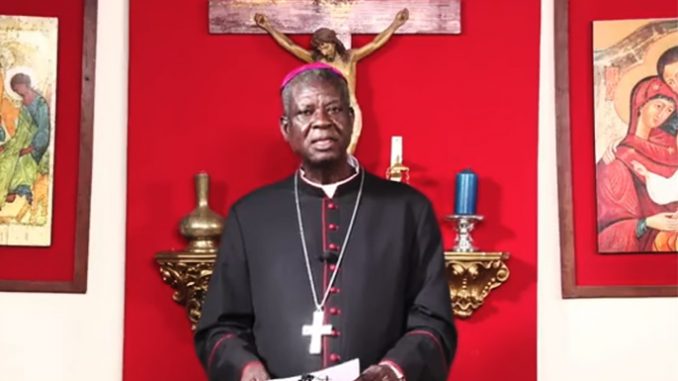
Archbishop Samuel Kleda of Cameroon’s Douala Archdiocese has issued the strongest indictment yet of the country’s justice system. In a recent pastoral letter, the outspoken cleric and frequent critic of the ruling class condemned a system defined by arbitrary arrests, enforced disappearances, and appalling detention conditions in both police stations and prisons.
Archbishop Kleda described the state of the nation’s prisons not merely as a legal failure, but as a profound test of the country’s humanity.
“The way we treat prisoners is a measure of our relationship with God,” he wrote.
He noted that inmates suffer from inadequate food, limited medical care, and severe overcrowding. The archbishop expressed particular outrage that men, women, and sometimes minors are forced to share the same spaces due to insufficient infrastructure. He also highlighted how the internal organization of prisons fosters predatory power dynamics, exacerbating the vulnerability of the weakest inmates.
Backlog, overcrowding, and systematic abuse
A primary driver of this crisis is the severe backlog in the justice system. According to the human rights organization Human Is Right, more than 69% of Cameroon’s inmates are in pre-trial detention, with many held for years without a verdict. Furthermore, those already convicted often remain incarcerated long after their sentences have expired.
Statistics from Prison Insider paint a grim picture of this overcrowding: as of January 2016, the country’s prison system operated at an overall occupancy rate of 163.8%. The Douala Prison, designed to hold 800 people, was hosting 5,000 inmates—a staggering 625% occupancy rate. Similarly, Yaoundé Prison was at 400% capacity, and Maroua Central Prison routinely exceeded 200%.
The case of Georges Endene, a 64-year-old Douala fisherman, encapsulates the systemic abuse decried by the archbishop.
Arrested on March 4, 2009, as an alleged accomplice to a crime, Endene was tortured during his initial interrogation.
In an interview for the report African Prisons: Human Rights in Cameroon Prisons, he recounted: “During my interrogation at the Bonanjo Territorial Brigade, the gendarmes ripped all my fingernails out with pliers because I refused to make a confession.”
Following the torture, Endene was held at the police brigade for three months—despite a legal limit of three days in police custody. He was then transferred to the notorious Douala New Bell prison, where he spent three years without trial. (Legally, no one should be held for longer than six months without trial; authorities can, however, extend this period for a maximum of another six months.) Even after finally being acquitted by the courts, he was unlawfully detained for an additional month.
It is these types of abuses that prompted the archbishop’s fierce condemnation. He noted it is deeply abnormal that Cameroonian prisons hold more remand prisoners than convicted ones, deploring the routine violation of statutory detention time limits.
“Ignoring their suffering means ignoring Christ; committing ourselves to alleviating their suffering and restoring justice means serving Christ,” Archbishop Kleda wrote.
Speaking to journalists, he added, “When you witness their reality, you realize these individuals are being treated as anything but human. The conditions they endure—hunger, sickness, extreme deprivation, and total abandonment—are shocking to confront.”
He also condemned what he termed “the intolerable practice of abductions and solitary confinement.”
A corrupt justice system
Building on Pope Leo XIV’s call for Cameroonian authorities to “break the chains of corruption,” Archbishop Kleda outlined the devastating impact of graft on the country’s justice and prison systems.
In his pastoral letter, he notes that financial means frequently determine legal outcomes, disproportionately victimizing the poor. He called on Cameroon—and Africa as a whole—to fight this phenomenon more aggressively, arguing that corruption stunts national development and destroys equal justice.
The archbishop also urged Cameroonians to rethink how they treat inmates, grounding his message in the Gospel of Matthew: “I was in prison and you came to visit me.” He called on the faithful to move beyond words and show practical solidarity.
“Loving one’s neighbor also means supporting prisoners, without distinction or exclusion, and recognizing in each person a dignity that never fades,” he wrote.
He laments that society is too quick to judge and forget prisoners, stressing that regardless of the crimes they are accused of, their humanity remains intact.
To address this, Archbishop Kleda went beyond merely condemning judicial delays, offering authorities a clear roadmap for reform. His concrete recommendations include banning secret detentions, ensuring all arrests are legally documented, and adopting alternative sentencing.
Furthermore, he called for hiring more judges and creating an independent commission to oversee a comprehensive overhaul of the country’s prison and judicial systems.
If you value the news and views Catholic World Report provides, please consider donating to support our efforts. Your contribution will help us continue to make CWR available to all readers worldwide for free, without a subscription. Thank you for your generosity!
Click here for more information on donating to CWR. Click here to sign up for our newsletter.

This is just appalling.