

 By
By Not many details are known about some of Jesus’ closest followers — here are some of their names and where their relics and tombs can be found today.
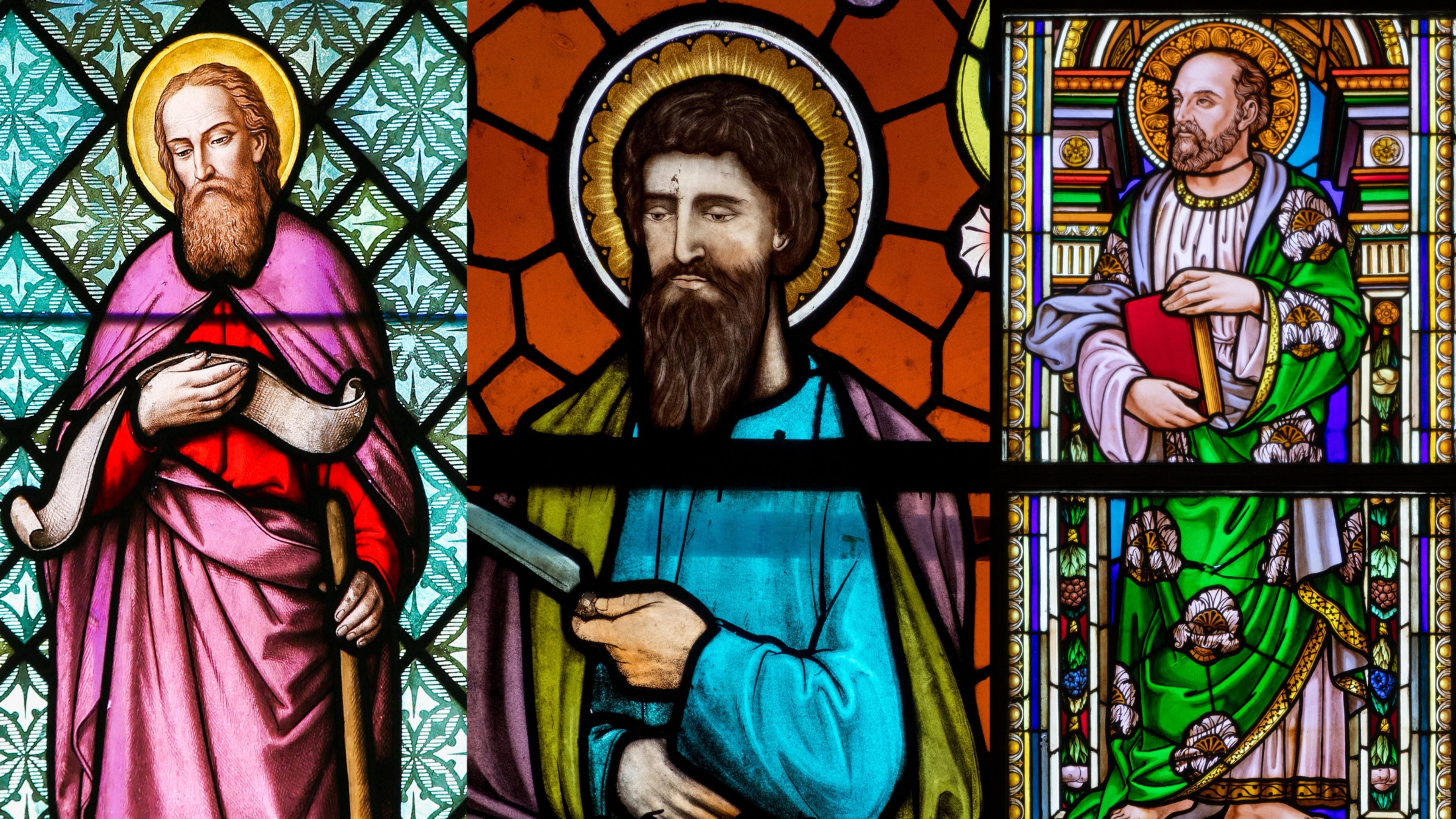
When Christians think of Jesus’ Twelve Apostles, they might immediately think of Peter, John, and Matthew. But what about some of the lesser-known followers he chose?
While Scripture gives us a significant amount of information about the lives of some apostles, not many details are known about others. Despite this, the Church has continued to remember and honor these apostles through the centuries, with churches, shrines, relics, and pilgrimage sites dedicated to them around the world.
Here are seven lesser-known apostles — and places where Catholics can still encounter their lives and legacy today.
St. James the Greater
James the Greater was the son of Zebedee and the brother of St. John the Apostle. He worked as a fisherman in the Sea of Galilee alongside his brother and father.
James and John were among the first disciples Jesus called. According to the Gospel of Matthew, Chapter 4, the brothers were mending their fishing nets when Jesus called them, and they immediately left their father and their fishing boat to follow him.
In Mark Chapter 3, Jesus gave the brothers the name “Boanerges,” an Aramaic nickname meaning “sons of thunder.”
James was one of the three apostles — along with Peter and John — who witnessed several particularly important moments in Jesus’ ministry. He was present at the raising of Jairus’ daughter, the Transfiguration, and Jesus’ agony in the Garden of Gethsemane.
After the resurrection and ascension of Jesus, James became the first of the Twelve Apostles to be martyred. In Chapter 12 of the Acts of the Apostles, it states that King Herod Agrippa I had him put to death “with the sword,” which is understood to mean that he was beheaded.
Today, St. James the Greater is honored through the famous Camino de Santiago — or Way of St. James — which is a network of walking trails that pass through several European countries and ends in Spain at the Cathedral of Santiago de Compostela. The cathedral is a major pilgrimage site and is home to St. James’ relics.
St. James the Lesser
James the Lesser was the son of Alphaeus and appears in the lists of the Twelve Apostles in the Gospels and Acts, but Scripture provides almost no information about his life or ministry.
In 2006, Pope Benedict XVI did a catechesis series on some of the lesser-known apostles, including James the Lesser. In his catechesis on James the Lesser, he explained that his title, “the Lesser,” was used to distinguish him from James the son of Zebedee, also known as James the Greater. It does not mean that he was less important.
The Holy Father also discussed the fact that James the son of Alphaeus has traditionally been identified by some with another prominent James in the early Church, but the identification remains disputed.
Today, the remains of James the Lesser — alongside those of the apostle Philip — are housed in the Basilica of the Twelve Holy Apostles in Rome.
St. Philip
Philip was from Bethsaida, the same town as Peter and Andrew, and appears the most in the Gospel of John.
After Jesus called Philip, he went to Nathanael and told him that he had found the one about whom Moses and the prophets had written. When Nathanael questioned whether anything good could come from Nazareth, Philip gave him a simple invitation: “Come and see.”
Philip also appears in the account of the multiplication of the loaves. Jesus asked Philip where they could buy bread for the large crowd, to which Philip replied that not even 200 denarii would be enough to buy bread for all those gathered.
Later, at the Last Supper, Philip asked Jesus to show the disciples the Father. Jesus responded by teaching Philip about his relationship with the Father.
In Pope Benedict XVI’s catechesis on Philip, he said: “According to certain later accounts (Acts of Philip and others), our Apostle is said to have evangelized first Greece and then Frisia, where he is supposed to have died, in Hierapolis, by a torture described variously as crucifixion or stoning.”
Today, Philip’s remains are housed — alongside those of the apostle James the Lesser — in the Basilica of the Twelve Holy Apostles in Rome.
St. Bartholomew
Bartholomew appears in the New Testament lists of the Twelve, but the Gospel narratives never tell a story about someone named “Bartholomew.”
Catholic tradition has long identified him with Nathanael, whom Philip brings to Jesus in the Gospel of John. Pope Benedict XVI described this as a traditional identification, while acknowledging that the New Testament itself does not explicitly make the connection.
After initially questioning whether anything good could come from Nazareth, he professed his faith in Jesus after meeting him, calling him “the Son of God” and “the King of Israel.”
In the Gospel of John, Jesus tells Nathanael: “Before Philip called you, when you were under the fig tree, I saw you.” While we don’t know what happened under the fig tree, it can be assumed that it was a “decisive moment in Nathanael’s life,” Benedict XVI explained.
The Basilica of St. Bartholomew on Tiber Island in Rome is dedicated to this apostle, as well as the Basilica of St. Bartholomew the Apostle in Benevento, Italy, which houses the saint’s relics.
St. Jude Thaddeus
St. Jude is sometimes confusing because he appears under different names in the New Testament.
Matthew and Mark call him Thaddeus, while Luke identifies him as Judas, son of James. Catholic tradition identifies these names with the same apostle and distinguishes him from Judas Iscariot by calling him Jude or Jude Thaddeus.
During the Last Supper, he asks Jesus why he will reveal himself to the disciples and not to the world. Jesus responds by speaking about those who love him and keep his word.
A Letter of Jude is also included in the New Testament. It traditionally bears the name of Jude Thaddeus, although questions about its authorship have been discussed by scholars. Pope Benedict XVI emphasized that the letter calls Christians to preserve their faith while remaining rooted in Godʼs mercy.
Jude is thought to have been martyred in Beirut around 65 A.D.
Despite very little being known about him, St. Jude is an important intercessor for Catholics around the world as the patron saint of impossible causes.
An experience Jude had while in the city of Edessa is said to be the reason why he is associated with impossible situations. According to the ancient Church historian Eusebius, while Jesus was still alive, the ruler Abgar V of Edessa was afflicted with an incurable and painful disease. He heard of the miracles of Jesus and wrote him a letter requesting a visit. Jesus responded that he would send one of his disciples.
After Jesus’ ascension into heaven, Jude went to evangelize near the city of Edessa and went to visit Abgar. Jude laid his hands on the sick ruler, and he was reportedly instantly healed.
Many people choose to carry or wear the image of St. Jude on a medal for comfort and as a reminder to call on him in times of need.
A major relic of St. Jude the Apostle has also traveled beyond its usual home in Rome. In 2023, a piece of the apostleʼs forearm bone began a nine-month tour across the United States, visiting churches, schools, and other locations so Catholics could venerate the relic and ask for the apostleʼs intercession. The relic had never before left Italy for such a tour. It is typically kept at the Church of San Salvatore in Lauro in Rome.
St. Simon the Zealot
Simon is one of the least-known members of the Twelve. The Gospels identify him as “the Zealot.” Matthew and Mark use the term “Cananaean,” while Luke uses “Zealot.” Pope Benedict XVI explained that the two descriptions convey the idea of zeal or ardor.
It is sometimes assumed that Simon belonged to the political movement known as the Zealots. However, Scripture does not establish this. His title could simply indicate that he was zealous in his religious devotion.
According to tradition, Simon the Zealot — alongside St. Jude — preached in Persia or Syria and was martyred.
While no major basilica is named after him, his relics can be found in St. Peter’s Basilica beneath the Altar of St. Joseph alongside St. Jude Thaddeus.
St. Matthias
Matthias was not one of the original Twelve chosen during Jesus’ earthly ministry. Instead, he was selected by the early Church after Judas Iscariotʼs death.
According to Acts 1, Peter explained that Judas’ replacement needed to be someone who had accompanied Jesus and the Apostles throughout Christʼs earthly ministry and could therefore serve as a witness to the Resurrection.
Two men were proposed: Joseph Barsabbas, also called Justus, and Matthias. After the community prayed, they cast lots, and Matthias was chosen.
That is essentially all Scripture tells us about Matthias. Pope Benedict XVI emphasized that he was among Jesus’ disciples from the beginning and was therefore able to serve as a witness to the Resurrection.
St. Matthias’ Abbey in Trier, Germany, holds the tomb of St. Matthias, making it the only burial place of an apostle in Germany and north of the Alps.
If you value the news and views Catholic World Report provides, please consider donating to support our efforts. Your contribution will help us continue to make CWR available to all readers worldwide for free, without a subscription. Thank you for your generosity!
Click here for more information on donating to CWR. Click here to sign up for our newsletter.

Leave a Reply