

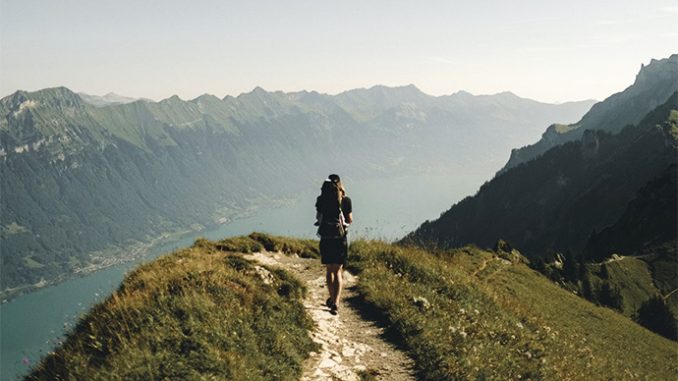
I thought of Jeff Gardner’s Landscapes of Grace during a recent mellow evening ramble with my teenage son. I thought of it again last weekend as I slogged uphill on a hot day, with the summit of a mountain just out of reach.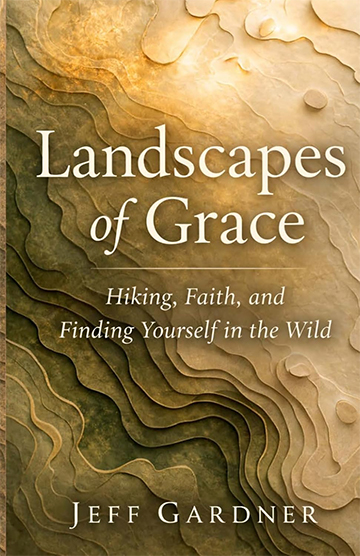
The expeditions were very different in terms of exertion, but both had the effect of an interior ordering, a stepping back and examining one’s place in the universe.
Just a few hours before heading up the trail to the peak, my husband, my sons, and I stood outside our tent, transfixed by a night sky ablaze with stars—a sight astonishing to suburban eyes. “How,” asked my husband, “can you question the existence of God when faced with this?” And the conversation turned easily from nature to the Creator.
That’s the point of this engaging collection of essays. It takes the reader out on the trail with the author, who, by his own admission, spends most of his time either hiking or daydreaming about hiking. As it does so, it examines the significance of getting outside as a spiritual practice.
Reminiscent of a leisurely conversation with a walking companion, Landscapes of Grace takes the reader through the reasons why simply being outside is so important, with some unhurried side trips. Along the way, Gardner takes us back to his Utah childhood, and the shadow of his father looms even as he reflects on his own parenting—appropriate for a book that encourages us to consider where we’ve been and where we’re headed.
Jeff Gardner is a Catholic writer whose words and photographs have been featured in numerous national and international publications. We caught up with him to discuss Landscapes of Grace and the importance of getting out.
CWR: Your book is about the vital nature of “wandering around outside.” In a nutshell, what is so important about being outside?
Jeff Gardner: This is, perhaps, the most important question: “Why go out?” The answer is simple: Going outside with intention, which means, among other things, staying out of our phones, takes us out of a place that harms us: indoors, in front of a screen. Going outside moves us into a place that heals us: any place green where plants and other animals, even if arranged, say, in a park, still predominate the landscape.
We were not created to spend so much time indoors and screen-bound, but our economy demands that we do just that. Being outside is a simple fix for the strain this demand places on all parts of our being.
CWR: Tell us more about your title, Landscapes of Grace.
Jeff Gardner: The title comes from many years of reflecting on what we need to navigate the terrain of our lives and ourselves, the exterior and interior landscapes of our existence.
Here is what I mean: Exterior landscapes are the spaces and places around us, whether we are indoors or outside. Interior landscapes are those “spaces and places” within us. We tend to think of those two landscapes as separate (if we think about them at all), but they are not: where we are and how we move through an exterior space shape how we feel about our interior selves, our internal landscapes.
But here’s the problem, the catch, if you will: Unlike exterior landscapes, our interior landscapes are harder to know, to navigate. In fact, for many, unhappily, navigating their interior landscapes, the terrain of “who am I and why am I here” is so difficult and frightening that many never venture very far within themselves. The fix to this problem is to acknowledge that, unlike an exterior landscape, say a park or a city street, we cannot navigate our interior selves on our own. We need guidance, we need God’s grace, along with our initiative, to traverse our interior pathways to knowing ourselves, and most importantly, to knowing God.
What I hope people come away with after reading my work is that through purposeful living, which involves prayer, movement and thought, they can get to know their interior landscapes, not as a strange, wild, savage country, but as a place of belonging, where they and God dwell—a landscape of grace.
CWR: In the book, you take the reader through some of your adventures—on challenging, stormy mountain hikes, but also reaching back into more mundane times in your childhood. Tell me more about what “being outside” means to you.
Jeff Gardner: What a beautiful question. I grew up in a household that was poor, violent, and chaotic. Being outside was a lifesaving contrast to my dysfunctional home. Outside was a place rich with possibilities beyond my poverty, calm with harmonious color and sound, and ordered with the rhythms of the seasons and the coming and going of all creation. Being outside was the antidote to a lot of what ailed me as a child.
Growing up, of course, I did not have the vocabulary to describe the contrast in these terms (that came later), but I was very aware of the polarity between what life felt like inside versus outside of my home.
CWR: Not everyone is an avid hiker. To some of us, being outside might mean simply walking the dog or sitting on the porch. Does that count?
Jeff Gardner: Absolutely. Being outside, in any green space, is so good for us. You don’t need to “do” anything in particular while outside, except be attentive to the outside. While there are some unique benefits to being in a wild(er) space, you don’t absolutely need to be in remote wilderness to benefit from being outside. You just need to go out and be attentive to the natural features of the space that you are in. Time on the porch, walking the dog, or even regular time spent in a garden that is just a few square feet in size can be helpful, too.
CWR: In “Hey Kids, Get Out”—probably my favorite essay in your book—you insist that parents need to get their kids out of the house. You cite some alarming statistics. Can you run through some of the statistics that prompted you to write this book?
Jeff Gardner: Yes, the statistics concerning what is happening to our children’s mental and physical health are alarming. From mounting rates of chronic diseases, to climbing rates of depression, to even an inability to identify with their own biology (gender, for example), it is beyond clear that things are not good, not good at all, for our children. Years before I wrote the book, however, I had been watching and writing about the skyrocketing rates of obesity among kids, and all the dire consequences that carrying too much weight has on their health, both mentally and physically.
I grew up in the 1960s and 1970s, and it was rare, very rare, to see a kid who was obese. Why was this? Unlike today’s children, we were not being held hostage by screens, and we spent too much time running around outside for obesity to get a foothold in our lives. Part of getting back to health physically and spiritually, for all of us, is as straightforward as stepping away from the screen, going outside, and moving around.
CWR: You describe your childhood, running around all day with neighborhood kids in the shadow of the Wasatch Mountains. What’s the most important thing you want parents to take away from that chapter?
Jeff Gardner: Great question. Answer: Send your children outside and encourage them, by talking with them and sharing the experience, to fall in love with the landscape where they live (be that mountains or not). Take them to nature sanctuaries and green spaces, and let them explore and play, even if they move ahead of you. If you don’t live near a natural space, take them out and let them walk, by themselves, in the city or town where you live, even if you are waiting for them a few blocks down. Let them go to the park on their own, even if they check in by text now and again.
The idea here is to “rewilding” our kids, as I call it in my book, as a way to teach them about themselves and the world. As children, we learn best by doing, and part of what we must learn while growing up is how to get, on our own, from where we are to where we want (and need) to be: physically, mentally, and spiritually. Sending children outside and allowing (or even forcing) them to figure things out for themselves is essential for them to learn how to get along with the world and how to get to where they want to be in life.
CWR: But haven’t things changed since you were a kid? Some parents would say that simply wasn’t safe, or that they want to be cautious about whom their kids are running around with all day.
Jeff Gardner: This, too, is a very important point. By the numbers, on average, things have never been safer for the overwhelming majority of us. Crime has continued to decline since the 1970s, and the places that kids play, like parks, and how we get them there, our cars, are safer than anytime in the past. What has gone up is our levels of anxiety, driven, I argue in Landscapes, by digital content designed to keep our faces glued to a screen.
CWR: Do you think your book has an appeal to Catholic readers in particular, and why?
Jeff Gardner: Yes, I do. I wrote Landscapes from an unapologetically Catholic-Christian, sacramental worldview. That is a worldview which assumes that all things, including us, are made good in God’s sight. It is a worldview that emphasizes the need for a well-considered balance between material beauty (of our church buildings or the celebration of the Mass, for example) and the growth in our longing and love for God.
As a convert (I was raised Mormon but spent decades as an atheist), I fought my way, with much fear and trembling, to an embrace of what I advance in Landscapes as a necessary “catholic” (meaning “universal”), sacramental worldview.
CWR: I thought it was interesting that you ended your book with a very moving reflection on death. Why end Landscapes on that note?
Jeff Gardner: Yes, good question. Over the course of my life, I have had a number of near-misses with death: from close calls while working in Iraq during the war with ISIS, to near-fatal auto accidents, in one of which the Landrover I was riding in plunged into a river in wild, remote Africa, nearly drowning me.
In addition to my own experiences, several people in my life, some close to me, have died. The suddenness of their deaths and the near occasions of my own death have made me uncomfortably aware of the brittle and unpredictable nature of existence.
We simply do not know when our material life will end, and we should not put off, for one minute, mending our relationships with one another, with God, and living out our vocations to the fullest.
• Jeff Gardner lives in the Midwest with his wife Kristi and their four children. You can contact him at jeffgardner.online. Landscapes of Grace is available on Amazon.
If you value the news and views Catholic World Report provides, please consider donating to support our efforts. Your contribution will help us continue to make CWR available to all readers worldwide for free, without a subscription. Thank you for your generosity!
Click here for more information on donating to CWR. Click here to sign up for our newsletter.

Yes, it’s much to our advantage to get away from screens and into the outdoors. We come in contact with our true nature in that converse with nature.
Had a similar experience at Lake Malawi Africa. The black night sky was brilliantly illumined by a countless array of stars reflected on the serene Lake waters. My thoughts were similar too. How could anyone not perceive the beautiful, intelligent hand of the Creator.
I’m reading this article sitting outside on my front porch.
🙂
Thank you so much for sharing this. My daddy used to take us up on the flat roof of our home to look at the night sky. He may have learned about the stars serving in WWII in the North Atlantic. I guess they still taught about that for navigation?
I’ve had children visit in the past who seemed frightened of nature. It took a great deal of coaxing to get them to take a little walk along the pasture and woods. They had so little experience outside of man-made environments. Every insect or small creature appeared threatening to them.
My brother was walking barefoot in a freshly harvested hayfield, in the late 50s, and stepped on a yellow jackets’ nest. He spent a few hours in the bathtub, but gad no reaction that needed the ER. He would have been stung barefoot or not but they immediately got him there as it was exposed.
Hopefully, your guests did not cower from the fireflies.
You know it’s very sad, I haven’t seen a single lightning bug this year. I know pesticides are supposed to be a reason but I read outdoor lightning might be too. I really miss seeing them.
I’m so glad your brother was okay. Yellow jackets are no fun.
Heard that about the lightning bugs, and not many June bugs this year.
my sister got stung once in the house and they had to call a guy to remove a hive of honey bees in the wall. there was a lot of honey comb though so some bonus.
Honeycomb can be *very* pricey these days but I’ve heard it can get a funky flavor when it’s been taken out of buildings .I hope your sister had better luck with hers.
For a similar topic, I highly recommend Belden Lane’s “The Solace of Fierce Landscapes.”