


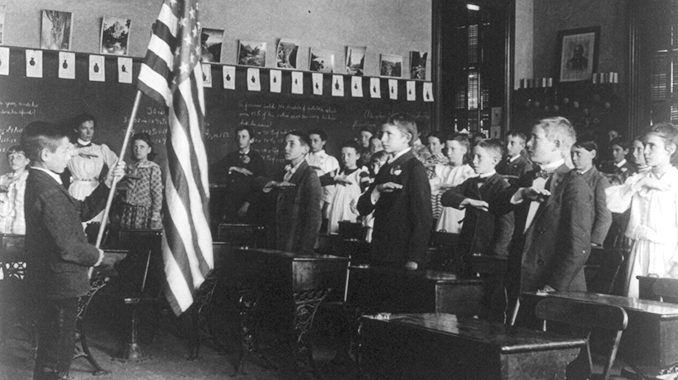
Many years ago, when my oldest daughter came home from her first day of second grade in our local public elementary school (after having been home-schooled for two years), I asked her how she liked it. “It was fine,” she said. “We started with a prayer that I didn’t know, but I think I’m learning it.”
“Prayer?” I asked her in astonishment. What prayer? What were the words? “Well,” she replied, it started with. “I pledge allegiance…”
It is not surprising that Abigail associated the Pledge of Allegiance with a prayer, not surprising that she did not know the words. She had been immersed in the liturgical practices of home and parish, so the form of the pledge resonated as a prayer. And, because I am not sure about the propriety of saying the pledge, my wife and I had not taught it to her.
As we celebrate the 250th anniversary of the Declaration of Independence of the nation whose flag Abigail was asked to pledge allegiance, it is an appropriate to ask: “Can Catholics give unqualified allegiance to our (or any) national flag?”
It’s not an idle or moot question. The Pledge of Allegiance isn’t merely an expression of loyalty (or patriotism). It has a performative effect on how we think about our relationship to the state. While we might toss off the pledge by rote without thinking about its implications, the collective impact of the Pledge is to instill and perpetuate moral and political commitments. It is as much an oath as a pledge.
When we say the Pledge to the flag, we are voluntarily expressing an oath to support and submit to the regime for which the flag is a proxy.
As far as I can tell, the United States is unique in having such a pledge. Even though it is largely taken for granted by most Americans, it is a very odd institution. It is not a pledge to a familial, linguistic, ethnic, or other natural demographic. Rather, the pledge is to a symbol (the flag) and an ersatz “republic”—a political entity, conceived in 1776 and born in 1789. When we say the pledge, we are not confirming a national identity, but rather submitting to the authority of a set of philosophical ideas and the political entity established by those ideas.
The fact that the Pledge is an expression of allegiance to a set of ideas and the state is of paramount importance. Unlike virtually every nation-state in the world, the United States is not the political expression of a national identity. Unlike the emergence, for example, of modern Italy in 1861 or Germany in 1871, the United States of America is not the consolidation of geographic regions under a common national identity. The American “state” does not emerge from an organic ethnic, linguistic, or other national demographic marker. Rather, it is invented by a document or a series of documents.
Arguably, there is no such thing as an “American” national identity. The United States is a State. But at least at its founding, it was not a “nation.” The Pledge of Allegiance is a pledge to the “Republic” (for which the flag is a proxy). But it is not an expression of solidarity with, or allegiance to, a national identification. It’s a pledge to an entity, not an identity. One might argue that indigenous Americans have a national identity. But that probably doesn’t work, as most indigenous Americans identify as members of a nation within the geographic area of the U.S., but distinct from it.
To illustrate, a Japanese national who is also a citizen of the state of Japan may renounce his citizenship by, for example, becoming a citizen of the state of France. But he cannot renounce his Japanese national identity. He is no longer a citizen of Japan, but he is still Japanese. But if an American renounces his U.S. citizenship, he ceases to be an American for all purposes. He might be “from” the U.S., but, unlike the Japanese person, he ceases to be an American when he renounces his citizenship. He no longer pledges allegiance to the state and its ideas, which constitute what it means to be an American.
But what if those political ideas are in tension (or even conflict) with the truths of the Catholic Faith?
When we say the Pledge of Allegiance, are we subordinating our faith to this invented national symbol and fictional state? Given that the pledge contains no limitation to the allegiance we are pledging, the logical conclusion is that any competing commitments must be subordinated to that unqualified oath. Faith must defer to the flag. Needless to say, that is a very serious problem, regardless of the actual content of the pledge or the political nation-state to which it commits us.
The problem is multiplied if we consider the provenance of the Pledge of Allegiance and the person responsible for inventing it. It was probably written by Francis Bellamy in 1892 as part of a promotional campaign for his magazine, Youth’s Companion. (Some historians think Bellamy might have cribbed it from someone else. But he was its promoter.) Bellamy’s purpose was less to encourage an assertion of allegiance to the U.S. than it was to renounce any national or religious commitment that might be seen to trump loyalty to the United States. A Baptist minister, Bellamy was an anti-Catholic, anti-immigrant nativist. Typically of late 19th-century nativists, his purpose was to effect the assimilation of southern and eastern European—and mostly Catholic—post-Civil War immigrants.
The Pledge is more about renunciation of national and religious commitment than affirmation of allegiance. It might not be unfair to conclude that the Pledge—at least as originally intended—is an expression of bigotry rather than patriotism.
Please note that by no means am I asserting that everyone who says the Pledge is participating in this bigotry. Its origins—and Bellamy’s intention—are mostly unknown to most of us when we say the Pledge as an act of patriotism.
One might counter that the Pledge itself contains the qualification “under God.” Indeed, Catholics are fond of pointing out that the phrase was added in 1954 by President Eisenhower, after the tireless campaign of Blessed Fr. Michael J. McGivney. But this compounds rather than reduces the problem. The phrase is not a qualification of allegiance, but rather an assertion of divine sanction of it. It is the “nation” (according to the Pledge) that is “under God,” not the person reciting it. Contrary to qualifying allegiance to the republic, it asserts divine favor for it.
Now, I know that many readers of this column both recite the Pledge of Allegiance without compunction and reserve qualifications in their own minds. “I pledge allegiance,” so the process goes, “but this allegiance is subordinated to my Catholic faith. When there is a conflict, my allegiance to the flag must yield to my fidelity to the Gospel.” This is a perfectly reasonable position. Indeed, if one does recite the Pledge, I would contend it is a necessary practice for the Catholic Christian.
However, that does not resolve the problem. The words mean what the words say. And the words do not contain a qualification. The words mean that allegiance to the flag and its republic are our highest commitment, and that all other commitments are subordinated to it. Regardless of any mental reservations, when we recite the Pledge of Allegiance, we perpetuate the myth (whether we embrace it or not) that American citizenship subordinates all other commitments. By the language of the pledge, the flag and the republic trump everything, including religious faith.
The 250th anniversary of the Declaration of Independence is an auspicious time to ask ourselves what it means to be American Catholics (or Catholic Americans?), and to reevaluate how our faith commitments do or don’t align with American values and commitments. I am not suggesting that we cannot be good American citizens, nor that we cannot sincerely embrace the good things about the United States. We can and we should.
On the other hand, celebrations of American identity must be subordinated to the truth of the Faith, not vice versa. Our unqualified allegiance is to the Gospel of Jesus Christ. Everything else—family, country, or nation—must be subordinated to, and relativized by, that primary allegiance.
If we give unqualified allegiance to the flag, even if we reserve mental qualifications, we are publicly suggesting that all things are subordinated to that fundamental commitment. What kind of witness is that to non-Christians?
And how can we consistently proclaim that Christ is King over all things from one side of our mouth, while pledging unreserved allegiance to another sovereign from the other?
These are questions that a short column cannot answer. But a short column can raise them and, thus, challenge us to think more deeply about what it means to be a Catholic in secular America. If we think it is easy, we are probably doing it wrong.
If you value the news and views Catholic World Report provides, please consider donating to support our efforts. Your contribution will help us continue to make CWR available to all readers worldwide for free, without a subscription. Thank you for your generosity!
Click here for more information on donating to CWR. Click here to sign up for our newsletter.

Leave a Reply