

Bradley J. Birzer, professor of history at Hillsdale College since 1999, is a prolific author and a good friend. He has written books on Russell Kirk, J.R.R. Tolkien, Christopher Dawson, Charles Carroll, and drumming legend Neal Peart.
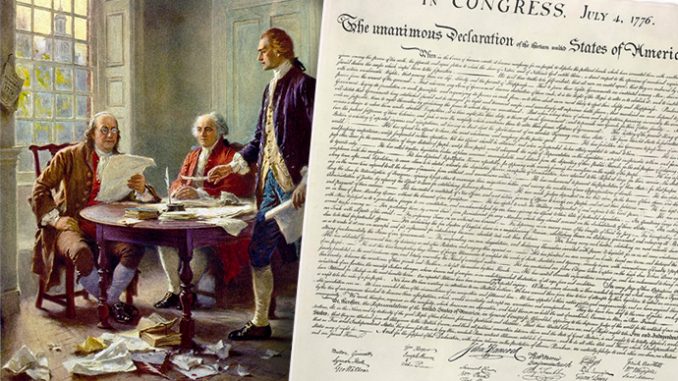
His most recent book is The Declaration of Independence: A Radical Experiment in Liberty (Stone House Press, May 2026). Brad corresponded with me recently about the book, discussing the importance of the document, its place and meaning today, and much more.
CWR: What do you think is the most remarkable thing about the Declaration of Independence, 250 years after it was written? And what is the most misunderstood or least recognized thing about it?
Bradley J. Birzer: Hello, Carl! You are so amazing, and I’m thrilled to be talking with you, especially since our friendship goes back several decades now. Great question.
The most remarkable thing about the Declaration is its statement of human dignity: “We hold these truths to be self evident, that all men are created equal, endowed by their Creator, with certain unalienable rights, among these are life, liberty, and the pursuit of happiness.”
Though not at the level of scripture, this sentence is a political, cultural, and social manifestation of the teachings of scripture. Think about St. Paul in his letter to the Galatians. When describing the human person, he notes that he is neither male nor female, neither Greek nor Jew. Though a Deist and skeptic, Jefferson made the same universal claim with regard to human dignity. As such, this one sentence is the single most important sentence in human history, outside of scripture. Further, it is universal, not just American, and it applies to all human beings, past, present, and future, here in the States, or in ancient Athens, or in present-day Nigeria.
Sadly, after a century and a half of progressivism, ideologies, and modernity, we’ve returned to the pre-1776 understanding of humanity, believing—falsely—that some humans are better than others. Further, we often ignore that the Declaration also teaches that 1) man is made in the image of his Creator, and 2) is a rights bearer.
These rights come not from government or society, but from God alone.
CWR: The Declaration mentions “rights” many times, including the famous statement “We hold these truths to be self-evident, that all men are created equal, that they are endowed by their Creator with certain unalienable Rights…” What is some of the background to this emphasis, both historically and philosophically? Why is it important? And why does it remain so widely debated today?
Bradley J. Birzer: Again, an excellent question. A right comes from one’s understanding of justice, one of the seven classical and Christian virtues. Properly understood, justice means “to give each person his or her due.” With justice this, we recognize that you, Carl, were born in a certain time and place, with certain accidents of birth, and specific talents. If justice works properly, you, as an individual, have the right and the duty to make the best of all of these.
This is, actually, a “pursuit of happiness”—that is, you are meant to become what nature and Nature’s God made you to be. Justice recognizes the specifics of each individual within the larger community and the larger cosmos. A right literally means “a right place in the order of justice.” For Jefferson, this was an extremely high calling. To have a “right to happiness” doesn’t mean getting stoned and binging Netflix. Rather, to pursue one’s happiness is to pursue excellence in whatever we do—in crafting a table, speaking in a conversation, helping a friend, or making a meal.
Critically, though, a right can come only from nature and God, and they’re inherent in the human person. We moderns have totally misunderstood this and have come to believe that our rights come from government, from the political sphere. Nothing could be more vile to the actual concept of right than to believe that they are man-made. They are man-discovered but not man-made.
No one man (or several men) has the right to determine the rights of a fellow human being. Only God can do that.
CWR: There has also been much debate about the formation and creation of the Declaration. What are some of the key points that you discuss in your book?
Bradley J. Birzer: The Declaration is, at once, a deeply conservative document and a deeply radical document. It is broken into four parts:
Paragraph one: the establishment of God and nature as sovereign, but with a recognition that men play a crucial role in the “course of human events.”
Paragraph two: all men—without exception—are endowed by their Creator with certain unalienable rights. Further, a government is only legitimate when it protects these rights. When it repeatedly violates them, we humans actually have a duty to overthrow our government—even if by violent means—not just a right to do so.
Following several paragraphs: a list of 28 grievances, each a violation of common law (law rooted in the experience, norms, and habits of a people; not imposed from above, but emergent from the ground below).
Final paragraph: this one is truly critical, and its most important part is written by Congress, not the Deist Jefferson. In its final sentence, noting Divine Providence and pledging one’s honor, fortunes, and lives, the Founders created a covenant. While not at the level of the Abrahamic or Mosaic covenant, it is a vital and critical reflection of each of these.
The Declaration is conservative in that it references the divine and dramatically protects common law (Common law, it should be noted, is rooted in the pre-Christian, Anglo-Saxons), but it is radical in its universal claims.
CWR: You note that the great first-century Roman historian Tacitus and the Enlightenment philosopher John Locke—the “father of liberalism”—were very influential among the Founders and others of that time. Why was that the case? And how did it shape the Declaration and the American Founding overall?
Bradley J. Birzer: One thing we’ve almost entirely forgotten is how deeply classical the American colonists were. If a person had any pre-collegiate schooling at all, even if, say, he went to school from ages 8 to 10, before he could fully labor on a farm, all—and I mean all—he would learn was Greek and Latin.
In the rare instance that he might attend one of the nine colleges in the colonies, the entrance requirements for each school were 1) the translation of the first three books of St. John’s Gospel from Greek to Latin; 2) the translation of three of Cicero’s orations from Latin to English; and 3) the translation of the first 1500 lines of The Aeneid from Latin to English.
So, every white colonist had a background in the classics. Even at the Battle of Yorktown, for example, the majority of French soldiers on the field had no English skills, and the minority of American soldiers knew no French. Instead, all field and military orders were in Latin, the language common to both sides. Therefore, it’s not surprising that the colonists loved historians like Tacitus, heroes like Aeneas, and philosophers like Cicero.
To be sure, though, the lineage of Western thinkers was not exclusively classical. Americans read widely and incorporated the then-modern teachings of John Locke and Algernon Sidney.
Famously, when Jefferson was asked in May 1825 what his influences were, he noted, critically, that he had said absolutely nothing new in the Declaration, itself an expression of the American mind of the colonies, the ideas of Aristotle, Cicero, Sidney, and Locke. While each of these individuals certainly played a role in the American mind, it’s vital that he recognize that Jefferson’s answer and professed lineage was shorthand for “the western heritage.”
CWR: To what degree, so to speak, were the Founders “Christian” or “Deist”? And what influence did Catholicism have on the Declaration and the Founding?
Bradley J. Birzer: I get this question a lot, and it’s evidence that the liberal and progressive historians have been up to much mischief.
There were four Enlightenment figures during the founding: Thomas Jefferson, Benjamin Franklin, Thomas Paine, and Benjamin Rush. While each of these men was crucial to the Revolution, they are, after all, only four guys. Simply put, the Enlightenment had almost no influence on the average colonist. The average white American—meaning about 99 out of 100—was immensely Protestant. As Edmund Burke would say, these Americans were the most Protestant of Protestants. As with all Protestants, they had two things that dramatically aided in the revolution—1) a distrust of authority and 2) extremely high literacy.
Remember, when the American colonies were being created, the English were experiencing their own Reformation and Civil War over religion. Consequently, the American Protestants were not just Protestants, but truly participants in a Reformation. Even Maryland—which we often erroneously remember as the “Catholic colony”—was only 8% Catholic in 1775. It was 92% Protestant.
Demographically, then, Catholics would have no say in America until the 1840s, when vast numbers of Irish and Germans immigrated to America. America from 1607 to 1846 was truly the most Protestant of Protestant countries.
That said, two Catholics—Charles Carroll of Carrollton, and his cousin and best friend, Jacky Carroll (later Archbishop John Carroll)—stood firm against immense prejudice and hatred of Catholicism. They were not only serious Catholics—trained in the liberal arts and in the anti-statist and anti-monarchical ideas and ideals of Bellarmine, Suarez, and de Mariana—but they were serious patriots, too.
They almost single-handedly made Catholicism respectable in the colonies. We Catholics owe them a great deal.
CWR: If Jefferson or Madison or Washington were alive today, what do you think they would say about what the United States has become?
Bradley J. Birzer: If any of the founders came back today, they’d be horrified by the state of society.
To them, a self-interested and self-satisfied society of smug tattooed and pierced human beings would look like some kind of cacotopia. They firmly believed that a republic could only exist if at least a significant minority of the population were virtuous and interested in the common good (the res publica). They would adamantly reject our democracy as a perversion of animal lusts, and they would find our progressivism bizarre and inhumane.
They would also—to the very marrow of their bones—be stunned by the size of government. In every single way, the founders believed that the political sphere should be radically limited, allowing for the flourishing of civil and civic society. Even the most pro-government of the founders, Alexander Hamilton, would never recognize our worship of Demos, Mars, and Leviathan.
On the good side, though, they would be incredibly impressed that 1) the republic still exists, no matter how bruised and beaten; and 2) that we have, for the most part, solved the race problem.
CWR: Why is the Declaration important today, in 2026, on this 250th anniversary? And how do you hope your book will help readers better understand and appreciate the document and the Founding?
Bradley J. Birzer: A hard question. I would say this—the Revolution, at heart if not in every instance, was an eruption of eternity into time. That is, its principles are true for all places, all times, and all men.
In our progressive and modern world, we so desperately need to remember that each person is a unique embodiment of truth, goodness, and beauty, a manifestation of Christ’s love, and a temple of the Holy Spirit. Yes, we remain fallen, but the Incarnation, Death, and Resurrection demand that we view all men and women as potential citizens of the City of God. As objective as I hope to be, I’m also a patriot and a Catholic.
Specifically, I hope for three things as we celebrate today.
First, I hope we recognize how precious each and every life is.
Second, I hope we one day extend our Declaration to the one population that has yet to receive its benefits, the American Indian. Drive onto the Pine Ridge Reservation, for example. What do you see? 90% poverty, little freedom (because of the horrific Bureau of Indian Affairs), and extremely high alcoholism. Every people in the world has benefited from the creation and settlement of America, with this one exception. We have a duty and moral obligation to make this wrong right.
Third, I would ask us to remember that the Founders severely limited the political sphere and political life. That sphere is meant to remain political only, and not extend into family, business, or community. We must reject politics, politicians, and political machinations and return our patriotic gaze upon our families, our neighborhoods, our schools, our voluntary associations, and our small businesses.
Simply put, democracy and Leviathan mechanize the human person. We must rehumanize society and return to the roots of our glorious republic.
If you value the news and views Catholic World Report provides, please consider donating to support our efforts. Your contribution will help us continue to make CWR available to all readers worldwide for free, without a subscription. Thank you for your generosity!
Click here for more information on donating to CWR. Click here to sign up for our newsletter.

My heart is heavy for the refusal of PiusX congregation. So true we need to be fasting and praying for all of them. Pride always goes before the fall as they say. God come to our aid! Lord make hate to help us.
What exactly does your comment have to do with the interview above?
Greater interview, Carl. I look forward to reading Professor Birzer’s book.
“Pride always goes before the fall as they say.”
Theadjacking is a sign of pride. It says to others I feel no need to offer relevant commentary on the matter at hand, and others are to subjected to my the transient indignities. So yes.
Posting comments to the wrong article can also be a sign of needing eyeglasses. Or at least better ones.
🙂
What an article! Several really good questions matched by even better answers. To truly “rehumanize” society, we must first define and recenter on the God who decided what it means to be human.
So True. Thank you for this timely article as a reminder of what it means to desire to be One Nation, Under God, And thus Indivisible, With Liberty and Justice For All🙏
Oops. I wouldn’t make the entrance requirements for one of the colonists’ colleges.
Nor do I get the reference to the worship of Demos and Leviathan (probably a result of above-mentioned deficiency).
Great interview.
Leviathan made me first think of the illustration in Thomas Hobbes book.
In agreement and full appreciation, but also (as is my tedious fixation!) a few vexing details….
FIRST, was it not more a War of Independence, rather than a Revolution? The broadly upending “revolution” came in 1789 with the guillotine, the consequences of which are vastly evident today. Yes?
SECOND, further, the irony is that the precipitating bankruptcy of France was due in part to the high cost (to France) of supporting the decade-earlier war in North America. And, in America the precipitating factor was the British parliament’s taxes to cover the cost to Britain of controlling events farther west in frontier Indian Country.
THIRD, and then further back there was Benjamin Franklin’s proposed Albany Plan of 1854 which, had it been accepted by the then fragmented colonies, might have enabled enough self-government to have peacefully anticipated by almost two centuries today’s harmonious British Commonwealth of Nations.
FOURTH, today, about fairness to Native Americans, I think I remember that at some point that the Soviet Khruschev simply wondered “why didn’t you just kill all of them?” Yes, there is the problem you identify, but there’s also a somewhat related snit in spendthrift Washington State, the only state in the Union which permits tribal gambling casinos (a lucrative source of income to support tribal school scholarships, etc. etc.)…while patronizingly refraining in the 1990s from getting its cut. The really big picture is that with the casino-culture the tribes are not excluded from the state/national funny money approach to community and public finance.
SUMMARY: methinks that even the great trends of history are precipitated by the flapping a butterfly’s wings. Within the so-called “arc of history,” things always might have been different. Such is our inalienable, radical, and personal freedom versus any retrospective progressivism. St. John Paul II mentions revolutions which might not have to be “violent”:
“The decisions which create a human environment can give rise to specific structures of sin which impede the full realization of those who are in any way oppressed by them. To destroy [!] such structures and replace them with more authentic forms of living in community is a task which demands courage and patience” (Centesimus Annus, 1991, n. 38).
I think it was both a revolt and our 1st war of secession/ civil war, Mr. Peter
. One of my children has a book that claims the English Civil War, our revolutionary war and our 1860’s civil war were all connected.
Ken Burns said in a podcast recently that while taxation and representation were issues, the desire for tribal lands beyond the Blue Ridge was perhaps more important a motive for secession.
Back in 2000, my wife and I visited England. In London I noticed a surprising number of statues of George Washington. I asked a tour guide about them, and he replied that many English people had relatives in the American colonies and were keeping as close an eye as the 18th century afforded them regarding what was going on there; also that many Britons sided with the Americans. He went on to corroborate what you stated about the interconnection between the English and American Civil Wars.
Thank you for sharing that, Ken T. George III was an admirer of Washington, also.
I think the book I mentioned is “The Cousins Wars”.
Peter, I think your distinction between a defensive War of Independence and the ideological revolutions that followed—especially 1789—is historically very important. The American Founding sought primarily to preserve inherited liberties under the rule of law; the Jacobins sought to reconstruct society from first principles.
This insight resonates with the recent work of the Italian political theorist Luigi Marco Bassani. He argues that the men of 1776 did not imagine themselves as architects of a universal political project. They were lawyers, merchants, landowners, and statesmen trying to solve concrete constitutional problems while avoiding both tyranny and anarchy.
What happened later, however, is perhaps even more fascinating. The historical American republic gradually became something larger than itself: a civilizational symbol. The Declaration ceased to be merely the founding document of one nation and came to embody, for much of the West, a vision of ordered liberty grounded in the Creator.
That is why I also appreciate your citation of Centesimus Annus. John Paul II reminds us that authentic renewal does not come through ideological revolutions but through the patient conversion of persons and institutions. Structures of sin cannot simply be demolished; they must be replaced by a truer understanding of the human person.
Perhaps this is where Europe and America now differ most dramatically. America still argues—sometimes fiercely—about the meaning of its founding principles because those principles continue to function as living points of reference. Europe, by contrast, has largely abandoned not only its Christian inheritance but even confidence in its own founding narrative.
Professor Birzer’s call to “rehumanize society” therefore strikes me as profoundly timely. A civilization ultimately declines not because it loses wealth or military power, but because it ceases to believe that its own existence has a transcendent purpose.
On a personal note, Peter, thank you for your ongoing camaraderie in these threads. We’ve danced through many of these debates together, and I’m always grateful when you step in to lend a hand. Looking forward to our next exchange!
Thank you.
And about those who “imagine themselves as architects of a universal political project”…Ratzinger called out the post-Vatican II revolutionaries who in the liturgy seem fixated on a flat-earth “project Church” (The Ratzinger Report, 1985). It is that paradigm-shift which converted (a conversion!) the distinct “synod of bishops” into mongrelized synodality.
Peter, I believe you have identified something profoundly important.
Ratzinger’s critique of the post-conciliar tendency to treat the Church as a project was never a rejection of Vatican II, but a warning against the temptation to engineer the Church rather than receive her. That temptation closely resembles the political mentality Professor Birzer describes: the conviction that living realities can be reconstructed from abstract programs instead of being received according to their own nature.
Yet there is also a deeper irony. As the eminent Italian Dominican theologian Fr. Giovanni Cavalcoli, O.P., has frequently argued, the opposite temptation—the Lefebvrist tendency to absolutize Tradition apart from the living Magisterium—rests on an equally inadequate understanding of Tradition. One approach reduces Tradition to a historical artifact that evolves with the times; the other isolates it as though it were self-interpreting. Both, in different ways, detach Tradition from the living act by which the Holy Spirit hands on the faith through the Church.
Vatican II teaches neither. Tradition is neither a museum nor a political project. It is the living transmission (tradere) of the one deposit of faith, entrusted to the Church and authentically interpreted by the Magisterium.
At the same time, as Fr. Cavalcoli himself often reminds us, theological discernment must never become theological alarmism. Error must certainly be identified with clarity, but persons are never reducible to the errors they happen to hold. The Church has always distinguished between judging propositions and judging souls. Many sincere Catholics carry doctrinal confusions while remaining deeply faithful in their desire to follow Christ. The task of theology, therefore, is not ideological classification but the patient service of truth in charity.
Above all, we must cultivate hope—”the little sister of faith,” as Charles Péguy so beautifully called her. Such hope is ultimately trust in the Holy Spirit, who continues to guide the Church precisely through her pastors, and in a unique way through the Successor of Peter. Our task is not to succumb to bitterness or apocalyptic defeatism, but to do our part with goodwill, intellectual honesty, and peaceful hearts.
Perhaps this is why Ratzinger insisted that authentic reform is never manufactured but received. The Church does not invent herself because she did not create herself. She continually returns to the living Source from whom she is always receiving her life. Perhaps the renewal of both the Church and our civilization begins precisely there: not by constructing new foundations, but by rediscovering the Source from which both continually receive their life.
On a final, more personal note, Peter, thank you for your ongoing spiritual and intellectual camaraderie in these threads. As a small “spiritual flower” from the desert of my heart, I would like to leave you with a thought that Alessandro Manzoni wrote to his friend Antonio Rosmini in November 1830. He wrote with an humility that borders on veneration, and it expresses exactly my sentiments toward you:
“You are a man who is not to be found every day, and I am a poor man who has no other merit than that of feeling and admiring yours.”
God bless you.
Peter, one further “flower,” if I may.
Your reflection on Ratzinger’s critique of the “project Church” prompted another thought. It seems to me that the same modern temptation—to replace what is received with what is engineered—extends far beyond ecclesiology. It has progressively touched the three deepest dimensions of human existence.
The first great technological revolution gave us unprecedented power over matter through the splitting of the atom.
The second has given us increasing power over human generation through artificial reproduction and biotechnology. Long before this became reality, Goethe foresaw its symbolic meaning in Faust (Part II), where Wagner proudly creates the Homunculus and dismisses natural generation as an obsolete and imperfect process.
Today we are entering what may be an even deeper revolution: not mastery over matter or even over biological life, but the temptation to externalize the personal act of understanding itself. Artificial Intelligence does not merely provide tools; it invites us to delegate judgment, memory, synthesis, and eventually even intellectual responsibility.
In that respect I cannot help recalling St. Thomas Aquinas’ De unitate intellectus contra Averroistas. Medieval Averroism held that human beings ultimately participate in one separate intellect rather than exercising truly personal understanding. Today’s digital civilization obviously proposes nothing metaphysical of the sort, yet it risks creating something functionally analogous: an increasingly centralized cognitive infrastructure upon which millions come to depend for their thinking.
Huxley’s Brave New World anticipated something remarkably similar. The Controller’s promise is not simply comfort, but liberation from the burden of difficult thought itself. Stability is purchased at the price of interior freedom.
Perhaps this is why Ratzinger’s concern reaches beyond the Church. Whenever living realities are treated primarily as projects to be managed rather than gifts to be received, we begin to replace persons with systems. The danger is not that machines will become human, but that human beings may gradually cease exercising those uniquely personal acts that constitute their dignity.
Aquinas’ simple affirmation therefore remains surprisingly contemporary: hic homo intelligit—this particular person understands. Civilization ultimately depends on preserving that irreducible personal act.
Both the “project Church” and the technocratic “project society” are tempted to trust systems more than sanctity, administration more than conversion, management more than grace. Yet neither the Church nor civilization can ultimately be renewed by technique alone. Both remain realities that must first be received before they can be faithfully cultivated.
Paolo,
Be assured that I am nobody. But it is gratifying to learn that I am not simply writing to myself. A few quick comments in response:
FIRST, looking back I have come to be thankful that circumstances placed a burr under my saddle at an early age, and that I have been on a non-formal but cumulative learning path over a lifetime of many decades. (No nominally Catholic schools or university’s to possibly deaden my curiosity?) Where Newman says that “10,000 difficulties do not constitute a doubt,” I propose that the same is true for 10,001.
SECOND, where you write: “One approach reduces Tradition to a historical artifact that evolves with the times; the other isolates it as though it were self-interpreting;” Pelikan says it this way (and I think he is quoted by G.K. Chesterton): “Traditionalism is the dead faith of the living; Tradition is the living faith of the dead.”
THIRD, about your remark: “the first great technological revolution gave us unprecedented power over matter through the splitting of the atom”…I was literally born within the Manhattan Project, inside the barricade and on the expansive desert setting in Eastern Washington for the Hanford Nuclear Reservation, in the frenzied summer of 1944. From the start, the “big questions” of our time, and before, were all around me. Probably the first deep dunking came at the age of ten. About “nuclear families” and nuclear reactors and mushroom clouds, see my long-term reflections at The Imaginative Conservative: https://theimaginativeconservative.org/2021/08/meditations-bomb-small-town-cul-de-sac-peter-beaulieu.html
FOURTH, St. Augustine wrote somewhere that “I never knew how much I knew until I started writing.” The path toward ever greater clarifications and sometimes course changes. So, ever thankful, here, for the prominence given at CWR for comments from the back bleachers, and for the give and take of still learning from so many others like you.
Peter,
Your latest reply moved me more than you may imagine.
To discover that my passing reference to the splitting of the atom happened to intersect the literal place of your birth at Hanford felt almost providential. It reminded me that history is never merely something we study; it is something into which we are born. Some men read about the great turning points of civilization; others, like yourself, begin life in their very shadow. Perhaps this is why your reflections always seem to carry both historical perspective and lived experience.
Your quotation from Pelikan is equally illuminating. I have always loved Chesterton’s defense of tradition, but Pelikan expresses the distinction with remarkable precision. Authentic Tradition is never nostalgia for the past, nor permission to redesign the faith according to the present. It is a living inheritance, continually received from those who have gone before us under the guidance of the Holy Spirit. That insight beautifully complements Ratzinger’s conviction that the Church must first be received before she can ever be reformed.
I was equally struck by your appeal to Newman: *”Ten thousand difficulties do not make one doubt.”* Perhaps the genuinely human life consists precisely in remaining willing to live with the ten-thousand-and-first difficulty rather than demanding artificial certainty. Real understanding does not eliminate mystery; it patiently dwells within it.
Your quotation from St. Augustine suddenly casts this in an even deeper light: *”I never knew how much I knew until I started writing.”* Perhaps writing is not primarily the production of thought but an act of reception. We often discover what we truly know only because, in trying to express the truth faithfully, we receive it anew.
That intuition reminds me of one of the most beautiful passages in St. Thomas Aquinas. Speaking of the highest wisdom attainable in this life (*scientia honorabilissima*), he observes that it is not possessed as private property, but held almost as something borrowed: *non ut possessio habeatur, sed sicut aliquid ab eo mutuatum* (*In Metaphysicam*, I, lect. 3, n. 64). The highest wisdom is never manufactured; it is welcomed. It is received before it is possessed.
Perhaps that single insight also illuminates the deepest crisis of our own civilization. Looking at our present historical horizon, one cannot fail to notice an extraordinary convergence: humanity has acquired unprecedented power over matter through nuclear science, over the origins of life through biotechnology, and increasingly over the very processes of thought through Artificial Intelligence. Each achievement is extraordinary in itself. Yet each also tempts us to believe that what can be technically mastered has therefore been existentially understood.
Goethe sensed something of this temptation when Wagner, in *Faust*, proudly dreams of producing life by technical reason alone. Dostoevsky perceived the same danger from another angle when the Underground Man rebels against a world reduced to calculation, insisting that man would rather become irrational than surrender his freedom. Both recognized, long before our own age, that technical rationality can become irrational when it forgets the mystery of the person.
This is why I have become increasingly convinced that the deepest crisis of modernity is not scientific but anthropological. Our greatest need is no longer simply better technology, but the recovery of contemplation—that humble recognition that reality is first received before it is manipulated, that truth is discovered before it is constructed, and that wisdom ultimately begins in gratitude rather than control.
You describe yourself as “nobody.” That is perhaps the most Christian description one can give of oneself. Yet the Church—and indeed every genuine intellectual friendship—is quietly built by such “nobodies”: men and women who seek truth without seeking prominence. Your thoughtful presence in these conversations has been a genuine encouragement to me, and I am deeply grateful for it.
May God continue to bless you and your family.
I’ve read colonists had much more familiarity with the classics and more studied Latin and Greek than today . But I’m not sure *every* male European colonial in 1776 had a background in the Classics .
It’s hard to exactly know colonial literacy rates. They seemed quite high in New England but but a good bit lower in Mid Atlantic and Southern states. You can find many instances of people making their” mark” on a document because they never learned to write. Some could read but not sign their names.
New England had community-supported schools from the beginning but schooling was by no means universal elsewhere. I happen to be doing some research on colonial New Jersey and see that people in that prosperous colony sometimes signed their wills with their mark, because they weren’t literate. And obviously before starting pupils in Greek and Latin, they had to learn to read first. Not to mention arithmetic. Perhaps Professor Birzer meant to say that any education beyond elementary school was based on Greek and Latin? Not every boy in Boston went to Boston Latin School. Otherwise, I’d like to see the data backing up his claim.
Hello, Miss Sandra. Yes thank you, perhaps Mr. Birzer meant those men who were literate and fortunate enough to be educated.
Women’s literacy was even lower back then. I know at least 2 great grandma’s from that period who made an “X” for their signature. One “wrote” letters seeking aid for their family and each letter was written in a different hand because it was dictated by her. She was unable to read or write.
Just so. I’ve been looking at random abstracts of will sin 17th-18th C New Jersey and see property owners who can’t sign. The availability of school varies considerably across the colonies, with only elite Southerners getting much education–from Northern universities if they were going a degree. William & Mary was the only university in the South before the Revolution. Women had fewer opportunities everywhere.
It’s also worth mentioning that “grammar schools” and universities were broadening their offerings after 1700 with instruction in philosophy, history, science, even modern languages. The Founding Fathers had not been educated exclusively in Greek and Latin and not all had much formal education. (Franklin attended Boston latin School but left at age 10 while John Adams had a bachelor’s degree from Harvard.)
Pardon my anachronism referring to colonial institutions of higher education as “universities.” They were still called “colleges” in those days.
Preparatory schools were ( some still are) called “colleges”, too. We used to have a Catholic one for boys nearby.
I was just reading an article about how the stories of illiterate Revolutionary era soldiers were passed down orally since they couldn’t write those down. And not a few of the descendants could either. We may know more about the war from the literate simply because they could put their experiences to pen & paper.
Gratitude for your responses, Author Professor Birzer. Living once again in the state of RI, I’m proud to know that banned for his tolerance of religious freedom from the Massachusetts Bay Colony, state founder Roger Williams paid the Native Narragansett Tribe in wampum for the land of the Providence plantations. There is room for improvement in treatment elsewhere of Native Americans. Justice is a virtue. -And since it’s our USA’s 250th anniversary, so is Patriotism as celebrated by sovereign nations-with rightful borders.
I enjoyed learning of the personal relationships expounded upon by Editor Olson and Prof. Birzer, and streamers Mr. Peter and Mr. Paulo. (Who needs inhuman AI ? Surely not well-formed,loved children of God/sisters & brothers in Christ/Catholic thinkers!)
Friendships clearly show God’s love/Holy Spirit within the human delightful relationships and exchanges. I agree with St. Augustine’s claim that ‘he never knew how much he knew [until he shared in conversation]’. I have that same realization recalling information during conversations in person.
Enjoyed the stimulating repartee, Mrs. Cracker and Ms. Sandra. Catholic University of America’s humble, recent former Pres. John Garvey’s statement I concur with (and I’m paraphrasing).: ‘Higher Education should consummate in knowledge of the Creator and greater understanding for the student.’
Again, the relationship dynamic is present whereby The Holy Spirit’s wisdom is shared among interactive learners. Language is a supreme gift to human beings. Thank you for this gem of an article, Catholic World Report’s Editor Olson! God bless America!🎶
Why oh why oh why (oh why!?) is not abortion (slavery’s twin!) mentioned in the same breath as created equal and inalienable, Jefferson gave us the words, Lincoln doubled down on them and we forget them in year 250. Way to go Catholics, punting on this secular defense of Catholic teaching!