

 By
By The converts describe their journey to faith in Jesus Christ, their experience of receiving the sacraments at the Easter Vigil, and the importance of their catechists and Christian community.

For Jonás’ family, who are Muslim, turning away from Islam constitutes a grave betrayal of their culture and roots. Despite this, following a long journey of searching and formation, the young man received the sacrament of baptism during the Easter Vigil at the cathedral in Getafe, the Spanish city where he has lived since he was barely a year old.
His decision came after a personal encounter with Christ, when he realized there was no turning back: He was firmly convinced that the Catholic faith was the true one.
The 25-year-old, who did not share his last name, first became interested in the Catholic faith during his school years, while studying authors such as St. Thomas Aquinas and St. Augustine of Hippo.
For over five years, until beginning his catechumenate in 2025, the young man reflected deeply upon and researched various religious traditions. In an interview with ACI Prensa, the Spanish-language sister service of EWTN News, Jonás recalled that it was during the process of researching Islam that “I ended up becoming a Christian.”
Transformed lives
For Jonás, the person of Christ and the sacraments were what transformed his life. “If Christ doesn’t enter into your heart, Christ who is God made man, who gave himself up for us on the cross, then ultimately you are not a Christian, but merely someone who knows a lot about Christianity,” he said. In his case, what impacted him most were Christ’s passion and self-sacrifice on the cross, as well as Jesus’ Sermon on the Mount.
On the same day as Jonás, Lourdes Ángel also received the sacrament of baptism. Like Jonás, she grew up in a Muslim family. However, she explained to ACI Prensa that she always felt it was abundantly clear “that Christ was present in my life; even though no one had ever spoken to me about him, I already felt his presence very deeply.”
“My mother always tried to instill the Muslim religion in me, but I always gravitated toward Christianity. It was as if my heart were already in another place, without having any formation” in the Catholic faith, the 21-year-old recalled.
She shared that God helped her escape a toxic relationship at the age of 19 and that it was then that she met her current boyfriend, who is involved with the Neocatechumenal Way. “I realized that God was calling me, and I wasn’t going to close the door on him or turn my back on him,” she recounted.
What struck her most about the Catholics she knew was seeing “that people were so happy. They follow God and are happy even when things go badly for them, even when they have problems from time to time. It’s as if they see something good in suffering and know that Christ has a better plan for them. I wanted that; I wanted to understand how they could be so happy.”
Breaking the parameters of their world
The journey both of them took to embrace the Catholic faith wasnʼt easy. “Leaving your initial faith,” Jonás explained, “is quite difficult, because ultimately it structures your life and [converting] entails breaking with the established framework of your world.”
What he found most difficult was conveying this decision to his family: “I don’t think they will ever understand it … they simply cannot wrap their heads around the idea that someone could change something like that. To them, it’s like a kind of identity or culture more than a path that one must seek out and discover.”
Even so, Jonás said that Jesus Christ is the one who helps him keep going, the one who comforts him and gives him the necessary strength to persevere. “Even Jesus himself warns us that the world will not particularly love us … if they did it to him, they’ll do it to us.”
For Lourdes, the most difficult part was leaving behind her former way of life and attempting to “fit God in without changing anything about myself.” She specifically recalled a lesson taught to her by her catechist: “You cannot bring God into your life without doing anything for him; you have to make room for him, and then you can worry about everything else.”
A new rebirth
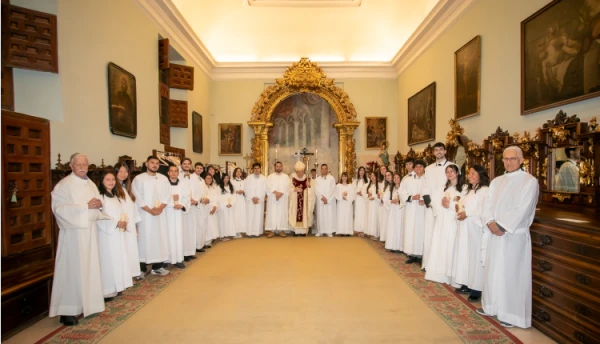
Jonás cherishes a fond memory of the Easter Vigil, when he received the sacraments of Christian initiation alongside 47 other adults. “It was a very happy experience. The next day, I felt completed,” he recalled.
He said that, before receiving baptism, “I felt a rather large void in my life, one I tried to fill with various ideologies … the truth is that I was living in a state of considerable internal disorder within my soul, within my spirit.”
“After accepting Jesus into my heart,” Jonás continued, “I believe I am a much more ordered person in the moral aspect. Now I view others not merely as instruments but truly as creations of God made in God’s image and that makes me feel complete; it’s been like being reborn.”
He also shared that he tries to go to Mass every day. “For me, the Eucharist is like a spiritual treasure, what recharges me with spiritual strength. The body of Christ gives us grace and the capacity to view the world in a supernatural way, not merely through human eyes, but to also see it somewhat like Jesus would,” he said.
Accompaniment and faith in community
On this journey of conversion, he said he is especially grateful for the guidance of his catechist as well as that of the parish priest and his fellow parishioners. He also highlighted the importance of living out one’s faith with the support of others and within a community, for as he pointed out, “in isolation, people succumb; they grow weak.”
Along these same lines, Lourdes emphasized that “forming yourself alone” is not the same as having the assistance of a catechist: “You are much more conscious of what you are receiving and of what you are going to do at Easter,” she emphasized.
Lourdes also recalled her baptism “with great joy.” Ultimately, she noted, “you receive Christ himself, something truly astonishing,” just as the realization “that God loved me despite everything I had done. He was there waiting for me, and I am very happy to have received him.”
Jonás encouraged those going through a similar situation not to give up, pointing out that the process of conversion “does not happen over a single weekend.”
“Don’t give up,“ he said. ”Ultimately, as Jesus said, a Christian is not accepted in his own home, nor in his own family. I would tell them to persevere, to draw strength from the words of Jesus in the Gospel, to come to know him, to continue inquiring and discerning, and to seek out people who share their beliefs and can help them.”
This story was first published by ACI Prensa, the Spanish-language sister service of EWTN News. It has been translated and adapted by EWTN News English.
If you value the news and views Catholic World Report provides, please consider donating to support our efforts. Your contribution will help us continue to make CWR available to all readers worldwide for free, without a subscription. Thank you for your generosity!
Click here for more information on donating to CWR. Click here to sign up for our newsletter.

Leave a Reply