


 By
By 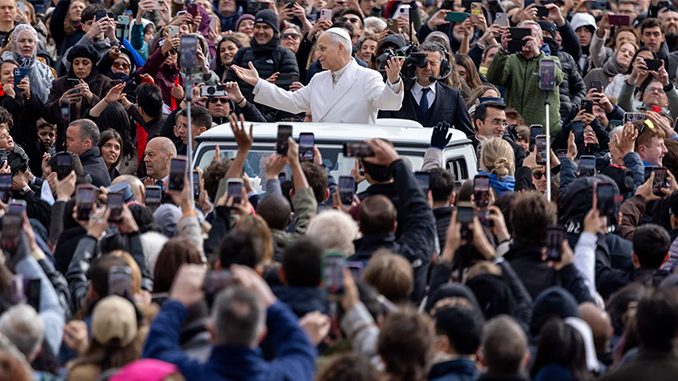
The laity are not “a formless mass, but the body of Christ,” endowed with dignity and responsibility in the Church and in the world, Pope Leo XIV said in his catechesis at the general audience on Wednesday.
After riding around a packed St. Peter’s Square in the popemobile on April 1, the Holy Father recalled the nature and mission of the laity, who for centuries had been defined simply as “those who are not part of the clergy or the consecrated life” in a reflection based on the Second Vatican Council’s dogmatic constitution Lumen Gentium.
Dignity and mission of the laity
The pope explained that Vatican II broke with the former understanding of the laity by affirming the equality of all the baptized and emphasizing both the dignity and the mission of the laity in the Church and in the world.
“Naturally, the greater the gift, the greater the commitment too,” the pontiff said.
In light of Lumen Gentium, Leo affirmed that, by virtue of baptism, “the lay faithful participate in the very priesthood of Christ.”
He recalled the apostolic exhortation Christifideles Laici, in which St. John Paul II emphasized that “the council, with its rich doctrinal, spiritual, and pastoral patrimony, has written as never before on the nature, dignity, spirituality, mission, and responsibility of the lay faithful.” In this way, the saintly pope “relaunched the apostolate of the laity,” Leo noted.
He also stressed that the vast field of the lay apostolate “is not confined to the Church but extends to the world” and that the Church is present “wherever her children profess and bear witness to the Gospel.”
As examples, he cited workplaces, civil society, and all human relationships, “wherever they, through their choices, show the beauty of Christian life, which foretells here and now the justice and peace that will be accomplished in the kingdom of God.”
Quoting Lumen Gentium, the Holy Father stated that “the world needs to be permeated by the spirit of Christ, and more effectively fulfill its purpose in justice, charity, and peace.” He added: “And this is possible only through the contribution, service, and witness of the laity!”
This, the pontiff explained, is the invitation to be the “outgoing” Church spoken of by Pope Francis: “a Church embodied in history, always open to mission, in which we are all called to be missionary disciples, apostles of the Gospel, witnesses of the kingdom of God, bearers of the joy of Christ whom we have encountered!”
During his greeting to pilgrims, Pope Leo XIV encouraged them to remain close to the tomb of Christ and to be faithful in the hour of silence and trial.
He also encouraged the faithful to strengthen their faith during Holy Week and to ask the Lord that the paschal mystery renew in them the grace to be joyful witnesses of the Risen One, confident that love and peace are stronger than death.
This story was first published by ACI Prensa, the Spanish-language sister service of EWTN News. It has been translated and adapted by EWTN News English.
If you value the news and views Catholic World Report provides, please consider donating to support our efforts. Your contribution will help us continue to make CWR available to all readers worldwide for free, without a subscription. Thank you for your generosity!
Click here for more information on donating to CWR. Click here to sign up for our newsletter.


Another truly welcome addition to Pope Leo’s ongoing catechesis on the Documents of the Second Vatican Council, in possible contrast with the excursion into deformed (and substitute?) synodality under Cardinals (insert names….).
About the baptized and our distinct role, this too: “Though they differ from one another in essence and NOT ONLY in degree [!], the common priesthood of the faithful and the ministerial or hierarchical priesthood are nonetheless interrelated” (Lumen Gentium, n.10).
An interrelatedness ineptly handled by doormat “synods (of bishops?),” where the decisions (or recommendations, or opinions, or ideologies, or whatever) are welcomed equally from the non-ordained— circularly as at the very symbolic roundtables. Today, the promise of more Consistories of Cardinals (January 2026), again this summer and then annually, should help to further untangle the inherited and blurred “mess” in governance and much else, even if conducted alongside distinctly different (!) and legitimate “ecclesial assemblies”— between now and another big one mentioned for Rome in 2028.
Vatican II’s recognition of the baptized laity satisfies a problem articulated by BENEDICT XVI long before the muddled Synod on Synodality…
He reflected on the loss of the “ecclesial assembly”—or “communio”— during the Reformation and Council of Trent. The needed restoration of the sacramentally ordained bishop/priest as more than a congregational and seeming “cult-minister”, but as a bearer of sacramentality through the Apostolic Succession and Holy Orders, also led to an unfortunate separation of the laity from the clergy— the loss of communio—”the problem of the laity, which arose at this time and still haunts us today.” The “original meaning of the word ‘ecclesia’—that is, a ‘coming together’” (“Successio Apostolica,” as Chapter 2 in Ratzinger, “Principles of Catholic Theology,” 1982/Ignatius 1987).
SUMMARY: Within the communio of the perennial Catholic Church, a town hall meeting is not quite a synod of bishops, and even a Council is what the Church DOES, not what the Eucharistic Church IS.
Leo seems to have something to say about almost everything. I wonder if he’ll weigh in on the chances that the Cubs will win the World Series.
Laity – Pillars of the Pilgrim Church. Their sons and daughters listen to the call of Christ, leave everything behind to humbly serve the Lord in thought, word, and action.
Very fine talks on VII from Leo.
I would ask Pope Leo to reference for us laity where exactly in the Gospels Jesus weighed in on the various military campaigns of the Roman emperors. Historically, the Church always loses its mission and ventures down dangerous paths when the Church views all things through a socio-political lens. This needs to stop. It is not Christ’s way.
What Leo XIV says in theory is true, although existentially we’re not the full realization of a community that is one faith. Of one baptism, yes.
Disunity remains liturgically and doctrinally. The former with the unresolved TLM and suppression of the ancient liturgy that remains under Leo. The other more substantial cause of disunity is the prevalent voice granted Cardinals McElroy, Hollerich et Al to legitimize Eucharistic communion for those in irregular relationships.
Converts through God’s gift of grace see through the fallacy and enter the one true faith drawn by Christ’s real presence in the Eucharist, whereas born Catholics are disillusioned by the fallacy promoted by papal favorites, the promoters of irregular sexual union, laxity in practice carried over from the previous papacy. Unless there’s a clean break with that legacy, disunity will persist.
Pope Leo’s recent lionization of Amoris Laetitia as a beacon of light for the world reinforces distance between Catholic progressive and the Apostolic traditional. As to the extent that Leo XIV by policy preference not only maintains but favors progressivism to Apostolic tradition, so will the division exist.
Laity who comprise the vast majority of the Body of Christ will remain diluted in witness to the truth until the said issues are corrected. It appears the present large entrance of more committed converts to the faith knowledgeable of the issues may providentially initiate that correction.
“Unless there’s a clean break with that legacy, disunity will persist.”
Sometimes, if one has the luxury of time, the better strategy is not a “clean break.” Instead of being lured into frenzied whack-a-mole, and thusly into cleverly laid optics— just change the conversation altogether…
The catechesis on the Documents of Vatican II—instead of on puffery from parts of the so-called and substitute (?) Synods—might be evidence of such a strategy. Likewise, the recent and scheduled Consistories of Cardinals, rather than only more “synodal” town hall meetings engineered by a few empty-suit cardinals. Also, the “disunity” runs back further than this added “mess” of the past twelve years. So, with each passing day the embedded moles are already in the rearview mirror, we hope.
True, however, much does depend on this coming year, and especially on new appointments—as the heads of five dicasteries are now at age 75 and will be submitting their resignations….
Well said and completely accurate Fr. M!
Fr. Morello above (6:42 a.m.) – Why so negative? It hasn’t been even a year and there are hopeful signs, “signs of the times”, if you will.
My desires for the Church are where your kind leanings are Cleo. And would much rather that your’s are correct. Mine are that of an old sentinel standing out in the cold. Searching the mists from which the wolf prowles.
To me those are words without substance.
If “the world needs to be permeated by the spirit of Christ” (I would prefer to say not by the spirit of Christ but by Christ because it makes a stronger point bringing His Person to the view) one must specify how.
I believe there is only one way to achieve that: via a person’s communion/relationship/union with the Person of Christ. A person in union with Christ does not speak slogan about justice, peace etc. – he acts it or better to say Christ acts it in him and via him. Now imagine we have the Church like those people, for whom Christ is a living centre of their souls, who know experientially that they cannot live without Him. If they have that orientation to Him, no matter how sinful they are, they will inevitably pursue that vector towards Him and try to bring others into that vector. Not into own vector but into a vector of Christ. I am speaking about a radical “turn” of a person, like a tiny piece of metal towards a magnet. If the Church is that all it is to live that vector towards Christ the Person everywhere.
If we look into Church’s history, we will see that charitable actions always flow from the inner life of a soul with Christ. There is no such a thing as “sing of our time” because in every time there is a soul and souls who need their Saviour. It is eternal. The attention of various needs of various people (individuals, groups etc.) flow from one thing: a living relationship of a soul with the Lord. If someone is surrendered to Christ, he naturally will provide for the hungry, without slogans. Likewise, he will naturally say “this is an apostasy” to something contrary to the Lord even if it is covered by “let us provide for disadvantaged”.
I would adopt “a sign of the time” in one case only: a terrible loneliness and disconnection of human beings in our world and the lack of meaning. This can be overcome only via bringing individuals to the Person of Christ, helping them to connect/have a relationship with Him and this is the true task of the Church.