


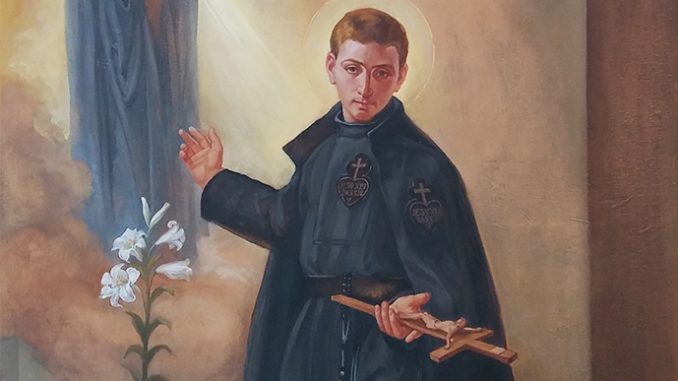
February 27th is the feast day of St. Gabriel of Our Lady of Sorrows.
The Passionist saint was born in Assisi, Italy, on March 1, 1838, and baptized Francesco Possenti on the same day, not only named after Assisi’s most famous resident but also baptized in the same baptismal font as St. Francis.
Early life and tragedies
His father was trained as a lawyer and worked in local government, promoted to a significant post in Spoleto a few years after Francesco’s birth. He was eleventh of thirteen children, and his parents were pious as well as prosperous. However, by the time he was four years old, tragedy had struck the home several times, including the death of an infant sister, the death of an older sister, and, in 1842, the death of his mother.
Francesco’s childhood probably seemed like the childhood of any family of a similar class at the time. There was little evidence of the saint he would become. He liked to play pranks, and he could be petulant, and sometimes his temper flared up. He had private tutors at home, only going off to school in early adolescence (first with the Christian Brothers and then with the Jesuits), where he excelled, in part due to a strong memory. He enjoyed the social scene in Spoleto and was known to give exceeding care to his personal appearance, sometimes taking an hour or more to get ready for dances. He had a reputation for being a fine dancer, and when of age, even earned a reputation for being a ladies’ man. He was well-liked by his peers and would go to the theater or out hunting with his companions.
He said his prayers as taught by his family and attended Mass, but that level of piety was not uncommon in that period. Perhaps the only sign of things to come was his ready charity towards the poor. When he fell ill around the age of thirteen, he made a promise to join a religious order if he got better. But when his condition improved, nothing happened with his promise. Death drew near to him with the loss of two older brothers (one by suicide). In 1853, he fell seriously ill due to a throat abscess. He attributed his recovery to the intercession of a recently beatified Jesuit saint, and had promised to become a Jesuit if he recovered. Nothing came of this promise either, and Francesco went back to being the darling of his school and the social scene in Spoleto.
Then tragedy struck his city in the form of a cholera epidemic. Francesco lost his sister, Mary Louisa, to the disease, who had taken charge of him after his mother died. As the epidemic crested and then waned, the ecclesial authorities ordered a procession of an ancient image of Mary through the streets. Kneeling as the procession passed, he heard a voice that asked him why he had not fulfilled the promise he had made now twice over. Francesco consulted with a priest he knew, and he resolved to enter the Passionist order (just a little over a hundred years old at the time).
The Passionists and radical change
His father was against him entering such an austere order and enlisted the help of family friends to try to talk him out of it. Perhaps he had in mind his son’s reputation for being frivolous. Francesco won out and left his hometown to enter the Passionists novitiate on September 21, 1856, and was given the name Gabriel of Our Lady of Sorrows, in honor of the feast the next day. He made his first vows in the community a year later, on September 22, 1857.
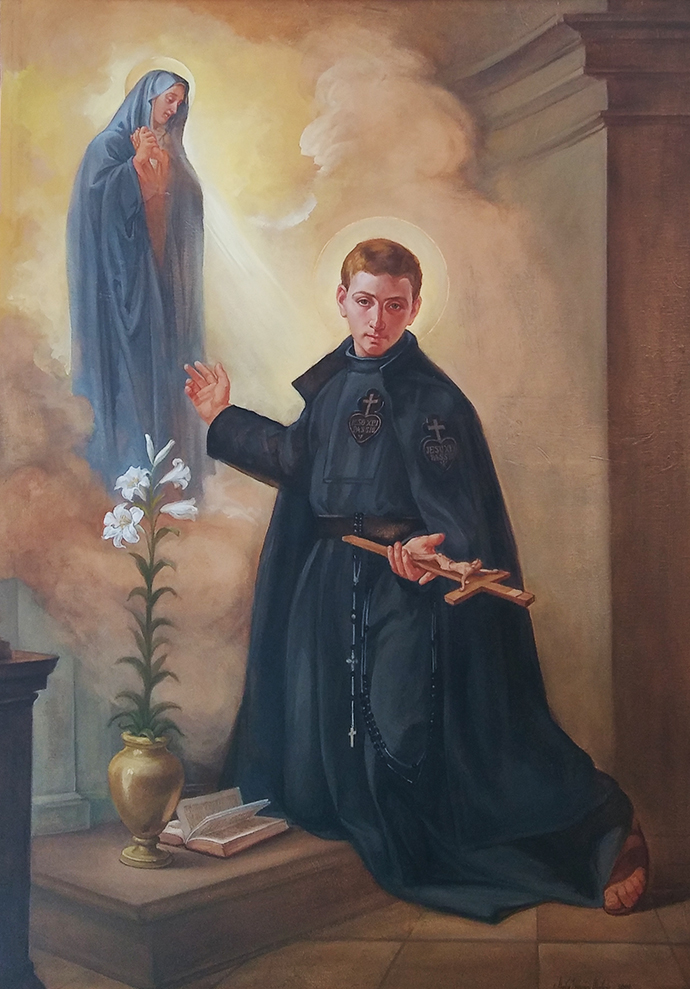
His novitiate gave Gabriel a focus that eluded him in the social scene of Spoleto. Gone were the hunts and the dances, gone were the fancy clothes, to be replaced by the rough black habit of the Passionists and their heart-shaped emblem with the letters “Jesu Xpi Passio”—an abbreviation of the Passionist motto, “May the Passion of Jesus Christ be always in our hearts.”
The same enthusiasm he had once given to secular and social affairs, Gabriel now applied to his life as a novice, to the extent that his spiritual director, Fr Norbert, had to rein in his enthusiasm. Fr. Norbert wisely counseled Gabriel away from extreme acts of piety and devotion and to follow the rule of the religious order and obey his superiors with prompt obedience. He made a list of resolutions in this early period to keep his ideal of sanctity as a member of a religious order always in his mind. One of them reads, “Faithfulness in little things is the motto I will always follow in my efforts to reach holiness.” The efforts to put this resolution into practice as a new Passionist brother radically changed the dancing young dandy.
Gabriel was sent to a more remote house of the community to begin his studies to become a priest. His life became marked by the monotony of life in community: the recitation of the Liturgy of the Hours throughout the day, the frugal and often penitential meals, his studies, community chores, Rosary and mental prayer, moments of fellowship with the community. With his pious resolutions, Gabriel let this routine reshape his life. His companions at this period in his life testified later that they never saw any unwillingness or hesitation to obey the least command of the rule or his superiors. Only when we know his early history can we get a glimpse of what this must have cost Gabriel.
What worked such a change in the former socialite? In addition to the vows to poverty, chastity, and obedience, Passionists make a fourth vow to always remember and promote Christ’s Passion. This was not a mere ritual for Gabriel, but he made Our Lord’s suffering and death his constant meditation, his constant companion in every action. All that he did, including being obedient to the least command of his superior, even when his own thoughts counseled him otherwise, he did to conform his life more and more to the Passion of his Savior.
Nor was the religious name given to him a mere coincidence. His meditation on the Passion was seasoned by meditation on Christ’s Mother and her sorrows. His love of Christ crucified could not be separated from his love of Mary, who stood by her Son at this all-important moment. It was the Passion especially seen through the eyes of Our Lady of Sorrows that changed the frivolous dancer and party-goer into an earnest young man striving for hidden but heroic virtue.
Two stories united
For almost six years, Gabriel was in formation for the priesthood, but the last two years saw first a weakness in the young man and then a marked decline in his health. A doctor examined him and diagnosed tuberculosis. During the last few months of his life, he was confined to a bed in the community infirmary, and even here his confessor and fellow religious noted a calm resignation to the will of God. Gabriel of Our Lady of Sorrows died on February 27, 1862, not having completed his education for the priesthood.
He was three days shy of his twenty-fourth birthday.
From one point of view, Francesco Possenti’s life would be judged a failure. He had given up a life of status and leisure to become a member of an austere religious order, only to die before he was ordained to the priesthood and could fully take part in the Passionist vocation of preaching and hearing confessions. He left only a few dozen letters and fragments of a few other writings. Yet his life of quiet sanctity soon became known to more than just his religious confreres. Despite the political vicissitudes of Italy in this period, the laity in the remote region in which the Passionist seminary was located came to visit Gabriel’s remains, praying for his intercession. And their prayers were answered, sometimes in miraculous fashion.
Gabriel’s reputation for holiness spread, especially as the Passionists circulated the story of his life. One Passionist priest, Fr. Germano Ruoppolo, wrote a brief biography that found its way into the hands of Gemma Galgani and strengthened her own conviction that she had a vocation to the Passionists. In addition to other mystical experiences, Gemma came to have visions of Gabriel of Our Lady of Sorrows, and his biographer, Fr. Ruoppolo, became Gemma’s confessor. Something about Gabriel’s holiness was contagious.
The readings from the Extraordinary Form of the Mass indicate why. For its Gospel reading for St. Gabriel’s feast, the traditional liturgy uses Mark 10:13-21:
And they were bringing children to him, that he might touch them; and the disciples rebuked them. But when Jesus saw it, he was indignant, and said to them, “Let the children come to me, do not hinder them; for to such belongs the kingdom of God. Truly, I say to you, whoever does not receive the kingdom of God like a child shall not enter it.” And he took them in his arms and blessed them, laying his hands upon them.
And as he was setting out on his journey, a man ran up and knelt before him, and asked him, “Good Teacher, what must I do to inherit eternal life?” And Jesus said to him, “Why do you call me good? No one is good but God alone. 19 You know the commandments: ‘Do not kill, Do not commit adultery, Do not steal, Do not bear false witness, Do not defraud, Honor your father and mother.’” And he said to him, “Teacher, all these I have observed from my youth.” And Jesus looking upon him loved him, and said to him, “You lack one thing; go, sell what you have, and give to the poor, and you will have treasure in heaven; and come, follow me.”
I have quoted the Gospel passage entirely because we see in the life of St. Gabriel that these two familiar stories become united. He was, in fact, the rich young man, but unlike the figure in the Gospel, our saint in fact chose to give up all that he possessed to follow the Crucified Christ. He became like a child, perhaps even giving the Church a foretaste of the Little Way that St.Therese of Lisieux would teach the world a few decades later.
And it was the Sorrowful Mother that led St. Gabriel on his journey of holiness, the same Mother Jesus gave from the Cross to every beloved disciple. And so St. Gabriel invites us to join him and learn at the school of Our Lady of Sorrows. As the Passionists pray today:
Lord, you gave Saint Gabriel of our Lady of Sorrows a special love for your mother and a compassion for her sorrows.
Through her, you raised him to the heights of holiness.
Give us great devotion to her sorrows, that we may know her as our loving mother.
We ask this through our Lord Jesus Christ, your Son who lives and reigns with you and the Holy Spirit, one God for ever and ever.
Amen.
If you value the news and views Catholic World Report provides, please consider donating to support our efforts. Your contribution will help us continue to make CWR available to all readers worldwide for free, without a subscription. Thank you for your generosity!
Click here for more information on donating to CWR. Click here to sign up for our newsletter.

Leave a Reply