

The historical relationship between Judaism and Catholicism is complex. Deep and abiding theological differences endure, and yet Jesus himself said that “salvation comes from the Jews” (Jn 4:22), and Pope Pius XI said that, “Spiritually, we are all Semites.” Looking at this long and complicated history, how can one navigate these issues? How can Catholics understand the relationship of Catholicism to Judaism?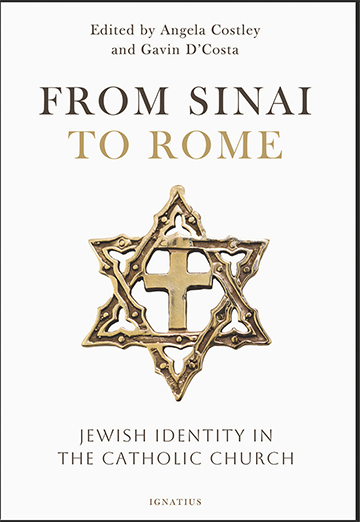
Angela Costley and Gavin D’Costa are the editors of a new book, From Sinai to Rome: Jewish Identity in the Catholic Church (Ignatius Press, 2025), which explores the deep Jewish roots of the Church and how understanding that patrimony can help Catholics come to a fuller understanding of our faith. The book features chapters from many contributors, including Scott Hahn, Brant Pitre, Roy Schoeman, Lawrence Feingold, and others.
From Sinai to Rome is a rigorous study of the rich, complex relationship between Judaism and Catholicism, which refuses to shy away from historical knots in Catholic and Jewish relations. The contributors explore this relationship in the context of the Catholic tradition, and with a deep foundation in Scripture and the history of Judaism.
Dr. Costley is a graduate of Oxford, completed her PhD at St. Patrick’s Pontifical University, and is a board member of the Association of Hebrew Catholics. D’Costa taught at the University of Bristol and now teaches at the Pontifical University of St Thomas Aquinas, Rome.
Costley and D’Costa recently spoke with Catholic World Report about their new book, the history of the Church’s relationship with Judaism, and why it is important to understand our Jewish roots.
Catholic World Report: How did the book come about?
Angela Costley: This is a bit of a funny story. I am a Hebrew Catholic, and I attended a Zoom event where Gavin was giving a talk, and I knew from his work that Gavin had a bit of an interest in Hebrew Catholicism. I happened to spot what I considered to be a lacuna in his thinking and, like a good Jew, wrote to tell him I disagreed.
Anyway, this sparked a wonderful conversation back and forth for a little while, and we got to know each other as scholars. Then, I started to have this idea about a book concerning Hebrew Catholicism. I felt that it was very important to draw attention to the presence of Jews in the Church as members of the Body of Christ, and this idea would not go away. So, I asked Gavin, a bit cheekily, if he would write a book with me—and he graciously said yes!
We then set about thinking about whom to invite into the project, and some fantastic scholars also said “Yes.” We have people like Scott Hahn and Brant Pitre on the Scripture side, as well as Bruce Marshall, Robert Fastiggi, and Lawrence Feingold on the Tradition side, as well as Roy Schoeman, author of Salvation is from the Jews, and Frs. David Neuhaus and Antoine Levy.
CWR: The subtitle of the book is “Jewish Identity in the Catholic Church.” Is it important for Catholics to recognize the Jewish roots of the Church? If so, why?
Costley: I would answer that with a heartfelt “absolutely!” One of the biggest obstacles to both dialogue with Jews and, indeed, to Jews entering the Church is that for centuries, supersessionism has had a real grasp on Catholic theology. The Church has long been depicted as a “New Israel” that surpasses the old, and this has led to a lot of anti-Semitism, something Robert Fastiggi talks about in his chapter in From Sinai to Rome, as well as Bruce Marshall, who looks at the writings of St. Thomas Aquinas on the Law as dead and deadening.
However, as I discuss in my own chapter, this was not the view of the Church held by the first disciples, who rather saw in Jesus the fulfilment of the Old Testament promises and the Church as, simply, Israel after the coming of the Messiah. At Vatican II, we saw a positive shift in the Church’s relationship to Judaism in Lumen Gentium and Nostra Aetate, which returned to this idea and drew on St. Paul’s image of the olive tree in Rom. 9-11, onto which gentile branches were grafted.
So, understanding the Church’s roots in Judaism is central to the Church’s understanding of herself. If we are truly to unpack the implications of Vatican II for theology and dialogue, we really need to appreciate the Church as blossoming from Israel rather than suppressing and supplanting it. This will lead to a greater respect for Jews and Judaism outside the Church and also to a much deeper understanding of the Church’s continuity with Ancient Israel, which will help to enrich Catholic theology, too, as we start to rejoin the dots between the Old and New Testaments.
CWR: In the earliest days of the Church, we see the apostles grappling with the question of how to understand and apply the Church’s Jewish roots going forward. Is this an ongoing project, in some sense?
Costley: Again, I would answer, “absolutely!”—this time with a bit of a sad sigh, though. As a Hebrew Catholic, one of the things I often get told is that I should forget my Jewishness, that it does not matter after the coming of Christ. However, that makes very little sense to me as a Jew because if you are claiming that Jesus is the Jewish Messiah, then why, in coming to faith in him, should Jews suddenly stop being Jews?
This actually puts off a lot of Jews from taking the leap into the Church who are otherwise considering becoming Catholic, not least because under this view, it means the destruction of our people as a people. Also, our relationship with God is different. For gentiles coming to faith in Christ, their first encounter with the God of Israel is through Jesus, but we have a whole history that precedes this, and gentiles therefore presume things about Jews in the Church on the basis of their spirituality without considering ours.
For instance, at Passover, it is not just that this festival pointed to Jesus; it was a real and powerful act in the nation’s history, and so we also feel a need to celebrate it on its own terms, not just in relation to Jesus, though that is important. Our spirituality is deeply rooted in Scripture. In Scripture, especially in Acts, what we see, in fact, is not Jews suddenly becoming gentiles because they believe in Jesus.
One of the things I discuss in my chapter in From Sinai to Rome is how, at the Council of Jerusalem, the restrictions on consuming blood, not eating strangled meat etc. were not just to “keep the peace” for table fellowship, but were actually requirements of gentiles living with Jews according to the Holiness Code in Leviticus. The gentiles were not expected to become Jews, but neither were Jews suddenly gentiles. At the moment, we have a number of Jews coming to faith in Christ, which has even prompted a response from the Vatican as Gavin talks about in his chapter in From Sinai to Rome, and as a Church, we need to realise that they view their faith in Christ not as entering into some kind of new religion, but as a deepening of the relationship they already have with God.
CWR: There is a cliché that the Catholic Church was complicit in (or even an explicit perpetrator of) anti-Semitism and anti-Semitic violence throughout the centuries. What is the truth in this matter? Is that cliché true?
Costley: I think this is a very complicated question.
Part of the issue stems from the fact that the earliest references to what we would consider anti-Semitism today come in the Church Fathers and other early Christian writers, but, somewhat ironically, because they wanted to prove to Jews that their Messiah had come. Justin Martyr is well known for his Dialogue with Trypho, for instance. Unfortunately, this was undeniably mixed up in claims of deicide.
Melito of Sardis, for instance, in On Pascha, commented that God had been murdered and the king of Israel was hanged on a tree by Israelite hand. However, I think their aim was partly that the harsh rhetoric would in some ways convince Jews of their error, and so I question whether they would have considered themselves anti-Jewish or even, in some cases, have had that intention.
Over the subsequent centuries, though, the rejection of Christ by “the Jews” was seen by many as a great sin, and the subjugation of Jews was often seen as punishment by Christian communities, as Robert Fastiggi notes in his chapter. However, there have been positive moves by some bishops and even popes to quell anti-Semitic fervour in the Church as well, even whilst all this was going on, which he also discusses in some detail.
I would certainly add that Christianity more broadly is sometimes blamed, including in Jewish circles, for Hitler’s crimes, especially since one of the things the Third Reich did in their “church” was to remove traces of Jewish identity from the New Testament. Some years ago, I gave a talk for the Jewish Society at Durham University on Catholic reactions to the Holocaust (we prefer “Shoah”) and I remember well the Jewish sadness expressed at what they perceived to be a lack of response on the part of the pope during that period, even though great efforts were made by various convents, etc. to hide children.
We do not shy away from this topic in the book because it is an important one, but it is also a complicated one, and I believe that were it not for the truth in this cliché, more Jews would possibly have come to faith in Christ.
CWR: How about Thomas Aquinas, and the accusations of anti-semitism against him? What do you make of that?
Gavin D’Costa: First, one must distinguish between anti-semitism and anti-Judaism, although of course the two are related. I use the terms to denote two different types of prejudice. Anti-semitism denotes a person who is anti ‘Semites’, which technically denotes both Jews and Arabs who speak Semitic languages. In this forum, it means anti-Jewish, in terms of ethnicity. Anti-Judaism would relate to both ethnicity, but also add a new element: the religion of the person, Judaism. Now, a gentile who converts to Judaism is not ethnically a Semite, but is religiously Jewish.
Back to Aquinas. Here we have one additional issue: the use of these terms varies over time, and Aquinas is a medieval writer. So, beware of anachronisms! In my view, Aquinas is neither anti-Semitic nor anti-Jewish in the contemporary, recognised sense of the term. He never advocates discrimination against living people, individually or communally, based on their being Jewish or their being Semites.
Three points should be registered. First, he believed that the Jewish law and ceremonies were given by God to his people, the Jews, so that they could worship the true and living God. This teaching provides contemporary Christians with amazing resources, as Aquinas goes so far as to call Jewish practices ‘quasi-sacramental’. Second, Aquinas mistakenly assumes that once the gospel is preached, those who reject Jesus Christ are sinful. I say mistakenly, as theologically, while what he teaches is right, it is not helpful or accurate to simply apply this to all non-Christians, or specifically to Jews.
Why? There are three problems with doing this in relation to Jews. First, Paul in Romans 9-11, actually sees the Jewish ‘no’ as part of providentially extending the Jewish covenant to the gentiles. When the time is right, by God, the Jewish people will be jealous and will come to Christ.
Second, Vatican II says in Gaudium et Spes 19 that there are reasons to believe that even those living in the heart of Christendom might not properly know the gospel. Why? Because so often Christians obscure it through their lives and practices.
Third, were Aquinas living today under the authority of the magisterium, I think he would use his first insight to develop a positive theology of Judaism. Bruce Marshall, in his great essay in our book, rightly wants to make clear that Aquinas, as Aquinas, rather than as a theologian we use and deploy to help us think through matters, did think the Jews had rejected Christ and thus were under condemnation. But this latter point should be contextualised and seen not as directly anti-Jewish, but arising from his belief that anyone who rejected Christ, rejects truth and the light, and thus salvation.
So, if we view those Christians who hold that Jesus Christ is the sole means to salvation are anti-Jewish, then this would be true of the entire Christian tradition. It would be true of the present teachings of the Catholic Church that Judaism is from God and Jews who practice their Judaism are participating in God’s grace. But it would be false, as the Church teaches now that Jews who become Catholics need not reject their Jewishness.
CWR: Is this book solely geared towards Catholics? Or can non-Catholics (whether Jewish or otherwise) get anything from the book?
D’Costa: The book is geared towards Catholics and all those interested in the mystery of Israel that is at the heart of the Christian gospel.
I think that many Christian communities have already begun to ponder this mystery and have made important inroads into the question. Also, I think there are some Jews who are very interested in how Christians make sense of the Jewish mystery, so they will find the book helpful.
However, a difficulty must be registered for our imaginary Jewish reader who is not a follower of Jesus. Most Jews think that a Jew who becomes a Christian is an apostate and loses the privileges and rights of a Jew, but they, of course, still remain a Jew–just an apostate Jew. And who likes apostates? Catholics have not been friendly to their apostates historically. However, in my view, every religious community can learn from its apostates, for many are sincere and seek the truth in their hearts and minds. The history of Catholicism owes its shining light to apostates (heretics and schismatics), for it pushes the Church to consider the truth, its expression, and its light. It should also require that we defend the truth in the light of these defections. As long as one does not burn and torture apostates, and neither community does that today, then all is well. But it is up to Jewish readers to make up their minds whether I’m being fanciful.
Other Christians share with us the Scripture, Trinitarian belief, and some share sacramentally as well. Within this context, the book is for all Christians. It asks them: Do you value and understand the Jewish mystery that constitutes our own Christian identity? Put bluntly, do you understand the Church and Christianity as a Jewish messianic movement that grafts into the mystery of Israel, the gentiles?
Finally, those Jews who are Catholics or Christians will find the book equally exciting, as it raises the question about the nature of the Church: a church of the circumcision and a Church of the gentiles, as a 2015 Vatican document puts it. And that same document makes the claim that this distinction is vital not just quantitatively (which is virtually insignificant) but qualitatively (which it sees as central). Wow. That means all gentile and Jewish Christians should read the book. I would say that!
CWR: What do you hope people will take away from the book?
D’Costa: For Christians and Catholics: I hope it will deepen their faith; that it will open their eyes to reading the Scripture, both Old and New, and see both constitute our faith and love of God, Jesus, the Blessed Virgin Mary, and the early Church. And it will help them pray more deeply and see that the patterns of Christian worship are so moulded and shaped by biblical Judaism.
If you value the news and views Catholic World Report provides, please consider donating to support our efforts. Your contribution will help us continue to make CWR available to all readers worldwide for free, without a subscription. Thank you for your generosity!
Click here for more information on donating to CWR. Click here to sign up for our newsletter.

Thank you for sharing this. It looks like an interesting read.
I would highly recommend The Association of Hebrew Catholics to any non Jewish Catholic who is looking for more information about our Jewish roots. You are very welcome to join. By doing so will receive an excellent periodical filled with news, testimonies, and scholarly contributions. But most importantly ,you will be introduced to some very precious brothers and sisters in Christ.
I am waiting for the usual suspects to come here quoting Session 11 of Florence to attack Jewish Catholics keeping their identity.
Warning to that Marcionite lot. I have citations from Benedict XIV, Gabriel Vasquez and Nostre Aetate warmed up and I am not afraid to use them. 😀
Shalom.
B’shem Yeshua & Miriam.
Shalom, Mr. Jim & Merry Christmas!
If any us of oppose the plans of the Israeli government and its lobby to involve America in the regime change war it wants to wage next year against Iran, will we incur your wrath?
You mean against your Jew-hating bile? Hell yes.
Thank you for your contribution reasoned debate.
POPE SAINT PIUS X in response to Theodore Herzl and the Zionist Quest, PLUS THE TRUE RELATIONSHIP BETWEEN THE CATHOLIC CHURCH AND THE JEWISH PEOPLE, and the TRUE STATUS OF JERUSALEM:
“We cannot give approval to this movement. We cannot prevent the Jews from going to Jerusalem—but we could never sanction it. THE SOIL OF JERUSALEM, IF IT WAS NOT ALWAYS SACRED, HAS BEEN SANCTIFIED BY THE LIFE OF JESUS CHRIST. As the head of the Church I cannot tell you anything different.
THE JEWS HAVE NOT RECOGNIZED OUR LORD; THEREFORED WE CANNOT RECOGNIZE THE JEWISH PEOPLE.
THERE ARE TWO POSSIBILITIES. EITHER THE JEWS WILL CLING TO THEIR FAITH AND CONTINUE TO AWAIT THE MESSIAH WHO, FOR US, HAS ALREADY APPEARED. IN THAT CASE THEY WILL BE DENYING THE DIVINITY OF JESUS AND WE CANNOT HELP THEM. Or else they will go there without any religion, and then we can be even less favorable to them.
THE JEWISH RELIGION WAS THE FOUNDATION OF OUR OWN; BUT IT WAS SUPERSEDED BY THE TEACHINGS OF CHRIST, AND WE CANNOT CONCEDE IT ANY FURTHER VALIDITY. THE JEWS, WHO OUGHT TO HAVE BEEN THE FIRST TO ACKNOWLEDGE JESUS CHRIST, HAVE NOT DONE SO TO THIS DAY.
Our Lord came without power. He was poor. He came in peace. He persecuted no one. He was persecuted.
He was forsaken even by his apostles. Only later did he grow in stature. IT TOOK THREE CENTURIES FOR THE CHURCH TO EVOLVE. THE JEWS THEREFORE HAD TIME TO ACKNOWLEDGE HIS DIVINITY WITHOUT ANY PRESSURE. BUT THEY HAVEN’T DONE SO TO THIS DAY.”
>>>>>>>>>>>>>>>>>>>>>>>>>>>>>>>>>>>>>>>>>>>>>>>>>>>>>>
Neither the non-dogmatic Nostra Aetate nor statements from other Popes carry any more weight than the statement of Pope St. Pius X. Still, what Pope St. Pius X predicted about how the Jews would continue to defy Jesus and His Church remains true to this day, thereby making it impossible for them to be properly recognized in any way wherein they have not been SUPERSEDED as described by POPE ST. PIUS X.
Trying to overlay Judaism onto Christianity to make them something more than what they are is what got Scott Hahn into so much trouble with his four cups machinations plus flying off with theories about how long the Last Supper was, if it was the seder meal, if it could have occurred on the Thursday evening and all that.
The issue doesn’t relate with Marcionism either and Jim the Scott keeps invoking this heresy like it was some kind of Catholic and/or faith master key for Jewish understanding of Catholicism and Catholic understanding of Judaism.
I don’t think I understand how the Catholic church owes its “shining light” to the apostates, schismatics and heretics.
It is an offensive statement, if not an outright blasphemy.
If you’re referring to Jews, they are not, by definition apostates, schismatics, and heretics.
I’m referring to what D’Costa had said in the interview.
All of Judaism, beginning in the Old Testament, including the entirety of the Hebrew people, are the chosen children of God. This did not change with the passion, death and resurrection of Christ. God, through Jesus, expanded salvation to include the entire human race along with the Jews.
For us, as Christians, they are and always will be our eldest brethren.
The Jews have not ceased being the people of the covenant beginning with Abraham and Isaac. Though Ishmael was the firstborn of Abraham, he was not of the covenant that God established through Abraham and Isaac.
To reject them in any way, shape or form is to reject ourselves as children of God redeemed by Christ. The Jews will be converted to Christianity at a time and under circumstances known to God alone. All politics aside, know with absolute certainty that God has not abandoned His firstborn.
Thank you Mr Rasavage and God bless you. 🙏
Merry Christmas!
Well said!
Merry Christmas and many blessings of God.
“All of Judaism, beginning in the Old Testament, including the entirety of the Hebrew people, are the chosen children of God.
Hello, Ambassador Huckabee.
I’ll be sure to write a check to the IFCJ. I want to please God, so I’ll support the millions of elderly Holocaust survivors who live without anything in one of the most robust welfare states in the world, and ignore the sex trade kidnapping of those Nigerian girls. They aren’t “chosen” so…
Hope you’re keeping up on your episodes of Candace!
We can know through both Faith and reason, that God Has not abandoned His firstborn, for “God So Loved us, He Sent His Only Son, for from The Beginning, God Willed us worthy of Redemption.
I think it is accurate to say that the Israelites of the Old Testament were the unborn Mystical Body of Christ. The ritual prescriptions of the Mosaic Law functioned as an umbilical cord through which God nourished this unborn Church. At Pentecost, however, the Mystical Body of Christ was born and the umbilical cord was severed, ceasing to be the Church’s means of nourishment now that she was able to receive God Himself as her food.
The Jews who rejected Christ were the cells that Christ’s Mystical Body lost when she was born. Judaism falsely teaches that these cells are alive and can be nourished by the umbilical cord of the old ritual laws. In fact, however, these cells and the umbilical cord are both dead, since they have been separated from the living organism of Christ’s Mystical Body. Only when they are reunited with this Body can these severed cells come back to life and be nourished by the very Body, Blood, Soul, and Divinity of Christ Himself. Jews who come into the Church should therefore cast aside the Jewish rituals and feasts, just as the umbilical cord is cast aside and disposed of after birth.
Dear VAG,
I am sincerely glad that Almighty God is not as cold, heartless and merciless as yourself. Umbilical cords indeed!
The Catholic Church Herself teaches that the conversion of the Jews will occur in the end times. That would not be the case if God has already cast them aside as unwanted cells.
Then again, you could expound on your unique aspect of God that even the great theologians of the Church overlooked – Umbilical Cord Theology!
Apparently not all Jews will convert at the end of time since many have been converted already by the numerous missionaries. Were they wrong? Was St. Peter wrong? St. Vincent Ferrer? St. John Chrysostum? St. Augustine? St. Ambrose? St. Athanasius? Pope St. Pius X? According to your logic are we to stop any and all evangelization with the Jews and tell them what? What changed? Who countermanded Jesus? Did Jesus set a timeline when we are to stop with Our Lord Jesus’ Great Commission?
Jim,
I strongly suspect that you are in the wrong alley of the wrong neighborhood of the wrong city of an unknown country in completely the wrong time.
What a horrible thing to say.
Catholics should investigate where Jews got the cups from and when they began their “tradition” of various cups. The Passover requirements are laid out in detail in Exodus, lamb, bitter herbs, blood on lintels; from what appears in the Bible there are no blessing cups or seder cups.
It could easily be that the one cup of consecration instituted by our Lord at the Last Supper, came under scrutiny of Jews who adapted the idea of to themselves; at which point you first got the single kiddush cup generally used at celebrations and Shabat and subsequently the four seder cups for the Passover.
In general, non-Christian religion coming under Christian influence and then adapting from Christianity is an area needing more direct attention, theological, historical, archeological, etc. Prior to the coming of Christianity to the Indian sub-continent, what they had was a plurality of divinities including underworld types, with multiple senior ones and multiple lower ones, all in disorganization. Kali from the underworld could take on a senior position. I think it will be found that with the coming of Christianity there then appeared an attempt to formulate a trinity; such that no such concept or idea ever existed before that time and there was never any such inkling.
Again with Islam, Mohammed condemns monasticism but within a short period there was a copy-cat development that seems to have been initiated in North Africa /Northwest Africa, the tariqa, marabouts and sufism; then proliferating and becoming more fine-tuned and specialized looking truly groundswell originally Islamic.
He called out saints and doctors of the church and even speculated on Aquinas, “…were Aquinas living today under the authority of the magisterium, I think he would use his first insight to develop a positive theology of Judaism.” Really? The Angelic Doctor? Who does this guy think he is?
His own synopsis is propped up by an illusory contemporary zeitgeist to deny the reality Jews need to convert. That reality was established long ago by Our Lord Jesus and His apostles. The Jews cursed themselves and their children (Matt. 27:25) with the Precious Blood of Our Lord. Their only remedy is quite simple “Repent and be baptized in the Name of Jesus” and they will “receive the gift of the Holy Spirit”. (Acts 2) Regardless what anyone says, especially the feckless dialogueers, pray for their conversion. “No one comes to the Father except through me” (John 14:6) They cannot be saved otherwise.
“Let us pray also for the faithless Jews [perfidis Judaeis]: that Almighty God may remove the veil from their hearts; so that they too may acknowledge Jesus Christ our Lord. [No instruction to kneel or to rise is given, but immediately is said:] Almighty and eternal God, who dost not exclude from Thy mercy even Jewish faithlessness [Judaicam perfidiam]: hear our prayers, which we offer for the blindness of that people; that acknowledging the light of thy Truth, which is Christ, they may be delivered from their darkness. Through the same our Lord Jesus Christ, who liveth and reigneth with thee in the unity of the Holy Spirit, God, for ever and ever. Amen.” (Pre 1955 Good Friday prayer for their conversion Jews)
Nostra Aetate: ” Nevertheless, God holds the Jews most dear for the sake of their Fathers; He does not repent of the gifts He makes or of the calls He issues-such is the witness of the Apostle.(11) In company with the Prophets and the same Apostle, the Church awaits that day, known to God alone, on which all peoples will address the Lord in a single voice and “serve him shoulder to shoulder” (Soph. 3:9).(12)
Since the spiritual patrimony common to Christians and Jews is thus so great, this sacred synod wants to foster and recommend that mutual understanding and respect which is the fruit, above all, of biblical and theological studies as well as of fraternal dialogues.
True, the Jewish authorities and those who followed their lead pressed for the death of Christ;(13) still, what happened in His passion cannot be charged against all the Jews, without distinction, then alive, nor against the Jews of today. Although the Church is the new people of God, the Jews should not be presented as rejected or accursed by God, as if this followed from the Holy Scriptures. All should see to it, then, that in catechetical work or in the preaching of the word of God they do not teach anything that does not conform to the truth of the Gospel and the spirit of Christ.”
“Although the Church is the new people of God, the Jews should not be presented as rejected or accursed by God, as if this followed from the Holy Scriptures.”
This particular line since it makes the distinction the Church as the new people of God (notice the writer avoids the traditional term New Israel). He then goes on makes the strawman argument that people think they are accursed by God. They are not. They cursed themselves and that self-imposed curse remains until they repent and convert or until the end of time. So the intent of Na (as well as other documents) appears to give the impression to everyone that the Church has changed Her teaching on the Jews. This is classic VII document doublespeak.
Bottom line (literally) subtly slides right into the reality…” All should see to it, then, that in catechetical work or in the preaching of the word of God they do not teach anything that does not conform to the truth of the Gospel and the spirit of Christ.” This is the mandate of the Great Commission without saying it. The ‘Truth of the Gospel’ has not changed and the “spirit of Christ” has not changed. But the Church’s practice HAS changed and they’re using the false interpretation to justify it. It’s straight up disobedience to God, and a terrible evil to the Jews.
To: ” steveb
DECEMBER 24, 2025 AT 10:44 AM
Nostra Aetate: ” Nevertheless, God holds the Jews most dear for the sake of their Fathers; He does not repent of the gifts He makes or of the calls He issues-such is the witness of the Apostle.(11) In company with the Prophets and the same Apostle, the Church awaits that day, known to God alone, on which all peoples will address the Lord in a single voice and “serve him shoulder to shoulder” (Soph. 3:9).(12) ….
Well said Steve!!
Agreed.
Jewish writers, producers, and comedians have mocked Our Lord again and again in film and tv. The Talmud says outrageous things about Jesus and Our Lady.
In no way can this be pleasing to God.
Leah,
The Talmud is a collection of commentaries from multiple Rabbinic schools, many of whom disagree with each other.
Ignore online “apostalates”, look to the teaching of the Church.
Indeed, let us look to the teaching of Mother Church, who feels no need to distinguish between Talmudic and non-Talmudic Jews–for they are both in error.
David,
Do not all Jews celebrate Hanukkah based solely upon the purported miracle of the oil, which can only be sourced to the Talmud?
(This miracle is mentioned nowhere in 1 and 2 Maccabees; however, these 2 books *do* describe the events leading up to the temple being rededicated–books that are rejected in the Jewish canon, ironically).
It seems that some weight is given to the contents of the Talmud.
“Jewish writers, producers, and comedians have mocked Our Lord again and again…”
So have a lot of Jesuits.
@Edward J Baker: I thought this article was about Jewry.
My intent was to say that atheist Jews who claim to believe in nothing (but seem to be relying on their ethnicity to call themselves Jewish) mock Our Lord with irreverent movie & tv productions.
However, Jews who practice their religion (which can be nothing but post-temple rabbinic Judaism) rely heavily on the Talmud, which contains blasphemous passages about the Son of God and His mother.
So, the ones that are actually practicing are being taught from a book that is offensive to God.
The ones who claim they’re atheists but consider themselves Jews by ethnicity alone still produce horrible anti-Christian content.
Neither of these are good things.
I always found it interesting the same people (not limited to Jews) who wouldn’t dream of using an ethnic or racial slur-and would rather die than refer to homosexuals with insult that also is used in England to refer to a bundle of sticks or a cigarette to the point of when it is necessary to even refer to such a word, will use the first letter and append “bomb” or “word”, freely include dialogue that includes “Damn” prefaced by God as an indicator of forsakenness and use “Jesus Christ” as an expression of exasperation, occasionally with a profanity as an a spurious adjective.
Heh, heh, heh! Touché.
The level of animosity towards our eldest brethren here is both unexpected and disturbing.
Jesus was saddened because He knew that many Jews would not convert and that they would reject Him to the point of executing Him. He predicted the destruction of the 2nd Temple.
These things had to happen in order to effect and complete Christ’s salvific act.
Yet, He said that “Salvation is from the Jews.”
Christ is the sprout from the stump of Jesse.
The Jews come from a separate and much older branch of the same tree. Yet we are all nurtured and sustained by the One who created all of us out of love.
Don’t be so eager to cut off branches.
In taking upon yourselves to do the work of God in His stead, the branch that you so enthusiastically desire to prune away may well be your own.
“The level of animosity towards our eldest brethren here is both unexpected and disturbing.”
********
Disturbing , yes. Unexpected, no.
Thank you, mrscracker.
And thank you, Br. Jacques
🙂
“On the Cross then the *Old Law died*, soon to be buried and *to be a bearer of death,* [36] in order to *give way to the New Testament* of which Christ had chosen the Apostles as qualified ministers;..”
–Pius XII, Mystici Corporis
May the Jews abandon their errors and unite themselves to the Catholic Church.
The modern Zionist State of Israel Is NOT continuous, equivalent, or identical with the ancient Israel of the Bible.
The core claim that God’s promise to give the land to Abraham’s descendants was only fulfilled in 1948 is egregious. Scripture says God already kept that promise—long ago. “Thus the Lord gave to Israel all the land that he swore to give to their ancestors… Not one of all the good promises that the Lord had made to the house of Israel had failed; all came to pass.” (Joshua 21:43–45)
The land promise was fulfilled during the conquest and settlement of Canaan under Joshua. That was thousands of years ago—not in 1948.
Another claim is that Israel’s modern founding fulfilled God’s promise to bring the Jews back from exile. But the Bible already records that return—after the Babylonian captivity—when King Cyrus of Persia decreed their restoration. “In the first year of Cyrus king of Persia… the Lord moved the heart of Cyrus… to proclaim: ‘The Lord… has appointed me to build a temple for him at Jerusalem… Any of his people among you may go up to Jerusalem.’” (Ezra 1:1–3)
Tens of thousands returned and rebuilt the Temple (Ezra 6). This was a real return—not a symbolic one, and not something postponed until the 20th century.
The prophets also spoke of a new covenant—one that would transcend land, ethnicity, and borders. “I will put my law within them, and I will write it on their hearts… They shall all know me.” (Jeremiah 31:33–34)
Jesus established that covenant—not with a nation-state, but with all who believe in Him. St. Paul makes this stunning claim: “Not all who are descended from Israel are Israel.” (Romans 9:6) “If you belong to Christ, then you are Abraham’s offspring, heirs according to the promise.”(Galatians 3:29) The Church—not a modern geopolitical state—is the “holy nation” of God: “You are a chosen people, a royal priesthood, a holy nation, God’s own people.” (1 Peter 2:9)
Catholic teaching has clearly and consistently affirmed what the Bible says: that Biblical Israel finds its ultimate fulfillment not in a modern ethnic or nationalist state but in the Church, the new Israel, the new people of God (Vatican II: Lumen Gentium 9; Ad Gentes 5; Nostra Aetate 4; and Catechism of the Catholic Church 839-840, 877).
To conflate the modern Israeli state with the biblical people of God is to deny the fullness of the Gospel. The modern State of Israel was founded by Jewish immigrants from Russia, Ukraine, and Poland not on the covenant of Sinai, but on the Nakba—the catastrophic expulsion of over 700,000 indigenous Palestinians, both Muslim and Christian. Over 400 villages were wiped from the map. Families were permanently exiled. Homes were stolen.
This wasn’t a divine restoration. It was a settler-colonial project led by secular European Zionists, many of whom had no interest in religion. It replaced one people with another, displacing the natives to make way for newcomers—a blueprint more in common with 19th-century colonialism than with the Book of Joshua.
Today, Israel continues to enforce a system of military occupation, apartheid laws, and ethnic cleansing. The world is watching in horror as Gaza is reduced to ashes. Children die of hunger. Hospitals are bombed. Water pipes are deliberately destroyed. This is not biblical prophecy—it is a violation of everything the Bible teaches about justice and mercy.
Zionist Israel is not the Israel of the Bible. It is a political entity born from expulsion, not election. God’s promises were fulfilled long ago. His covenant today is in Christ. And His call to us now is clear: to stand with the oppressed, to reject false prophecy, and to follow the Prince of Peace.
You forgot the part about the equal number of North African, Egyptian , etc. Jews expelled from communities that had existed since the days of the Greeks and Romans. Their property was also confiscated. If Israelis are “settler-colonialists” what are the Roman/Byzantine/Arab/Turkish populations that took over Palestine after the Jewish Revolts and the destruction of the Second Temple?
The founders of the Israeli state mostly came from Eastern Europe because that was where the greatest–and most oppressed–concentrations of modern Jews lived. The State of Israel was proclaimed by UN decree in 1948 and immediately invaded by armies of the Arab League. Non-Jewish Palestinians who fled the fighting were encouraged to stay in refugee camps by the invaders even after they’d been repelled by the outnumbered Israelis. And there they’ve stayed because no Islamic country would accept them as immigrants. They were forced to stay in the camps to provide a victim population as an excuse for conflict with Israel. It’s interesting that all this Islamic solicitude for Palestinians isn’t matched by a scintilla of sympathy for Muslim Rohingyas, who languish in miserable refugee camps in Southeast Asia. Whatever could explain the difference??
All such points that prompt the correct question: What right things should be done today.
Not to take a side or presume any answer, but your select history markers are debatable, besides.
What’s really behind this hysterical campaign against “antisemitism” that has been ratcheted up so much since Tucker Carlson’s interview of Nick Fuentes? Surely, one podcaster interviewing another one, even if both are popular and controversial, doesn’t merit this level of frenzy. The purpose has become clearer to me over the last couple of weeks as the list of conservatives being accused of “Jew hating” has expanded.
The Israeli government and its diaspora lobby fully intend to get the United States into a war against Iran in 2026. This year’s twelve-day conflict proved that Israel can start such a war, but can’t finish it, if the goal is nothing short of regime change in Iran. For that, the might of the US military is required. No single airstrike will topple the Iranian government, massive bombardment and a large-scale ground invasion are what would be needed.
It is pretty obvious that this the goal of this coordinated effort is to preemptively discredit those on the American right whom the Israel-first crowd knows will oppose this war. The tactic comes from a playbook that was mostly successful in 1991 and 2003. One should read David Frum’s 2003 hit piece against antiwar “Unpatriotic Conservatives” (still available online) to see the similarities between now and then.
I hope and pray that otherwise sensible and decent people won’t fall for the same lies today.
Someone famous is quoted as saying, “this battle is not between mere flesh and blood but between principalities and powers.”
This discussion, until now, has made no mention of politics, earthly powers, governments or military strategies.
You need to make sure that you are in the right discussion group.
“This discussion, until now, has made no mention of politics, earthly powers, governments or military strategies.”
And that very well might be a deficient omission, rather than a logical limitation of scope.
I hear similar arguments when people discuss filthy lucre. The reality is one cannot separate the economy from the polity, both affect and limit each other.
Mrs Cracker and some other posters take a view of the idea of “Chosen” that does not distinguish between the Twelve Tribes of Israel, and modern Talmudic Judaism, or between the Jewish faith and the secular nation state of Israel.
Whether the functional Dispensationalists can distinguish the fact that the modern nation state of Israel was a product of political Zionism and people like David Ben Gurion, not Divine favor and King David. The Israelis and their supporters have carefully advanced this idea for political and state ends.
We are constantly told we must support Israel, because if we don’t, we’re contemptuous Jew haters.
It’s been a useful cudgel in political rhetoric. However, the days when Bill Buckley could defame and exile Pat Buchanan are over. It was a patently pandering and ultra vires act for Ron DeSantis to fly to Israel to sign a censorship law.
If you think I’m going to give deference to the divided loyalties of a Ben Shapiro “I THINK [JESUS] WAS A REBEL WHO GOT KILLED FOR HIS TROUBLE”, you need a reality check.
I feel chastened reading this on Christmas morn. Anyway, I thought my comments were relevant enough. Perhaps you objected more to the point of view they expressed than their aptness? Merry Christmas.
Tony W:
“It is pretty obvious that this the goal of this coordinated effort is to preemptively discredit those on the American right whom the Israel-first crowd knows will oppose this war.”
What is obvious is the lengths to which antisemites will go to protect their soul from facing their moral failings, even believing such nonsense as Israeli demands for U.S. intervention, or the inference that Jews ever demanded any special considerations for human empathy.
Aside from all your consistent factual nonsense, you overlook the central cause of the founding of Israel. As if centuries of Christian crimes against Jews were not enough, including numerous crimes committed by Catholics, including “saints,” the culmination of self-evident forced alienation and mass extermination propelled a legitimate new Exodus to their ancient homeland, which preceded all other Palestinian peoples.
You say: “What’s really behind this hysterical campaign against “antisemitism” that has been ratcheted up so much since Tucker Carlson’s interview of Nick Fuentes? Surely, one podcaster interviewing another one, even if both are popular and controversial, doesn’t merit this level of frenzy.”
No very real antisemitism, without the sneer quotes, is what ratchets up outrage against antisemitism, including the personal inhumanity from a pair of professional pundits who trivialize the Holocaust, especially the buffoonery of Nick Fuentes, who frequently takes on his girlish giggle while contemplating the mass extermination of Jews.
If you’ll bear with me, I’ll fill in some background.
I was baptized as an infant into the Roman Catholic Church.
My parents and grandparents, for countless generations going back on both sides of my family, were all staunch Roman Catholic.
With the onset of DNA testing, a tremendous amount of genealogical information has come to pass.
In regard to the context of this discussion, I have been aware that I am descended from the Sephardic Jews of the Iberian peninsula on my mother’s side. Ancestry.com says that I am 3% Sephardic Jew and 1% ashkenazi Jew.
Having discovered this ancestral relationship, I feel compelled to both acknowledge and embrace this ancestral reality.
God started out with His chosen people in Genesis with Adam and Eve, along with all of the generations that followed.
God Almighty never abandons His children, no matter how sinful
They may be.
God’s covenants with His people are perpetual.
If God says that He will do something, then He will do it.
Nothing that satn or the entire collective of the human ego combined can impede His will.
The Jewish people, like it or not, are still to this day, God’s Chosen People.
Bottom line: Christ did not endure His Passion, Death and Resurrection to abrogate and nullify the covenants of the Old Testament. He did all that He did to fulfill all that is contained in the Old Testament along with establishing all that must still be fulfilled in the New Testament.
To reject our elder brethren, the Jews, or any other peoples for that matter, is to reject all that the Heavenly Father planned, since before time itself began.
It is far better to seek healing and reconciliation, than to perpetuate ingrained prejudices and malice, which does nothing more or less than feed the hunger of satn and her minions.
Amen, Mr. Rasavage. God’s promises don’t have expiration dates. At the end of the day conversion is a work of the Holy Spirit and God’s timing is different from ours.
Family history and DNA are very interesting. A great many people in the Americas share your family’s ancestry. Beginning with Colombus, Sephardic Jews fled to the New World to escape persecution and find opportunities. Later, Ashkenazi Jews emigrated here for similar reasons.
The longer one’s family has lived in a former European colony in the Americas, the more likely they’ll find Jewish ancestry. (Amongst other things.) All kinds of ethnicities assimilated and intermarried.
“…the Catholic Church has always been accustomed to pray for the Jєωιѕн people, who *were* the depository of divine promises up *until the arrival of Jesus Christ,* notwithstanding their subsequent blindness, or rather, *because of this very blindness.* Moved by that charity, the Apostolic See has protected the same people from unjust ill-treatment, and just as it censures all hatred and enmity among people, so it altogether condemns in the highest degree possible hatred against the people *once* chosen by God, …”
—Decree of the Holy Office, Cum Supremae, 1928
NB: “were” and “once”
The Jews (many of them) are indeed *beloved* for the sake of the patriarchs, and they will convert en masse before the second coming. But they are no longer “chosen” in some special sense–whether as a race or as religious group–which permits them to ignore the call of the gospel.
May the veil be removed from the eyes of the Jews, that they may see the Truth about Christ and embrace it–and Him.
Your genealogy has no bearing on the merits of what you say, except perhaps to explain the obviousness of having a dog in the fight.
The typical European has as much as 5% Neanderthal DNA. And if you say “wo what?’ Exactly.
According to the internet, your surname is likely Polish or Lithuanian.
There’s an interesting tendency for Poles to be used as comedic foils by Hollywood.
On “All in the Family” Rob Reiner was an apostate histrionic radical, Michael Stivic. On “Barney Miller”, Max Gail portrayed Stan “Wojo” Wojciehowicz and a chronically tardy, overly emotional and dense, sexually hyperactive Stan “Wojo” Wojciehowicz.
More courtesy of AI(Grok): “name movies or television shows where Polish people are portrayed negatively.”
Here are some notable examples of movies and television shows where Polish characters or people are portrayed negatively, often through stereotypes like brutishness, criminality, thievery, low-status immigrant roles, or unintelligence (including via “Polish jokes”):
A Streetcar Named Desire (1951 film): Stanley Kowalski (played by Marlon Brando) is a rough, aggressive, animalistic Polish-American man, embodying stereotypes of Polish men as violent and uncultured.
The Sopranos (TV series): Features a Polish housekeeper who steals from the family, reinforcing images of Eastern Europeans (specifically Poles) as sneaky thieves and untrustworthy immigrants.
The Fugitive (1993 film): Includes Polish drug dealers living in a stereotypical “Polish” apartment decorated with religious icons, portraying Poles as criminals.
RocknRolla (2008 film, directed by Guy Ritchie): Depicts Polish characters as heavies or thugs.
Peep Show (British TV series): Uses Polish builders as a running gag for cheap, exploitable labor.
Friends (TV series): Chandler makes a bizarre joke about invading Poland as a metaphor for confidence, playing on historical stereotypes of Poland as weak or invadable.
Various 1960s–1970s U.S. TV shows (e.g., All in the Family, Laugh-In, The Tonight Show): Frequently featured “Polish jokes” portraying Poles as stupid or subhumanly unintelligent, contributing to widespread negative stereotyping.
These portrayals often draw from historical anti-Polish sentiment and media tropes, though some shows (like Gossip Girl with the character Dorota) mix positive and stereotypical elements. Modern media has seen less of this, but older examples persist in reinforcing biases.
So what are you doing to defend the good name of your Polish ancestors who more than likely contributed a lot more than 4% of your DNA-which could be less than your Neanderthal and far more likely to be treated with popular disdain.
Approximately 2 percent of people in Poland have Jewish DNA from recent generations and up to two thirds of Poles have more distant Jewish DNA markers.
People are a great deal more mixed up than they might realize and often the first thing our ancestors did moving to the States was to reinvent themselves. I knew someone who spoke really dreadful stuff about Jews and wouldn’t you know, their DNA test showed an unbroken maternal Jewish DNA line. And that’s not an uncommon story.
God has a sense of humor I think.
When I see Televangelists shilling for money, I also realize that God has a sense of humor.
I sincerely hope He does.
🙂
I’m curious if this book grasps the nettle named St. John Chrysostom? His sermons denouncing Jews–the most extreme in surviving Patristic literature–can not be excused as attempts to persuade Jews that Jesus is the real Messiah. No, their purpose is to warn Christians away from all things Jewish by presenting Jews as an innately depraved, disgusting people hated by God Himself. But John was a great saint, one of the Four Eastern Fathers so his opinions had lasting influence. Christian/Catholic anti-Judaism can not be explained away, only mourned.
By the way, the correct descriptive term for Judaism since the destruction of the Second Temple is “Rabbinical” not “Talmudic.” Using the term “Talmudic Jews” is a “tell” revealing the user’s prejudice.
Finally, I’ve been writing about Catholic antisemitism–spare us the sophistry about Semitic language-speakers–for decades, even for this site. These articles have nothing whatever to so with Israeli politics, much less the vast Judeo-Masonic conspiracy. I write against it because it’s evil.
Merry Christmas, Miss Sandra. I always look forward to your comments & articles.
God bless!
Lutheran historian Robert Wilken presents Chrysostom in context and sees Chrysostom as a product of his time and as a critic of Christian Judaizers. Chrysostom comes out unscathed.
Once I actually was granted access to the entire book via Google but was denied access a second time. Maybe you’ll have better luck. https://books.google.com/books?id=pDdLAwAAQBAJ&dq=Wilken+john+jews&source=gbs_navlinks_s
Since Carl Olson is the editor of this thoroughly lukewarm and mid journal, you can be sure this book on the Jews they are promoting does not tell the full truth and stands nicely within the limits set by the Zionist controlled discourse. Read E Michael Jones to get the fuller story.
I always appreciate sane and thoughtful fan mail. But I also enjoy the insane and silly stuff on occasion.
Thaddeus, one of the reasons I’ve donated to CWR & Ignatius Press in the past is because of their fairmindedness & balance.
Mr. Thad,
In the past newspaper articles were written at the 5th grade level, is my understanding. I guess that was for optimum intake by the masses.
I remember the headlines from the 1970s and the “Middle East.” Confusing to the vast majority of the world’s population still.
Question, Tony: how should we properly label the garbage Candace spews?
Thanks for taking a break from your reading of THE PROTOCOLS OF THE ELDERS OF ZION to answer this!
The Opus sacerdotale Amici Israel or the Clerical Association of Friends of Israel, was a short-lived international organization of Roman Catholic priests founded in Rome in February 1926. Its purpose was to pray for the conversion of the Jews and to promote a favorable attitude towards them within the Roman Catholic Church.
Its first request to the Church was that the word “perfidis”, which described the Jews during the Good Friday Prayer for the Jews, be removed. The head of the Holy Office, Cardinal Rafael Merry del Val, himself a member of the Friends, objected, saying:
“This report put forward by the so-called Amici Israel strikes me as completely unacceptable, indeed even rash. We are dealing with ancient prayers and rites of the liturgy of the Church, a liturgy inspired and consecrated for centuries that includes condemnation of the rebellion and betrayal perpetrated by the chosen people who were at once unfaithful and deicide…. I would hope that these Amici Israel would not fall into a trap laid by the Jews themselves, who insinuate themselves throughout modern society and seek with whatever means to minimize the memory of their history and take advantage of the good will of Christians.”
Some are saying how comments here are disturbing, others that they are unexpected, still others that they are expected.
Without a doubt the most disturbing comments here are the ones going against the perennial teachings of the Church, going against the Truth of the Gospels and against numerous Saints, Fathers, Doctors and Theologians of the Church.
The next most disturbing comments are those who try to muzzle commenters who are standing up for the truth by shaming them and using other kinds of emotional blackmail.
Since when has the Catholic Church built her teachings on the quicksands of emotionalism? Since when, for that matter, has serious discourse according to the best traditions of Western scholarship given emotionalism priority over intellectual rigour?
One would think going by some of the comments that we are in the midst of a soapie on TV rather than in the biggest fight for her life the Church has ever experienced.
Indeed. It is a disgrace.
The Church’s real enemy is a supernatural one whose name means breaking apart and division.
We look for scapegoats when we should be looking back at ourselves.
Respectfully, who is scapegoating? It’s not scapegoating to disagree with some of the interview claims about the Church. Truly, the beauty of the Truth should be shared with everyone. To pretend that it’s not necessary is a grave injustice.
Jesus opponents were the purists of the Mosaic Law and who had him executed, and John’s Gospel calls their persecutors simply … “the Jews”. And I seem to recall that the Christians were expelled from the synagogues about 90AD, and the Jews rejected the scriptures in Greek and returned to the Hebrew writings which didn’t have the Macabees, and therefore their scriptures didn’t have the rededication of the Temple. Protestantism also rejected the scripture in Greek and accepted the Hebrew Bible too, hence they don’t accept the mention of Purgatory in the Maccabees. Then, too, the God Moses dealt with was an anthropomorphic God, who got angry, and somehow this God got satisfaction out of slaughter of animals, and our own Catholicism echoes these same sentiments, and has God the Father somehow getting satisfaction in seeing Jesus suffer. Better I think to worship the Trinity Jesus taught us and reject the doctrines the Church adopted on the teaching of Augustus about Jesus requiting the Father’s anger.
The critical point missed by so many is that we all killed Jesus.
With the exception of our Blessed Mother, who was created without stain of original sin, the rest of humanity, past, present and future, by sinning, participated in effecting the sufferings of Christ in His passion and death.
God Himself chose to suffer to the magnitude and extent that was required to pay the debt owed God the Father for our collective sinfulness.
Now, in all honesty, look at the world around us.
If you think God is not angrier now than He has ever been, just wait. The page is about to be turned.
The final cause of the crucifixion was the redemption of mankind, but the Jews were still the efficient cause of his death. They had free will and were not forced to torture Christ to death. 1 Thess 2:14-16 The Jews killed Christ and are the enemies to the gentiles. Nostra Aetate cannot change Church teaching no matter how deceitfully it’s interpreted.
Here is the footnote from the USCCB-published section of 1-Thess you reference:
[2:15–16] “Paul is speaking of historical opposition on the part of Palestinian Jews in particular and does so only some twenty years after Jesus’ crucifixion. Even so, he quickly proceeds to depict the persecutors typologically, in apocalyptic terms. His remarks give no grounds for anti-Semitism to those willing to understand him, especially in view of Paul’s pride in his own ethnic and religious background.”
In other words, St. Paul is not providing the justification for antisemitism that you imply.
We read: “God the Father somehow getting satisfaction in seeing Jesus suffer [….] and the teaching of Augustus about Jesus requiting the Father’s anger.” Thou hast cobbled together some undigested vocabulary and impressions not shared by others.
Consider that the Church, as the Mystical Body of Christ, teaches what Christ taught (and who He is!), and not whatever Your “Augustus” (Caesar Augustus?) might have said.
The different St. Augustine witnesses to an alarming Mystery but also presumes readers of deeper sort. As the Second Person of the Triune One, the incarnate Jesus Christ IS the “doctrines of the Church,” that is, the Self-disclosure of the very inner nature of this God as being and doing infinite love…and even to the extremity of a divine and Self-donating love—intent on saving us fallen beings with our flawed self-wills, and not infrequently with a good measure of human stupidity… In need of real Redemption!
We are even invited to sacramentally participate in the Divine Life. About the disdained (?) Eucharistic presence in the sacrifice/communio (both) of the Mass, the Self-donating Christ, himself, is recognized by St. Augustine as reassuring each of us: “I am the food of grown men. Grow, and you shall feed upon me. You will not change me into yourself, as you change food into flesh, but you will be changed into Me” (Confessions, Book 7, Ch. 10:16).
See especially the Gospel of John 6:53-66. Neither the Greek nor the Hebrew translations (which you mention) contain later lines to the effect that, well “hey you guys who are rejecting my words and Me and are walking away; I was just kidding, man, y’all come back and let’s just call it a day.”
I would agree that the flap over the Greek vs the Hebrew translations did not have to become a wedge. The Greek (one source of St. Jerome’s translation) is simply broader than the Hebrew in that it captures later history and revelations (you correctly note Maccabees), and also is not confined to the smaller geography of Palestine, nor to only the more tribal Hebrew language, nor to a more truncated tribal calendar in history. In endorsing the Septuagint-based Bible, the much later Council of Trent simply found it to be a reliable translation, but not the only translation.
@Brian Greaves: no, the idea that God vented His wrath on Jesus is an error of Protestantism. As is the idea that God was somehow tempermental and was appeased with animal sacrifices. That isn’t a sentiment in Catholicism.
But, as I understand it, the idea of sacrificing animals is more about the transgressor realizing their sins and offering something precious in acknowledgement of that. Animals were very valuable. However, there were also cereal offerings.
The point isn’t that God is demanding them merely for Himself, but it’s meant to make one truly repentant or reliant on Him. There’s a lot of humbling that happens when you publicly give something up to God because you sinned or in gratitude for His blessings. It’d be very easy to merely say “sorry” or “thanks”…but the point of sacrifice is that it’s, well, a sacrifice. Everything we have is because of His blessings and it all belongs to Him, anyway.
In order to put these issues, both ancient and modern, in perspective, let’s revisit what Jesus said in Matt 5:17-20
17
“Do not think that I have come to abolish the law or the prophets. I have come not to abolish but to fulfill.
18
Amen, I say to you, until heaven and earth pass away, not the smallest letter or the smallest part of a letter will pass from the law, until all things have taken place.
19
Therefore, whoever breaks one of the least of these commandments and teaches others to do so will be called least in the kingdom of heaven. But whoever obeys and teaches these commandments will be called greatest in the kingdom of heaven.
20
I tell you, unless your righteousness surpasses that of the scribes and Pharisees, you will not enter into the kingdom of heaven.”
But you are quoting Scripture wrongly in service of your own interpreting. Jesus is with the Church as from the Resurrection; Catholicism isn’t divided because of Judaism or to accommodate being Jewish.
Obviously very hard for you Rasavage and other notables on this page. Besides your being too thin-skinned.
Christ is the New Tree of Salvation onto which all have to be grafted. What has been brought to completion in Christ is God’s work just as the reality of the Promise had always been God’s. The Jews at the time trying to own this as theirs rejected the results of the Promise. Jews are no more special than anyone else in having to find their place in Christ and for Christians their own elder brethren are the saints in heaven. Don’t go around misleading Jews or anyone else.
The history of it exemplifies how Jews themselves oppress one another in their vying which continues down through the ages including during the 20th Century and now.
Costley -:
‘ So, understanding the Church’s roots in Judaism is central to the Church’s understanding of herself. If we are truly to unpack the implications of Vatican II for theology and dialogue, we really need to appreciate the Church as blossoming from Israel rather than suppressing and supplanting it. This will lead to a greater respect for Jews and Judaism outside the Church and also to a much deeper understanding of the Church’s continuity with Ancient Israel, which will help to enrich Catholic theology, too, as we start to rejoin the dots between the Old and New Testaments. ‘
Wrong.
The Church is the Heavenly City already established on earth in virtue of the the Divine Fulfillment and her source is the Holy Spirit from Christ’s side.
Jesus told the Samaritan woman at the well that Jews worship what they know, underscoring that the Promise of salvation was made known to the Jews. This Promise is like a betrothal not a marriage; and it is henceforth offered to all. The stark truth is that even though the Jews understand it they can refuse the Bridegroom the same way as all and anyone else now equally betrothed. The Redemption means that henceforth salvation is from the Church and no longer from the Jews. The “Twelve Seats” already got the appointments and this was not done in some sort of trusteeship for when “all Jews would finally come into the Church”.
There is an interesting double conflux in the story of this Samaritan woman. Jesus Himself is giving the example and impetus to the evangelical dispensation, offered to the non-Jew, Who Himself had said at the outset, in the “power of the Spirit”, addressing Jews alike to everyone else, “Repent and believe, the Kingdom is at hand and here is the Bridegroom.”
And the (non-Jew) woman begins to attest to what God is making known to her, “all that I have done.”
Elias – it is you who are wrong.
I disagree with your meandering, disconnected reasoning.
As such, I will continue to fight to accept the Jews into the Kingdom of God, which He already said He does, at least to the degree that you have already rejected and condemned them.
That’s your go-to refrain when you’re stumped or can’t handle the stress or deal with the incoming whether it is cogent or meandering, as you did above in your non-reply/attempted reply to James – :
‘ Paul Rasavage
December 26, 2025 at 3:27 pm
Jim,
I strongly suspect that you are in the wrong alley of the wrong neighborhood of the wrong city of an unknown country in completely the wrong time. ‘
A lot of strange comments, many of which are borderline Anti Semitic. The notion that somehow Jews today are responsible for Christ crucified, 2,000 years ago is absurd. As a Catholic with some Jewish ancestry, I find this attitude disturbing.
On Catholic terms, there are many ways to join in the sin of another. But shared responsibility is not unique to Catholic theology/spirituality; it is known in many systems of thought as well as component part of social organization coming through for example, criminal law, fiduciary laws and public admin law.
Then there is ethics. Let us say Nikolai Tesla did invent and produce his “teleforce death ray”, yet it got confiscated by the War Department through an espionage and some double-dealing who subsequently persist in misrepresenting its origins: people today who known the truth about it and maintain the cover-up would be complicit. If there were Jews in there, exposing them would not be “anti-semitism”.
So, are you saying that the Jews of today are responsible for Christ’s crucifixation? Is that right? I cannot accept that. I also cannot accept aggressive attempts of conversion of Jews. Some of the posters seem to favor another inquisition. No thanks.
William, actually, you are saying it and doing so in a way to makes it impossible when it remains the distinct possibility for everyone including Jews.
Distinct possibility of what? What are you advocating! Aggressive conversion of Jews? No thanks.
Everyone but the BVM (and the good angels) is responsible for Christ’s Crucifixion but not everyone will be raised with Him in the end; that includes Jews.
Paul, a Jew, captioned that for all time for before and after Christ until the consummation of the ages.
The Cross renders Eternal Judgment as well as Temporal Judgment on it; whoever you are, Jew and non-Jew, Catholic and non-Catholic, atheist, etc., your sins are responsible for the rejections, murder and trumped up accusations put on the Lord Jesus Christ. Such is the reality of sin from the time of the Fall of Man.
The idea that a Jew is not part of what other Jews did so long ago, is as alien to the faith as anyone else saying it has nothing to do with him/them.
But I do not see where I am trying to convert anybody let alone aggressively.
I see where I gave a good explication across a number of analogies by which you feel alienated -perhaps offended- on your own reasoning of some sort which also comes over as passive-aggressive contempt not commensurate with the analogies all of which are apt and instructive.
I don’t know who you are. It could be you are a rabbi (?) who is projecting some reactions according to some “borderline”/”non-borderline” aspects of “teaching about Jesus” and you haven’t gotten to making it known yet. It could be you are following come rabbi’s instruction. Maybe you’re AI?
I note sometimes how disbelievers like atheists dialogue about ethics as if to say until they’re convinced they can be held to no wrongdoing. See Camus’ L’Etranger. I hold that any religious can do something similar in respect to their religious feelings, including some Jews. They can express this in different mannerisms: anxiety, defensiveness, over-assertiveness, mis-ascribing intentions or statements, exaggeration, outbursts.
If the Cross produces rage or revulsion or indifference in you -whatever, well, Christ is still Son of God.
Define borderline.
🙂
Borderline meaning statements which blame Jews of today for Christ’s death 2,000 years ago, or advocating aggressive conversion efforts towards Jews, or statements that the Jewish religion is in error. Read the comments. Some are really out there and resemble something written by Grand Inquisitor Tomas Torquemada. These people do not speak for God. They take old quotes out of context to justify their attitude towards Jews. They are wrong.
You alone mentioning Torquemada.
You seem to be attacking Rasavage who intends to “fight” for the conversion of the Jews. Then paint that and “resulting feeling” across the whole page. But it’s not clear what you mean since some of your “borderline” meanings are not “borderline” in meaning, they’re beyond “borderline”.
Which quotes are out of context? Taken from where or from whom? Made by whom?
If there are some things about ancestry in general and your own in particular, that help resolve those, you haven’t said what such would be or are.
Jewish religion has conflicting Rabbinic approaches to many areas including who Jesus is; pointing it out would not be “borderline” but you are clouding the issue by overlaying words “borderline”, “Torquemada”, “resemble”, “attitude”.
Many of those “teachings” on Jesus try to intelligently portray a “borderline personality tyopolgical messiah”.
Interesting, yesterday long before your post, I was searching online “borderline personality disorder”, an article by Frum in THE ATLANTIC “ancestry”, WIKIPEDIA “Jewish view of Jesus” and other places.
https://www.theatlantic.com/international/2025/12/canada-indigenous-land-court/685463/
https://en.wikipedia.org/wiki/Jewish_views_on_Jesus
https://www.ccjr.us/news/views/tablet2010dec18
Anything less than affording modern Judaism and its members a privileged social and theological status (exempting AIPAC from FARA) and/or objecting to the lavish economic and military support of the modern secular nation state of Israel so it can afford an extravagant welfare state AND a top-flight military, and supporting its military actions, no matter how questionable they may be.
You know anything that might turn Ben Shapiro or Mark Levin into whirling dervishes of indignity.
Informing others, including our Jewish friends, that Jesus Christ is Our Lord And Savior, Our Messiah, because we affirm Christ’s Teaching that the fullness of Love Is desiring Salvation for one’s beloved, in no way, shape, or form, is discrimination, but rather is an act of authentic Life-affirming and Life-sustaining Love.
“No one can Come To My Father, Except Through Me.”-Jesus The Christ
Christ’s passion, death and resurrection was the ultimate act of Divine Mercy performed to grant salvation to the entirety of the human race (pro omnia = for all), though not all would choose to accept said Divine Mercy. This why the Church uses the term at Holy Mass, pro multis = for many.
Every human being, our Blessed Mother excepted, has sinned or will sin. Only by individual acknowledgment of our sins via sacramental confession, are we freed from these sins and may, by an act of free will, choose to accept the Divine Mercy that Jesus has already merited on our behalf.
Christ suffered and died for ALL. However, only a subset of ALL will enter heaven, according to each person’s exercise of individual free will.
ALL includes Jews, Christians, Moslems, pagans, atheists and even criminals, politicians, abortionists and the rest.
So, even though there was a group of people living at a time in human history chosen by God during which Christ would be born, live, spread His Messianic teachings, be judged, condemned, then tortured and nailed to a cross until He died, it was God who predetermined the entire act of salvation and who would play which part long before the world came to exist.
Ultimately, it was to atone for the totality of humanity’s sins that Jesus offered Himself to the Father in His ultimate sacrifice.
So, whoever’s sins can be included in the long list of the total sum of humanity’s sins, that person can be said to have participated, by committing those sins, in the passion and death of Jesus Christ.
Which takes us back to our Lord’s direction to the mob who caught the woman in adultery – “Let he who is without sin cast the first stone.”
Paul Rasavage, in respect of my sins I have been wrong.
I wager, if we got 2 of the biggest Samsonite suitcases and you put your sins in yours and I put my sins in mine, you could close yours with room to spare and I would run out of space with sins falling out and suitcase that can’t close.
So by no means am I always right. I would have to cater extra suitcases maybe some of those old style baggage trunks/chests that might give it all a sort of impressive entourage look.
Studying closely what rabbis and “scholarly Judaism” report about Judaism and Jews retaining an “always enduring unique (divine) significance”, one begins to catch a glimpse of how certain well-placed Jews would have been insinuating “new ideas” upon influential Catholics in the backrooms prior to the onset of Protestantism, say the span between 1100 to 1500. Mixed in with easy access to high-level financing and usury on favoured terms. A relationship that was sealed in the Protestant revolts and is loyally sustained down through the centuries ongoing today.
Note to Elias: I am not a Rabbi. I am an old cradle Catholic and former Latin Rite altar boy. In addition, a lot of training with the LaSallian Christian Brothers and some Jesuits. Finally, one of my degrees is in Clinical Psychology and I doubt that I am “passive aggressive” just because I don’t agree with you. You seem to think that you know the mind of God. I don’t and I doubt that you do either.
We can know the mind of God and in more than one way, the whole business of Revelation and faith. That is, everyone can know Him; it’s not reserved to me or you. Your jumping in and out of your own arguments or mine or the next writer, concurrent with them and/or after-the-fact, could add bipolar and/or schizoid to passive-aggressive. Clinically, drugs could make it the worse for you whether or not you had those conditions. Hopefully those ideas and fashions you express are not what the LaSalle Bros. and Jesuits were imparting!
Parts of the Jewish religion are indeed in error. Why are you offering blanket endorsement and using us writers to do it.