


Beirut, Lebanon, Dec 2, 2025 / 04:52 am (CNA).
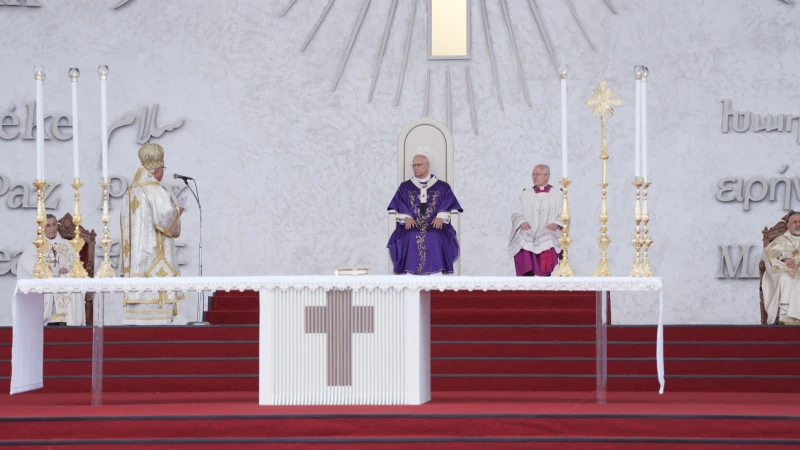
Beirut heard a different kind of voice on Tuesday morning. In a city still marked by the sounds of the 2024 escalation between Hezbollah and Israel, Pope Leo XIV urged Lebanon to rise above violence and division. “Lebanon, stand up. Be a home of justice and fraternity. Be a prophetic sign of peace for the whole of the Levant,” he said at a Mass attended by about 150,000 people at Beirut Waterfront.
The liturgy closed the final day of the pope’s visit to a nation strained by intermittent political paralysis, economic freefall and persistent instability. The Waterfront itself carries symbolic weight. Built on land reclaimed from the sea with rubble from downtown Beirut destroyed in the civil war, it has come to represent both loss and reconstruction.
In his homily, Pope Leo spoke of praise, hope, beauty and responsibility, calling for unity at a moment of national fracture. He acknowledged the burdens carried by the Lebanese people and said praise becomes difficult “when life is weighed down by hardship.” Lebanon, he added, has suffered “many problems” and “difficult situations” that leave people feeling powerless.
The pope urged the country to rediscover gratitude. Lebanon, he said, is “the recipient of a rare beauty,” even though that beauty is often obscured by suffering. The country is also, he noted, a witness to how “evil, in its various forms, can obscure this splendor.”
From the open coastal space, he recalled biblical images of Lebanon. He then pointed to the nation’s present wounds: poverty, political instability, economic collapse and renewed fear after conflict. He mentioned his prayer earlier in the day at the Beirut port, the site of the 2020 explosion, and connected that visit to the broader national trauma. In such circumstances, he said, praise and hope can give way to disillusionment.
The pope invited the faithful to look for “small shining lights in the heart of the night.” Jesus, he said, gives thanks not for extraordinary signs but for the faith and humility of “little ones.” He spoke of the “small signs of hope” found in families, parishes, religious communities and lay people who remain dedicated to service and to the Gospel. These lights, he said, promise rebirth.
He urged the country not to yield to “the logic of violence” or the “idolatry of money,” and asked all Lebanese to work together. “Everyone must do their part,” he said. He called for a “dream of a united Lebanon” where peace and justice prevail and where all recognize one another as brothers and sisters.
At the end of Mass, the pope offered a spontaneous prayer for peace in the region and the world, calling on “Christians of the Levant” to be “artisans of peace, heralds of peace, witnesses of peace.”
If you value the news and views Catholic World Report provides, please consider donating to support our efforts. Your contribution will help us continue to make CWR available to all readers worldwide for free, without a subscription. Thank you for your generosity!
Click here for more information on donating to CWR. Click here to sign up for our newsletter.


Life is a pilgrimage. Pilgrims are thirsting for peace. May the Prince of Peace shower his blessings on the pilgrims across the Levant.
This is a stirring and theologically rich address by Pope Leo XIV. Moving beyond a simple plea for peace, his call for Lebanon to actively “be a home of justice and fraternity” frames the nation’s crisis within its historic vocation as a model of coexistence. The language echoes the Church’s social doctrine, challenging all factions to a higher standard rooted in human dignity.
My question is about practical ecumenism and interfaith action. Given that Lebanon’s “fraternity” must be built between Christian, Muslim, and Druze communities, what concrete, on-the-ground initiatives—perhaps led by the local episcopal conference or religious orders—are most critical right now to translate this papal call into shared action that demonstrates justice and rebuilds broken trust among the populace?