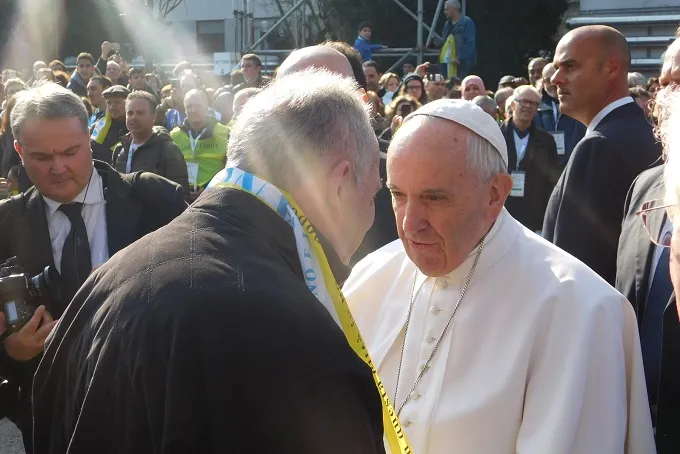
Milan, Italy, Mar 25, 2017 / 06:31 am (CNA/EWTN News).- During his daytrip to Milan Saturday, Pope Francis told the diocese’s priests and religious not to fear the challenges that come with their ministry nor the increasing number of empty convents, urging them instead to focus on the core of their mission: bringing Christ to his people.
“Our congregations were not born to be the mass, but a bit of salt and yeast which would have given their own contribution so that the mass grows; so that the People of God have that ‘condiment’ they were missing,” the Pope said March 25.
He noted that for many years in the past, congregations moved forward with the idea that they needed to “occupy spaces” more than launching new processes and projects.
The perception then, he said, was that “ideas (or our impossibility to change) were more important than reality; or that the part (our small part or vision of the world) was superior to the whole Church.”
But today’s reality serves as a challenge, and “invites us to again be a bit of yeast and a bit of salt,” he said, asking “Can you imagine a meal with too much salt? Or a pasta that’s totally fermented? No one would eat it, no one could digest it.”
“I’ve never seen a pizzamaker use a kilo of yeast and a gram of flour” to make the dough, Francis said, and urged religious to “listen to reality, to open ourselves to the ‘mass,’ to the Holy People of God, to the entire Church.”
Pope Francis spoke to priests and religious inside Milan’s cathedral of St. Mary of the Nativity during his March 25 daytrip to the city.
He kicked off the visit by stopping by the “White Houses” high-rise complex in the eastern quarter of the city, an area marked by acute poverty where many migrants, including Muslim families, live. He then headed directly to Milan’s cathedral where he met with the priests and religious.
<blockquote class=”twitter-video” data-lang=”en”><p lang=”en” dir=”ltr”>Up-close view of a papal blessing to some small pilgrims in <a href=”https://twitter.com/hashtag/Milan?src=hash”>#Milan</a> via <a href=”https://twitter.com/andygag”>@andygag</a> <a href=”https://twitter.com/hashtag/PopeFrancis?src=hash”>#PopeFrancis</a> <a href=”https://t.co/lEiFe59PCE”>pic.twitter.com/lEiFe59PCE</a></p>— Catholic News Agency (@cnalive) <a href=”https://twitter.com/cnalive/status/845563394254082048″>March 25, 2017</a></blockquote>
<script async src=”//platform.twitter.com/widgets.js” charset=”utf-8″></script>
The Pope took questions from three members of the audience, including Ursuline sister Mother M. Paola Paganoni, parish priest Fr. Gabriele Gioia and Robert Crespi, one of the diocese’s 143 permanent deacons.
Instead of taking notes and giving an entirely off-the-cuff speech as usual during his Q&A sessions, this time Francis decided to follow a written text due to the day’s full schedule, deviating to add a few lines here and there.
The question on numbers was posed by Sr. Paganoni, who asked the Pope how to be a prophetic sign in modern society, and to which peripheries they should go, given that religious are small in number and constitute a “minority” in the Church.
In response, the Pope not only told the nun to not fret about numbers, but he also cautioned against the feeling of “resignation,” which he said can frequently creep up when looking at how few they are.
“Without realizing it, each time that we think or see that we are few, or in many cases elderly, we experience the weight, the fragility more than the splendor, and our spirit begins to corrode from resignation,” he said.
In turn, resignation can lead to the spiritual sin – also called a “disease” – of acedia, about which the Fathers of the Church issued sharp warnings since it essentially leads a person into despair, indifference and apathy regarding the faith and one’s vocation.
“Few yes, a minority yes, elderly yes, but resigned no!” he said, explaining that the lines in this regard are fine, are can only be recognized by a process of self-reflection in front of the Lord.
“When resignation takes hold of us,” he said, “we live with the imagination of a glorious past which, far from awakening the original charism, increasingly surrounds us in a spiral of existential heaviness. Everything becomes heavier and difficult to lift up.”
He warned religious to stay away from this attitude, as well as the temptation to use the empty structures to get money by turning them into hotels or looking for other “human solutions” to the problem. Doing this, he said, “hinders or deprives us of joy.”
And while he said he can’t tell them which peripheries to go to, since that’s the job of the Holy Spirit, who inspired their original charism, Pope Francis urged religious to choose them well and reawaken “the hope spent and sapped by a society that has become insensitive to the pain of others.”
“Go and bring the ‘anointing’ of Christ,” he said, telling them never to forget “that when you put Jesus in the midst of your people, they find joy…only this will render our lives fruitful and will keep our hearts alive.”
In response to Crespi’s question on what contribution deacons can give to the Church, the Pope said they have “a lot to give,” specifically when it comes to managing the tensions and blessings of ministry and family life.
However, Francis also cautioned against viewing deacons as “half-priests and half-laity,” because in reality “they are neither here nor there.”
Looking at them in this way “does harm to us and does harm to them” and takes strength away from their vocation in the Church, he said, explaining that the deaconate “is a specific vocation, a family vocation that recalls service as one of the characteristic gifts of the people of God.”
“The deacon is – so to speak – the guardian of service in the Church,” Pope Francis said. Because of this, his specific mission consists of “reminding all of us that faith, in its various expressions – communitarian liturgy, personal prayer, different forms of charity – and in its various states of life – lay, clerical, familial – has an essential dimension of service.”
Speaking directly to the deacons, he said they are “a sacrament of service to God and to your brothers. A vocation which like all vocations is not only individual, but lived inside the family and with the family, inside the People of God and with the People of God.”
Francis also answered Fr. Gioia’s question on what can be done in order not lose the joy of evangelizing in the face of challenges such as secularism and ministering to a multi-cultural, multi-ethnic flock with different religions.
In his response, the Pope said we shouldn’t be afraid of challenges, because they are “a sign of a living faith, of a living community that seeks its Lord and has eyes and hearts opened.”
Rather, what we must fear instead is “a faith without challenges, a faith believed to be complete, as if everything has been said and realized,” because without challenges, there is a danger that our faith becomes “an ideology.”
The Pope also spoke of the importance of recognizing the richness of the differences in the Church throughout its history, explaining that “the Church is one in a multifarious experience.”
Although there can also be “horrors” and errors in the ways some interpret religion, he stressed the need to separate and distinguish between the “luminous aspects and the dark aspects” of each.
He also cautioned against confusing unity with uniformity and plurality with pluralism, saying that in both cases “what is being sought is to reduce the tension and remove the conflict or ambivalence to which we are subjected as human being.”
Finally, the Pope in his last point to the priest emphasized the need for pastors to offer better formation in discernment, particularly to youth.
“The culture of abundance to which we are subjected offers a horizon of many possibilities, presenting them as valid and good,” he said, noting that today’s youth are exposed to a constant “zapping” of information.
“Whether we like it or not, it’s a world in which they are inserted and it’s our duty as pastors to help them pass through this world,” he said, explaining that because of this, “it’s good to teach them to discern, so that they have the tools and elements which help them to walk the path of life without extinguishing the Holy Spirit which is in them.”
After his audience with priests and religious, Pope Francis led pilgrims gathered outside the cathedral in praying the Angelus before heading to the city’s Casa Circondariale di San Vittore prison, which in 2012 held 1,700 detainees.
At the prison, the Pope is slated to greet employees and police officers who work at the facility before greeting the inmates themselves. He is then expected to have lunch with 100 of prisoners before heading to Milan’s Parco di Monza to celebrate Mass and meet with youth after.
 […]
[…]



About geometry, and parsing St. Thomas More:
“Some men think the Earth is round, others think it flat; it is a matter capable of question. But if it is flat, will James Martin’s duplicity make it round? And if it is round, will James Martin’s duplicity flatten it? No, I will not sign” (Robert Bolt’s “A Man for all Seasons,” 1960).
To say—”people with deep-seated homosexual tendencies…must be treated with respect, compassion, and sensitivity. Every sign of unjust discrimination in their regard should be avoided”–does not square the circle, either, for blessing incongruous couplings as “couples,” or justify cross(!)-dressing Calvary with a rainbow banner.
And, to think that James Martin’s duplicity started so simply, when another Martin (Luther) likewise embraced the still-binary (!) bigamy of Henry VIII and the German elector Philipp of Hesse…strange bedfellows.
[A disclaimer: my comment concerns so-called “LGBTQ+ activists” and not common people with different sexual orientation]
I remember, when the situation in the Church began turning decisively bad, I was thinking about purchasing a t-shit “Orthodoxy of Death”, to separate myself from the environment (man-focused homilies, Christ being pushed away by self-glorification etc.) via publicly stating my identity (“true = correct = uncorrupted faith”). But then I realized that it would be a bit silly and proud, in a context of Christ/Christianity, to wave a smaller identity. “Christ or Death” would be more appropriate, for a Christian, but there is no need to shout out the obvious. And so, I continued going to Mass as I am used to i.e. without t-shirts with slogans, simply with a Crucifix around my neck.
If “Orthodoxy of Death” looks a bit silly and proud in the context of the Catholic Church/Christ, then to march on pilgrimage wearing a “LGBTQ+” Catholics” t-shirt, waving rainbow flags is even more stupid, as long as being Catholic means being Christian. If “there is neither Jew nor Greek, slave nor free, male nor female, for you are all one in Christ Jesus” then there is also “nor gay nor lesbian for you are all one in Christ Jesus”. Hence, waving “LGBTQ+” Catholics” identity is nothing else but a refusal to be a mere Christian, like millions of others.
I suspect the point of a pilgrimage is not so much about “Christian” or Christ but about “LGBTQ+” or better to say there is an attempt to subordinate Christ to “LGBTQ+”, to use Him as a mere tool to achieve something. This is not the news. The Church itself in recent years has attempted to use (and abuse) Christ for various, purely human or even diabolical agendas. What we see now is just another (albeit very bold and decisive) step in that direction.
Unfortunately, there is no option here to post a photo of the so-called ‘Rainbow Cross’ which I saw today in the online article about “LGBTQ+ pilgrimage”. It was a very good example of how the sacred images are used and abused for the sake of “an agenda”, the bigger/infinite for the smaller. “Rainbow Cross” is the wooden Cross with cloth overthrown, like it is done on the Passion Friday in the Catholic churches. But instead of the white cloth, the rainbow cloth is being used. But this is not all: the inscription on the Cross, “INRI” = “Jesus King of the Jews” which is the title of Christ, is swapped with the new inscription, “LGBTQ+”. So, now we have “LGBTQ+” people instead of Christ on the Cross. No Christian = one who loves Christ = one who has an identity in Christ would do such a thing so it is very self-revealing. Christians worship the Cross because Christ was crucified on it bringing the Salvation; those who changed the letters into “LGBTQ+” effectively worship “LGBTQ+” = themselves – and invite the rest of the world to worship them as well. It is an extreme act of malignant self-love that knows no sacred, thus it has nothing to do with the “Christians” part of the slogan.
To put it bluntly, if you feel entitled to use the sacred symbols which belong only to Christ, changing and degrading them to suit your agenda, you are not Christians. Truly, either you give up this entitlement, take off your t-shirts with slogans, throw away the flags and go on pilgrimage as all do, not attracting attention to oneself because the purpose of any pilgrimage is to come to Christ, not make your point, whatever it is. The two cannot be reconciled.
PS As for “the rejection and prosecution of “LGBTQ+” in the Church, about 50% of Roman Catholic clergy are homosexual/bisexual (according to surveys). How friendlier it can be?
Life is short and sweet. Evangelization and conversion are ongoing and never-ending opportunities. We need to pray for the wellbeing of fellow pilgrims on journey.
Gradualism: Here we come!
Are we as a welcoming Church endorsing disordered behavior or seeking to convert to Christ? LGBT attendees received the Holy Eucharist.
“Bishop Savino said St Paul’s writings in the New Testament teach us that ‘a small step’ in the midst of great human limitations may be ‘more pleasing to God than the outwardly correct life’ of those who do not experience trials in life. We all have to convert, that is, we turn, we look in the opposite direction than before. The Acts of the Apostles documents this experience as defining and definitive”.
Savino’s remarks [specifically a small step] are right out of Amoris Laetitia, where Francis says in allusion to reception of the Eucharist for those in ‘irregular unions’ – this can be a first step. Although does reception of the Eucharist when one is given the impression of accommodation of their behavior going to inspire conversion?
The Eucharist is not magic. There must be at least an interior desire to reform one’s life to Christ and his commandments. Unless of course there is a different Christ being taught at the Vatican other than the Christ revealed to Paul and the Apostles.
We read: “LGBT attendees received the Holy Eucharist.”
Apparently the abyss of receiving the Eucharist sacrilegiously applies only to conscientious individuals, but not to a privileged category such as the tribal LGBTQ aggregate…
“To respond to this invitation [the Eucharist as the Real Presence, CCC 1374] we must ‘prepare ourselves’ for so great and so holy a moment. St. Paul urges us to examine our conscience: ‘Whoever therefore, eats the bread or drinks the cup of the Lord in an unworthy manner will be guilty of profaning the body and blood of the Lord. Let a man examine himself, and so eat of the bread and drink of the cup. For any one who eats and drinks without discerning the body eats and drink judgment upon himself.’ Anyone conscious of a grave sin must receive the sacrament of Reconciliation before coming to communion” (CCC 1385).
Far be it from any of us to judge another (“who am I to judge?”)! But, as for “judgment upon himself,” what of the beckoning clerics at the head of the line? And, what of the roadmap discerned by St. John Chrysostom: “The road to hell is paved with the bones of priests and monks, and the skulls of bishops are the lampposts that light the path.”
Whatever?
Reception of the Blessed Sacrament when one is in an adulterous or fornication relationship, which is the case for those who are sexually active outside of the bond of a sacramental marriage between a biological man and a biological woman, is objectively always a serious sacrilege – and the engagement in such a sexual relationship is an intrinsic evil. To ignore or violate this perennial teaching of the Catholic Faith is not a small step – it is a large step that will send one to hell, if not repented of – and ceased altogether. Our failure to re-iterate this truth in today’s world, where relativism reigns supreme, makes prelates, clergy, and teachers in the Church complicit in the deadly sins of so many. Enough with the emotionally-laden, inclusive language. Tell it like it is. Think of the number of souls confirmed in deadly and sacrilegious sin by this so-called LGBT+ Jubilee weekend – not just those who attended – but all who viewed the support of the Vatican for its events via the media. How much longer do we think Our Lord will stand idly by and allow this loss of souls to continue?
The issue isn’t treating gays rudely or dismissively. No one says that’s okay.
The issue is accepting sin as normal.
These pilgrims actually identify as “the gay community.”
They march under banners proclaiming, celebrating — even advocating for — their sins.
This is the doing of James Martin, yes, but also of so many more in the Dark and demonic Vatican. Including and especially Bergoglio himself.
*This* is the legacy of the most evil and destructive pope in history.
Pope Leo must now set about to restore sanity — and sanctity. May God bless and sustain him.
I think if Leo was genuinely interested in addressing the issue of homosexuality in the church, this vile display would never have taken place.
No one has been “denied dignity,” and God’s love is not unconditional in the sense that I can flagrant sin sexually and expect God to look favorably on that. Catering to the LGBT lobby is profoundly sinful.
“. . . the outwardly correct life of those who do not experience trials in life”.
Who would those “those” be?
This guy needs to get out more.
Yikes! I don’t feel peaceful about this. Am I misreading it? To me, this sounds like the organizers are trying to deny that homosexual acts are sinful. Am I committing a sin of judgmentalism to draw this conclusion? I am a musician so I have plenty of gay friends, including sexually active and celibate gay friends. I don’t try to “preach”
to them, but I pray for them. I’m not sure how to interpret this occurrence.
We read: “Yikes…. this sounds like the organizers are trying to deny that homosexual acts are sinful.” Dear Sharon, please consider that rather than simple-minded denial, this “occurrence” almost completes the insurgency of past decades and especially the past twelve years.
Three points:
FIRST, the game is to claim “validation” (!), first in the secular world through the oxymoron of gay “marriage,” and then by the tribal gang-raping of the Church in Rome itself with the position (so to speak) that this staged occurrence is unopposed, and therefore consensual, and therefore the new normal in moral theology and human relations.
Now all that’s needed is the paperwork…
SECOND, for this mere formality we might look to the post-“synodal” Study Group #9 which is charged to conjure “theological criteria and synodal methodologies for shared discernment of controversial doctrinal, pastoral, and ethical issues.” But how can one argue any longer with the “spontaneous, informal, non-liturgical” blessing of irregular couples, as “couples” (!), under the kissing car[di]nals Fiducial Supplicans, now that it’s non-spontaneous, formal, and liturgical—and even sacrilegious? A done deal with needed fingerprints! One is almost reminded how in revolutionary France, the altar of Notre Dame Cathedral in Paris was likewise hijacked—as a dance platform for a nude prostitute. The issue here is much broader than even LGBTQ…
THIRD, over half a century ago, Georges Bernanos said it this way:
“The modern world will shortly no longer possess sufficient spiritual reserves to commit genuine evil. Already . . . we can witness a lethal slackening of men’s conscience that is attacking not only their moral life, but also their very heart and mind, altering and decomposing even their imagination . . . The menacing crisis is one of INFANTILISM.” (Interview with Samedi-Soir, Nov. 8, 1947, cited in Hans Urs von Balthasar, “Bernanos: An Ecclesial Existence” [Ignatius, 1996], p. 457, caps added).
Wha we need is an Inquisition by the Laity of homoheretics, starting with James Martin SJ.
Theologians and Cannon Lawyers can probably argue the nuances of this action and come up with some level of apologetics to create a definition of acceptance for this action. As an average pew buffer, let me provide a “theologically uneducated view” of what this action shouts…Sodomy, and multiple other perversions are, not just O.K., but have the support and encouragement of the Roman Catholic Church.