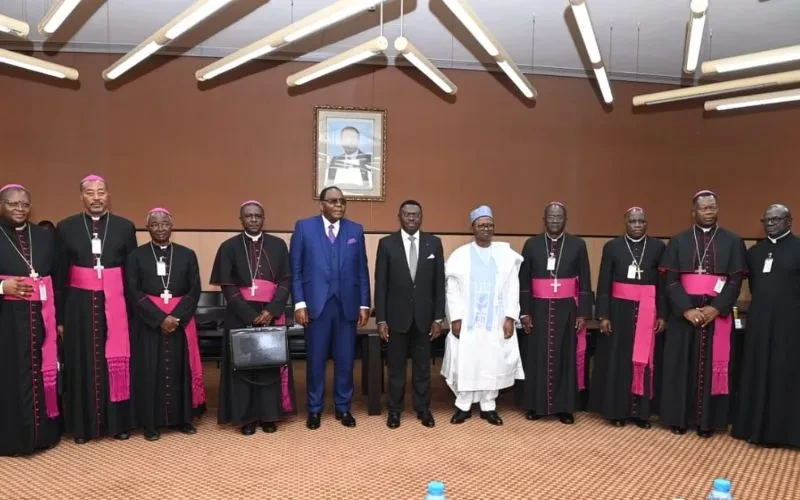
Some members of the National Episcopal Conference of Cameroon (NECC) meet with the minister of state, secretary-general at the presidency. / Courtesy: President of the Republic of Cameroon
ACI Africa, Aug 17, 2025 / 07:00 am (CNA).
The minister of state, secretary-general at the presidency of Cameroon has commended the Catholic Church in the Central African nation for committing to peace-building as the country prepares for its presidential election in October.
A statement on Aug. 13 said Ferdinand Ngoh Ngoh invited a delegation from the National Episcopal Conference of Cameroon (NECC) to the Unity Palace — also called the Etoudi Palace, which serves as the official presidential residence and administrative headquarters — at the directive of President Paul Biya to consult with them on matters of peace ahead of the election.
The NECC secretary-general said in the statement that the minister, in his remarks to the bishops, recognizes “the Catholic Church’s contribution to peace-building” before discussing with them how to foster peace during the election period.
Father Paul Nyaga said that, considering the sensitive moment the country is going through, particularly with the approaching presidential election, the minister told the bishops that he invited them “to seek their contribution to ensure a climate of peace in the country before, during, and after the election.”
In addition, Cameroon’s minister of state is said to have emphasized the administration’s determination to commit to fair and transparent elections.
Responding to the minister’s remarks, Archbishop Andrew Fuanya Nkea of the Archdiocese of Bamenda clarified that the bishops “came as men of God, carrying the hopes and concerns of the people.”
According to the NECC Aug. 13 statement, Nkea, who serves as the NECC president, recalled the consistent positions of the Catholic bishops in the country, who he said have expressed their calls for peace messages and pastoral letters.
He highlighted the message on the socio-economic situation of Cameroon, dated Jan. 11, and the pastoral letter on the occasion of the presidential and regional elections March 28 and said the bishops expressed their position through the documents that were handed over to the minister.
Nkea reaffirmed the Catholic Church’s nonpartisan position when it comes to politics.
The archbishop said the Church is not taking sides but is “determined to continue its evangelization mission by promoting justice, reconciliation, and peace, serving all Cameroonians, sharing in their joys and hopes, as well as their sorrows and anxieties.”
“To this end, the Church encourages the multiplication of consultation platforms with public institutions to strengthen cooperation in the service of the common good,” he said during the Aug. 13 visit to the Unity Palace.
Individual Catholic bishops in Cameroon have also voiced their desire for peace in the country, decrying behaviors likely to jeopardize peace-building efforts.
In his pastoral letter shared with ACI Africa on Aug. 12, Archbishop Samuel Kleda of the Archdiocese of Douala denounced what he termed as “anti-Gospel acts,” including corruption and bad governance that he said are causing discontent among Cameroonians as they prepare for the October presidential election.
Kleda said the Central African nation is “shaken by multiple evils that afflict all social strata” and is in a great need for peace, justice, and reconciliation especially during this electioneering period.
“The malaise that is eating away at our country at the present time and which is causing widespread discontent in the hearts of citizens in this pre-electoral period has its roots in the anti-Gospel acts that are being instituted in the management of our country,” he said.
The Cameroon archbishop also highlighted the absence of democracy, widespread poverty, and unemployment, illegal immigration, a poor road network, and difficulty in accessing water and electricity as additional acts causing discontent among his compatriots.
In his pastoral letter addressed to clergy, women and men religious, and the laity, Kleda also highlighted the “nebulous management of oil,” mining injustices, and security crisis in the country’s northern region as additional factors behind discontent.
This story was first published by ACI Africa, CNA’s news partner in Africa, and has been adapted by CNA.
If you value the news and views Catholic World Report provides, please consider donating to support our efforts. Your contribution will help us continue to make CWR available to all readers worldwide for free, without a subscription. Thank you for your generosity!
Click here for more information on donating to CWR. Click here to sign up for our newsletter.
Mosul, Iraq, Mar 29, 2021 / 05:10 pm (CNA).- A statue of the Virgin Mary that had been desecrated by the Islamic State but was later restored has been returned to its original church.
The statue was decapitated, and its hands cut off, in Karemlesh, a largely Christian town 18 miles east of Mosul, during the Islamic State’s occupation of the villages in the Nineveh Plains from 2014 to 2017. It belongs to St. Adday church.
The statue has been partially restored. The original head was found in the rubble when the statue was recovered.
The head has been placed back onto the statue in a manner that still shows the damage from where it had been decapitated, and the hands dangle below the wrist.
It was present at Pope Francis’ March 7 Mass in Erbil.
The statue returned to Karemlesh March 18, and on March 19 it was placed in St. Adday church with a simple ceremony.
“Having Her here is a sign of courage and bravery for our people. That everyone can see that the destroyed and restored image returns to the church with a new appearance is a beautiful sign. This encourages them to have the courage to continue,” Fr. Thabet Habeb, pastor of St. Adday, told CNA.
He added that “after the Pope’s visit, we hope that there may be some attention to the Chaldean community.”
The Islamic State swept through large swathes of Syria and Iraq in 2014, giving families of Christians and other religious and ethnic minorities an ultimatum – convert to Islam, die, or leave.
In 2017 the Nineveh Plain was liberated from the rule of the Islamic State.
While Church leaders are yet to comment, ACI Africa, CNA’s news partner in Africa, has confirmed media reports that tensions have increased between Ethiopia and Eritrea of late, resulting in rumors of war. / Credit: Ethiopia Catholic Secretariat… […]
The Sisters of St. Joseph of the Apparition cover the altar, just dedicated by the cardinal. The covering of the altar signifies that it is both the place of the Eucharistic sacrifice and the Lord’s table. / Credit: Photo courtesy of the Latin Patriarchate of Jerusalem
Jerusalem, Sep 12, 2024 / 07:00 am (CNA).
On Aug. 31, exactly 100 years after its dedication, the Church of Our Lady of the Ark of the Covenant was reopened for worship on the hill of Kiryat Yearim, nine miles from Jerusalem.
The church, which was closed for four years for restoration work, stands atop the hill overlooking the (Muslim) village of Abu Gosh. From the top, visitors can see Jerusalem.
A view from the hill of Kiryat Yearim, where the Church of Our Lady of the Ark of the Covenant stands. At the foot of the hill lies the Muslim village of Abu Gosh, with Jerusalem visible in the background, a little more than nine miles away. The place, mentioned in the Bible as “Kiriath-Jearim,” held an important role in the history of the Jewish people, as it was here that the Ark of the Covenant rested for about 20 years until King David brought it to Jerusalem. Credit: Marinella Bandini
The place, mentioned in the Bible as “Kiriath-Jearim,” has held an important role in the history of the Jewish people as it was here that the Ark of the Covenant rested after being recovered from the Philistines (see 1 Samuel 6).
The ark contained the two stone tablets on which the Ten Commandments — God’s covenant with the Jewish people — were inscribed and was the sign of God’s presence among his people.
According to the Bible, it was hosted in the house of Abinadab, where it remained for about 20 years (see 1 Samuel 7:1-2) until King David brought it to Jerusalem.
For this reason, even today, the site is visited by many groups of Jews.
A Byzantine basilica was built on the top hill around the fifth century. The current church, the foundation stone of which was laid in 1920, stands on the remains of that building. It was consecrated in 1924 by the then-Latin patriarch of Jerusalem, Luigi Barlassina, and dedicated to Our Lady of the Ark of the Covenant.
The Church of Our Lady of the Ark of the Covenant in Kiryat Yearim (exterior). The church is dedicated to the Virgin Mary, whom Christians also honor with the title of “Ark of the Covenant.” “The covenant of God with his people finds its fulfillment in Jesus Christ, who is no longer just the sign of God’s presence but God himself among us. Mary is the new Ark of the Covenant because she carried Christ himself in her womb,” said Cardinal Pierbattista Pizzaballa, the Latin patriarch of Jerusalem, in his homily. Credit: Marinella Bandini
Cardinal Pierbattista Pizzaballa, the current Latin patriarch of Jerusalem, recently came to the basilica to dedicate its new altar on the occasion of the reopening of the church.
“This reopening is a moment of trust in the future, a desire to start anew, and this is what we need most at this time, when everything around us speaks of death and endings,” he told CNA after the celebration on Aug. 31.
The opening of the doors of the Church of Our Lady of the Ark of the Covenant in Kiryat Yearim on Aug. 31, 2024, for the solemn celebration with the rite of dedication of the altar, presided over by Cardinal Pierbattista Pizzaballa, the Latin patriarch of Jerusalem. Credit: Photo courtesy of the Latin Patriarchate of Jerusalem
“Climbing this mountain, blessed by the presence of the Lord,” he added, “invites us to have a broad and farsighted perspective on events and not to close ourselves off in the dramatic present moment.”
Hosting the event were the Sisters of St. Joseph of the Apparition, a French congregation founded in 1832 by Mother Emilie De Vialar, which owns and operates the church and surrounding property.
The complete details of how the land came to be acquired by the sisters are lost to history, but it centers on one of the order’s sisters who died in 1927. Sister Josephine Rumèbe, who is buried in the church, was reportedly endowed with special mystical gifts and managed to acquire the land on behalf of the sisters. The story goes that she had 5,000 francs at her disposal and sought the help of a clergyman for the purchase. To prevent a competing buyer from acquiring it, the cleric secured the entire hill for 20,372 francs. Miraculously, when Sister Josephine counted the gold coins hidden in her room, the amount matched exactly what she needed.
Cardinal Pierbattista Pizzaballa, the Latin patriarch of Jerusalem, pours the chrism oil on the new altar of the Church of Our Lady of the Ark of the Covenant in Kiryat Yearim. On Aug. 31, 2024, he presided over the solemn Mass with the rite of dedication of the altar, marking the reopening of the church after four years of restoration and maintenance work. Credit: Marinella Bandini
The dedication of the new altar in the basilica took place after the recitation of the creed and chanting of the litanies. The cardinal placed relics in the altar, including that of Mother Emilie De Vialar, who was canonized a saint in 1951. This was followed by the anointing of the altar with chrism oil, the incensing of the altar, the covering of the altar, and the lighting of the altar.
The relics placed inside the new altar of the Church of Our Lady of the Ark of the Covenant in Kiryat Yearim, which was dedicated by Cardinal Pierbattista Pizzaballa, the Latin patriarch of Jerusalem, on Aug. 31, 2024. Among the relics are those of Mother Emilie De Vialar, founder of the Sisters of St. Joseph of the Apparition, the order who owns the church and surrounding property. Credit: Marinella Bandini
“The covenant of God with his people finds its fulfillment in Jesus Christ, who is no longer just the sign of God’s presence but God himself among us. Mary is the new Ark of the Covenant because she carried Christ himself in her womb,” said the cardinal in his homily, inviting the faithful, following the example of the Virgin Mary, to renew their trust in God as the Lord of history and active within history.
Upon entering the church — whose iconographic elements were created by artists from the Ave Center of the Focolare Movement — the eye is drawn to the golden flame emanating from the center of the apse.
Cardinal Pierbattista Pizzaballa, the Latin patriarch of Jerusalem, celebrates the Eucharistic liturgy on the altar he dedicated in the Church of Our Lady of the Ark of the Covenant in Kiryat Yearim on Aug. 31, 2024. Credit: Marinella Bandini
A special decoration that, on one hand, evokes the biblical significance of fire, symbolizing the presence of God, and on the other, is connected to the history of this place and particularly to Sister Josephine’s vision of a “mountain of fire,” holds significance here.
When she was still a young postulant in France, during Eucharistic adoration, Sister Josephine had a vision of flames forming a mountain with Jesus above them instead of the host. The vision then vanished, and only 50 years later, at the time of laying the foundation stone of the church, it was revealed to her that the “mountain of fire” was indeed Kiryat Yearim, which she used to call “the Holy Mountain.”
Sister Valentina Sala, the current provincial of the congregation for the Holy Land, immediately felt a strong connection to this place. She recounted to CNA: “The first time I came here for a few weeks, a sister took me to Kiryat Yearim. I knelt at Sister Josephine’s tomb and prayed to return if that was God’s will.”
Sister Valentina Sala, the current provincial of the congregation of the Sisters of St. Joseph of the Apparition for the Holy Land, prays at the tomb of Sister Josephine Rumèbe, founder of the convent and the church in Kiryat Yearim. “The first time I came here for a few weeks, a sister took me to Kiryat Yearim. I knelt at Sister Josephine’s tomb and prayed to return if that was God’s will,” she recounted to CNA. Credit: Marinella Bandini
On the centenary of the church’s dedication, Sister Valentina also emphasized the significance of this place for her congregation, whose charism is to serve the needs of people through works of charity.
“What is charity work? What people need today is not just health care or education; there is a hunger and thirst for God. We must be able to recognize this need, helping those who come here to listen to his voice. We need places where people can pause and rest with God,” she said.
When the construction of the church was nearly complete, Sister Josephine had a vision of the Virgin Mary, at the top of the church, facing Jerusalem with outstretched arms in a gesture of dispensing grace. A statue now stands above the church to recall that vision, facing away from those entering and directed toward Jerusalem.
“This place, which evokes the covenant, invites us to realign ourselves with God and to be under this blessing,” Sister Valentina concluded.
This is also the meaning of the words she addressed to those present — the vast majority of local faithful from Jerusalem as well as from Galilee — at the end of the Mass.
Hundreds of local faithful from Jerusalem and Galilee attend the solemn Mass with the rite of dedication of the altar, marking the reopening of the Church of Our Lady of the Ark of the Covenant in Kiryat Yearim, on Aug. 31, 2024. A hundred years ago, Sister Josephine Rumèbe of the Sisters of St. Joseph of the Apparition wrote about having seen a vision of “a crowd rushing toward the basilica. I saw priests, sisters of our order, and then men and women of the world who were even more pleasing to God than all the others, holy souls shining like stars.” Credit: Marinella Bandini
“Sister Josephine had already seen you in various visions: ‘I saw a crowd rushing toward the basilica. I saw priests, sisters of our order, and then men and women of the world who were even more pleasing to God than all the others, holy souls shining like stars.’”
She continued: “And what if we are that vision? What if we are that future? Of course, we are! From now on, you will be the ones to bring life to this hill, to this covenant between God and his people. Come, rush, stay, feel at home. There is not only a newly renovated church to see but a Presence to discover: Take the time to dwell with the Lord. What could be more beautiful… Many graces await to be dispensed from here!”
Leave a Reply
