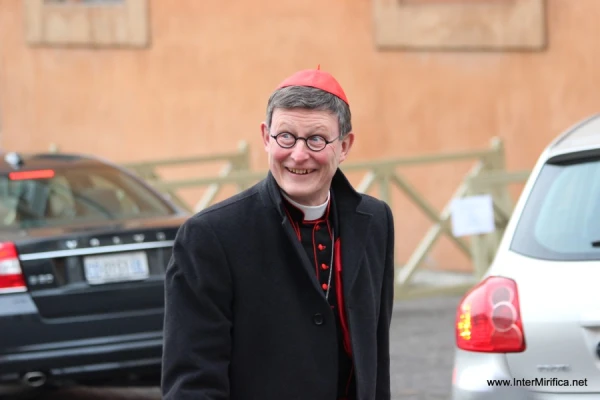
Cologne, Germany, Feb 3, 2020 / 11:30 am (CNA).- A leading lay Catholic in the German city of Cologne has openly condemned his own archbishop for voicing concerns over the ongoing “binding synodal process” underway in the country.
Tim Kurzbach, chairman of the Diocesan Council of Catholics in the Archdiocese of Cologne issued a public denunciation of Cardinal Rainer Woekli on Monday, accusing the cardinal of “destroying the authority of his episcopal office” by failing to support the so-called “synodal way.”
The statutes for a “synodal way” were formally adopted by the German bishops’ conference in September last year, despite repeated warnings and interventions from the Pope Francis and the curia. The two-year process proposes to debate and reform issues of universal Church teaching and discipline, including clerical celibacy, Church-approved blessings for same-sex couples, and the sacramental ordination of women.
After months of controversy, including several interventions by the Vatican, the synodal assembly met for the first time last week in Frankfurt. Speaking after the session, Cardinal Woekli said that speeches at the meeting had made it clear to him that the assembly was not functioning as a Catholic body.
“I basically saw all my fears confirmed. We witnessed the implementation of a de facto Protestant church parliament,” Woekli said in an interview Feb. 1.
“The essential prerequisites of an ecclesiological nature with regard to what the Catholic Church is were – in my opinion – ignored in many speeches,” the cardinal said, explaining that the hierarchical communion of the Church was being set aside for a democratic reinvention of the faith.
“That was already the very clearly defined image when entering the [liturgical] service, when bishops and lay people all processed in together and thus it was expressed that everyone is equal. And that actually has nothing to do with what the Catholic Church is and means.”
In his statement on Monday, Kurzbach said that Woekli and a few “traditionalists” were “overwhelmed by the fact that suddenly everyone can speak with equal rights in the ‘synodal way’,” and accused the cardinal of refusing to listen to those demanding reforms and insisting on the authentic teaching authority of the Church and bishops.
Calling the synodal discussions “fearless,” Kurzbach said that bishops like Woekli had to convince the assembly of their defense of traditional Church teachings and that “he should have long since recognized that the office [of bishop] alone no longer establishes true authority.”
In an interview Saturday, Woekli was asked about the seating in the synodal assembly, in which all participants were seated alphabetically and not by group or status. “I can live with that,” said the cardinal, but explained that the so-called synodal process was proceeding in a way which undermined the teachings of Vatican Council II.
The seating arrangements were just one of “many other small sings” which “simply make it clear that the hierarchical constitution of the Church, as documented again in Vatican Council II and expressed in Lumen Gentium, is questioned,” Woekli said.
Pope Francis and curial officials issued repeated warnings to the German bishops last year ahead of the synodal process.
In a June letter to the whole Church in Germany, the pope warned against a false synodality rooted in making the Church conform to modern secular morals and thought, which he called “a new Pelagianism” which seeks “to tidy up and tune the life of the Church, adapting it to the present logic.”
The result, Francis said, would be a “well organized and even ‘modernized’ ecclesiastical body, but without soul and evangelical novelty.”
In response, Woelki urged the other bishops in Germany to “take the pope very seriously.” He told the plenary session of the German Episcopal Conference in September that the Church in Germany must begin by “re-evangelizing itself” as an “indispensable prerequisite” for its wider mission, noting that Francis’ letter made clear that this required the bishops to remain rooted in the essential unity of faith, in Christ, and with the whole Church.
“This is the indispensable sign for our synodal way, which has to run like a thread through it, so that the Synodal Way can bear true fruit. The Pope’s letter leaves no doubt about that,” the cardinal said at the time.
Different curial heads also made explicit interventions, first in private, then in public, telling the German bishops that their synodal plans were a challenge to the universality of Catholic teaching and discipline and not valid.
A legal assessment of the German synodal plans from the Pontifical Council for Legislative Texts concluded that the German bishops’ plan confers to the synod’s membership the ability to make new policies for the Church in Germany. This, the Vatican concluded, is not acceptable.
The Vatican letter also said that the proposed make-up of the synodal assembly is “not ecclesiologically valid.” It cited the bishops’ proposed partnership with the Central Committee of German Catholics, a lay group that has taken public stances against a range of Church teachings, including on women’s ordination and sexual morality.
The Vatican assessment noted with concern that the Central Committee of German Catholics only agreed to be involved in the process if the synod assembly could make binding policies for the German Church.
“Synodality in the Church, to which Pope Francis refers often, is not synonymous with democracy or majority decisions,” wrote Archbishop Filippo Iannone, head of the PCLT.
“The synodal process must take place within a hierarchically structured community,” the letter added, and any resolutions would require the express approval of the Apostolic See.
On Jan. 27, the secretary of the German bishops’ conference gave a pointed interview insisting that it is “unacceptable” that Rome continue to have full discretion over universal teaching and discipline.
Instead, Fr. Father Hans Langendörfer, SJ, called for other regions to follow the German’s example and effectively force through a new federal model on the Church.
 […]
[…]



As it stands during this pontificate we’re left with concern. Will this be to further witness to Apostolic tradition on faith and morals? Or will it be to coerce, however amicably, to transfer focus from proselytism to evangelism, both terms misconstrued in meaning by His Holiness?
Proselytism in its original form means conversion. A term much used by the early Fathers. During time, particularly now with governmental statutes to protect a right to privacy – examples of violation of that right would be found in federal health care facilities by over aggressive ministers seeking to convert patients. As such proselytism acquired a prejudiced interpretation as pressuring persons who resist conversion. The law is a good one. The interpretation is misplaced.
Pope Francis’ interpretation misconstrues proselytism as an abrogation of a right to privacy. As invasive of privacy and an immoral disrespect of conscience. Although the singular feature of evangelization, a word he promotes, and proselytizing – is in fact to convert. Both preach the Gospel for that reason. Inferred from this is His Holiness’ aversion for conversion.
That is the rationale since 2013 to lower the barriers as Francis perceives them of restrictive rules for reception of the sacraments. To make the Church more open to embrace the ‘wounded’ as he perceives his policy. Although it’s been argued endlessly by prominent, credentialed theologians, hierarchy that dismissing ‘rules’ radically changes Christ’s revelation and mission. If the Spanish bishops have no trepidation of this pontifical visit, I do on the grounds as explained.
It takes courage to answer a call. With fearless minds and confidence in their wrists, seminarians need to be prepared to impart mercy and divine blessings to all by bending low to uplift the lowly, the poor, the sick, the weak, the victims of injustice, violation, and exploitation.