National Dialogue for Peace in Mexico. / Credit: Ibero Puebla
ACI Prensa Staff, Sep 27, 2023 / 19:00 pm (CNA).
The Mexican Bishops’ Conference (CEM), together with the Society of Jesus (Jesuits) and the Conference of Major Superiors of Religious of Mexico (CIRM), announced the launch of a Citizen Accord for Peace, which aims to “overcome the dynamics of violence and destruction of the social fabric” in the country.
This accord, as well as the creation of a National Peace Network, came as the National Dialogue for Peace was held Sept. 21–23 in Puebla state, Mexico.
“Peace is a joint effort at different levels and with all social sectors. It implies the joining together of wills, the coordination of efforts, and the generosity of all to overcome the fear that affects us due to the indolence and ineffectiveness of the authorities, who have not attended to their main task of seeking unity, security, justice, and peace in the country,” says a statement signed by representatives of the CEM, the Jesuits, and the CIRM.
According to the statement, this initiative arises from “the pain of the victims, which we make our own,” to those who want to say “that they are not alone, that in Mexico there is enough energy, generosity, and intelligence to transform our reality and overcome this dark stage that has already done enough harm to all of us.”
To this end, the three groups are committed to fostering dialogue and collaboration mechanisms as well as spaces to share experiences. In addition, they announced the creation of a National Peace Agenda, which will be presented to all candidates for public office who will run in the 2024 elections.
The organizers noted that “it is time to act” and “to propose an itinerary of action that brings to life the words of the prophet who proclaims: ‘How beautiful are the feet of the messenger who brings us peace!’” (Is 52:7).
This story was first published by ACI Prensa, CNA’s Spanish-language news partner. It has been translated and adapted by CNA.
If you value the news and views Catholic World Report provides, please consider donating to support our efforts. Your contribution will help us continue to make CWR available to all readers worldwide for free, without a subscription. Thank you for your generosity!
Click here for more information on donating to CWR. Click here to sign up for our newsletter.
Father Alberto Reyes has emerged as a critical voice against the extreme poverty and repressive actions of Cuba’s police state, having himself experienced both and seen them in the lives of his fellow Cubans. / Credit: Rachel Diez/EWTN Noticias
ACI Prensa Staff, Mar 13, 2024 / 16:00 pm (CNA).
In an interview with EWTN Noticias, the Spanish-language sister service of EWTN News, Cuban priest Alberto Reyes spoke about his apostolic ministry in Camagüey province, located in the central area of the island, and about how his defense of religious freedom on the island has earned him friends and enemies alike.
Reyes did not hesitate to say that in Cuba “communism will not survive” and “the Church will remain.”
The Cuban priest works in Esmeralda, a small town “that was once flourishing,” according to EWTN Noticias correspondent Rachel Diez. Today, the daily life of the people is the same as that of many others in Cuba, one of “sadness, migration, and deprivation,” he commented.
Since his ordination, Reyes has always been involved with the peripheries of society, in areas that have been very poor, but with a community of faithful always willing to serve just as they are in Esmeralda.
The diocesan priest has been a critical voice against the extreme poverty and the repressive actions of the police state, since he himself has experienced both and has seen them in the lives of fellow Cubans.
Reyes shared that although he grew up in an environment close to the Church, he never thought about consecrating his life to Jesus. “There are people who say that I’m very brave, but that’s not true,” he said.
“I think I’ve learned to flee forward [instead of running away from a problem to face it head on]. I have learned not to be taken captive by fear,” he added, noting that he has seen for himself the extreme poverty that exists in Cuba. “In Maisí [Guantánamo province] I saw children sleeping in cardboard boxes, something I had never seen before.”
The priest explained that he felt the need to let the outside world know about the suffering of the Cuban people in order to contrast that terrible reality with what the state propaganda apparatus presents to the world.
“This is a Cuba that’s going hungry and that’s a reality: People are hungry. That Cuban paradise of television and international propaganda doesn’t exist. What hurts me most about this Cuba is the hopelessness. People feel like they can’t do anything; they’re afraid,” Reyes said.
This fear, the priest continued, is understood because every time Cubans have expressed their disagreement with the communist regime, they have been silenced “with beatings and jail.” He recalled the spontaneous street protests of July 11, 2021, and said that they were a sign that the people “don’t want this system.”
That day thousands of Cubans took to the streets to call for freedom and better living conditions. The mass protests were violently repressed by the regime of President Miguel Díaz-Canel and to this day hundreds of the protesters are still in prison.
As the priest sees it, in 1959 the country supported the so-called Cuban revolution because “they were deceived” by Fidel Castro, who promised to restore the democracy that the dictatorship of President Fulgencio Batista had suppressed. “We were deceived and a [new] dictatorship was established, which is a prison that continues to this day,” he added.
“Let us be a free and prosperous people, because there is no right to keep this people in the misery that they are in,” Reyes said.
Several religious in Cuba have dared to denounce the abuses of the regime. Personally, Reyes has been the subject of “acts of repudiation,” the regime’s term for orchestrated acts of harassment against critics of the government who are singled out as enemies of the people.
“There have been many threats, sometimes worse and sometimes less. I feel like I’m doing what I have to do,” he said and condemned the violence and persecution to which dissidents are subjected in the country.
Finally, despite the obstacles and the complicated situation that Cuba is experiencing, the priest said that to achieve true change in the country, it is necessary to have “a people that accepts God and embarks on paths of prosperity and peace.”
This story was first published by ACI Prensa, CNA’s Spanish-language news partner. It has been translated and adapted by CNA.
A priest gives Communion to children at the 53rd International Eucharistic Congress in Quito, Ecuador, on Sunday, Sept. 8, 2024. / Credit: Eduardo Berdejo/EWTN News
Quito, Ecuador, Sep 9, 2024 / 16:36 pm (CNA).
In an atmosphere of celebration, … […]
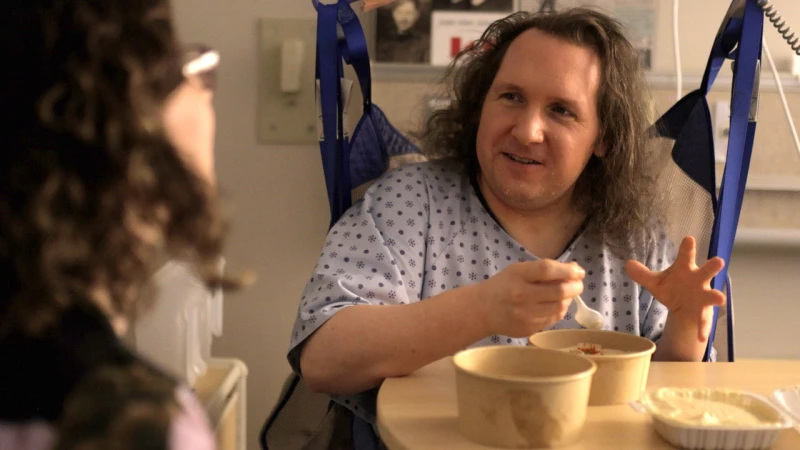
Roger Foley enjoys taste-testing three different kinds of hummus, his favourite food, on the day of a video shoot with Amanda Achtman of the Dying to Meet You project in Canada. The two spoke about Foley’s difficulty accessing quality care for his needs and being offered Medical Assistance in Dying (MAID) “several times.” / Courtesy of Amanda Achtman
CNA Staff, Jun 23, 2024 / 06:00 am (CNA).
Amid ongoing efforts to expand euthanasia in Canada under the name of “medical aid in dying” (MAID), one Ottawa man says he has been offered euthanasia “multiple times” as he struggles with lifelong disabilities and chronic pain from a disease called cerebellar ataxia.
Roger Foley, 49, shared some of his story in a recent video interview with Amanda Achtman of the Dying to Meet You project, which was created to “humanize our conversation on suffering, death, meaning, and hope.” The project seeks to “[restore] our cultural health when it comes to our experiences of death and dying” through speaking engagements and video campaigns.
Roger Foley, a Canadian man with disabilities, says he’s been offered euthanasia “multiple times.”
Listen to him speak out against being devalued as he fights for the support he needs to live. pic.twitter.com/yY8N4NILkS
In the video, the fourth of a series, Foley said he has struggled with subpar medical help in his own home, where he is supposed to be getting quality care. Canada has a nationalized health care system but Foley said that individuals with illnesses are “worked at … not worked with.” He spoke out against being devalued as he fights for the support he needs to live.
In one case, he said, a home worker helped him into his bathtub and then fell asleep in the other room; Foley was left to crawl out of the bathroom on his own. “I reported to the agency, and then he confessed, and the agency, they really didn’t care,” he said.
Asked by Achtman if he has ever been offered euthanasia, Foley said: “Yeah, multiple times.”
“One time, [a doctor] asked me, ‘Do you have any thoughts of self-harm?’ I’m honest with them and tell them I do think about ending my life because of what I’m going through, being prevented from the resources that I need to live safely back at home.”
“From out of nowhere, he just pulls out, ‘Well, if you don’t get self-directing funding, you can always apply for an assisted.’”
Foley said the offers from doctors to help end his life have “completely traumatized me.”
“Now it’s this overlying option where in my situation, when I say I’m suicidal, I’m met with, ‘Well, the hospital has a program to help you with that if you want to end your life.’”
“That didn’t exist before [MAID] was legalized, but now it’s there,” he said. “There is not going to be a second within the rest of my life that I’m not going to have flashbacks to [being offered suicide]. The devaluing of me and all that I am.”
Noting that he’s “not religious,” Foley said: “Saying that it’s just religious persons who oppose euthanasia in society is completely wrong.”
“These people who usually say it, they have an ableist mindset,” he said. “And they look at persons with disabilities and see us as just better off dead and a waste of resources.”
Achtman told CNA there is a need for euthanasia-free health care spaces, not only for protecting the integrity of Catholic institutions but also because many patients — including nonreligious patients like Foley — want to be treated in facilities that do not raise euthanasia with patients.
“Having euthanasia suggested, in a sense, already kills the person. It deflates a person’s sense of confidence that doctors and nurses are going to truly fight for them,” Achtman told CNA. “When euthanasia is suggested ostensibly as one ‘treatment’ option among others, there are all-too-frequently no other real options provided.
She continued: “This is why I always say that a request for euthanasia is not so much an expression of a desire to die as it is an expression of disappointment. Responding to such disappointment with real interventions that are adequate to the person is demanding, but that’s what people deserve. It is wrong to concede or capitulate to a person’s suicidal ideation — instead, every person deserves suicide prevention rather than suicide assistance.”
Roger Foley enjoys taste-testing three different kinds of hummus, his favorite food, on the day of a video shoot with Amanda Achtman of the Dying to Meet You project. The two spoke about Foley’s difficulty accessing quality care for his needs and being offered Medical Assistance in Dying (MAID) “several times.”. Courtesy of Amanda Achtman
Canada has become one of the most permissive countries in the world when it comes to euthanasia. The country first began allowing doctors to help kill terminally ill patients nearing death in 2016; the law was then expanded in 2021 to include patients whose death is not imminent.
In February the country paused a proposal to allow mentally ill individuals access to MAID, with the proposal set to be reconsidered in 2027. Earlier this year, Canadian health researchers alleged that MAID will “save” the Canadian health care system between $34.7 and $136.8 million per year.
A couple in British Columbia is currently suing the provincial government, as well as a Catholic health care provider, after their daughter was denied euthanasia while suffering from a terminal illness. The suit demands that the government remove the religious exemption from the Catholic hospital that protects them from having to offer MAID.
A judge in March, meanwhile, ruled that a woman with autism could be granted her request to die by MAID, overruling efforts by the woman’s father to halt the deadly procedure.
Asked what gives him hope, Foley told Achtman that he aspires one day to “be able to break through [the health care system] and get access to the resources that I need and to live at home with workers who want to work with me and I want to work with them and that we can work as a team.”
“I have a passion to live,” he said. “I don’t want to give up my life.”







Leave a Reply