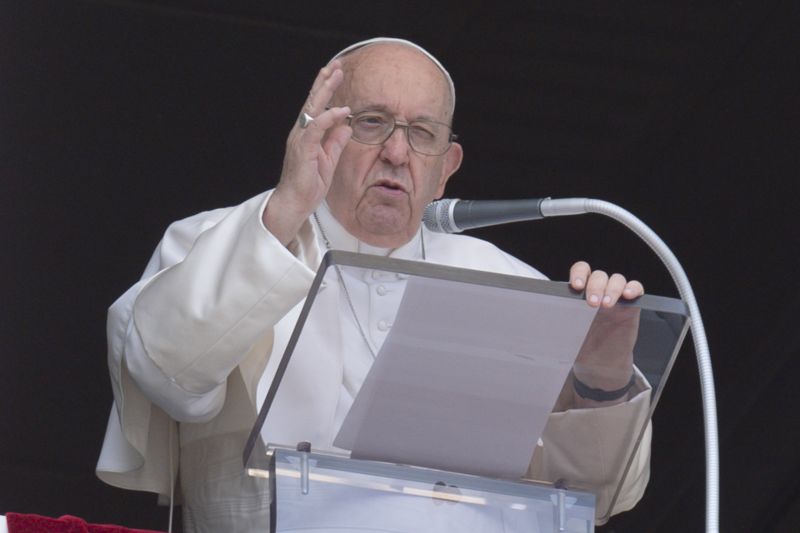
Pope Francis delivers his Regina Caeli address on May 21, 2023. / Vatican Media
Vatican City, May 21, 2023 / 06:40 am (CNA).
One week after meeting with Ukrainian President Volodymyr Zelenskyy, Pope Francis urged that “we must not get used to war” as he prayed for peace in Ukraine and Sudan.
In his Regina Caeli address on May 21, the pope entreated people to “continue to stand by the battered people of Ukraine” more than one year after Russia’s invasion.
The day prior, Pope Francis entrusted Italian Cardinal Matteo Zuppi with a peace mission on behalf of the Vatican to try to help end the war in Ukraine.
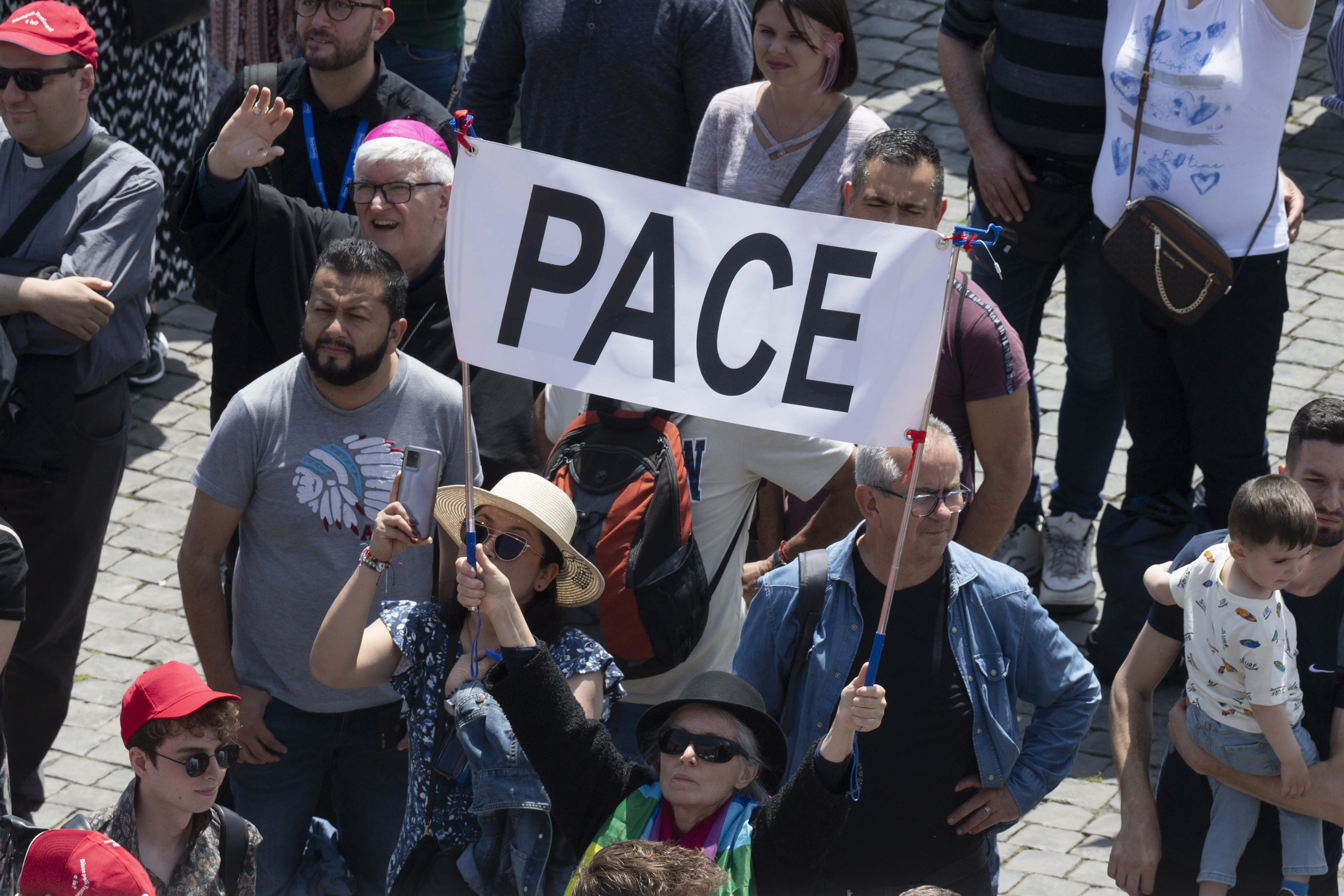
Pilgrims in St. Peter’s Square hold up a sign that says “pace,” which means “peace” in Italian. Vatican Media
Pope Francis also prayed for peace in Sudan, where fighting between the country’s military and a coalition of paramilitary forces has killed hundreds and displaced nearly 1 million people.
“It is sad, but one month after the outbreak of violence in Sudan, the situation continues to be grave,” he said.
The pope welcomed the “partial agreements” that have been made between the country’s warring parties one day after they signed a seven-day cease-fire.
“I renew a heartfelt call for the laying down of arms and call on the international community to spare no effort to make dialogue prevail and alleviate the suffering of the people,” Pope Francis said.
“Please, let us not get used to conflict and violence. We must not get used to war!”
In his brief spiritual meditation, Pope Francis spoke about the power of intercessory prayer with a reminder that Jesus himself is in heaven interceding on our behalf before the Father.
The pope noted that many countries, including Italy and some dioceses in the United States, celebrate the solemnity of the Ascension of the Lord on Sunday.
“Why are we celebrating? Because with the Ascension, something new and beautiful happened: Jesus brought our humanity into heaven … that is, in God,” he said.
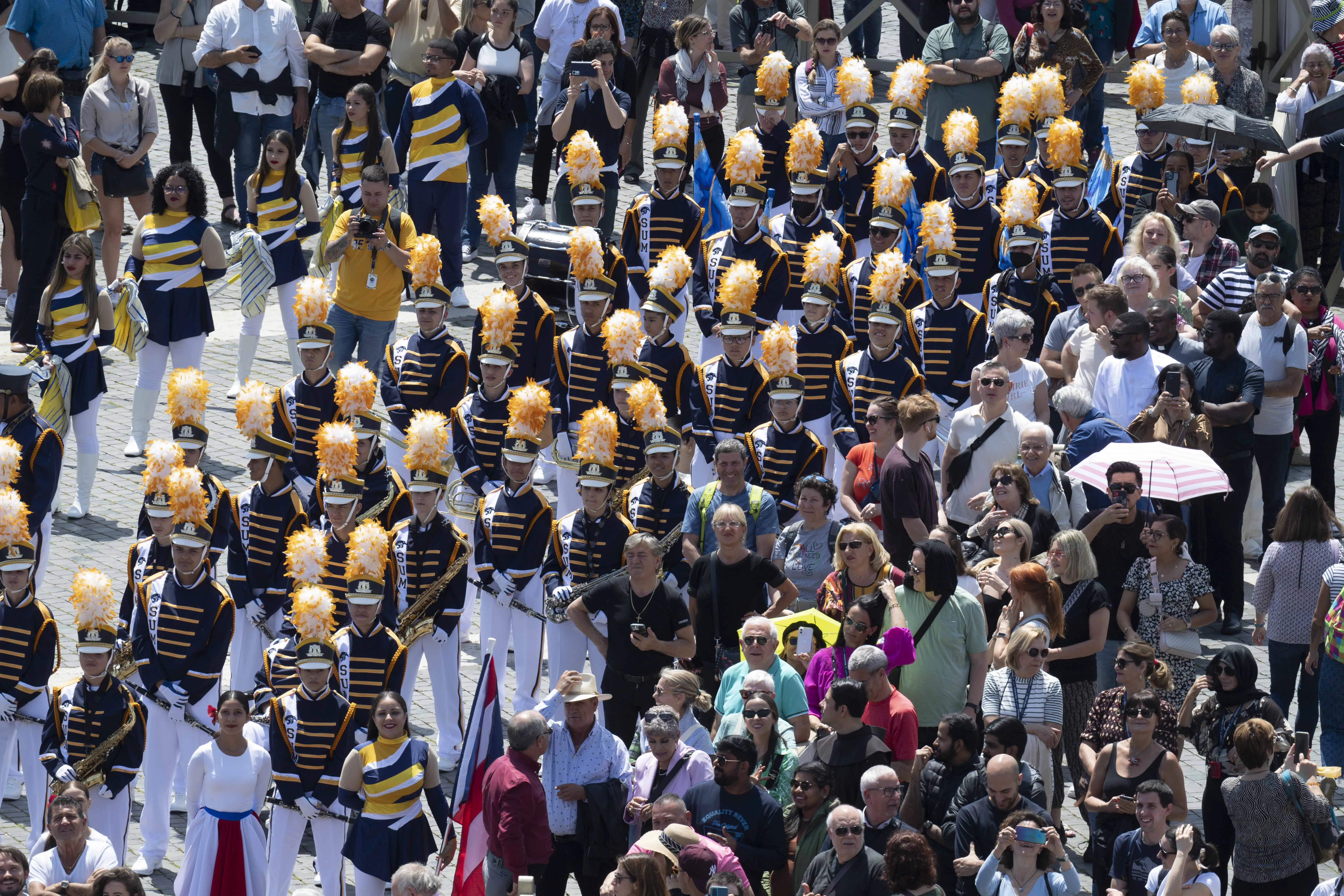
A marching band from Puerto Rico played music in St. Peter’s Square after Pope Francis’ speech. Vatican Media
Quoting the fourth-century bishop St. Gregory of Nyssa, he said: “‘What splendid news! He who became man for us … to make us his brothers, presents himself as man before the Father to bear with himself all those who are joined with him.’”
Pope Francis added: “What does Jesus do in heaven? He is there for us before the Father, continually showing our humanity to him, showing his wounds. I like to think that Jesus, before the Father, prays like this, showing him his wounds. … He shows him the price of redemption and the Father is moved. This is something I like to think about.”
At the end of his Regina Caeli address, Pope Francis marked World Communications Day by thanking journalists and encouraging them to always work in “the service of truth and the common good.”
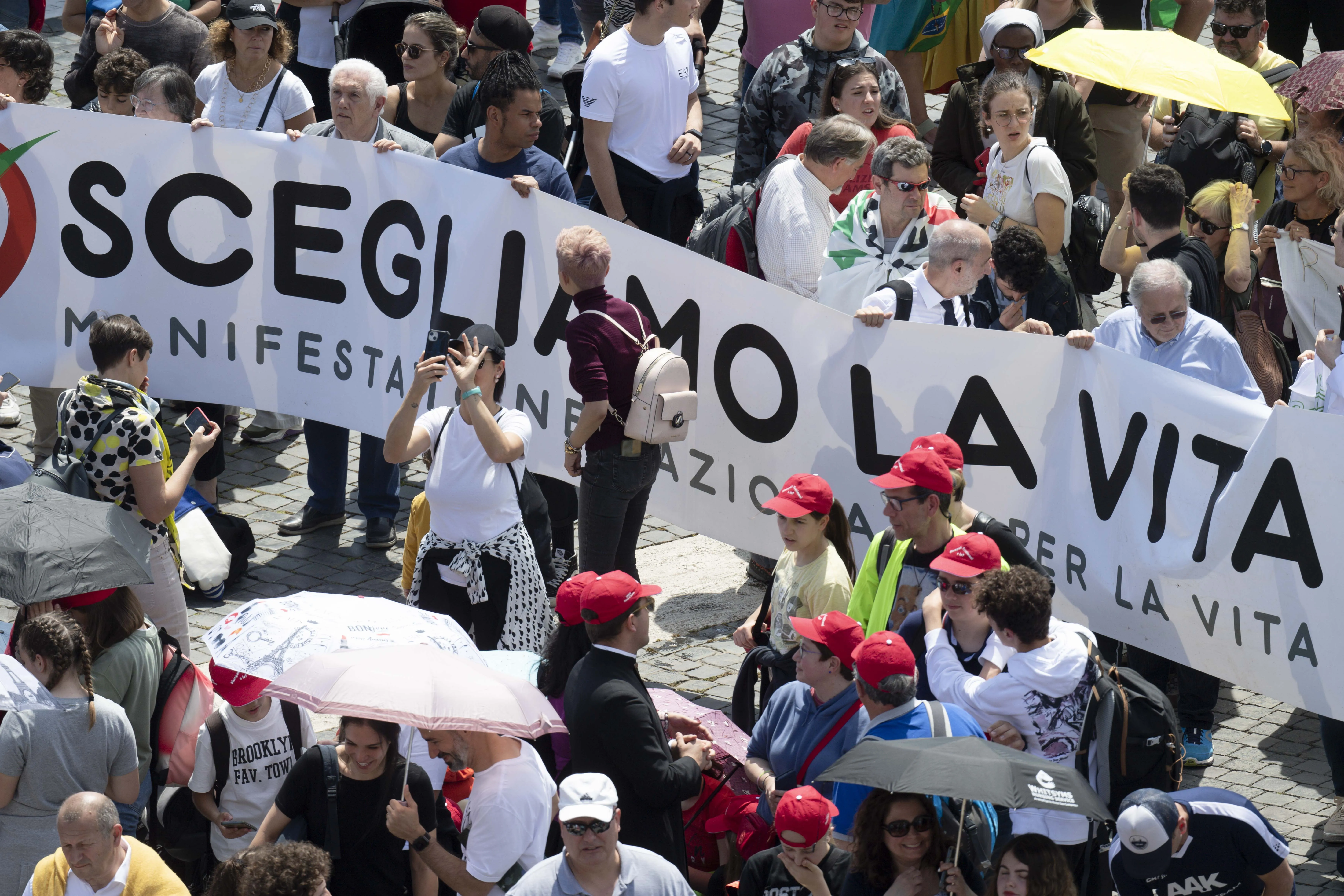
Pope Francis greeted pro-life groups who were present in St. Peter’s Square holding a banner one day after Italy’s national “Demonstration for Life.”. Vatican Media
The pope also greeted pro-life groups one day after Italy’s national “Demonstration for Life” and highlighted the beginning of Laudato si’ Week May 21–28. Pope Francis asked people to use their skills and creativity to do something to “care for our common home.”
Pilgrims gathered in St. Peter’s Square from Mali, Argentina, Malta, and many other countries received Laudato si’ booklets from the Vatican, which were printed in collaboration with the Stockholm Environmental Institute.
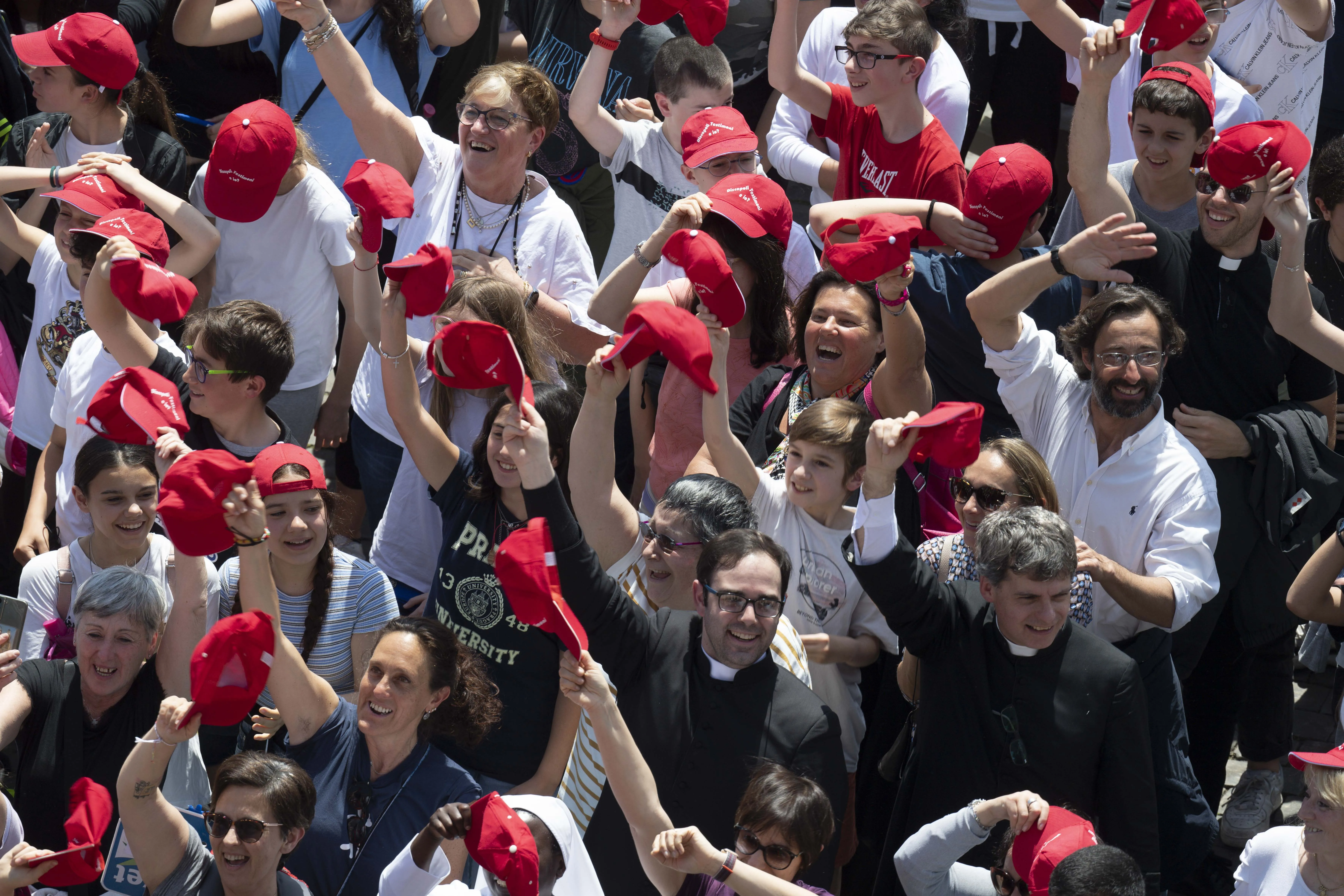
A large group of young people wearing red baseball caps from the Archdiocese of Genoa cheered loudly as the pope mentioned their visit to the Vatican. Vatican Media
A marching band from Puerto Rico played music in St. Peter’s Square at the end of the audience and a large group of young people wearing red baseball caps from the Archdiocese of Genoa cheered loudly as the pope mentioned their visit to the Vatican.
“I wish you all a good Sunday. Please don’t forget to pray for me. Please do not forget,” Pope Francis said.
If you value the news and views Catholic World Report provides, please consider donating to support our efforts. Your contribution will help us continue to make CWR available to all readers worldwide for free, without a subscription. Thank you for your generosity!
Click here for more information on donating to CWR. Click here to sign up for our newsletter.
Pope Francis presides over the funeral Mass for Pope Emeritus Benedict XVI in St. Peter’s Square on Jan. 5, 2023. / Vatican Media
Rome Newsroom, Jan 15, 2023 / 11:00 am (CNA).
It was widely anticipated that a major reform of the Diocese of Rome was coming, as Pope Francis has been thinking about it for some time.
But no one expected it to come when it did: On Jan. 6, one day after the funeral of Francis’ predecessor as Bishop of Rome, Pope Emeritus Benedict XVI.
With the reform, Pope Francis firmly took over the reins of the vicariate, or hierarchy, of the diocese. Everything is centralized, and everything must pass, at least formally, under the control of the pontiff.
Cardinal Angelo de Donatis, the pope’s vicar for the diocese, sees his role deeply diminished. The diocese’s auxiliary bishops strengthen their direct link with the pope. In the end, the pope has made it clear that he is the one who also formally presides over the Episcopal Council, a new body established as an “expression of synodality.”
Cardinal Angelo De Donatis. . Daniel Ibanez/CNA
The backstory
Before going into some details of the new decree, however, some background is necessary.
The last reform of the structure of the Vicariate of Rome was outlined by John Paul II in 1908, with the apostolic constitution Ecclesia In Urbe. For the new reform, Pope Francis copied and pasted several passages from that document. In some cases, these have been minimally rewritten to emphasize some details instead of others. In other cases, greater changes were made but these do little to alter the basic substance of things.
The reform presents two general characteristics of Pope Francis’ way of legislating: using councils or commissions and requiring those bodies to report directly to him.
It is clear that the pope is the bishop of Rome and that the pope’s vicar for the diocese is his auxiliary. Pope Francis, however, in this case, goes further, including with the constitution a decree that directly defines the areas of competence of the auxiliary bishops.
Pope Francis shows, in this way, a willingness to exercise greater personal control over everything that happens in the vicariate. At the same time, this choice also testifies to a “break” in the relationship of trust with his vicar, Cardinal de Donatsi.
Although Francis called de Donatis to preach retreats to the Roman Curia in 2014, he was never the pope’s candidate to succeed Cardinal Vallini as vicar. That was Cardinal Paolo Lojudice.
Pope Francis, however, wanted to first consult the parish priests of Rome, 80% of whom preferred de Donatis. It was impossible, therefore, for the pope not to listen to them. He appointed De Donatis vicar (and cardinal) and made Lojudice archbishop of the prestigious Diocese of Siena, and a cardinal, as well.
Last May, at the general assembly of the Italian Episcopal Conference, it seemed clear that Pope Francis preferred the appointment of Cardinal Lojudice as the new president of the CEI.
Cardinal Matteo Zuppi and Cardinal Augusto Paolo Lojudice. Francesco Pierantoni via Wikimedia (CC BY 2.0)/Pufui PcPifpef via Wikimedia (CC BY-SA 4.0).
The plan was to appoint Lojudice vicar of the Diocese of Rome to succeed Cardinal de Donatis, who had finished his five-year term, which would then have made Lojudice the primary contact person for the pope both in Rome and among the Italian bishops. De Donatis would have been appointed the new Penitentiary in place of Cardinal Mauro Piacenza, who has now turned 78.
The Italian bishops, however, preferred Cardinal Matteo Zuppi, archbishop of Bologna, who was not unwelcome to Pope Francis.
Lojudice didn’t become vicar for the Rome Diocese, either, as everyone assumed would happen. Meanwhile, the relationship of trust between de Donatis and the pope seemed to have been interrupted in 2020, when, at the beginning of the lockdown for COVID-19, de Donatis decided to close the churches of Rome. When Pope Francis later highlighted the inadvisability of closing churches, de Donatis withdrew the decree but announced that every decision had been made in agreement with the pope. There also have been other moments of friction in recent years.
The pope, however, now seems intent on changing the vicar this year when de Donatis’ mandate expires. An indication of this is the fact that in the decree in which the Pope defines the area and pastoral competencies of the auxiliary bishops, de Donatis is not mentioned as vicar. One might take his presence for granted, of course, but the general interpretation is that the change will be made.
What’s new
What are the novelties introduced by Pope Francis? First, the figure of the prelate general secretary disappears, while the vicegerente (or the deputy of the vicar) manages the offices of the General Secretariat. The prelate secretary also had the function of the moderator of the Curia. In this case, everything is entrusted to the vicegerente, who thus sees his functions and weight increase.
The pope chose the vicegerente from among the auxiliary bishops, and in this case, Baldassare Reina was selected. Bishop Reina does not come from the Diocese of Rome but was called from Agrigento. The pope’s logic is to break possible power chains by bringing in fresh and foreign forces.
The choice of a new parish priest is entrusted to a lengthy procedure which must then, in any case, be submitted to the pope, who acts as the true and proper bishop of Rome without relying on the vicar, who is left with the appointment of assistant parish priests.
Article 20 of the Constitution requests a report for each candidate for the priesthood or diaconate to be submitted before ordination. Also, in this case, the candidates must be presented by the cardinal vicar to the pope, and only after obtaining the Episcopal Council’s consent. Therefore, the vicar seems to be practically a commissariat: He does not choose the candidates but submits them to the pope and can submit them only after the Episcopal Council has endorsed the choice.
The council is defined as the “first organ of Synodality” and must meet “at least three times a month,” presided over by the pope. Only in the absence of the pope can the cardinal vicar preside over the council, which is made up of the vicegerent and the auxiliary bishops. However, the pope wants to receive “the agenda for each meeting as soon as possible.”
Finally, there is also the establishment of an Independent Supervisory Commission. This will have a regulation that must be “approved by the Pope” and six members appointed by the pope who can remain in office for a maximum of two five-year terms.
The service for the protection of minors and vulnerable people is also added, which “reports to the Episcopal Council, through the auxiliary bishop appointed by me,” the pope has decreed.
Pope Francis attends the Italian bishops’ plenary assembly in Rome on May 24, 2021. Vatican Media.
The effects of the reform
The constitution also redistributes the areas and offices of the Vicariate’s Curia, and the accompanying decree gives each auxiliary bishop a specific task.
Beyond the reorganization, it should be noted how the pope enters into action as the actual bishop of Rome. Everything must pass through the decisions of the pope, while before, the cardinal vicar enjoyed trust and discretion. For the first time, however, the pope’s vicar is defined as an “auxiliary.” He is, therefore, an auxiliary among the auxiliaries, with a considerable reduction in his weight.
With this centralization, Pope Francis probably wants to overcome the risk of having “abuses” within the Vicariate.
It is worth remembering that in June 2021, Pope Francis ordered an inspection of the Vicariate itself. It was an audit entrusted to the Auditor General of the Holy See, Alessandro Cassinis Righini. It was the first time the Vicariate sifted through the accounting books, registers, and cooperative societies.
However, the Pope, as a matter of practice, has sent an inspection to all the dicasteries of the Curia every time there is a reform or a new mandate. The review, therefore, already predicted the change of pace in the Vicariate, one that has led Pope Francis to be increasingly alone in command.
Vatican City, Jun 14, 2020 / 07:30 am (CNA).- Pope Francis expressed “great apprehension and sorrow” Sunday after eight mass graves were discovered in Libya amid the ongoing civil war.
“I urge international bodies and those who have political and military responsibilities to recommence with conviction and resolve the search for a path towards an end to the violence, leading to peace, stability and unity in the country,” Pope Francis said in his Angelus address June 14.
The United Nations announced this week the discovery of at least eight Mass graves in Tarhuna, Libya, 62 miles southeast of the capital in Tripoli.
“I am following the dramatic situation in Libya with great apprehension and sorrow. It has been present in my prayer in recent days,” the pope said.
The pope’s prayer comes a day following the UN Secretary General António Guterres’ call for a “thorough and transparent investigation” to identify the victims and bring the perpetrators to justice. It remains unclear when the killings occurred, according to the New York Times.
Libya’s civil war started in 2014 after disputed elections when rebel commander Khalifa Hifter led the Libyan National Army on a military offensive against the Tripoli-based Government of National Accord led byPrime Minister Fayez al-Sarraj.
Libya has the largest oil reserves of any country in Africa, increasing the stakes for a number of foreign powers who have become involved in the conflict.
Hifter is backed by Russia, Egypt, Saudi Arabia, and the United Arab Emirates, while Al-Sarraj’s administration is supported by the U.N., Turkey, Qatar, Italy, and the United States.
The ongoing violence in Libya has led tens of thousands of people in Libya to flee their homes.
Pope Francis prayed for these internally displaced people, as well as the hundreds of thousands of migrants and asylum seekers who have traveled to Libya from neighboring African countries.
“I also pray for the thousands of migrants, refugees, asylum seekers and internally displaced persons in Libya,” he said. “The health situation has aggravated the already precarious conditions in which they find themselves, making them more vulnerable to forms of exploitation and violence. There is cruelty.”
“I call on the international community to please take their plight to heart, identifying pathways and providing means to provide them with the protection they need, a dignified condition and a hopeful future,” Pope Francis said.
“Brothers and sisters, we are all responsible for this. No one can consider him or herself dispensed from this. Let us all pray for Libya in silence,” he added.
In his Angelus address Pope Francis also offered a reflection for the Solemnity of Corpus Christi, celebrated in Italy and other countries this Sunday.
“Jesus is present in the sacrament of the Eucharist to be our nourishment, to be assimilated and to become in us that renewing force that gives once again the energy and the desire to set out again after every pause or after every fall,” he said.
Earlier on Sunday Pope Francis offered Mass and Eucharistic adoration in St. Peter’s Basilica with a limited number of people present to safeguard against the coronavirus. In his homily, he said that Christ’s presence in the Eucharist heals wounds and transforms bitter negativity into the joy of Lord.
The pope said the body and blood of Christ unites the Church to God and to each other, in his reflection before the Angelus prayer.
“We are a community, nourished by the body and blood of Christ. Communion with the body of Christ is an effective sign of unity, of communion, of sharing,” he said.
“The Lord knows well that our human strength alone is not enough for this. On the contrary, He knows that there will always be the temptation of rivalry, envy, prejudice, division … For this reason too He left us the Sacrament of His real, tangible and permanent Presence, so that, remaining united to Him, we may always receive the gift of fraternal love,” Pope Francis said.
Pope Benedict XVI leads the recitation of the Holy Rosary during a candlelight vigil at the Catholic shrine of Fatima in central Portugal, May 12, 2010. / M.Mazur/www.thepapalvis
Washington, D.C. Newsroom, Jan 4, 2023 / 15:22 pm (CNA).
The fune… […]
2 Comments
I’ve been waiting for this for quite a while now:
“…and a large group of young people wearing red baseball caps from the Archdiocese of Genoa cheered loudly…”
* * *
Finally! A ‘Make Catholicism Great Again’ movement in the Church!
I’ve been waiting for this for quite a while now:
“…and a large group of young people wearing red baseball caps from the Archdiocese of Genoa cheered loudly…”
* * *
Finally! A ‘Make Catholicism Great Again’ movement in the Church!
Health is wealth. Peace is good for health. Long live peace.
