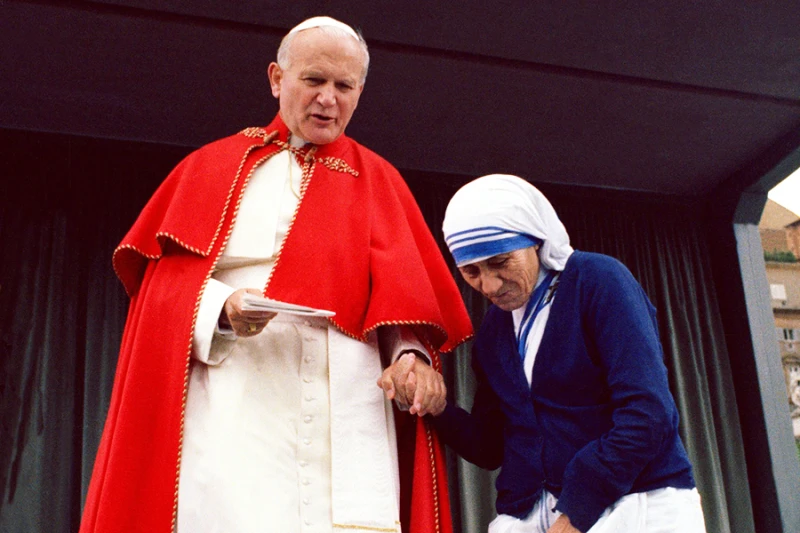
Mother Teresa and John Paul II, May 25, 1983. / L’Osservatore Romano.
Denver, Colo., Feb 14, 2023 / 09:15 am (CNA).
In a culture where the family is attacked and love is often confused with lust, it can be hard to know what a godly love looks like among one’s relationships — whether that be in dating, in marriage, or within the home.
Here are 11 quotes from the saints on love and relationships.
St. Teresa of Calcutta: “It is easy to love the people far away. It is not always easy to love those close to us. It is easier to give a cup of rice to relieve hunger than to relieve the loneliness and pain of someone unloved in our own home. Bring love into your home, for this is where our love for each other must start.”
Venerable Fulton Sheen: “When a man loves a woman, he has to become worthy of her. The higher her virtue, the more noble her character, the more devoted she is to truth, justice, goodness, the more a man has to aspire to be worthy of her. The history of civilization could actually be written in terms of the level of its women.”
St. John Paul II: “Love is never something that is ready-made, something merely ‘given’ to man and woman; it is always at the same time a ‘task’ which they are set. Love should be seen as something which in a sense never ‘is’ but is always only ‘becoming,’ and what it becomes depends upon the contribution of both persons and the depth of their commitment.”
Venerable Fulton Sheen: “It takes three to make love, not two: you, your spouse, and God. Without God people only succeed in bringing out the worst in one another. Lovers who have nothing else to do but love each other soon find there is nothing else. Without a central loyalty life is unfinished.”
St. Clare of Assisi: “We become what we love and who we love shapes what we become.”
St. John XXIII: “The charity which burned in the household at Nazareth should be an inspiration for every family. All the Christian virtues should flourish in the family, unity should thrive, and the example of its virtuous living should shine brightly.”
St. John Chrysostom: “When a husband and wife are united in marriage they no longer seem like something earthly, but rather like the image of God himself.”
St. Josemaría Escrivá: “Marriage is to help married people sanctify themselves and others. For this reason they receive a special grace in the sacrament which Jesus instituted. Those who are called to the married state will, with the grace of God, find within their state everything they need to be holy.”
St. John Paul II: “Love that leads to marriage is a gift from God and a great act of faith toward other human beings.”
St. Gianna Molla: “Love is the most beautiful sentiment the Lord has put into the souls of men and women.”
St. Thomas Aquinas: “The greater the friendship, the more solid and long-lasting the marriage will be, as we are united not only in flesh but in domestic activity.”
If you value the news and views Catholic World Report provides, please consider donating to support our efforts. Your contribution will help us continue to make CWR available to all readers worldwide for free, without a subscription. Thank you for your generosity!
Click here for more information on donating to CWR. Click here to sign up for our newsletter.
The Vatican ambassador to Colombo, Archbishop Brian Udaigwe (third from left) and Sri Lanka’s Cardinal Malcolm Ranjith (fourth from left) take part in a remembrance service during the fifth anniversary of the Easter Sunday suicide attacks at St. Anthony Church in Colombo on April 21, 2024. / Credit: ISHARA S. KODIKARA/AFP via Getty Images
ACI Prensa Staff, Apr 23, 2024 / 16:05 pm (CNA).
More than 50,000 Catholics have asked the Church in Sri Lanka to recognize as martyrs the 171 victims of the 2019 Easter massacre in the island nation.
On April 21, 2019, Easter Sunday, eight suicide bombers attacked two Catholic churches, a Protestant church, and three luxury hotels, killing 269 people and leaving more than 500 injured.
Of the victims, 171 were Catholic faithful who were attending Mass at St. Sebastian and St. Anthony Churches in Colombo, the capital of the Asian country.
Five years after the tragedy, on Sunday, April 21, the local Church announced that it will begin the procedures to recognize the martyrdom of the 171 Catholics, who were remembered with various initiatives, including a petition with more than 50,000 signatures that was presented to the archbishop of Colombo, Cardinal Albert Malcolm Ranjith.
The Archdiocese of Colombo will now send an official request to the Dicastery for the Causes of Saints to proceed with the opening of the diocesan phase of the beatification cause.
“The collection of signatures and raising awareness among the faithful has been underway since the beginning of Lent. Among the people there is full awareness of the gift of faith of those innocent people, murdered in the church while celebrating the resurrection of Christ,” Father Jude Chrysantha Fernando, director of the archdiocese’s communications office, told the Vatican news agency Fides from Colombo.
The priest said that on Sunday “there was a large participation of the faithful in the celebrations: in the morning memorial Masses were held in all churches and a special ceremony was held in the presence of Cardinal Ranjith at St. Anthony Church in Colombo” as well as with other religious leaders and civil authorities.
In Colombo thousands of people observed “a solemn two-minute moment of silence, which was also observed in churches across the country, to honor and remember those who lost their lives” on Easter 2019.
“It was a moment of great spiritual intensity for the Catholic community of Sri Lanka: The memory of these ‘heroes of the faith’ is alive and a source of inspiration for many,” Fernando told Fides.
In the Mass held at St. Anthony Church, Ranjith noted that the Catholic Church in Sri Lanka has been asking for justice for five years and demanding that an international and independent investigation into the 2019 attacks be carried out.
This story was first published by ACI Prensa, CNA’s Spanish-language news partner. It has been translated and adapted by CNA.
Denver, Colo., Jun 4, 2019 / 04:00 am (CNA).- A narrow majority of Americans now consider abortion “morally unacceptable,” while less than 10% disapprove of birth control, a new Gallup Poll has found.
An artist’s rendering of the affordable apartment complex soon to be built by Our Lady Queen of Angels Housing alliance in Los Angeles. / Courtesy of Our Lady Queen of Angels Housing alliance
St. Louis, Mo., Aug 26, 2024 / 06:30 am (CNA).
Los Angeles is one of the most expensive cities in the United States, with an average home price almost touching a million dollars in 2024 — a landscape that crowds out not only the poor, but also young families with children. The high cost of housing is one of the primary reasons why tens of thousands of people live on the streets of LA, and most of those who are housed are “rent burdened,” which means they spend more than 30% of their income just keeping a roof over their heads.
In the face of such challenges, the Archdiocese of Los Angeles recently announced it will provide land for a new housing development dedicated to serving community college students and young people exiting the foster care system.
Amy Anderson, executive director of Our Lady Queen of Angels Housing alliance and a former chief of housing for the City of Los Angeles, told EWTN News that a group of Catholic lay leaders from the business and philanthropic community reached out to the archdiocese with a vision for creating an independent, nonprofit affordable housing development organization.
“Our vision is to really collaborate with the archdiocese and [use] the resources potentially available from the archdiocese to create homes that are affordable to a wide range of populations and incomes,” Anderson told “EWTN News Nightly” anchor Tracy Sabol.
She said they hope to break ground on the project, known as the Willowbrook development, “about a year from now.”
“The archdiocese is a fantastic partner. They are providing the land for our first development, which is already in process, and we’re working really closely with them to identify additional opportunities.”
The proposed building, which will be located steps from Los Angeles Community College, will feature 74 affordable housing units, as well as “on-site supportive services” for young people transitioning out of foster care — a population that often ends up experiencing homelessness.
The land, located at 4665 Willow Brook Ave just a few miles from the Hollywood Sign, currently hosts a Catholic Charities building, which will move its operations to another site to make way for the apartments.
“Through Catholic Charities and our ministries on Skid Row [an LA street where many unhoused people live] and elsewhere, we have been working for many years to provide shelter and services for our homeless brothers and sisters,” Archbishop Jose Gomez said in a statement to LAist.
“With this new initiative we see exciting possibilities to make more affordable housing available, especially for families and young people.”
Making land work for mission
The Catholic Church is often cited as the largest non-governmental owner of land in the entire world, with an estimated 177 million acres owned by Catholic entities.
Maddy Johnson, program manager for the Church Properties Initiative at the University of Notre Dame’s Fitzgerald Institute for Real Estate (FIRE), noted that the Church as a large landowner is not a new phenomenon, but there is a need today to adapt to modern challenges like regulations, zoning, and the importance of caring for the natural environment.
Many Catholic dioceses and religious orders have properties in their possession that aren’t fulfilling their original purpose, including disused natural land and parking lots, as well as shuttered convents and schools. Sometimes, Johnson said, a diocese or religious order doesn’t even realize the full extent of what they own.
“How can the Church make good strategic decisions, strategic and mission-aligned decisions, if it doesn’t know what properties it’s responsible for?” she said.
The Church of St. Agatha and St. James in Philadelphia, with The Chestnut in the foreground, a housing unit developed on property ground-leased from the church. Courtesy of Maddy Johnson/Church Properties Initiative
Since real estate management is not the Church’s core competency, FIRE aims to “provide a space for peer learning” to educate and equip Church leaders to make better use of their properties in service of the Church’s mission.
To this end, they offer an undergraduate minor at Notre Dame that aims to teach students how to help the Church make strategic real estate decisions that align with the Church’s mission. The Institute also organizes a quarterly networking call with diocesan real estate directors, as well as an annual conference to allow Catholic leaders to convene, share best practices, and learn from each other.
Fr. Patrick Reidy, C.S.C., a professor at Notre Dame Law School and faculty co-director of the Church Properties Initiative, conducts a workshop for diocesan leaders on Notre Dame’s campus in summer 2023. Courtesy of David J. Murphy/Church Properties Initiative
In many cases, Catholic entities that have worked with FIRE have been able to repurpose properties in a way that not only provides income for the church, but also fills a need in the community.
Johnson said the Church is called to respond to the modern problems society faces — one of which is a lack of housing options, especially for the poor.
“Throughout its history, there have been so many different iterations of how the Church expresses its mission…through education, healthcare — those are the ones that we’ve gotten really used to,” Johnson said.
“In our day and age, could it be the need for affordable housing?…that’s a charitable human need in the area that’s not being met.”
Unlocking potential in California
Queen of Angels Housing’s first development, which has been in the works for several years, is being made possible now by a newly-passed state law in California that aims to make it easier for churches to repurpose their land into housing.
California’s SB 4, the Affordable Housing on Faith Lands Act, was signed into law in October 2023. It streamlines some of the trickiest parts of the process of turning church-owned land into housing — the parts most people don’t really think about. These can include permitting and zoning restrictions, which restrict the types of buildings that can be built in a given area and can be difficult and time-consuming to overcome. SB 4 even includes a provision allowing for denser housing on church-owned property than the zoning ordinances would normally allow.
Yes in God’s Backyard
The law coming to fruition in California is part of a larger movement informally dubbed “Yes in God’s Backyard,” or YIGBY — a riff on the term “Not in My Backyard” (NIMBY), a phenomenon whereby neighbors take issue with and oppose new developments.
Several Catholic real estate professionals with ties to California expressed excitement about the possibilities that SB 4 has created in the Golden State.
Steve Cameron, a Catholic real estate developer in Orange County, told CNA that he is currently working with the Diocese of Orange, which abuts the LA archdiocese, to inventory properties that could be repurposed for residential use.
He said their focus is on building apartment buildings and townhomes, primarily for rental rather than for sale, in an attempt to address the severe housing shortage and high costs in Southern California.
Unlike some dioceses, the Orange diocese has an electronic GIS (geographic information system) database showing all the properties it owns. Prepared by a civil engineering firm, the database includes details such as parcel numbers, acreage, title information, and demographic reports, which facilitate the planning and development process.
“Strategically, what we’re doing is we’re inventorying all of the property that the diocese and the parishes own, and trying to understand where there might be underutilized property that would make sense to develop some residential use,” Cameron said.
Cameron said he can’t yet share details about the housing projects they’re working on, but said they are looking to the Archdiocese of Los Angeles and the Queen of Angels housing project as a model for how to take advantage of the new incentives created by SB 4.
“I think it’s great, and it’s exciting that they’re taking the lead and that they are able to find an opportunistic way to repurpose an underutilized property to meet the housing shortage in California,” he said.
“[We] look at them as a role model for what we’re trying to accomplish here in the Diocese of Orange.”
Holy Name Cathedral in Chicago with One Chicago Square in the background, a residential tower constructed on the former cathedral parking lot, which was sold in 2019. Courtesy of Maddy Johnson/Church Properties Initiative
John Meyer, a former president of the California-based Napa Institute who now works in real estate with J2 Development, emphasized the importance of viewing the Church’s vast real estate holdings as an asset rather than a liability.
Meyer said he is currently working with two Catholic entities on the East Coast on ground lease projects, one of which will fund the construction of a new Catholic Student Center at a university. He told CNA he often advises Catholic entities to lease the land they own rather than selling it, allowing the church to maintain ownership of the property while generating income.
Naturally, he noted, any real estate project the Church undertakes ought to align with the Church’s mission of spreading the Gospel, and not merely be a means of making money.
“Any time we look at the Church’s real estate decisions, it’s got to be intertwined with mission and values,” he said.
“We’re not just developing for the sake of developing. What we want to do is we want to create value for the Church, and we also want to create value for the community. So working closely with the municipality to make sure that needs are met, and to be a good neighbor, is important.”
He said Church leaders should strongly consider taking advantage of incentives in various states such as California for projects like affordable housing, which align with the Church’s mission and provide both social and financial benefits.
“Priests and bishops aren’t ordained to do these things, and sometimes they have people in their diocese that have these abilities, and sometimes they don’t,” Meyer said.
“This [new law] in California has created an incentive that we can take advantage of, so we need to take advantage of that incentive…it’s allowing us to unlock potential value in land while at the same time serving a social good that’s part of the mission of the Church.”
The Venerable Fulton Sheen. May the Lord raise up more expositors of the Word, such as Sheen.
2 Timothy 4:2 Preach the word; be ready in season and out of season; reprove, rebuke, and exhort, with complete patience and teaching.
1 Timothy 4:11-15 Command and teach these things. Let no one despise you for your youth, but set the believers an example in speech, in conduct, in love, in faith, in purity. Until I come, devote yourself to the public reading of Scripture, to exhortation, to teaching. Do not neglect the gift you have, which was given you by prophecy when the council of elders laid their hands on you. Practice these things, immerse yourself in them, so that all may see your progress.
Hebrews 4:12 For the word of God is living and active, sharper than any two-edged sword, piercing to the division of soul and of spirit, of joints and of marrow, and discerning the thoughts and intentions of the heart.
Acts 12:24 But the word of God increased and multiplied.






The Venerable Fulton Sheen. May the Lord raise up more expositors of the Word, such as Sheen.
2 Timothy 4:2 Preach the word; be ready in season and out of season; reprove, rebuke, and exhort, with complete patience and teaching.
1 Timothy 4:11-15 Command and teach these things. Let no one despise you for your youth, but set the believers an example in speech, in conduct, in love, in faith, in purity. Until I come, devote yourself to the public reading of Scripture, to exhortation, to teaching. Do not neglect the gift you have, which was given you by prophecy when the council of elders laid their hands on you. Practice these things, immerse yourself in them, so that all may see your progress.
Hebrews 4:12 For the word of God is living and active, sharper than any two-edged sword, piercing to the division of soul and of spirit, of joints and of marrow, and discerning the thoughts and intentions of the heart.
Acts 12:24 But the word of God increased and multiplied.
Saint Teresa of Calcutta continues to inspire the young and the young at heart. May her tribe increase.