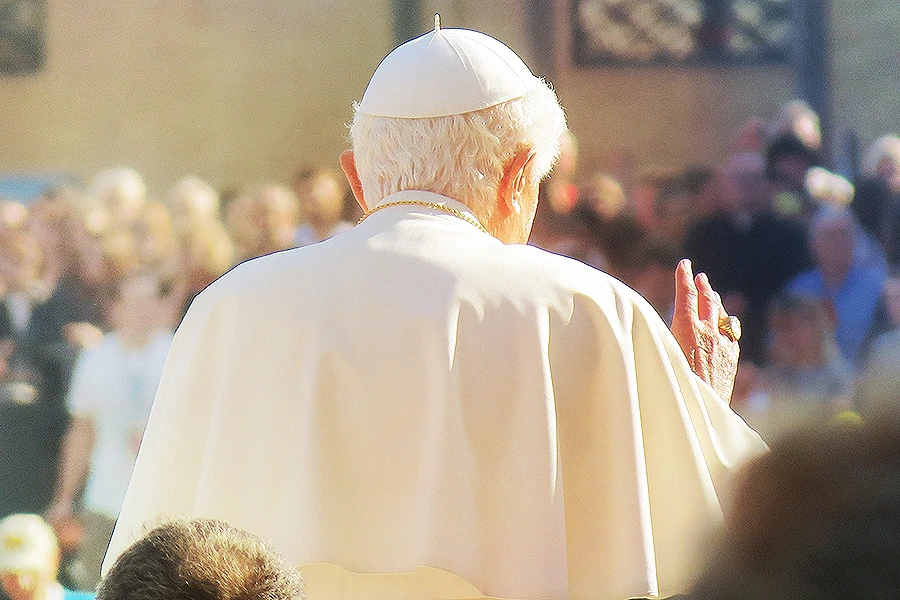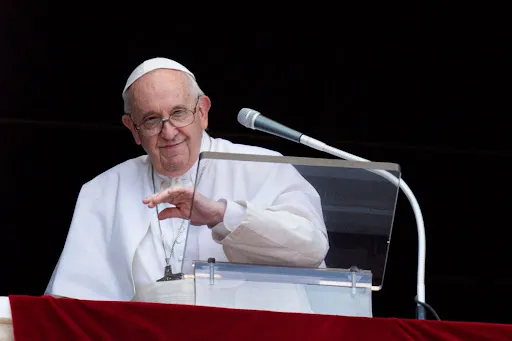
Pope Francis during his appearance for the Angelus in St. Peter’s Square on June 29, 2022, the feast of Saints Peter and Paul. / Vatican Media
Vatican City, Jun 29, 2022 / 08:40 am (CNA).
The journey of faith is never easy for anyone, not even for the Apostles Peter and Paul, Pope Francis said in his Angelus address on Wednesday.
“The journey of faith is not a walk in the park, but is instead demanding, sometimes arduous,” he said on June 29.
The pope prayed a mid-week Angelus to mark the Solemnity of Saints Peter and Paul, the patron saints of the city of Rome.
In his message before the Marian prayer, he reflected on a passage from the Gospel of St. Matthew, when Peter says to Jesus: “You are the Christ, the Son of the living God.”
“It is a profession of faith, which Peter pronounces not on the basis of his human understanding, but because God the Father inspired it in him,” he said.
When Jesus then reveals to his disciples that he will suffer, die, and on the third day be raised, Peter rebukes him, saying, “God forbid, Lord! No such thing shall ever happen to you.”
Pope Francis recalled that Jesus’ response to Peter was: “Get behind me, Satan! You are a scandal to me, because you do not think according to God, but according to men!”
“Does not the same thing happen to us?” the pope said. “We repeat the Creed, we say it with faith, but when faced with the harsh trials of life, everything seems to falter.”
“We are inclined to protest to the Lord,” Francis added, “telling him that it is not right, that there must be other, more direct, less strenuous ways.”
St. Peter needed time to mature, moving from first horror at the cross to a courageous embrace of his own death, he said, noting that “the Apostle Paul also had his own path, and he too passed through a slow maturation of faith, experiencing moments of uncertainty and doubt.”
“The journey of faith is never a walk in the park, for anyone, not for Peter nor for Paul, not for any Christian,” he said.
The pope concluded his message with two questions for reflection.
“In the light of this experience of the holy apostles Peter and Paul, each of us can ask ourselves: When I profess my faith in Jesus Christ, the Son of God, do I do so with the awareness that I must always be learning, or do I assume that I ‘already have it all figured out’?” he said.
“And again,” he continued, “in difficulties and trials do I become discouraged, do I complain, or do I learn to make them an opportunity to grow in trust in the Lord? For he, in fact — as Paul writes to Timothy — delivers us from all evil and brings us safely to heaven.”
The pope addressed an estimated 15,000 people from a window overlooking St. Peter’s Square, according to the Vatican. During the Angelus and his remarks afterward, he sometimes placed his right hand on the windowsill and leaned his weight on his right arm.
The 85-year-old pope, who has an injury in his right knee, has used a wheelchair for many of his public audiences for almost two months. He has recently walked short distances with the support of a cane.
If you value the news and views Catholic World Report provides, please consider donating to support our efforts. Your contribution will help us continue to make CWR available to all readers worldwide for free, without a subscription. Thank you for your generosity!
Click here for more information on donating to CWR. Click here to sign up for our newsletter.
Stuart Long (Mark Wahlberg) in Columbia Pictures’ Father Stu. / Courtesy of Sony Pictures.
Denver Newsroom, Feb 10, 2022 / 18:05 pm (CNA).
An upcoming film about a rough-and-tumble Montana priest has the potential to inspire every person to consider a relationship with God, Academy Award nominee Mark Wahlberg said in an interview that aired Feb. 10 on EWTN’s The World Over.
“It felt like it was a story and a message that everybody needed to hear,” Wahlberg said. “If we get one other person, if we plant one more seed…and even if it takes him 50 years to get there to impact somebody else, we’re doing our job.”
Father Stu features the story of Father Stuart Long, a Montana priest who died of a rare muscular condition in 2014. Father Stu, as he was affectionately known, was a late vocation to the priesthood. He pursued careers in boxing, acting, teaching, and museum management before his ordination in 2007 for the Diocese of Helena. He is also remembered for his no-nonsense and, at times, rough demeanor.
Wahlberg plays the role of Father Stu in the film and Academy Award-winner Mel Gibson plays the role of Bill Long, the late priest’s father.
“It’s based on a true story,” said Father Bart Tolleson, a priest of the Diocese of Helena and a longtime friend of Father Stu. “It certainly will take liberties with the story, but it will get interest in his life, and that alone is a good thing. It’s a great story.”
Father Stu was an avid athlete. He played football at Carroll College, a Catholic university in Montana, though he wasn’t Catholic at the time. He later pursued boxing, winning the Montana Golden Gloves championship in 1985.
He then moved to Los Angeles to pursue a career in acting, taking a job at a comedy club before managing an art museum in Pasadena for several years. He would ride his motorcycle, an artifact of his acting days, to and from the museum.
“One day, I was riding home after work, and I got hit by a car, and I smashed into a car in the next lane with my head,” Father Stu shared in a 2010 interview with The Montana Catholic. “The witnesses told the sheriffs and reporters that I was rolling down the road and another car ran over the top of me. And here I am.”
Father Stu had what he called a “religious experience” in the hospital and he entered RCIA shortly after. On the day he was baptized, he knew he was going to become a priest.
He entered Mount Angel Seminary in Oregon in 2003. While in seminary, doctors discovered a fist-sized tumor and diagnosed Father Stu with inclusion body myositis, a rare muscular condition for which there is no cure. He died in 2014 after seven years as a priest.
“That cross of his disease was the most powerful way to serve people,” said Father Tolleson. “He was tireless in his service and the Lord gave him many beautiful gifts, of counsel, of providing the sacraments. He was fearless even though he was limited.”
The project seems to be one of incredible personal importance for Wahlberg. He first learned about Father Stu in 2016 during a dinner with two priests.
Wahlberg said he was impressed by Father Stu’s perseverance in the face of suffering.
“[His story] gives me so much hope…because death is inevitable. Sickness, all of those things are inevitable. We’re going to face those,” Wahlberg said. “But how you face those things and how Stu is able to embrace those things. And as his physicality started to deteriorate, his spirituality just soared.”
“It allowed him to get closer to God through his suffering,” he continued. “And it gave him the ability to share that with other people in a very honest way that was very relatable.”
Wahlberg said he was able to connect with Father Stu’s suffering because of his own father’s battle with cancer.
“My dad was the strongest guy that I ever seen,” Wahlberg said. “And then next thing I know my dad was in a wheelchair, and my dad couldn’t walk, and we had to take care of him. He lived in an assisted living home, so I understood that.”
Also, Wahlberg’s mother died during the production of Father Stu. Wahlberg said his grief plays out in the film.
“Obviously [I] went to the services and everything and I was able to digest it a little bit. But I kind of kept it bottled inside,” he said. “And then I was…shooting the scene where I’m asking God ‘why?’ before crawling at the altar…and it was one take for probably about 15 minutes, and it all just came out.”
Wahlberg said he was also motivated to pursue the project because of his own Catholic faith.
“I’ve always been kind of thinking about how…I continue to pay for all the blessings that have bestowed upon me,” he said. “I know God didn’t put me in this position to kind of forget about where I came from.”
“I’ve always been kind of saying, ‘okay, what is my mission? What is my purpose?’ And planting the seed, letting it blossom and then utilizing that to continue to spread His word.”
The project took about six years to complete because Wahlberg struggled to find the right screenwriter. He told EWTN’s The World Over that he prayed for God’s intercession for the film’s success. Wahlberg ultimately chose screenwriter Rosalind Ross, who also directed the film. Sony Pictures picked it up in January.
The film does include foul language. Wahlberg said this was intentional, to make the film accessible to a wider audience: “We wanted to be brutally honest,” Wahlberg said. “We want to make sure that this movie is not exclusive to Catholics and devout people. This is inclusive to everybody…You remember what God’s mission was, right? He didn’t come to save the righteous.”
Father Stu will be released in theaters on Good Friday, April 15.
”I cannot wait for people to see it,” Wahlberg said. “I cannot wait to go from city to city, state to state, encouraging people to see it, showing them, having conversations and encouraging people.”
The sisters Madeleine and Marie-Liesse together with Louis Antona at the entrance of Greece. The three young people covered the distance from Paris to Jerusalem on foot, arriving in mid-May 2024. “I needed to walk 4,500 kilometers to understand that Jesus is not just in Jerusalem, but was by my side every step of the way,” Antona told CNA. / Credit: Photo courtesy of French pilgrims Madeleine and Marie-Liesse
Jerusalem, Jun 18, 2024 / 06:00 am (CNA).
On Sept. 17, 2023, two sisters left Paris and walked for approximately eight months to Jerusalem. Madeleine and Marie-Liesse, 19 and 22, who grew up in a Catholic family, decided to become pilgrims to grow in their faith.
“We needed to make the faith our own,” they told CNA. “This pilgrimage was to discover God, to truly search for him and deepen our faith. We learned that we can trust God; he takes care of us in everything. The Gospel is not a joke.”
Two months later, in mid-November 2023, Louis Antona, 24, also left Paris on foot, bound for Jerusalem. The three young people met providentially in Albania, walked together through Turkey, then parted ways and reunited in Jerusalem. They shared the story of their pilgrimage with CNA.
“I needed to walk 4,500 kilometers to understand that Jesus is not just in Jerusalem but was by my side every step of the way,” Antona told CNA. He walked a total of 189 days and arrived in Jerusalem on May 18.
Madeleine and Marie-Liesse — who asked that their last name not be used to protect their privacy — left from the Basilica of the Sacred Heart of Montmartre in the center of Paris with the blessing of their parents and a priest.
“It was a calling from God,” Madeleine said of the decision she and her sister made to leave. “There’s no need for reasons when God calls; you simply need to follow what he tells you.”
Madeleine and Marie-Liesse during a moment of their journey, between Slovenia and Croatia. “The faith of the people struck us: during Advent, tradition dictates that Mass be attended every morning at 6, and every time we went, the church was packed with people,” they told CNA. The two sisters left Paris on September 17, 2023, and walked for about eight months to Jerusalem. Credit: Courtesy of French pilgrims Madeleine and Marie-Liesse
The sisters created a simple blog to keep friends and family updated on their pilgrimage. The photos and brief stories reveal all the freshness of two young people on a journey while not hiding moments of doubt and difficulty.
“We chose to embark on this journey as beggars,” Marie-Liesse told CNA. “We left with just a few clothes and nothing else — no food, no money. We wanted to surrender ourselves into the hands of providence. Every evening, we knocked on people’s doors asking for shelter, a bed, and food. The Lord always provided.”
Their days were marked by walking and prayer.
“We didn’t have a strict rule because we had to adapt every day to the people who hosted us, the place, and the situation,” Marie-Liesse explained. “But we had a framework: We knew we had to pray in the morning, at midday, at night… It was important for us to be faithful to God. Every day, we also recited a rosary, praying for the intentions entrusted to us.”
The most challenging moment was making the decision to continue the journey after hearing that war had broken out in the Holy Land. “We were in Germany and full of doubts about whether to go on.”
Their journey led them to cross Switzerland, Germany, Austria, Slovenia, and Croatia. In Croatia, “the faith of the people struck us: during Advent, tradition dictates that Mass be attended every morning at 6, and every time we went, the church was packed with people,” the sisters wrote on their blog.
They stopped for a month in Medjugorje (Bosnia and Herzegovina), where their family joined them for Christmas.
“It was a difficult time. Again, we didn’t know what to do. But after a period of discernment, we realized that Christ was calling us back on the road again,” Madeleine said.
Madeleine and Marie-Liesse crossed Montenegro and arrived in Albania, where they encountered Antona.
“I had just finished my studies and wanted to offer something to God,” Antona told CNA. “I wasn’t sure what, but I thought that the best thing I had at that time was time itself. So, I decided to offer God a year of my life by embarking on a journey. It was a challenge; I wasn’t sure if I would enjoy walking and being alone.”
Louis Antona, 24, during a moment of his journey. “I had just finished my studies and wanted to offer something to God,” he told CNA. “I thought that the best thing I had at that time was time itself. So, I decided to offer God a year of my life by embarking on a journey.” Credit: Photo courtesy of Louis Antona
Antona decided to leave, despite the war. “I believe the hardest part of a pilgrimage like this is deciding to start. I knew that if I gave up because of the war, I would never do it again. Anyway, I thought that by the time I arrived, the war would already be over.”
Madeleine and Marie-Liesse are filled with wonder at the manifestation of providence in every detail of their pilgrimage, in the beautiful weather and in the rain, in every small encounter — those who hosted them after seeing them at the bus stop, those who taught them how to make bread, the gentleman who opened his door just before a downpour. “If we had arrived a minute later, we wouldn’t have met him,” they said.
The encounter with Antona wasn’t coincidental either. The two sisters had prayed to God to give them a travel companion.
“We planned to not go through Turkey because we were two women alone, but we would have liked to go that way. So we asked God to meet one pilgrim, and we met him,” the sisters explained.
The three crossed Macedonia and Greece, arriving in Turkey on Palm Sunday. In this predominantly Muslim country, they celebrated Easter, warmly welcomed by the small French-speaking community there.
The sisters Madeleine and Marie-Liesse together with Louis Antona received a blessing from a priest during a Mass in Turkey. They arrived in Turkey on Palm Sunday 2024. In this predominantly Muslim country, they celebrated Easter, warmly welcomed by the small French-speaking community there. Credit: Photo courtesy of Louis Antona
“Every day of this pilgrimage was a miracle,” Antona said. “Every day we have met people who smiled or were nice to us. I have to say that in Turkey we found the most welcoming people.”
“It is not uncommon for the Turks to spontaneously lend us a hand,” Madeleine and Marie-Liesse wrote on their blog. “In Turkey, we encountered an infinite respect for passing strangers and for Christianity, even though Christians here are forced to protect themselves from regular attacks.”
The arrival of Madeleine and Marie-Liesse in Albania. In the photo, Marie-Liesse is in front of a statue of Mother Teresa, who was originally from this country. “Every evening, we knocked on people’s doors asking for shelter, a bed, and food. The Lord always provided,” they told CNA. Credit: Photo courtesy of French pilgrims Madeleine and Marie-Liesse
Upon leaving Turkey, the paths of the three pilgrims split again. The sisters’ route went through Cyprus but they could not find a way from there to Jerusalem by sea due to suspension of transportation because of the war. Providentially, they met someone in Cyprus who offered to pay for airfare, and the sisters arrived in Tel Aviv on May 6. Three days later, on the feast of the Ascension, they were in Jerusalem.
“Many times, we thought we couldn’t reach Jerusalem,” Madeleine said. “We learned that the journey is even more important than reaching the goal. Being here is a great gift, just to be here.”
“We unpacked our bags once and for all, knelt before this Holy Land, and prayed. What peace, what a moment of grace! As we admired the sunrise and the golden light that brought color to the roofs of the old city, we could reread the wonders of God and meditate on the Gospels. His infinite love overwhelmed us,” the two sisters wrote on their blog.
The sisters Madeleine and Marie-Liesse received a blessing from a Franciscan friar at the Basilica of the Holy Sepulcher after their arrival in Jerusalem. “The greatest gift is to be here and understand what happened here, to see with our own eyes, to witness the actual places,” Madeleine said. “We were able to pause in every place, to pray and meditate in silence.” Credit: Photo courtesy of French pilgrims Madeleine and Marie-Liesse
Madeleine has no doubts: “Prayer is what carried us. When you’re weak, that’s when you’re strongest because that’s when God can act in you; you don’t take up all the space. Trusting in God can be challenging, but when you understand that God only wants you to be happy and will give you everything you need, then you realize you have everything to be happy in this moment; you can trust him.”
Ten days later, on the eve of Pentecost, Antona also arrived in Jerusalem. “Even if I had to stop somewhere else, at least I would have aimed to reach Jerusalem. This is a very important city for Christians, but the journey you take to reach it is also very important.”
French pilgrim Louis Antona arrived in Jerusalem on May 18, at the vigil of Pentecost. “Every day of this pilgrimage was a miracle,” he said. Credit: Photo courtesy of Louis Antona
The three pilgrims are still in the Holy Land. They have had the opportunity to participate in various celebrations and to visit the holy places in addition to many other sites in the area.
“The greatest gift is to be here and understand what happened here, to see with our own eyes, to witness the actual places,” Madeleine said. “We were able to pause in every place, to pray and meditate in silence.”
A journey like this isn’t for everyone, but all three of the pilgrims agree that “if God calls you, go in peace. If God helps you, everything becomes possible.”
The French pilgrims rest under the portico of the Church of the Beatitudes on a hill overlooking the Sea of Galilee. In the photo is Louis Antona. A journey like this isn’t for everyone, but, the three young people said, “if God calls you, go in peace. If God helps you, everything becomes possible.” Credit: Photo courtesy of French pilgrims Madeleine and Marie-Liesse
Easy journey is no journey. People always remember their tough journeys in life. Long live the memories of the inspiring journeys of Saint Peter and Saint Paul.