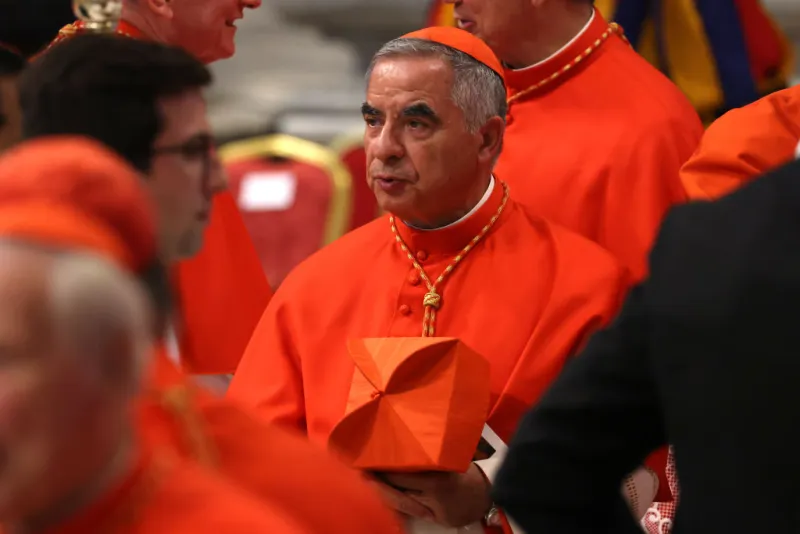
 Cardinal Giovanni Angelo Becciu attends the Consistory for the creation of new Cardinals at the St. Peter’s Basilica on Aug. 27, 2022, at the Vatican. / Photo by Franco Origlia/Getty Images
Rome Newsroom, Nov 30, 2022 / 11:00 am (CNA).
As the Vatican trial against Cardinal Angelo Becciu and nine others rounds the corner in its 16th month, recent court hearings have introduced a few revelations about the case as well as possible new accusations against the Secretariat of State’s former No. 2.
Here are some of the latest twists and turns in the trial to prosecute people in and around the Vatican for financial crimes.
A secret papal recording
During a Nov. 24 hearing, a Vatican prosecutor played a recording of a phone call between Pope Francis and Cardinal Becciu — secretly recorded on the cellphone of Becciu’s niece.
Though media and observers had to leave the courtroom while the recording, which had not yet been admitted into evidence, was played, Italian news agency Adnkronos later published a full transcript.
The recording revealed, Vatican prosecutor Alessandro Diddi said in court, that Becciu had called Pope Francis on July 24, 2021 — 10 days after the pope had surgery on his colon and three days before the start of the trial — to ask him to confirm that he had authorized payments to free a kidnapped nun in Mali.
During the phone call, Becciu lamented that a letter from the pope repeated the same accusations of prosecutors. “I almost should not go to trial anymore because, I’m sorry, but the letter you sent me is a condemnation,” he said, according to the transcript published by Adnkronos.
The cardinal also reportedly said he would not be able to call Pope Francis as a witness in the trial, which is why he was calling him to have his statement that he had authorized the financial operations.
Francis said he wanted to stay above the fray of the trial and asked Becciu to put his questions to him in writing.
Possible criminal conspiracy
In the same hearing, Diddi said he also was investigating a new possible charge against Becciu and others: criminal conspiracy.
The accusation concerns the charge that Becciu misused Vatican funds to support the cooperative SPES — which works with the local Caritas in Becciu’s home Diocese of Ozieri in Sardinia. SPES is mostly managed by the cardinal’s family members.
Diddi said financial police in Sardinia have found falsified documents apparently used to justify a transfer of money from Caritas to SPES in 2018.
Police found that 927 transport documents for bread had actually been created in the summer of 2021, a few weeks before the start of the Vatican trial, and back-dated to 2018.
Becciu sues — and loses
An Italian court last week rejected a defamation lawsuit filed by Cardinal Becciu against three journalists at the Italian newspaper L’Espresso.
Becciu was ordered to pay 40,000 euros in court costs to the GEDI Publishing Group, which owned L’Espresso when the complaint was filed.
The cardinal’s lawyer had argued that L’Espresso’s reporting in 2020 had cost Becciu the chance to be pope. His lawsuit asked judges to award him 10 million euros in compensation.
This was Becciu’s second lost lawsuit this month. Earlier in November, a judge in northern Italy ordered the cardinal to pay over 20,000 euros each in court costs to his former collaborator Monsignor Alberto Perlasca and Perlasca’s friend after suing them for “persecutory acts.”
In his sentence, the judge called Becciu’s lawsuit an “abuse of the procedural instrument” and also directed the cardinal to pay 9,000 euros in damages to Perlasca.
Becciu could choose to appeal the decisions.
Perlasca’s day in court
Monsignor Perlasca, the former head of administration at the Secretariat of State, testified two days last week, his first time taking the stand during the Vatican’s finance trial. His questioning continued on Nov. 30.
Perlasca was once considered a suspect in the finance investigations, but he was never charged after volunteering information to investigators during extensive questioning in 2020 and 2021. He is now the prosecution’s star witness.
Perlasca had sought to have most of his pretrial interrogations excluded from evidence at trial. He argued that due process was not followed since he did not have a lawyer with him while questioned.
But the president of the Vatican court, Giuseppe Pignatone, denied the plea on the eve of Perlasca’s testimony, only excluding a part of one interrogation from Aug. 31, 2020.
Perlasca, who contradicted his prior statements throughout questioning Nov. 24 and 25, was warned by Pignatone to be careful of his answers — or risk being charged with perjury.
When asked about the Secretariat of State’s decisions around the purchase of the London building, the investment at the heart of the trial, Perlasca claimed to have so little power that he could not even sign his name to anything.
But the prosecutor pointed out that Perlasca’s name was signed to the “framework agreement” that transferred the management of the London property from Raffaele Mincione to Gianluigi Torzi, both defendants in the trial.
Perlasca said the “current sostituto,” or No. 2, at the Secretariat of State, Archbishop Edgar Peña Parra, told him to sign it.
The former right-hand man of Becciu said he did not know much about financial affairs, unlike his predecessor in the position, and distanced himself from all responsibility, despite having been the head of administration.
He said Becciu is guilty of all the charges against him and insinuated the cardinal put pressure on him, while he himself is “neither accomplice, nor conniver, nor abettor.”
Perlasca also downplayed threats of suicide he made to Becciu over messages, calling them “provocations” now being exaggerated for dramatic effect.
According to Perlasca, Becciu suggested multiple times he should visit his brother, Mario Becciu, a psychologist and licensed therapist in Rome.
A statement from Becciu’s lawyers welcomed the opportunity to examine Perlasca’s claims in court and said the priest’s testimony did not correspond to the accusations against their client.
Earlier this year, Perlasca entered the Vatican trial as a civil plaintiff, joining the Secretariat of State; the Vatican’s two financial bodies, APSA and the IOR; and internal financial watchdog authority ASIF in requesting damages.
[…]



Leave a Reply