A thief on Friday returned the relics of a 19th-century Polish saint who inspired St. John Paul II and apologized for taking them.
St. Joseph’s Church in the Podgórze district of Kraków, southern Poland, announced on its Facebook page June 18 that the relics of St. Albert Chmielowski had been safely returned.
It said: “Today, just before 7 a.m. the stolen relics of St. Brother Albert returned to our Sanctuary. The perpetrator of the theft brought them personally and apologized for the situation. Thanks be to God! Thank you for your prayers!”
The parish reported the theft on June 11. “Let us pray for conversion and repentance for the perpetrator,” it said on Facebook.
In a newsletter dated June 13, it told parishioners: “We regret to inform you that last Tuesday after 9 a.m. a reliquary with the relics of St. Brother Albert was stolen from the Apostles of Mercy Altar.”
Chmielowski — known as Brat Albert (Brother Albert) in Poland — was born into a wealthy aristocratic family in 1845. He was injured at the age of 18 while participating in an uprising against Russian forces. His leg was amputated without an anesthetic.
He studied art and became a well-known painter in Kraków. But feeling a call to help those in need, he abandoned the art world, becoming a Secular Franciscan and taking the name Albert.
In 1887, he founded the Brothers of the Third Order of St. Francis, Servants of the Poor (Albertine Brothers). In 1891, he founded the Albertine Sisters. Both branches were dedicated to service of the poor and homeless.
Brother Albert died on Christmas Day 1916.
In 1949, the future Pope John Paul II wrote a play about Albert called “Our God’s Brother.” It was made into a film in 1997, directed by Krzysztof Zanussi.
The Polish pope recalled that when he was considering the priesthood he drew inspiration from Albert’s decision to leave the art world for a life of radical service.
John Paul II beatified Albert in 1983 and canonized him six years later, on Nov. 12, 1989. His feast day is June 17.
If you value the news and views Catholic World Report provides, please consider donating to support our efforts. Your contribution will help us continue to make CWR available to all readers worldwide for free, without a subscription. Thank you for your generosity!
Click here for more information on donating to CWR. Click here to sign up for our newsletter.
Pope Francis waves to pilgrims in St. Peter’s Square gathered for his weekly general audience on April 3, 2024. / Credit: Vatican Media
Vatican City, Apr 3, 2024 / 09:05 am (CNA).
Pope Francis during his general audience on Wednesday deplored the recent killing of humanitarian workers in the Gaza Strip, with the Holy Father renewing his appeal for an immediate cease-fire amid the ongoing Israel-Hamas war.
The pope buttressed his plea with a catechesis focused on the virtue of justice, noting that it is the building block for a well-ordered society premised upon the rule of law.
“I express deep regret for the volunteers killed while distributing food aid in Gaza,” the pope said to the 25,000 gathered in St. Peter’s Square on an overcast Wednesday morning.
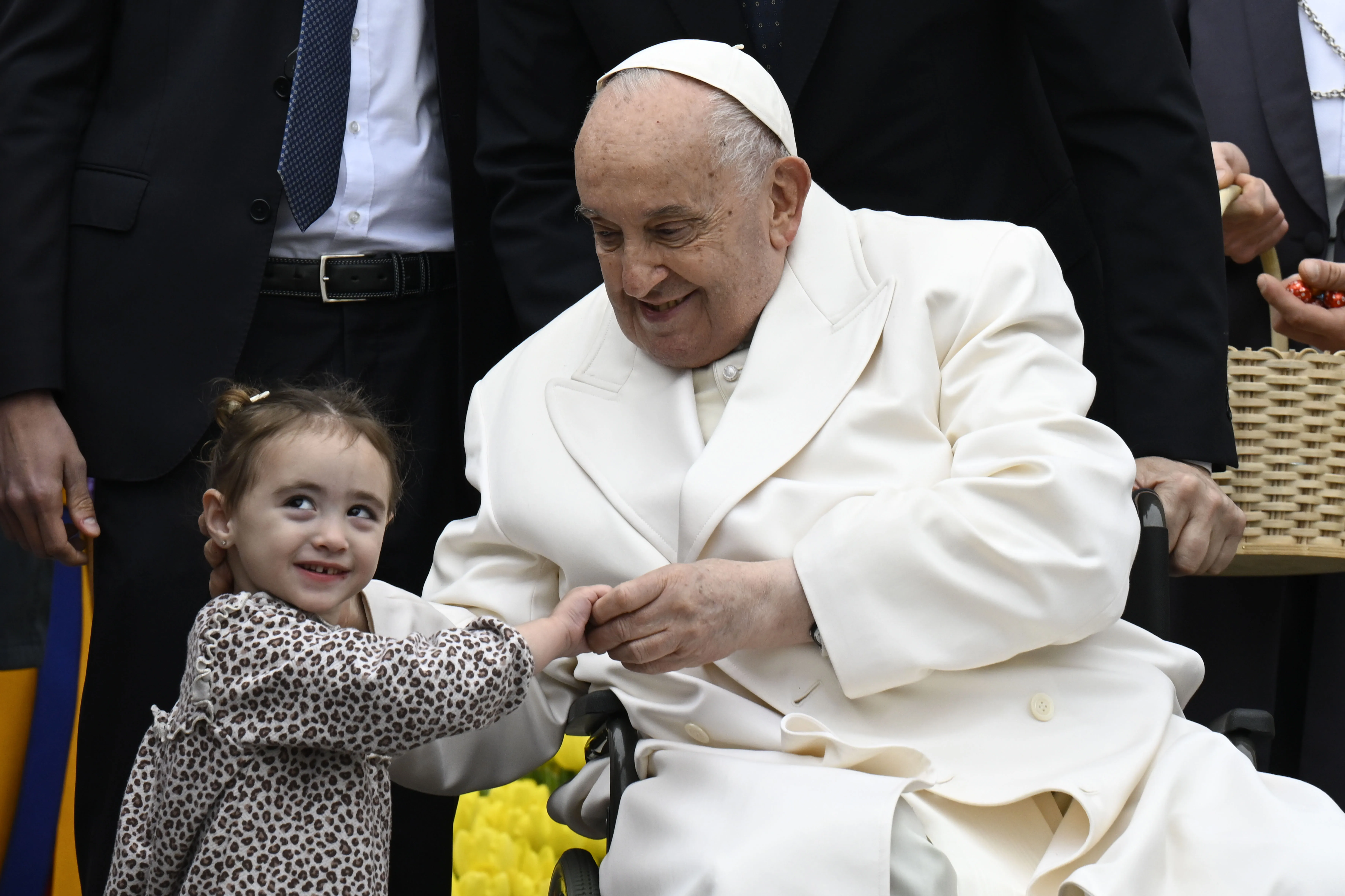
Pope Francis greets a young girl in St. Peter’s Square during his general audience on April 3, 2024. Credit: Vatican Media
Seven volunteers from the nonprofit World Central Kitchen were killed in an Israeli strike on Monday while traveling in a “deconflicted zone” after delivering 100 tons of food aid to a town in central Gaza.
Israeli Prime Minister Benjamin Netanyahu called the incident “tragic,” suggesting that the Israel Defense Forces “unintentionally struck innocent people in the Gaza Strip.”
Pope Francis on Wednesday reiterated his regular call for an immediate cease-fire in the Gaza Strip so that the “exhausted and suffering civilian population be allowed access to humanitarian aid.” The civilian death toll continues to mount in the beleaguered zone with reportedly nearly 33,000 deaths.
The pope also turned his attention to the ongoing war in “tormented” Ukraine. At one point Francis set down the text of his address to hold up a rosary and a copy of the New Testament that belonged to a slain 23-year-old Ukranian soldier named Oleksandr.
“This 23-year-old boy died in Avdiïvka, in the war. He left a life ahead of him,” the pope said. “I would like to have a little silence at this moment, everyone, thinking of this boy and of many others like him who died in this madness of war. War always destroys! Let us think of them and pray.”
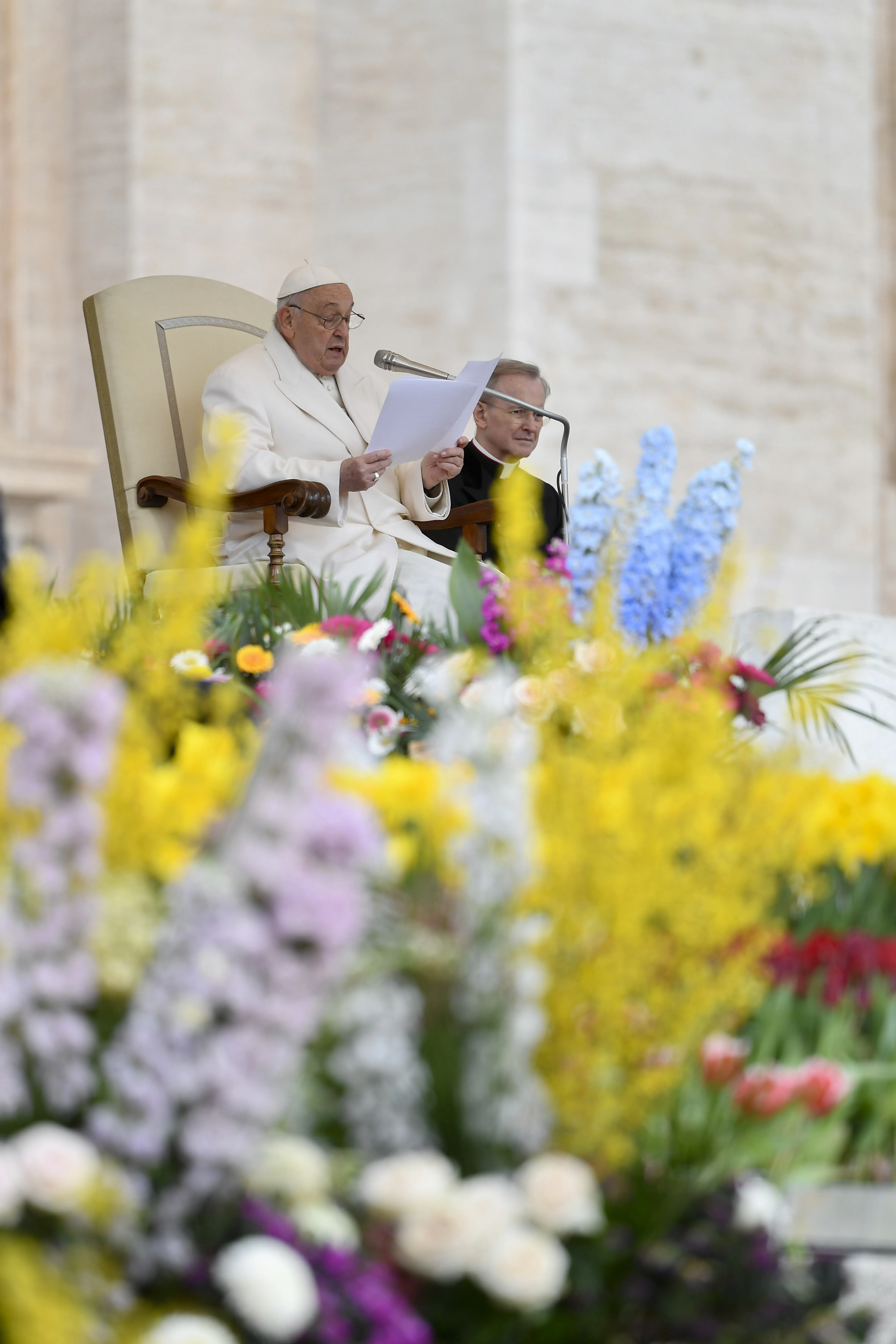
Pope Francis addresses pilgrims gathered in St. Peter’s Square during his general audience on April 3, 2024. Credit: Vatican Media
Against the backdrop of these parallel conflicts, the pope framed his reflection on the virtue of justice, observing that it forms the basis of a well-ordered civil society that is built upon the rule of law — a principle of governance premised on the impartial application of legal norms for all citizens, institutions, and leaders.
“Without justice, there is no peace,” Pope Francis said. “Indeed, if justice is not respected, conflicts arise. Without justice, the law of the prevalence of the strong over the weak is entrenched.”
The pope stressed that justice is as a critical underpinning for the common good and the management of civil society, noting: “It is the virtue of law that seeks to regulate the relations between people equitably.”
“A world without laws,” without justice — and the corollary virtues of “benevolence, respect, gratitude, affability, and honesty” — would “be a world in which it is impossible to live,” the pope said.
“The righteous person reveres laws and respects them, knowing that they constitute a barrier protecting the defenseless from the tyranny of the powerful,” the pope expressed. “The righteous person does not think only of his own individual well-being but desires the good of society as a whole.”
The pope defined the characteristics of the “righteous person” in part as one who “desires an orderly society.”
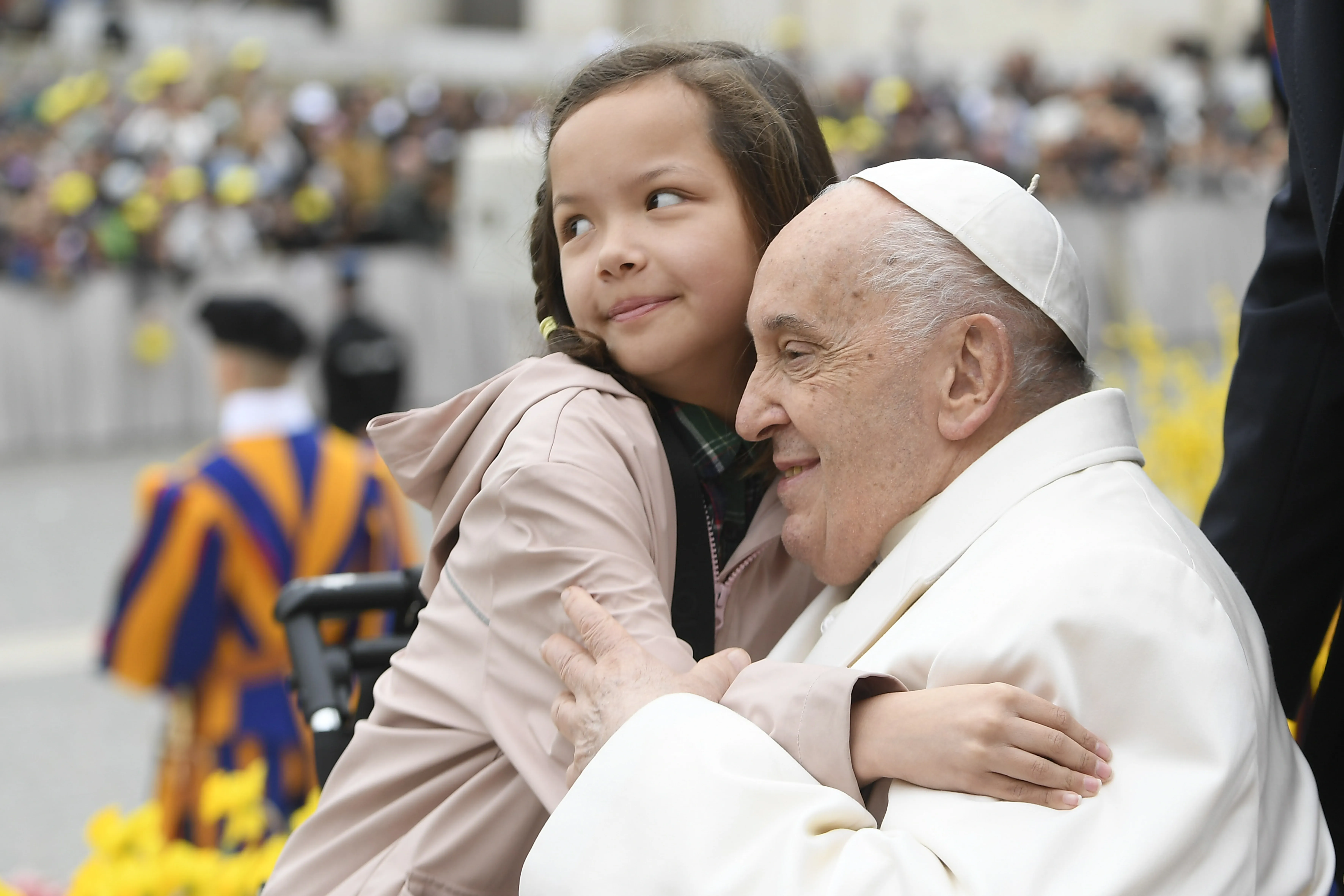
A young girl embraces Pope Francis during his general audience in St. Peter’s Square on April 3, 2024. Credit: Vatican Media
“He desires an orderly society, where people give luster to the office they hold, and not the other way around. He abhors recommendations and does not trade favors. He loves responsibility and is exemplary in promoting legality,” the pope continued.
The pope stressed the importance of imparting the virtue of justice into young people so as to build a “culture of legality.”
“It is the way to prevent the cancer of corruption and to eliminate criminality, removing the ground from beneath it.”
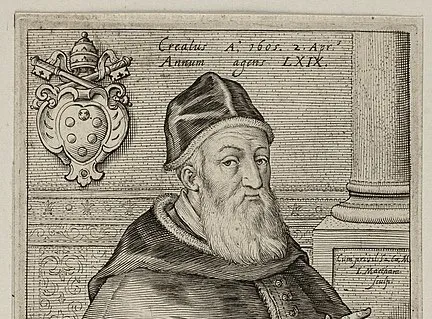
Jacob Matham’s portrait of Leo XI, who reigned April 1-27, 1605. / public domain
Denver Newsroom, Sep 18, 2022 / 14:00 pm (CNA).
Blessed John Paul I did not serve as Roman Pontiff for long, but 10 other popes had shorter pontificates than he did. Their stories are a microcosm of the history of the papacy. Some were friends of saints and worked for the good of the Church, while the qualifications of others might be a bit questionable. Through all these more or less flawed men who sat in the Chair of Peter, the Catholic Church teaches that the connection to St. Peter and his profession of faith in Christ endures.
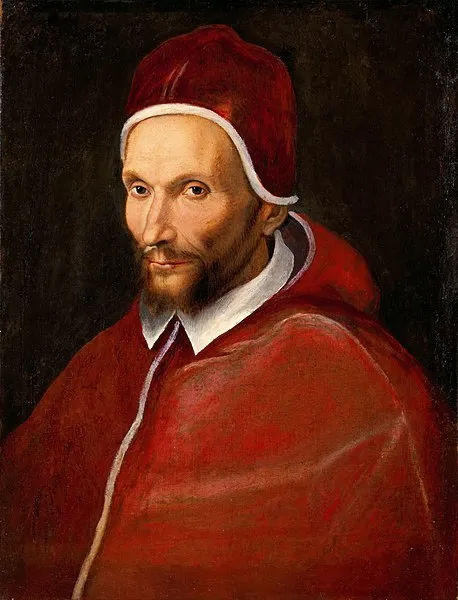
Urban VII was pope for 13 days, Sept. 15–27, 1590.
He was born Giambattista Castagna at Rome, the home city of his mother. His father was of Genoan nobility. His uncle was a cardinal, whom he served at points during his long career in the Church. He held doctorates in civil and canon law.
Castagna worked in government and diplomacy on behalf of the papacy, which at the time held civil power over parts of Italy. He led several commissions during the Council of Trent and helped organize the military alliance against the Ottoman Empire, according to the New Catholic Encyclopedia. He was appointed archbishop in 1553 and became a cardinal in 1583.
He had a reputation for genuine piety, intelligence, and ability to govern.
Jacopino del Conte’s portrait (c. 1590) of Urban VII. public domain
After his election as pope, he made sure to address the needs of the poor in Rome. His initial plans included expanded public works to employ the poor.
As God’s providence allowed, he did not have time to do much more than plan. He died of malaria at the age of 69. In his will, he left his personal fortune to support poor girls.
Celestine IV reigned for 15 days, Oct. 25–Nov. 10, 1241.
The future pope was born Goffredo da Castiglione in Milan. He spent time with the Cistercian religious order and was a cardinal bishop of Sabina. He was a nephew of Pope Urban III. He was already in poor health when he was elected, at a time when the papacy was a center of political conflict between backers and opponents of Holy Roman Emperor Frederick II.
Boniface VI reigned for 16 days, April 11–26, 896.
He was born in Rome. Not much is known about this pope, though records indicate that during his life he was canonically deprived of holy orders on two occasions: the first time as a subdeacon, and the second as a priest. His irregular past caused controversy over his election, the New Catholic Encyclopedia says.
Theodore II reigned for 20 days in December 897.
Another little-known pope, it is said that his clergy loved him, that he loved peace, and that he lived a life of chastity and charity to the poor. He came to power soon after a low point of the papacy. Pope Theodore annulled the acts of the “Cadaver Synod,” which had put on trial the corpse of his predecessor, Pope Formosus. He recovered the dead Roman Pontiff’s body from the River Tiber and gave it a proper burial. He also reinstated clergy who had been forced to resign.
Sisinnius was pope for 21 days, Jan. 15–Feb. 4, 708.
This pope was born in Syria. His health troubles included disabling arthritis, and he was unable to feed himself. The papacy was responsible for the military defense of Rome at this time, with Lombards invading from the north of Italy and Muslim armies advancing from the south. Sisinnius ordered the walls of Rome to be reinforced as his first act, the New Catholic Encyclopedia says. Before he died, Pope Sisinnius ordained one priest and consecrated a bishop for Corsica.
Marcellus II was pope for about 22 days in April and May, 1555.
He was born Marcello Cervini, at Montefano in Tuscany. Like the sainted Pope Marcellus of the fourth century, he kept his baptismal name as his papal name.
His father worked under several pontificates as a scribe and secretary.
Before Cervini was elected pope he served various roles as a secretary to popes and cardinals, including work to correct the Julian calendar. He was actively engaged with the “New Learning” of Renaissance humanism. He served as protector of the Vatican Library and helped improve and expand its collection. Cervini served the Vatican at the time of its response to the Protestant Reformation. He was a president at the Council of Trent, which continued through his short pontificate.
He gained a reputation as a Church reformer and had hoped to pursue this path during his papacy. He was not consecrated a bishop until the day after he was elected pope.
Pope Marcellus reputedly became sick from overwork during the celebrations of Holy Week and Easter, and the illness turned fatal.
The Missa Papae Marcelli of Giovanni Pierluigi da Palestrina was composed in his honor.
Damasus II reigned for 24 days in July and August, 1048.
This pontiff was named Poppo. He was born in Bavaria and was of German extraction. He served as Bishop of Brixen in Tyrol, in what is now western Austria.
Popes at the time could be nominated in an unusual manner. Pope Damasus II was named by Holy Roman Emperor Henry III. The pope, however, soon died of malaria.
Pius III was pope for 27 calendar days, Sept. 22–Oct. 18, 1503.
He was born Francesco Todeschini in Siena. He was the nephew of Pope Pius II, a famous Renaissance-era pope. His uncle took him into his household and became his patron, allowing the young man to add the pontiff’s family name Piccolomini to his own last name.
Francesco studied canon law. His uncle named him to become administrator of the Archdiocese of Siena and later made him a cardinal-deacon.
The future Roman Pontiff had a reputation of living an upright life as a cultured, gentle man, the New Catholic Encyclopedia reports. He took part in several conclaves of his time, including that which elected Alexander VI.
His service to the papacy included several diplomatic appointments to Germany, France, and Perugia.
Francesco’s own papal election took place amid ruling Italian families’ disputes over control of Rome and included an unsuccessful power play by the Borgia family.
Pius III was known to be in poor health. At the time of the papal coronation he was already suffering from a diseased leg, which developed into a septic ulcer. He died at the age of 64.
Leo XI was pope for 27 days, from April 1–27, 1605.
The Florentine-born Alessandro de Medici was a member of the famous Medici family. He was grand-nephew to Pope Leo X. He sought to become a priest from an early age, but because his mother objected he was not ordained until after she died, according to the New Catholic Encyclopedia. He served as an ambassador to Rome on behalf of Tuscany, before he began to advance in the Church. He would eventually become a bishop, then archbishop of Florence, before being named a cardinal.
He served as a papal legate to France and was head of the Congregation of Bishops.
Among his great friends was St. Philip Neri, founder of the Oratorians.
He was elected pope at the age of 69 and became sick almost immediately.
Benedict V served as pope for 33 days, May 22–June 23, 964.
He was born in Rome and had a reputation for great learning.
He reigned at a time of great turmoil in the Church. Holy Roman Emperor Otto I had interfered with the pontificates of his predecessors. The emperor had forcibly deposed a pope and installed his own nominee on the See of Peter. There were rival claimants to the papacy under Benedict V and Otto again interfered, laying siege to Rome and taking the pope away from Rome by force. Benedict either renounced the papacy or was forcibly deposed. He lived in exile in Hamburg for another year.
John Paul I served as Roman Pontiff from Aug. 26–Sept. 28, 1978, 33 calendar days.
His beatification on Sept. 4 renewed attention to his life. He had a reputation for humility and for teaching the faith in an understandable way.
The future John Paul I took part in the Second Vatican Council and was named patriarch of Venice.
As a cardinal, Luciani published a collection of “open letters” to historic figures, saints, famous writers, and fictional characters. The book, “Illustrissimi,” included letters to Jesus, King David, Mark Twain, Charles Dickens, and Christopher Marlowe, as well as Pinocchio and Figaro, the barber of Seville.
He was the first pope to have two names. He took his papal name from his immediate predecessors, Sts. John XXIII and Paul VI.
Pope Francis speaking at the general audience at the Vatican, Dec. 21, 2022. / Vatican Media
Rome Newsroom, Jan 25, 2023 / 08:10 am (CNA).
Pope Francis has reiterated that homosexuality is “not a crime” in a new interview published Wednesday.Th… […]


 By




Leave a Reply