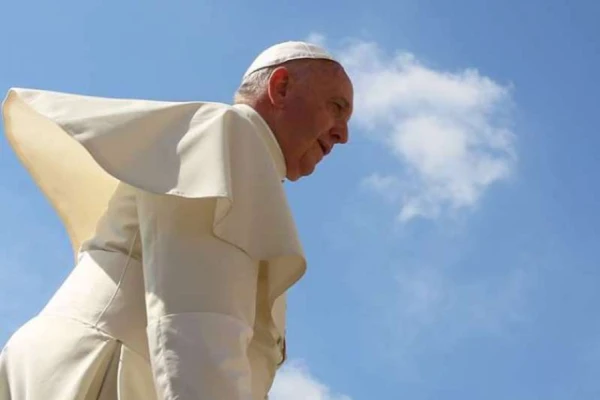
Pope Francis at a Wednesday general audience in St. Peter’s Square on June 17, 2015. Credit: Bohumil Petrik.
Vatican City, Mar 4, 2021 / 04:00 am (CNA).- A day before he departs for Baghdad, Pope Francis sent a video message to the Iraqi people, saying that he was coming to Iraq as “a pilgrim of peace.”
“I am coming as a pilgrim, as a penitent pilgrim, to implore from the Lord forgiveness and reconciliation after years of war and terrorism, to beg from God the consolation of hearts and the healing of wounds,” the pope said in the video message released March 5.
“Yes, I am coming as a pilgrim of peace, seeking fraternity and prompted by the desire to pray together and to walk together, also with our brothers and sisters of other religious traditions, in the steps of Father Abraham, who joins in one family Muslims, Jews and Christians,” he said.
Pope Francis expressed his desire to see his “dear brothers and sisters in Iraq” and to visit “an ancient and extraordinary cradle of civilization.”
The pope said that he felt “honored to meet a martyr Church,” and expressed gratitude to Christians in Iraq “who have witnessed to their faith in Jesus in the midst of very hard trials.”
“You still have in your eyes the images of destroyed houses and desecrated churches, and in your heart the wounds of affections left behind and abandoned houses,” he said.
“I would like to bring you the affectionate caress of the whole Church, which is close to you and to the tormented Middle East and encourages you to move forward.”
In the video message to the Iraqi people, Pope Francis said two phrases in Arabic: “As-salamu alaykum,” which means “peace be upon you” and “shukran,” which means “thank you.”
“Dear brothers and sisters, I have thought so much of you in these years, of you who have suffered so much, but you have not been despondent. To you, Christians, Muslims; to you, peoples, like the Yazidi people, the Yazidis, who have suffered so much, so much; all brothers, all. Now I come to your blessed and wounded land as a pilgrim of hope,” the pope said.
“From you, in Nineveh, the prophecy of Jonah resounded, which prevented the destruction and brought a new hope, the hope of God. Let us allow ourselves to be infected by this hope, which encourages us to rebuild and start over.”
Pope Francis’ March 5-8 trip to Iraq will take him from excavations of historical biblical sites dating back thousands of years to churches where Catholics suffered horrific terrorist attacks only a few years ago.
He will visit a Catholic church in Baghdad on March 5 that was the site of a suicide attack by the Islamic State during Sunday Mass in 2010 in which more than 50 people were killed.
The following day he will meet with Muslim and other religious leaders in Ur in southern Iraq, which the Bible records as the birthplace of Abraham.
“Let us not give up in the face of the spread of evil: the ancient sources of wisdom of your lands direct us elsewhere, to do as Abraham who, while leaving everything, never lost hope; and trusting in God, he gave birth to descendants as numerous as the stars of heaven,” Pope Francis said in his video message.
“From you, millennia ago, Abraham began his journey. Today it is up to us to continue it, with the same spirit, along the paths of peace together,” he said. “For this reason, upon all of you I invoke the peace and blessing of the Most High. And I ask all of you to do the same as Abraham: walk in hope and never stop looking at the stars. And I ask everyone to please accompany me with prayer. Shukran.”
If you value the news and views Catholic World Report provides, please consider donating to support our efforts. Your contribution will help us continue to make CWR available to all readers worldwide for free, without a subscription. Thank you for your generosity!
Click here for more information on donating to CWR. Click here to sign up for our newsletter.

A photo of Deborah Emmanuel’s photo on her Facebook page. Emmanuel, a Christian student in Nigeria, was killed by an Islamic mob on her college campus on May 12, 2022. / CNA
Washington, D.C. Newsroom, Jun 23, 2022 / 14:01 pm (CNA).
Deborah Emmanuel, the Nigerian Christian student who was murdered by a Muslim mob last month, spent her final hours with a close friend who has shared exclusive details of the brutal killing with CNA.
CNA is using the pseudonym “Mary” for the woman’s protection. A Christian herself, she nearly was killed by the same mob.
Significantly, Mary’s account contradicts the claim of authorities that they attempted to rescue Emmanuel from the mob but were “overwhelmed.”
On the contrary, the police “could have stopped the murder if they had really tried,” Mary told CNA.
Emmanuel’s so-called “blasphemy murder” took place on May 12 on the campus of Shehu Shagari College of Education in Sokoto, Sokoto State, a major city located in the northwest corner of Nigeria. The city is home to the Muslim Sultan who serves as the top religious authority for Nigeria’s 100 million Muslim believers.
Prior to the attack, Emmanuel, a home economics major who attended Evangelical Church Winning All, was bullied by fanatical Muslim students at the teacher’s college for audio statements she made on WhatsApp, a messaging platform. She credited Jesus Christ for her success on a recent exam, and when threatened and told to apologize she refused, invoking the Holy Spirit, saying “Holy Ghost fire! Nothing will happen to me,” according to WhatsApp messages reviewed by CNA.
In the aftermath of these heated exchanges, a Muslim mob attacked Emmanuel on the college’s campus. After an hours’ long siege, the mob beat and stoned her to death, then set her body on fire with burning tires, according to graphic video footage posted online. The rioters also rampaged in a Catholic Church compound in Sokoto, according to reports. The riots spread to other Christian-owned properties over two days.
A relative of Emmanuel’s, who said he was standing approximately 60 feet from the mob, also told CNA he believes the police could have saved her. He, too, asked that his identity be withheld for his safety.
Unarmed campus security personnel made a futile attempt to rescue Emmanuel, according to a campus security report shared with CNA. But Emmanuel’s relative said there were dozens of armed police officers on the scene who didn’t fire their weapons.
The commissioner of police in the state also said officers did not fire their weapons. However, he maintained that only 15 of his officers were at the scene, according to a report in The Epoch Times.
Bishop Matthew Hassan Kukah of the Diocese of Sokoto has strongly condemned the attack and called on Emmanuel’s killers to be brought to justice..
“This matter must be treated as a criminal act,” he said. You can read his full statement here.
A plea for help
On the day of Emmanuel’s death, Mary received a frantic phone call from her around 9 a.m, asking for help. By that time, women who lived in her dormitory had begun slapping Emmanuel, Mary told CNA.
Mary arrived at the campus to see her friend surrounded by a mob and being led by a campus staffer to a gatehouse building for her protection. The Muslim students had bloodied her face and head with blows from rods and were joined by male students who believed their duty was to execute a blasphemer on the spot, Mary said.
“Allahu Akbar!” meaning “God is Great” was bellowed for hours, she said.
Mary initially stayed outside the building and tried to intercede for her friend, but she said it wasn’t long before the mob turned on her, too. Within moments Mary was trying to ward off punches and blows from sticks as she backed away from the gatehouse and toward the gate of the college 40 feet away.
Mary said a college lecturer rescued her and brought her to join Emmanuel inside the gatehouse by 10 a.m.
At 10:25 a.m., the relative said, six officers of the Department of State Security (DSS) — the equivalent to the FBI in the U.S. — arrived, firing their rifles in the air but with no effect. Five minutes later, he said, a group of Sokoto police came on the scene and fired tear gas, temporarily scattering the mob.
The above map is based on eyewitness accounts of the murder of Nigerian Christian student Deborah Emmanuel on her college’s campus on May 12, 2022. Graphic by Alexander Hunter
For about 10 minutes police had an opportunity to disperse the mob and force their way to the gatehouse to extract Mary and Emmanuel, Emmanuel’s relative believes. But that did not happen.
By 11 a.m., the mob had returned to the building, holding cloths against their faces to ward off the tear gas. The mob tried hurling stones at Mary through the windows of the locked gatehouse, but Mary barricaded herself behind a table.
The mob then threw gasoline on the women through the front windows and attempted to burn them alive, Mary said.
“Deborah was soaked with gasoline, but when lighted plastic was pitched in through the windows, I quickly stamped the flames out,” Mary said.
No escape
All of this transpired as police and DSS officers watched from a safe distance, according to Emmanuel’s relative.
The traumatized women said little to each other, but Emmanuel was still hoping to do her examination that day, Mary said. At one point, she recalled, Emmanuel asked, “What time is it? I have an examination at noon.” Mary said she looked at her cell phone and told her it was 1 p.m.
After another excruciating hour of siege, the mob pushed down a single Sokoto policeman guarding the door, broke the padlock on the door, and rushed in to find Mary and Emmanuel hiding behind furniture, Mary and the relative related. Two rioters placed a chain around Mary’s neck and pulled it hard, trying to strangle her, she recounted.
“Let this girl go! She is not an offender,” Mary recalled one of the rioters shouting. But as they released her, a young man in the mob grabbed Emmanuel and took her to the front steps of the gatehouse. There she was bludgeoned with steel pipes and wooden rods and stoned, the relative said.
Two DSS officers attempted to rescue Emmanuel but were hit by stones and pushed aside, the relative said. The police officers remained in position and did not come to her aid, he alleged.
Mary collapsed inside the gatehouse gasping from the strangulation. Approximately 40 minutes later, she said, she was roused by one of the mob to leave the building, which was on fire.
As she walked through the smoke, Mary saw the gatehouse burning and Emmanuel’s lifeless body in flames.
The face of Christian persecution
In the aftermath of Emmanuel’s murder, human rights advocates and others have leveled sharp criticism at Nigeria’s government leaders for not doing enough to stem the rising tide of violence directed at Christians and other non-Muslims.
Relatives of Deborah Emmanuel at her burial in Niger State, Nigeria. Courtesy of the Emmanuel family
Anti-Christian hatred was evident in days of rioting in Sokoto following the arrest of two suspects in Emmanuel’s murder. The rioters reportedly were incensed that there were any arrests at all.
“Deborah Emmanuel, like kidnapping victim Leah Sharibu (who was enslaved by Boko Haram insurgents in 2019), has become the face of Christian persecution in Nigeria,” said Kyle Abts, executive director of the International Committee on Nigeria (ICON). “There has not been an official report from the security forces on the lynching of Ms. Emmanuel. Her killing and subsequent riots show clear government complicity and coverup.”
Tina Ramirez, founder of the international nonprofit Hardwired Global, also believes the Nigerian government has been unwilling to take a strong stand against blasphemy killings.
“The recent attacks on students are reminiscent of the attacks at Nigerian colleges two decades ago that were the precursor to the growth of extremist groups across Nigeria’s North and Middle Belt,” Ramirez wrote in a text to CNA.
Leave a Reply