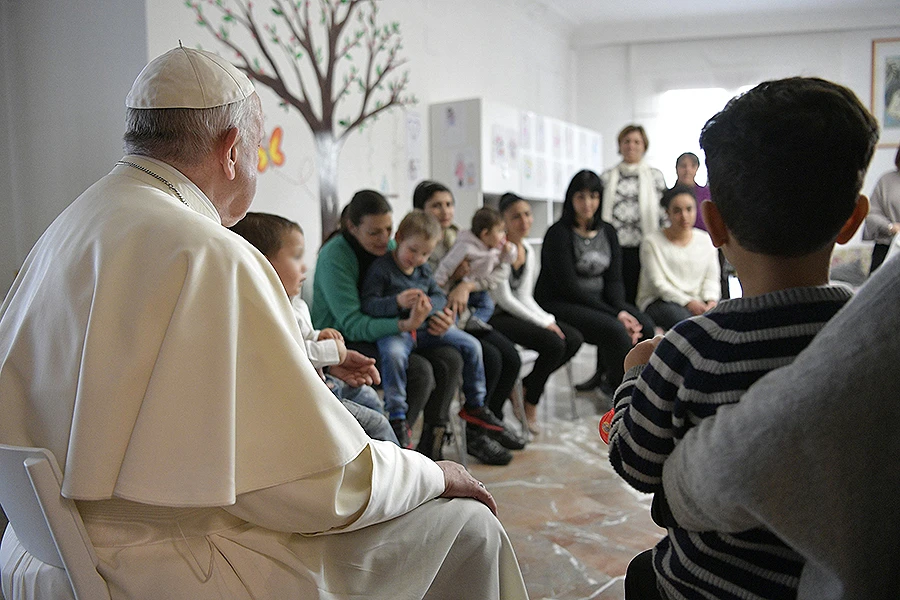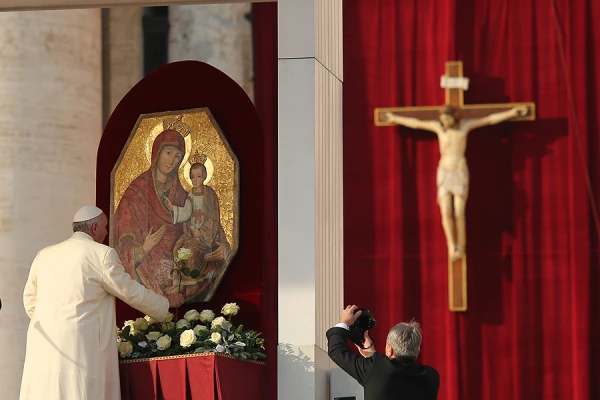
Rome, Italy, Mar 11, 2020 / 03:21 pm (CNA).- As the Diocese of Rome holds a day of prayer and fasting for victims of coronavirus, Pope Francis sent a message asking for the protection of the Blessed Virgin Mary, invoking her under her title of Salus Populi Romani.
“Under Your protection we seek refuge, Holy Mother of God. Do not despise the entreaties of us who are in trial, and free us from every danger, glorious and blessed Virgin,” Francis prayed March 11 via video.
“You, Protectress of the Roman People, you know what we need and we are sure that you will provide so that, as in Cana of Galilee, joy and celebration may return after this trying moment,” he said.
The pope’s prayer video was sent as part of the Diocese of Rome’s call to spend March 11 in prayer and fasting for those who are sick with or have died from coronavirus.
The vicar general of the Diocese of Rome, Cardinal Angelo De Donatis, said Mass at the Sanctuary of Our Lady of Divine Love, on the outskirts of Rome, as part of the day’s special prayers.
The diocese is also collecting monetary donations to provide support to healthcare workers as they sacrifice to care for the sick.
A communication from the vicariate of Rome said the day is “a moment of grace, when united in spiritual communion, we will feel like brothers and sisters in faith, in solidarity, and not suspicious of each other.”
“We will pray not only for our city, but for Italy and for the whole world,” it said.
In Italy, as of March 11, the number of confirmed coronavirus cases reached over 10,500. At least 827 people have died from the virus in the country. Rome has 99 active cases.
The Italian government put the country on a nationwide lockdown through April 3 to help contain the spread of the virus.
The quarantine prevents movement within the country and limits other travel. People are required to stay at home except to go to work, the supermarket, or the pharmacy.
“Oh Mary, you always shine on our way as a sign of salvation and hope,” Pope Francis prayed. “We rely on you, Health of the Sick, that at the cross you were associated with the pain of Jesus, keeping your faith firm.”
“Help us, Mother of Divine Love, to conform to the will of the Father and to do what Jesus will tell us, which took our suffering upon itself and took on our pains to lead us, through the cross, to the joy of the resurrection.”
If you value the news and views Catholic World Report provides, please consider donating to support our efforts. Your contribution will help us continue to make CWR available to all readers worldwide for free, without a subscription. Thank you for your generosity!
Click here for more information on donating to CWR. Click here to sign up for our newsletter.

Father Patrick Hughes shows how to make a traditional St. Brigid’s Cross in County Cavan, Ireland. / Credit; Courtney Mares/CNA
Rome Newsroom, Feb 1, 2024 / 06:00 am (CNA).
Ireland on Thursday is celebrating the 1,500th anniversary of the death of St. Brigid of Kildare, the Emerald Isle’s female patron saint.
St. Brigid (c. 453–524 A.D.) is credited with pioneering female monastic life in Ireland. Her feast is celebrated on Feb. 1, which became an annual public bank holiday across Ireland last year in her honor.
“St. Brigid was a huge figure of authority in the early Church, baptized by St. Patrick, professed by St. Mel, spiritual adviser to St. Conleth,” Bishop Denis Nulty of Kildare and Leighlin said at a Mass ahead of her feast.
Ireland’s Kildare County has organized lectures, pilgrimages, and many activities in its Brigid 1500 Program to mark the anniversary, including a workshop on how to weave a St. Brigid’s Cross — St. Brigid’s most enduring symbol.
A St. Brigid’s cross is traditionally made out of rushes or reeds freshly pulled from the ground.
Father Patrick Joseph Hughes, a country priest in County Cavan, can make a St. Brigid’s cross from rushes in a matter of minutes.
Hughes told CNA that the story that has been handed down over the years is that St. Brigid was trying to explain to the local chieftain, who did not believe in God, that Jesus was his savior and died on a cross for him. The chieftain did not understand, so she made a cross out of rushes from the ground and presented it to him: “‘Look,’ she said, ‘that’s a cross, and Jesus was stretched out on that for the world.’”
On the eve of the Feast of Saint Brigid, it is tradition in Ireland to make a St. Brigid’s Cross out of rushes.
Last year while we were filming in Ireland, Father Patrick Hughes gave us a quick demonstration of how to make one.
St. Brigid’s Catholic Church in Kildare will kick off the feast day on Feb. 1 with a Mass at 9:15 a.m. offered by Bishop Nulty.
The bishop recently installed St. Brigid’s relics in St. Brigid’s Catholic Church on Jan. 29 as part of the 1,500th anniversary celebrations.
The relics were taken from the bone fragment of St. Brigid’s head, which has been kept in St. John the Baptist Church in Lumiar, Portugal, since three Irish knights brought it there in 1273. The Portuguese church gave the relic to the Brigidine Sisters in Tullow, Ireland, in the 1930s, and they recently gifted it to St. Brigid’s in Kildare.
“Today we have brought her home,” Nulty said. “Obtaining the relic of a saint like Brigid is no easy feat. I visited Lumiar in October 2021 with the singular intention of securing a relic for St. Brigid’s Church. I was privileged then to hold the relic of her head, which is contained in a splendid brass casket. Sadly, I couldn’t squeeze it into my Ryan Air flight bag!”
Notably, the Catholic bishop and female Anglican leaders will also come together for an ecumenical service at 11 a.m. on the feast day at the historic St. Brigid’s Cathedral, built on the site of the ancient hilltop where St. Brigid founded her monastery in the year 480 A.D. The previously Catholic cathedral, consecrated in 1230, is now an Anglican cathedral.
The service will be followed by a “pause for peace,” a minute of silent prayer for peace. St. Brigid was known as a peacemaker. Among the many stories told about St. Brigid, local tradition holds that Brigid gave away her father’s sword in exchange for food for a family suffering from hunger.
The fifth-century abbess St. Brigid is one of Ireland’s three patron saints, along with St. Patrick and St. Columba. Most historians place her birth around the year 450, near the end of St. Patrick’s evangelistic mission.
St. Brigid. Credit: Octave 444, CC BY-SA 4.0, via Wikimedia Commons
It is notoriously hard to establish the historical details of Brigid’s life, but according to one of the more credible biographies of Brigid — Hugh de Blacam’s essay in “The Saints of Ireland” — Brigid was born out of wedlock to a pagan chieftain named Dubthach and a Christian slave woman named Broicsech. The chieftain sold the child’s pregnant mother to a new master but contracted for Brigid to be returned to him eventually.
Brigid was likely baptized as an infant and raised as a Catholic by her mother. Thus, she was well formed in the faith before leaving Broicsech’s slave quarters at around age 10 to live with Dubthach and his wife.
After this, Brigid’s faith grew immensely. She gave generously to the poor and tended to the sick. One story says Brigid once gave away her mother’s entire store of butter, which was later replenished after Brigid prayed.
Once she was released from servitude, she was expected to marry. However, Brigid had no interest in marrying. She went so far as to disfigure her own face and prayed that her beauty be taken from her so no one would want to marry her. Because she refused to change her mind about marriage, she received permission to enter religious life.
Brigid, along with seven friends, is credited with organizing communal consecrated religious life for women in Ireland.
In 480, Brigid founded her monastery in Kildare, which was called “Church of the Oak.” The monastery sat on top of a shrine to a Celtic goddess. Throughout the rest of her life, she established several monasteries across Ireland.
Brigid rooted her life as a nun in prayer, but she also performed substantial manual labor: cloth making, dairy farming, and raising sheep. She also spent time traveling across Ireland founding new houses and building up a uniquely Irish form of monasticism. When she was not traveling, pilgrims made their way to Kildare, seeking the advice of the abbess.
“What were the character traits that defined St. Brigid of Kildare? To mention just a few, she was hospitable, she was a peacemaker, she was a strong woman of faith,” Nulty said.
CNA Staff, Sep 23, 2020 / 12:00 am (CNA).- After fire toppled the iconic spire and destroyed the roof of the Notre Dame Cathedral in Paris, France in April 2009, heated debates ensued about whether the reconstruction should use the church’s original design, or use a more modern design and technique.
Some proposed futuristic ideas included a rooftop swimming pool and a greenhouse atop the 850-year-old cathedral.
Last year, the French Senate passed a bill mandating that Notre-Dame be rebuilt as it was before the fire, with lumber and medieval carpentry techniques, which were highlighted in a public demonstration Saturday in the cathedral’s square.
“It shows…firstly that we made the right choice in choosing to rebuild the carpentry identically, in oak from France,” Gen. Jean-Louis Georgelin, who heads the reconstruction efforts, told the AP.
“Secondly, it shows us the…method by which we will rebuild the framework, truss after truss.”
The public carpentry demonstration was held Sept. 19 as part of European Heritage Days. The triangular truss highlighted at the event was the seventh of a total of 25 new trusses that will be installed in the nave of the cathedral during the rebuild.
Carpenters told the AP that they selected a truss with a more complex design for the event. The truss, built in July, was raised from the ground for display at the event using a pulley system. Once raised, a celebratory oak branch was tied to the top, a traditional “symbol of prosperity and a salute to the workers,” according to the AP.
“It’s a moment to see ancestral techniques that last. There is the present and the past and it links us to our roots,” Romain Greif, an architect attending the event with his family told the AP. “It’s an event.”
The trusses will be installed in the roof of the church at a yet unknown date. French president Emmanuel Macron has said he wants the reconstruction to be completed by 2024, when Paris is set to host the Olympics.
Last year on the evening of April 15, 2019, a major fire broke out at the cathedral, destroying the roof and the spire. Shortly after midnight April 16, firefighters announced that the cathedral’s main structure had been preserved from collapse.
The major religious and artistic treasures of the cathedral were removed as the fire began, including a relic of the crown of thorns.
Originally built between the twelfth through fourteenth centuries, the landmark cathedral in the French capital is one of the most recognizable churches in the world, receiving more than 12 million visitors each year.
Its original spire was constructed in the 13th century, but was replaced in the 19th century due to damage.
The cathedral was undergoing some restorative work at the time the fire broke out, though it is unknown if the fire originated in the area of the work.
Mass for U.S. military personnel at a forward operating base in Kandahar, Afghanistan, Dec. 23, 2001. / U.S. Navy photo by chief photographer’s mate Johnny Bivera (Public Domain).
Rome Newsroom, Aug 3, 2021 / 04:30 am (CNA).
As the U.S. is winding down its operations in Afghanistan after 20 years, there is much concern about the situation of the Church in the country. There is only one Catholic church in Afghanistan, located in the Italian embassy in Kabul, and consequently shut down as long as the embassy remained closed during the pandemic.
Afghanistan’s 2004 constitution defined the country as an Islamic republic. It is forbidden to preach the Gospel in public or to convert to Christianity.
This is the reason why missionaries and Catholics in Afghanistan rarely speak on the record: they apply some necessary prudence in a challenging environment. CNA spoke with them and agreed to their requests for anonymity.
In 2002, Pope John Paul II established a mission sui iuris, or independent mission, in Afghanistan serving some 210 Catholics with three priests.
But there are other missionaries in Afghanistan. The Jesuits entered the country in 2004 and set education as one of their primary goals. The Missionaries of Charity came that same year to provide humanitarian assistance in the war-torn country.
The U.S. decision to leave Afghanistan opens the way for the return of the Taliban, posing new challenges for the country’s Christians.
According to local sources, it isn’t easy to describe the current situation in Afghanistan. But sources say that “beyond the waged war, there is seemingly an information war. Both of the conflicting parties claim their successes, and in both cases, it is hard to assess them.”
The sources note that Western media tend to say that the Taliban are regaining territory and influence. At the same time, Afghan government officials claim that all the districts that fell into the Taliban’s hands were rescued.
Yet the Catholic community will not leave unless it is “obliged to.” Local Catholics underscore that their mission in the territory began long before U.S. troops arrived in Afghanistan.
For example, the Barnabite Fathers went to Afghanistan in 1934, and this is why it was natural to entrust the mission sui iuris to them. They will certainly stay in the country as long as they are permitted to, looking out any for possible openings
One of these openings might be the Taliban’s reported intention to ask for and accept the help of everyone to rebuild Afghanistan, NGOs included. This would not exclude Catholic NGOs, which would be a sign of hope.
But the most problematic scenario is that Afghanistan will get trapped in civil war. The scenario is furtherly complicated by as yet unverified rumors that foreign jihadists are moving to the country.
Local Catholics have no other hope than that the neighboring countries — Russia, China, Pakistan, India, and Iran — will help Afghanistan in its transition, as “it is their interest that Afghanistan remains peaceful.”
Pray to God Almighty, in the name of Jesus Christ! Not Mary, that is an abomination to God. Folks, do what’s written in the Bible, not what the leader of a corrupted religion says.
May I suggest that you read Brent Pitre’s book Jesus and the Jewish Roots of Mary? Then when you understand the role of the Queen Mother in the Old Testament you will understand why we ask Our Lady to intercede for us.
Eve,
We believe in the Communion of Saints. Perhaps you do too?
If I ask you to pray for our protection against this virus it’s not an abomination. Nor if you ask me or if we ask that of Our Lord’s Mother.
I understand how it might seem confusing if you’re not Catholic but maybe this helps explain a little bit.
Can doctrine be an acceptable alternative to scriptural guidance? People can find comfort in tradition, yet is the apostolic tradition not the best for our eternal souls?
This has been a debate over the generations and if we depart from scripture, what will validate an alternative view? To endorse the perspective that (Mary may her name be blessed) is given a capacity that falls outside of the limits of the Bible, may not be paying proper obeisance to our Lord and saviour!?
The purpose is not to destroy another’s faith, rather, to put matters into the context of Holy Writ. Where do we find the Church doctrinal position confirmed in the Bible?
1 Peter 1:10-12 Concerning this salvation, the prophets who prophesied about the grace that was to be yours searched and inquired carefully, inquiring what person or time the Spirit of Christ in them was indicating when he predicted the sufferings of Christ and the subsequent glories. It was revealed to them that they were serving not themselves but you, in the things that have now been announced to you through those who preached the good news to you by the Holy Spirit sent from heaven, things into which angels long to look.
1 Corinthians 2:5 That your faith might not rest in the wisdom of men but in the power of God.
Romans 11:33 Oh, the depth of the riches and wisdom and knowledge of God! How unsearchable are his judgments and how inscrutable his ways!
I (and others) have addressed this several times already, Brian. You write: “and if we depart from scripture, what will validate an alternative view?” But when you accept the NT canon, you “depart” from Scripture, as Scripture does not tell us which books belong in, well, Scripture! But, Scripture does point us to “the household of God, which is the church of the living God, the pillar and bulwark of the truth” (1 Tim 3:15). Now, we know that this household of God, the Church, is not Protestant, as the Protestant Revolution took place in the 1500s. It’s not complicated. But it is life-changing, so I understand why you keep avoiding it.
After a fulsome day of celebrating the Lord, who turns up but your problem child? As we dialogue, our focus is to honour the Lord and clear up misunderstandings which are part and parcel of life.
“But when you accept the NT canon, you “depart” from Scripture, as Scripture does not tell us which books belong in, well, Scripture!”
Is the NT not the fulfillment of the OT? It is a well settled fact through the various councils, the NT is divinely inspired!
We will not look at the Apocrypha as Jerome didn’t consider it part of the canon, however others differed and it found its way in. Yet, did I read somewhere that it is not included in the updated Vulgate?
John 14:26 But the Helper, the Holy Spirit, whom the Father will send in my name, he will teach you all things and bring to your remembrance all that I have said to you.
1 Corinthians 2:10-13 these things God has revealed to us through the Spirit. For the Spirit searches everything, even the depths of God. For who knows a person’s thoughts except the spirit of that person, which is in him? So also no one comprehends the thoughts of God except the Spirit of God. Now we have received not the spirit of the world, but the Spirit who is from God, that we might understand the things freely given us by God. And we impart this in words not taught by human wisdom but taught by the Spirit, interpreting spiritual truths to those who are spiritual.
In any event, what is the scriptural basis on which the churches position is envisioned and extrapolated?
Once again thank you for taking the time, you bring out the best in yours truly (as meagre as it may be)!
Continued blessings,
Brian
1 Corinthians 2:10-13 these things God has revealed to us through the Spirit. For the Spirit searches everything, even the depths of God. For who knows a person’s thoughts except the spirit of that person, which is in him? So also no one comprehends the thoughts of God except the Spirit of God. Now we have received not the spirit of the world, but the Spirit who is from God, that we might understand the things freely given us by God. And we impart this in words not taught by human wisdom but taught by the Spirit, interpreting spiritual truths to those who are spiritual.
John 14:26 But the Helper, the Holy Spirit, whom the Father will send in my name, he will teach you all things and bring to your remembrance all that I have said to you.
God has given you energy in abundance. In reading your articles, He has also given you a quest for truth and the desire to educate.
Never the less, your alter ego presents itself as you deliver zingers to recalcitrant commenters on various topics. Yes indeed, it’s the “Papal Bull” in this corner, ladies and gentleman.
As you don your cape and step into the ring to address your challenging characters, a win for the Lord is the goal.
We can agree on a great deal as God leads us. The wonder of His love for us!
We know that Luther and Calvin didn’t show up at the councils, however we can postulate that some of their views may have been discussed long before they were born!
The New Vulgate and the versions used amongst protestant believers are much the same. Koine Greek is used to render the most accurate translation in both cases (NIV, Vulgate, etc)!
God bless you,
Brian
2 Timothy 3:16 All Scripture is breathed out by God and profitable for teaching, for reproof, for correction, and for training in righteousness,
Romans 15:4 For whatever was written in former days was written for our instruction, that through endurance and through the encouragement of the Scriptures we might have hope.
Hebrews 4:12 For the word of God is living and active, sharper than any two-edged sword, piercing to the division of soul and of spirit, of joints and of marrow, and discerning the thoughts and intentions of the heart.
2 Peter 1:19-21 And we have something more sure, the prophetic word, to which you will do well to pay attention as to a lamp shining in a dark place, until the day dawns and the morning star rises in your hearts, knowing this first of all, that no prophecy of Scripture comes from someone’s own interpretation. For no prophecy was ever produced by the will of man, but men spoke from God as they were carried along by the Holy Spirit.
Mark 12:24 Jesus said to them, “Is this not the reason you are wrong, because you know neither the Scriptures nor the power of God?
Psalm 19:7-11 The law of the Lord is perfect, reviving the soul; the testimony of the Lord is sure, making wise the simple; the precepts of the Lord are right, rejoicing the heart; the commandment of the Lord is pure, enlightening the eyes; the fear of the Lord is clean, enduring forever; the rules of the Lord are true, and righteous altogether. More to be desired are they than gold, even much fine gold; sweeter also than honey and drippings of the honeycomb. Moreover, by them is your servant warned; in keeping them there is great reward.
Be with us O Mary along the way – Guide every step we take.
Pray to God Almighty, in the name of Jesus Christ! Not Mary, that is an abomination to God. Folks, do what’s written in the Bible, not what the leader of a corrupted religion says.
God came to us through Mary, do you not think he would listen to those who come to HIM through her also? She only leads to Jesus.
May I suggest that you read Brent Pitre’s book Jesus and the Jewish Roots of Mary? Then when you understand the role of the Queen Mother in the Old Testament you will understand why we ask Our Lady to intercede for us.
Eve,
We believe in the Communion of Saints. Perhaps you do too?
If I ask you to pray for our protection against this virus it’s not an abomination. Nor if you ask me or if we ask that of Our Lord’s Mother.
I understand how it might seem confusing if you’re not Catholic but maybe this helps explain a little bit.
Can doctrine be an acceptable alternative to scriptural guidance? People can find comfort in tradition, yet is the apostolic tradition not the best for our eternal souls?
This has been a debate over the generations and if we depart from scripture, what will validate an alternative view? To endorse the perspective that (Mary may her name be blessed) is given a capacity that falls outside of the limits of the Bible, may not be paying proper obeisance to our Lord and saviour!?
The purpose is not to destroy another’s faith, rather, to put matters into the context of Holy Writ. Where do we find the Church doctrinal position confirmed in the Bible?
1 Peter 1:10-12 Concerning this salvation, the prophets who prophesied about the grace that was to be yours searched and inquired carefully, inquiring what person or time the Spirit of Christ in them was indicating when he predicted the sufferings of Christ and the subsequent glories. It was revealed to them that they were serving not themselves but you, in the things that have now been announced to you through those who preached the good news to you by the Holy Spirit sent from heaven, things into which angels long to look.
1 Corinthians 2:5 That your faith might not rest in the wisdom of men but in the power of God.
Romans 11:33 Oh, the depth of the riches and wisdom and knowledge of God! How unsearchable are his judgments and how inscrutable his ways!
With respect and appreciation.
I (and others) have addressed this several times already, Brian. You write: “and if we depart from scripture, what will validate an alternative view?” But when you accept the NT canon, you “depart” from Scripture, as Scripture does not tell us which books belong in, well, Scripture! But, Scripture does point us to “the household of God, which is the church of the living God, the pillar and bulwark of the truth” (1 Tim 3:15). Now, we know that this household of God, the Church, is not Protestant, as the Protestant Revolution took place in the 1500s. It’s not complicated. But it is life-changing, so I understand why you keep avoiding it.
Dear Carl:
After a fulsome day of celebrating the Lord, who turns up but your problem child? As we dialogue, our focus is to honour the Lord and clear up misunderstandings which are part and parcel of life.
“But when you accept the NT canon, you “depart” from Scripture, as Scripture does not tell us which books belong in, well, Scripture!”
Is the NT not the fulfillment of the OT? It is a well settled fact through the various councils, the NT is divinely inspired!
We will not look at the Apocrypha as Jerome didn’t consider it part of the canon, however others differed and it found its way in. Yet, did I read somewhere that it is not included in the updated Vulgate?
John 14:26 But the Helper, the Holy Spirit, whom the Father will send in my name, he will teach you all things and bring to your remembrance all that I have said to you.
1 Corinthians 2:10-13 these things God has revealed to us through the Spirit. For the Spirit searches everything, even the depths of God. For who knows a person’s thoughts except the spirit of that person, which is in him? So also no one comprehends the thoughts of God except the Spirit of God. Now we have received not the spirit of the world, but the Spirit who is from God, that we might understand the things freely given us by God. And we impart this in words not taught by human wisdom but taught by the Spirit, interpreting spiritual truths to those who are spiritual.
In any event, what is the scriptural basis on which the churches position is envisioned and extrapolated?
Once again thank you for taking the time, you bring out the best in yours truly (as meagre as it may be)!
Continued blessings,
Brian
1 Corinthians 2:10-13 these things God has revealed to us through the Spirit. For the Spirit searches everything, even the depths of God. For who knows a person’s thoughts except the spirit of that person, which is in him? So also no one comprehends the thoughts of God except the Spirit of God. Now we have received not the spirit of the world, but the Spirit who is from God, that we might understand the things freely given us by God. And we impart this in words not taught by human wisdom but taught by the Spirit, interpreting spiritual truths to those who are spiritual.
John 14:26 But the Helper, the Holy Spirit, whom the Father will send in my name, he will teach you all things and bring to your remembrance all that I have said to you.
“After a fulsome day of celebrating the Lord, who turns up but your problem child?”
Ha! I appreciate your sense of humor, Brian.
“Is the NT not the fulfillment of the OT?”
Yes, absolutely! We agree on this. But–on what basis do you accept the 27 books in the NT as inspired by Holy Spirit, etc.?
“It is a well settled fact through the various councils, the NT is divinely inspired!”
Ah, there you go. And were those councils Protestant?
Hello Carl:
God has given you energy in abundance. In reading your articles, He has also given you a quest for truth and the desire to educate.
Never the less, your alter ego presents itself as you deliver zingers to recalcitrant commenters on various topics. Yes indeed, it’s the “Papal Bull” in this corner, ladies and gentleman.
As you don your cape and step into the ring to address your challenging characters, a win for the Lord is the goal.
We can agree on a great deal as God leads us. The wonder of His love for us!
We know that Luther and Calvin didn’t show up at the councils, however we can postulate that some of their views may have been discussed long before they were born!
The New Vulgate and the versions used amongst protestant believers are much the same. Koine Greek is used to render the most accurate translation in both cases (NIV, Vulgate, etc)!
God bless you,
Brian
2 Timothy 3:16 All Scripture is breathed out by God and profitable for teaching, for reproof, for correction, and for training in righteousness,
Romans 15:4 For whatever was written in former days was written for our instruction, that through endurance and through the encouragement of the Scriptures we might have hope.
Hebrews 4:12 For the word of God is living and active, sharper than any two-edged sword, piercing to the division of soul and of spirit, of joints and of marrow, and discerning the thoughts and intentions of the heart.
2 Peter 1:19-21 And we have something more sure, the prophetic word, to which you will do well to pay attention as to a lamp shining in a dark place, until the day dawns and the morning star rises in your hearts, knowing this first of all, that no prophecy of Scripture comes from someone’s own interpretation. For no prophecy was ever produced by the will of man, but men spoke from God as they were carried along by the Holy Spirit.
Mark 12:24 Jesus said to them, “Is this not the reason you are wrong, because you know neither the Scriptures nor the power of God?
Psalm 19:7-11 The law of the Lord is perfect, reviving the soul; the testimony of the Lord is sure, making wise the simple; the precepts of the Lord are right, rejoicing the heart; the commandment of the Lord is pure, enlightening the eyes; the fear of the Lord is clean, enduring forever; the rules of the Lord are true, and righteous altogether. More to be desired are they than gold, even much fine gold; sweeter also than honey and drippings of the honeycomb. Moreover, by them is your servant warned; in keeping them there is great reward.