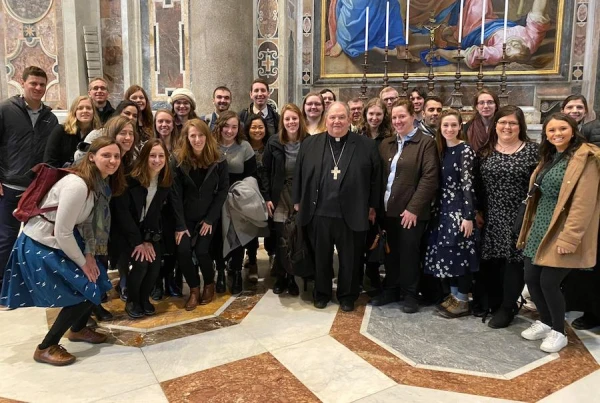
Vatican City, Jan 18, 2020 / 04:35 pm (CNA).- Young adults from the Archdiocese of St. Paul and Minneapolis are accompanying their bishops on their ad limina visit to Rome this week, joining them at “the threshold of the apostles.”
The 25 young Catholics are in Rome Jan. 10-18, visiting the city as Archbishop Bernard Hebda and Auxiliary Bishop Andrew Cozzens make their “ad limina apostolorum” visit to the pope and Vatican with the other bishops of Minnesota, North Dakota, and South Dakota.
“It’s really been incredible, it’s been fun to pray for [the bishops] as they meet with the Holy Father, to hear about their experiences,” Maddie Schulte, 23, told CNA.
On Jan. 15, the young adults – ranging in age from 21 to 34 – had their own opportunity to greet Pope Francis after his weekly general audience.
Enzo Randazzo, who organized the pilgrimage, works in the archdiocese’s evangelization office. He said St. Paul and Minneapolis have been blessed with a vibrant young adult community and seen a lot of fruit come from that ministry.
“We are here representing the people [Archbishop Hebda] shepherds back home,” Randazzo, 30, said.
During an ad limina, which typically takes place every five years, diocesan bishops prepare a report on the state of their diocese, which is presented to Pope Francis and to various offices inside the Vatican.
The bishops also celebrate Mass at the tombs of the apostles St. Peter and St. Paul, and at the other two major papal basilicas. The young people have been present at each of these Masses.
“We really appreciate the fact that they are accompanying the bishops,” Archbishop Hebda told CNA. “They’ve really dedicated themselves to praying for Pope Francis and praying for us in the course of this ad limina. Just to have them at these ad limina liturgies is beautiful.”
“They’re young people with such hope, such joy, it’s a real pleasure to be with them,” he said.
Hebda and Cozzens have also joined the pilgrim group for dinners and on a daytrip to Assisi.
Twenty-two-year-old Mitchell Kohler said the bishops have taken the time to sit with them and listen to what they have to say.
“They’ve been very present throughout the pilgrimage. While they’ve had their own work to do, they’ve been having dinner with us, spending time with us, making sure to connect with us and show that as young adults from the archdiocese we are very valued,” he noted.
Schulte said the “succession of Peter” has come to life for her during this trip.
Fr. Tim Wratkowski, a newly ordained priest of the archdiocese and former student at the Pontifical North American College, has been present as chaplain.
Also taking part is Will Herrmann, 30, a convert who joined the Catholic Church at the Easter Vigil in 2019.
He said that as a young adult, he sometimes feels lonely in his faith, so he has appreciated the bishops’ efforts to be present during the pilgrimage, as well as the chance to build community with other young adults passionate about their faith.
“This community aspect has been wonderful,” he said. “I hope that I can really serve [the bishops] when we get back to the archdiocese, whether that’s directly through anything they ask of me or indirectly through my parish and the work I do locally there.”
From a Lutheran background originally, Herrmann said coming to Rome and encountering the saints has felt “like meeting the family, meeting all the relatives.”
“Some I’ve heard of; some I’ve never met… Just really feeling like I belong the more I’m here.”
If you value the news and views Catholic World Report provides, please consider donating to support our efforts. Your contribution will help us continue to make CWR available to all readers worldwide for free, without a subscription. Thank you for your generosity!
Click here for more information on donating to CWR. Click here to sign up for our newsletter.

Father Roberto Pasolini. / Credit: Daniel Ibáñez/CNA
Rome, Italy, Jan 7, 2025 / 10:30 am (CNA).
Franciscan Capuchin Father Roberto Pasolini is very comfortable with public speaking — it’s basically his job as a Scripture expert called on to giv… […]
Pope Francis with Cardinal Arthur Roche, Prefect of the Vatican’s Dicastery of Divine Worship and Discipline of Sacraments, at the consistory in St. Peter’s Basilica, Aug. 27, 2022 / Daniel Ibáñez / CNA
Rome Newsroom, Aug 27, 2022 / 08:31 am (CNA).
Pope Francis created 20 new cardinals for the Catholic Church during a liturgy in St. Peter’s Basilica Saturday.
“Jesus calls us by name; he looks us in the eye and he asks: Can I count on you?” Pope Francis said in a homily addressed to the College of Cardinals and its new members on Aug. 27.
“The Lord,” he said, “wants to bestow on us his own apostolic courage, his zeal for the salvation of every human being, without exception. He wants to share with us his magnanimity, his boundless and unconditional love, for his heart is afire with the mercy of the Father.”
The pope’s reflection followed a reading from the Gospel of Luke, chapter 12, verses 49-50: “In that time, Jesus said to his disciples: ‘I have come to set the earth on fire, and how I wish it were already blazing! There is a baptism with which I must be baptized, and how great is my anguish until it is accomplished!’”
“The words of Jesus, in the very middle of the Gospel of Luke, pierce us like an arrow,” Francis said.
“The Lord calls us once more to follow him along the path of his mission,” he said. “A fiery mission – like that of Elijah – not only for what he came to accomplish but also for how he accomplished it. And to us who in the Church have been chosen from among the people for a ministry of particular service, it is as if Jesus is handing us a lighted torch and telling us: ‘Take this; as the Father has sent me so I now send you.’”
The pope ended his homily mentioning that one cardinal-elect, Richard Kuuia Baawobr of Wa (Ghana), was not present. Francis asked for prayers for the African prelate, explaining Baawobr had been taken ill.
At the beginning of the consistory, Pope Francis pronounced the opening prayer of the ceremony in Latin.
During the ceremony, the new cardinals made a profession of faith by reciting the Creed. They then pronounced an oath of fidelity and obedience to the pope and his successors.
Each cardinal then approached Pope Francis, kneeling before him to receive the red birretta, the cardinal’s ring, and a document naming the titular church he has been assigned.
Pope Francis embraced each new cardinal, saying to him: “Pax Domini sit semper tecum,” which is Latin for “the peace of the Lord be with you always.” Each cardinal responded: “Amen.”
The new cardinals also exchanged a sign of peace with a number of the members of the College of Cardinals, representative of the whole college.
While placing the red biretta on the head of each cardinal, the pope recited these words: “To the glory of almighty God and the honor of the Apostolic See, receive the scarlet biretta as a sign of the dignity of the cardinalate, signifying your readiness to act with courage, even to the shedding of your blood, for the increase of the Christian faith, for the peace and tranquility of the people of God and for the freedom and growth of the Holy Roman Church.”
As he gave each new cardinal the ring, Francis said: “Receive this ring from the hand of Peter and know that, with the love of the Prince of the Apostles, your love for the Church is strengthened.”
In his homily, the pope said: “The Lord wants to bestow on us his own apostolic courage, his zeal for the salvation of every human being, without exception. He wants to share with us his magnanimity, his boundless and unconditional love, for his heart is afire with the mercy of the Father.”
He also recalled another kind of fire, that of charcoal. “This fire,” he said, “burns in a particular way in the prayer of adoration, when we silently stand before the Eucharist and bask in the humble, discreet and hidden presence of the Lord. Like that charcoal fire, his presence becomes warmth and nourishment for our daily life.”
“A Cardinal loves the Church, always with that same spiritual fire, whether dealing with great questions or handling everyday problems, with the powerful of this world or those ordinary people who are great in God’s eyes,” he said.
The pope named three men as examples for the cardinals to follow: Saint Charles de Foucauld, Cardinal Agostino Casaroli, and Cardinal Van Thuân.
The consistory to create cardinals also included a greeting and thank you to Pope Francis, expressed by Cardinal Arthur Roche, prefect of the liturgy dicastery, on behalf of all the new cardinals.
Cardinal Arthur Roche speaking on behalf of the new cardinals in St. Peter’s Basilica, Aug. 27. 2022. Daniel Ibáñez / CNA
“All of us, coming from different parts of the world, with our personal stories and different life situations, carry out our ministry in the vineyard of the Lord. As diocesan and religious priests, we are at the service of preaching the Gospel in many different ways and in different cultures, but always united in the one faith and the one Church,” Roche said.
“Now, in manifesting your trust in us, you call us to this new service, in an even closer collaboration with your ministry, within the broad horizon of the universal Church,” he continued. “God knows the dust of which we are all made, and we know well that without Him we are capable of falling short.”
Roche quoted Saint Gregory the Great, who once wrote to a bishop: “We are all weak, but he is weakest of all who ignores his own weakness.”
“However, we draw strength from you, Holy Father,” he said, “from your witness, your spirit of service and your call to the entire Church to follow the Lord with greater fidelity; living the joy of the Gospel with discernment, courage and, above all, with an openness of heart that manifests itself in welcoming everyone, especially those who suffer the injustice of poverty that marginalizes, the suffering of pain that seeks a response of meaning, the violence of wars that turn brothers into enemies. We share with you the desire and commitment for communion in the Church.”
At the end of the consistory to create cardinals, Pope Francis convened a consistory for the cardinals to give their approval to the canonizations of Blessed Artemide Zatti and Giovanni Battista Scalabrini.
The new cardinals are:
— Cardinal Arthur Roche, 72, prefect of the Congregation for Divine Worship and former Bishop of Leeds (England);
— Lazarus You Heung-sik, 70, prefect of the Congregation for Clergy and former Bishop of Daejeon (South Korea);
— Jean-Marc Noël Aveline, 63, Archbishop of Marseille, the first French diocesan bishop to get the honor during Pope Francis’ pontificate;
— Peter Ebere Okpaleke, 59, Bishop of Ekwulobia in the central region of Nigeria, who was created bishop in 2012 by Benedict XVI;
— Leonardo Ulrich Steiner, 77, Archbishop of Manaus, in Brazil’s Amazon region, a Franciscan who played a leading role during the Amazon Synod and as Vice President of the recently created Amazonian Bishops’ Conference;
— Filipe Neri António Sebastião do Rosário Ferrão, 69, Archbishop of Goa (India), appointed bishop by St. John Paul II in 1993;
— Robert McElroy, 68, Bishop of San Diego (United States), whose diocese is suffragan to the Archdiocese of Los Angeles, led by the President of the USCCB, Archbishop José Gomez;
— Virgilio do Carmo Da Silva, 68, a Salesian, since 2019 the Archbishop of Dili (East Timor);
— Oscar Cantoni, 71, Bishop of Como (Italy), appointed in January 2005 by St. John Paul II, who is suffragan to Milan;
— Archbishop Fernando Vérgez Alzaga, L.C., 77, president of the Governorate of the Vatican City State and of the Pontifical Commission for the Vatican City State; the Spaniard is the first Legionary of Christ to become a cardinal;
— Anthony Poola, 60, Archbishop of Hyderabad (India), a bishop since 2008 and the first dalit to become a cardinal;
–Paulo Cezar Costa, 54, Archbishop of Brasilia (Brazil), the fourth archbishop of the Brazilian capital to become a cardinal;
— Richard Kuuia Baawobr, 62, Bishop of Wa (Ghana), former Superior General of the White Fathers, and bishop since 2016;
— William Goh Seng Chye, 65, Archbishop of Singapore since 2013;
— Adalberto Martinez Flores, 71, Archbishop of Asunción (Paraguay) and the first Paraguayan cardinal;
— Giorgio Marengo, 47, Italian Missionary of the Consolata and Apostolic Prefect of Ulan Bator in Mongolia, the youngest cardinal in recent history, along with Karol Wojtyla, who also was created a cardinal at 47, during the consistory of June 26, 1967.
Furthermore, Pope Francis appointed the following prelates over the age of 80, who are therefore excluded from attending a future conclave.
Jorge Enrique Jiménez Carvajal, 80, Archbishop Emeritus of Cartagena (Colombia); Arrigo Miglio, 80, Archbishop Emeritus of Cagliari (Italy); Fr. Gianfranco Ghirlanda, a Jesuit and former rector of the Pontifical Gregorian University, who extensively collaborated in the drafting of the Apostolic Constitution Praedicate Evangelium; and Fortunato Frezza, 80, (Italy) currently a Canon at the Basilica of St. Peter, who collaborated for several years at the Secretariat General for the Synod of the Bishops.
Pope Francis had originally also nominated Ghent Bishop Luc Van Looy, 80, who later declined to accept the post because of criticism of his response to clergy abuse cases.
Vatican City, Apr 21, 2020 / 03:30 am (CNA).- The Holy Spirit can help Christians overcome the three temptations that destroy community life, Pope Francis said at his morning Mass Tuesday.
The pope noted April 21 that money, vanity and idle chatter have divided believers since the early days of Christianity.
“But the Spirit always comes with his strength to save us from this worldliness of money, vanity and idle chatter,” he said, “because the Spirit is not the world: he is against the world. He is capable of doing these miracles, these great things.”
Reflecting on the day’s Gospel (John 3:7-15), in which Jesus tells Nicodemus that he “must be born from above,” the pope said we are reborn through the Holy Spirit rather than by our own efforts.
“Our docility opens the door to the Holy Spirit: it is He who makes the change, the transformation, this rebirth from above,” he said. “It is Jesus’ promise to send the Holy Spirit. The Holy Spirit is capable of doing wonders, things that we cannot even think about.”
Speaking from the chapel of his Vatican residence, Casa Santa Marta, the pope turned to the day’s first reading (Acts 4:32-37), which describes the harmony among the first Christians. This description was no fantasy, he said, but rather a model for today’s Church.
“It is true that immediately after this problems will begin,” he observed, “but the Lord shows us how far we can go if we are open to the Holy Spirit, if we are docile. In this community there is harmony.”
Pope Francis said that many things divided parishes, dioceses, communities of priests, and men and women religious. He identified three major temptations: money, vanity and idle chatter.
“Money divides the community,” he said. “For this reason, poverty is the mother of the community. Poverty is the wall that guards the community. Money divides … Even in families: how many families ended up divided by an inheritance?”
He continued: “Another thing that divides a community is vanity, that desire to feel better than others. ‘Thank you, Lord, that I am not like the others:’ the Pharisee’s prayer.”
Vanity could be seen at the celebration of sacraments, the pope said, with people vying to wear the best clothes.
“Vanity enters there too. And vanity divides. Because vanity leads you to be a peacock and where there is a peacock, there is division, always,” he said.
“A third thing that divides a community is idle chatter: it’s not the first time I’ve said it, but it’s reality … That thing that the devil puts in us, like a need to talk about others. ‘What a good person that is…’ — ‘Yes, yes, but…’ Immediately the ‘but:’ that’s a stone to disqualify the other.”
Yet with the Holy Spirit we are able to resist all three temptations, he said, concluding: “Let us ask the Lord this docility to the Spirit so that He may transform us and transform our communities, our parish, diocesan, religious communities: transform them, so that we may always move forward in the harmony that Jesus wants for the Christian community.”
After Mass, the pope presided at adoration and Benediction of the Blessed Sacrament.
He led those watching via livestream in an act of spiritual communion, praying: “My Jesus, I believe that you are truly present in the Most Holy Sacrament. I love you above all things, and I desire to receive you into my soul. Since I cannot at this moment receive you sacramentally, come at least spiritually into my heart. I embrace you as being already there and unite myself wholly to you. Never permit me to be separated from you.”
Finally, those present sang the Easter Marian antiphon “Regina caeli.”
At the start of Mass, Pope Francis noted that amid the coronavirus lockdown towns and cities had fallen silent.
“In this time there is so much silence,” he said. “One can also feel the silence. May this silence, which is a little new in our habits, teach us to listen, make us grow in our ability to listen. Let us pray for this.”
M/F sex ratio says much.
Communists claimed the allegiance and support of young people for their propaganda campaigns, too. So did others.