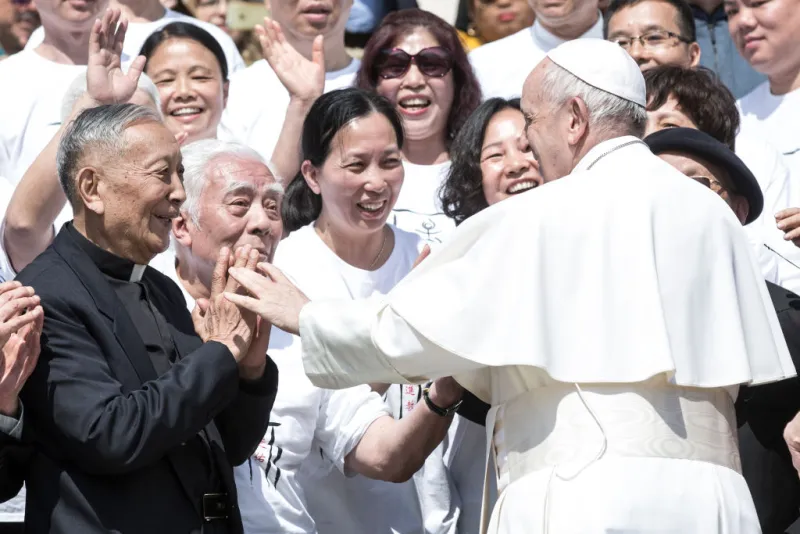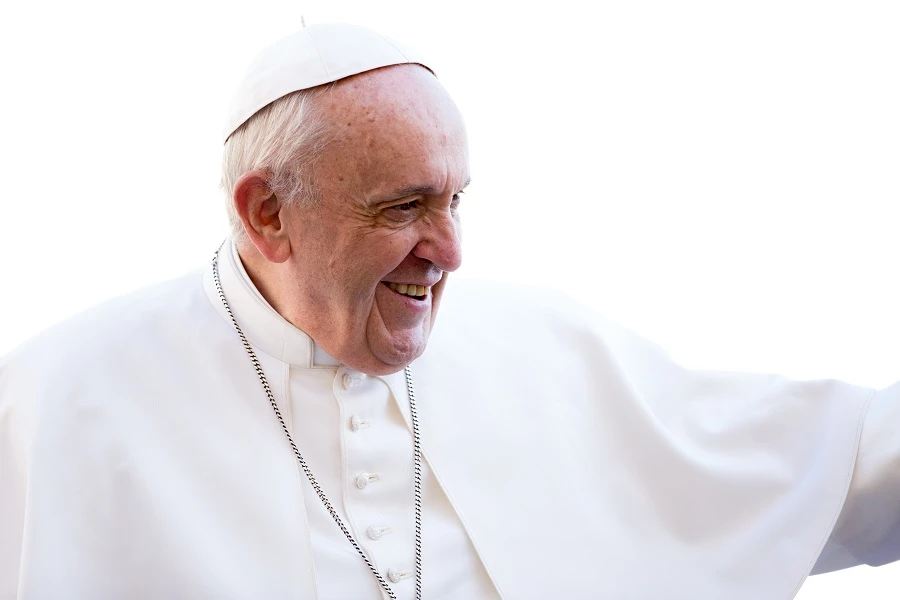
Vatican City, May 6, 2018 / 05:33 am (CNA/EWTN News).- God’s love requires that we give our best to each and every one of our brothers and sisters, even those who are in the final stage of their life, Pope Francis said during his Regina Coeli address Sunday.
“Love for others cannot be reserved for exceptional moments, but must become the constant of our existence,” the pope said May 6.
“That’s why to the sick, even if in the last stage, we must give all possible assistance. This is why unborn children are always welcomed; that is why, ultimately, life must always be protected and loved from conception to its natural setting. And this is love.”
Speaking before the traditional Regina Coeli prayer, which the pope leads from a window overlooking St. Peter’s Square, Francis said to be available “to every brother and sister, whoever he is and in whatever situation,” is the way in which Catholics can share Christ’s love, especially with those closest: in the family, community, work, and school.
This love is what also calls people to protect the elderly as a “precious treasure,” he said, even if it is economically difficult, or inconvenient, to do so.
Francis said that “we are loved by God in Jesus Christ, who asks us to love each other as He loves us,” but that this is impossible unless we have the “same Heart” as Christ, which we acquire through participation in the Eucharist, which has “the purpose of forming in us the Heart of Christ, so that our whole life is guided by his generous attitudes.”
In his meditation, the pope also invoked the intercession of the Blessed Virgin Mary to help Catholics “remain in the love of Jesus and to grow in love for all, especially the weakest, to fully correspond to our Christian vocation.”
He pointed to the day’s Gospel passage, in which Jesus says: “If you keep my commandments, you will remain in my love,” noting that Jesus confirms that love is not a superficial feeling, but a “fundamental attitude of the heart, which manifests itself in living” as Christ requests.
Like Jesus, we receive the love that comes from the Father, trying to not separate ourselves through selfishness and sin. “Jesus asks us to keep his commandments, which are summarized in this: ‘that you love one another as I have loved you,’” the pope said.
“How can we be, therefore, this love that the risen Lord gives us, [so that] it can be shared with others?” he asked.
After praying the Regina Coeli, the pope asked for prayers for the people of the Central African Republic (CAR), who experienced a deadly attack on a Catholic Church May 1.
The attack took place at Our Lady of Fatima parish in the capital Bangui, on the outskirts of the PK5 neighborhood, a largely Muslim area known for violent clashes. At least 15 were killed, including a priest identified as Fr. Albert Toungoumale Baba, and as many as 99 others were wounded.
Francis said that the CAR is a “country that I had the joy of visiting and which I carry in my heart. Through the intercession of the Virgin Mary, the Lord helps everyone to say no to violence and revenge, to build peace together.”
Pope Francis also noted Saturday’s beatification in Aachen, Germany, of Clara Fey, founder of the Sisters of the Poor Child Jesus, asking everyone to “give thanks to God for this zealous witness to the Gospel, a caring educator of disadvantaged youth.”
If you value the news and views Catholic World Report provides, please consider donating to support our efforts. Your contribution will help us continue to make CWR available to all readers worldwide for free, without a subscription. Thank you for your generosity!
Click here for more information on donating to CWR. Click here to sign up for our newsletter.
Vatican City, Feb 15, 2020 / 11:03 am (CNA).- The next ordinary assembly of the synod of bishops is to be held in the fall of 2022, according to a press release from the Vatican on Saturday.
The theme has not yet been decided, but will be up to Pope F… […]
Altar of the Chair in St. Peter’s Basilica, where Bernini’s gorgeous bronze monument to the Chair of Peter acts as a massive
bronze reliquary for the historic wooden chair. / Credit: Vatican Media
Vatican City, Nov 9, 2024 / 06:00 am (CNA).
For the first time in over a century, the historic Chair of St. Peter, a wooden throne symbolizing the pope’s magisterial authority, has been removed from its gilded bronze reliquary in St. Peter’s Basilica to be displayed for public veneration.
Pilgrims and visitors can now behold this storied relic directly in front of the basilica’s main altar, just above the tomb of St. Peter, where it will remain on display until Dec. 8, the solemnity of the Immaculate Conception.
The last major public viewing of the chair occurred in 1867, when Pope Pius IX exposed the Chair of Peter for the veneration of the faithful for 12 days on the 1,800th anniversary of the martyrdoms of St. Peter and St. Paul, according to Pietro Zander, head of the Necropolis and Artistic Heritage Section of the Vatican.
It was the first time that the centuries-old wooden throne had been exhibited to the public since 1666 when it was first encased within Gian Lorenzo Bernini’s monumental bronze sculpture under the stained-glass Dove of the Holy Spirit window at the basilica’s apse.
The historic wooden Chair of St. Peter as it is currently on display in St. Peter’s Basilica. Credit: Courtney Mares/CNA
Formally known as the Cathedra Sancti Petri Apostoli, or more simply as Cathedra Petri, the chair has held a revered place in Catholic tradition over the centuries, representing papal authority from St. Peter to the present.
“The chair is meant to be understood as the teacher’s ‘cathedra,’” art historian Elizabeth Lev told CNA. “It symbolizes the pope’s duty to hand down the teaching of Christ from generation to generation.”
“It’s antiquity [ninth century] speaks to a papacy that has endured through the ages — from St. Peter who governed a church on the run trying to evangelize with the might of the Roman Empire trying to shut him down, to the establishment of the Catholic Church and its setting down of roots in the Eternal City, to our 266th successor of St. Peter, Pope Francis,” she explained.
Pope Francis venerates the Chair of St. Peter at the end of the closing Mass of the Synod on Synodality on Oct. 27, 2024, the first day the chair was displayed for public veneration. Credit: Vatican Media
A storied history
The wooden chair itself is steeped in history. According to the Vatican, the wooden seat was likely given by the Holy Roman Emperor Charles the Bald to Pope John VIII in A.D. 875 for the emperor’s Christmas coronation in the old St. Peter’s Basilica. A depiction of the emperor appears on the crossbeam of the chair, and its ivory panels illustrate the labors of Hercules along with other scenes from Greek mythology.
The informational sign near the chair in St. Peter’s Basilica informs visitors that “shortly after the year 1000, the Cathedra Petri began to be venerated as a relic of the seat used by the apostle Peter when he preached the Gospel first in Antioch and then in Rome.”
The Fabric of St. Peter, the organization responsible for the basilica’s upkeep, maintains that “it cannot be ruled out that this ninth-century imperial seat may have later incorporated the panel depicting the labors of Hercules, which perhaps originally belonged to an earlier and more ancient papal seat.”
Before returning the chair to its place within Bernini’s monumental reliquary, Vatican experts will conduct a series of diagnostic tests with the Vatican Museums’ Cabinet of Scientific Research. The ancient seat was last removed and studied from 1969 to 1974 under Pope Paul VI but was not shown to the public.
Closer details can be seen of the historic relic of the Chair of St. Peter. For the first time in over a century, the wooden throne symbolizing the pope’s magisterial authority has been removed from its gilded bronze reliquary in St. Peter’s Basilica to be displayed for public veneration. Credit: Daniel Ibanez
The recent restoration of Bernini’s works in the basilica, funded by the Knights of Columbus in preparation for the Catholic Church’s 2025 Jubilee Year, made it possible for the chair to be moved from the bronze sculpture in August.
Pope Francis got a sneak peak of the relic in early October and a photo of the moment — showing him sitting in a wheelchair before the Chair of St. Peter — quickly went viral. Afterward, the pope requested that the relic be displayed for public veneration.
Francis ultimately decided that the Chair of St. Peter — a symbol of the Church’s unity under the instruction of Christ — would be unveiled for the public at the closing Mass for the Synod on Synodality.
“Pope Francis has been exceptionally generous to the faithful about displaying relics,” Lev said. “He brought out the bones of St. Peter shortly after his election, he had the Shroud of Turin on view in 2015, and now he has taken the Chair of Peter out for veneration in the basilica.”
“In our virtual age, where much confusion reigns between what is real and what is not, Pope Francis has encouraged us to come face to face with these ancient witnesses of our faith and our traditions.”
Pope Francis venerates the Chair of St. Peter at the end of the closing Mass of the Synod on Synodality on Oct. 27, 2024, in Rome. Credit: Vatican Media
Feast of the Chair of St. Peter
The Feast of the Chair of St. Peter, celebrated each year on Feb. 22, dates back to the fourth century. St. Jerome (A.D. 347–420) spoke of his respect for the “Chair of Peter,” writing in a letter: “I follow no leader save Christ, so I enter into communion with … the Chair of Peter, for this I know is the rock upon which the Church is built.”
As Pope Benedict XVI explained in a 2006 catechesis: “‘Cathedra’ literally means the established seat of the bishop, placed in the mother church of a diocese, which for this reason is known as a ‘cathedral.”
“It is the symbol of the bishop’s authority and in particular, of his ‘magisterium,’ that is, the evangelical teaching which, as a successor of the apostles, he is called to safeguard and to transmit to the Christian community,” he said.
When a bishop takes possession of the particular Church that has been entrusted to him, he sits on the cathedra, Benedict explained: “From this seat, as teacher and pastor, he will guide the journey of the faithful in faith, hope, and charity.”
“The Church’s first ‘seat’ was the upper room, and it is likely that a special place was reserved for Simon Peter in that room where Mary, mother of Jesus, also prayed with the disciples,” he added.
Benedict XVI described Peter’s ministry as a journey from Jerusalem to Antioch, where he served as bishop, and ultimately to Rome. He noted that the See of Rome, where Peter ultimately “ended his race at the service of the Gospel with martyrdom,” became recognized as the seat of his successors, with the cathedra representing the mission entrusted to Peter by Christ.
“So it is that the See of Rome, which had received the greatest of honors, also has the honor that Christ entrusted to Peter of being at the service of all the particular Churches for the edification and unity of the entire people of God,” he said.
The Altar of the Chair in St. Peter’s Basilica, where Bernini’s bronze monument to the Chair of Peter acts as a massive bronze reliquary for the historic wooden chair. Credit: Vatican Media
Bernini’s Baroque masterpiece
Bernini’s monumental reliquary for the chair, commissioned by Pope Alexander VII and completed in 1666, is one of the most iconic artworks in St. Peter’s Basilica. Bernini encased the wooden relic within a bronze-gilded throne, dramatically raised and crowned by a stained-glass depiction of the Holy Spirit, symbolized as a dove, surrounded by sculpted angels.
The bronze throne is supported by massive statues of four doctors of the Church — two from the West, St. Augustine and St. Ambrose, and two from the East, St. John Chrysostom and St. Athanasius — symbolizing the unity of the Church through the ages, bringing together the teachings of both the Latin and Greek Church Fathers. And at the top of the throne, cherubs hold up a papal tiara and keys symbolizing papal authority.
On the chair itself, there are three gold bas-reliefs representing the Gospel episodes of the consignment of the keys (Matthew 16:19), “feed my sheep” (John 21:17), and the washing of the feet (John 13:1-17).
The ongoing restoration of Bernini’s monument at the Altar of the Chair, along with the recently finished restoration of the baldacchino, is significant not only in light of the 2025 Jubilee Year but also the upcoming 400th anniversary of the consecration of the current St. Peter’s Basilica in 2026.
“Celebrating the ‘Chair’ of Peter,” Benedict XVI said, “means attributing a strong spiritual significance to it and recognizing it as a privileged sign of the love of God, the eternal Good Shepherd, who wanted to gather his whole Church and lead her on the path of salvation.”
Leave a Reply