Djibouti, Djibouti, Oct 16, 2017 / 03:01 pm (CNA/EWTN News).- After Somalia suffered its deadliest terrorist attack on Saturday, the Bishop of Djibouti reflected on the need for hope and unity among Somalis lest it become “a double attack.”
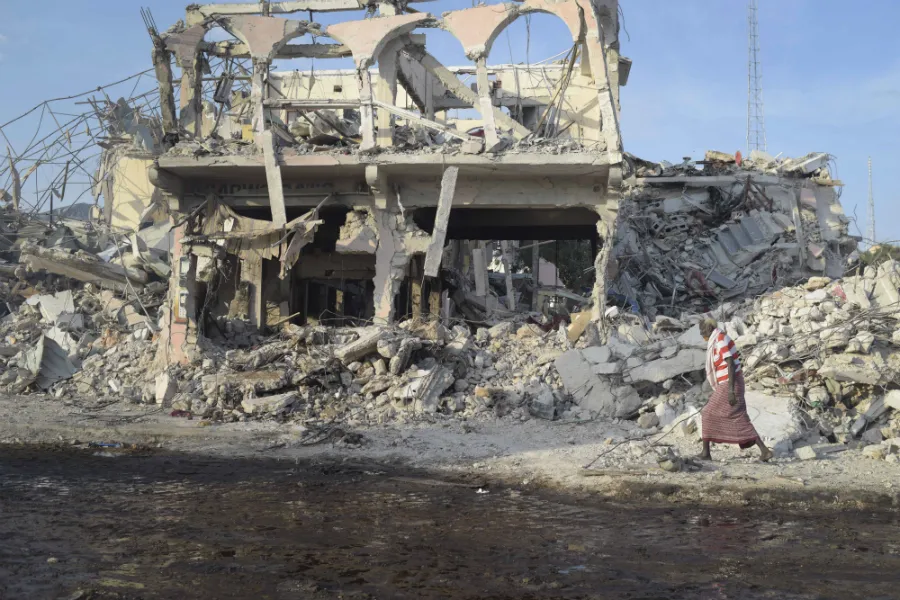
A truck packed with explosives exploded in front of a hotel in the Somali capital Mogadishu Oct. 14, killing at least 276 people. Many more were wounded.
“I would say that even though what has happened its a catastrophe, we mustn’t despair. It would be a double attack if we despaired,” Bishop Giorgio Bertin of Djibouti told Vatican Radio.
Bishop Bertin also serves as apostolic administrator of the Diocese of Mogadishu, which has been vacant since the assassination of its last bishop in 1989.
The bombing has yet to have been claimed by any group. Some Somalis have reacted to the attack by condemning al-Shabaab, an Islamist militant group associated with al-Qaeda.
Somali president Mohamed Abdullahi Mohamed called it a “heinous act” targeting “civilians who were going about their business.”
Bishop Bertin commented that “when one goes [to Somalia] the situation seems normal; I could spend five days in Baidoa, two days in Mogadishu. Obviously I was accompanied by an armed escort, but the Somalis seemed to be living normally. It seems like normal life.”
“You might have the impression that they are rather habituated to seeing, undergoing these momentary attacks, but they never seem to change life there.”
The bishop added that he thinks “we should continue to seek greater unity within Somalia and the international community to face this problem.”
Turkey is taking 40 of those injured in the attack for medical treatment, and the African Union has said it will continue its support of Somalia as it works “to achieve sustainable peace and security.”
The US Mission to Somalia stated that it “lauds the heroic response of the Somali security forces and first responders and Somali citizens who rushed to the aid of their brothers and sisters. Such cowardly attacks reinvigorate the commitment of the United States to assist our Somali and African Union partners to combat the scourge of terrorism to promote stability and prosperity for the Somali people and their regional neighbors.”
Somalia has been in a state of turmoil since the early 1990s, and was long regarded as a failed state. It has relatively stabilized in recent years, and has been called a fragile state.
The federal government has consolidated control over much of the southern part of the country, though Islamists still control several swathes of territory. Somalia’s northern areas are effectively governed as the autonomous regions of Somaliland and Puntland.
If you value the news and views Catholic World Report provides, please consider donating to support our efforts. Your contribution will help us continue to make CWR available to all readers worldwide for free, without a subscription. Thank you for your generosity!
Click here for more information on donating to CWR. Click here to sign up for our newsletter.

Thousands turned out for a Eucharistic procession followed by the holy liturgy at the St. Charbel Hermitage and the monastery of St. Maroun Annaya on July 22, 2024. / Credit: Marwan Semaan/ACI MENA
ACI MENA, Jul 24, 2024 / 04:00 am (CNA).
On Ju… […]
Two vehicles for the Spanish troop within the United Nations Interim Force in Lebanon (UNIFIL) on the tense southern border of the country in August 2024. / Credit: Ramiz Dallah/Shutterstock
ACI MENA, Aug 9, 2024 / 12:25 pm (CNA).
In a stark de… […]
A large crowd gathered for the ceremony welcoming Patriarch Gregory Peter XV Agagianian’s remains to Beirut’s Martyrs’ Square on Thursday, Sept 12, 2024. / Credit: Romy Haber/ACI Mena
ACI MENA, Sep 15, 2024 / 07:00 am (CNA).
On Thursday, Sept. 12, the Armenian Catholic Patriarchate held a grand ceremony in Beirut’s Martyrs’ Square to welcome the remains of cardinal and patriarch Gregory Peter XV Agagianian from Rome. His body will be laid to rest in the Armenian Catholic Cathedral of St. Elias and St. Gregory the Illuminator in downtown Beirut.
Agagianian, known for his strong opposition to communist rule during the Cold War era, became a prominent figure in Catholic Church history. He was a leading candidate for the papacy on two occasions. The process of his beatification, a step toward sainthood in the Catholic Church, began in Rome on Oct. 28, 2022.
The late Armenian Catholic patriarch’s remains arrived in Lebanon in a glass casket carried by 12 young Lebanese men from various religious denominations, symbolizing interfaith unity.
As the Armenian scouts’ band played, attendees reached out to touch the casket for blessings. Some threw rice and rose petals on the casket — a Middle Eastern tradition symbolizing a joyful welcome.
The ceremony, attended by various political and religious figures, began with a documentary about the late patriarch’s life.
In a heartfelt speech, the current Armenian Catholic Patriarch, Raphaël Bedros XXI Minassian, said: “We brought him to Lebanon to show the world our unity, solidarity, and mutual love among denominations and all parties. Young men from various denominations carried the casket, representing a true reflection of what a Lebanese family looks like.”
Maronite Patriarch Cardinal Bechara Boutros al-Rahi, leader of Lebanon’s largest Christian community, confirmed that Aghajanian’s tomb would be in the Armenian Catholic Cathedral of St. Elias and St. Gregory the Illuminator in Dabbas Square, Beirut.
“He is among the incorruptibles of the Church,” he added. “We hope that this miracle will facilitate the plea for his beatification. In any case, he will be a blessed and great saint. We congratulate the Armenian Catholic Church, all churches, and all of Lebanon. God’s wonders are great in his saints.”
Bishop Krikor Badishah, auxiliary bishop of the patriarchal Diocese of Beirut, stated: “Thanks to the magnificent presence of numerous participants, Martyrs’ Square is once again not a mere location but a national symbol that unites all Lebanese, regardless of their affiliations. It is a beacon of hope shining over our beloved homeland, constantly reminding us of our shared values and our unbreakable unity.”
During the ceremony, singer Layal Nehmé Matar performed, accompanied by the Lebanese army’s band, adding an atmosphere of reverence and solemnity.
The beatification process
The initiative to beatify Agagianian began with former Armenian Catholic Patriarch Krikor Bedros XX Ghabroyan. It gained momentum when the current patriarch, Minassian, requested the opening of Agagianian’s tomb about two years ago, revealing his apparently incorrupt body.
While there is no official protocol in the Church for determining whether a body is incorrupt and incorruptibility is not considered an indication of sainthood, many saints are considered to be incorrupt. The formal process for his possible canonization was launched in Rome on Oct. 28, 2022.
This stage involved a thorough investigation, examining all aspects of Agagianian’s life and virtues. Information was gathered from written documents and contemporary witnesses, as well as accounts of miracles attributed to his intercession. The process is now progressing rapidly.
A large crowd gathered for the ceremony welcoming Patriarch Gregory Peter XV Agagianian’s remains to Beirut’s Martyrs’ Square on Thursday, Sept 12, 2024. Credit: Romy Haber/ACI MENA
The legacy of Patriarch Agagianian
Agagianian was renowned for his virtue. The Virgin Mary held a special place in his spirituality, and he was devoted to the Sacred Heart of Jesus and the Eucharist. He was an advocate for justice and served the marginalized, including the elderly, orphans, and people with disabilities. Even after becoming a bishop, he continued to visit the Armenian diaspora worldwide.
Agagianian held several significant positions in the Church. Named a cardinal by Pope Pius XII in 1946, he was head of the Sacred Congregation for the Propagation of the Faith (Propaganda Fide), the future Congregation for the Evangelization of Peoples, from 1958 to 1970 and presided over the papal commission responsible for drafting laws for Eastern Catholic Churches. He was also appointed by Pope Paul VI to serve as one of the four moderators of the last years of the Second Vatican Council (1962–1965), a landmark event in modern Catholic history. At a time when the pope rarely left Rome, Agagianian served as an envoy of the Holy See, visiting many countries across multiple continents. He was twice considered “papabile,” a serious candidate for the papacy, in 1958 and 1963.
Agagianian’s connection to Lebanon
Agagianian was of Georgian-Armenian descent but acquired Lebanese citizenship after coming to the country as an apostolic visitor in 1935. A year later, at the age of 42, he became patriarch of the Armenian Catholic Church.
He developed close relationships with various segments of Lebanese society and worked to bring politicians together. He would often gather them at the Armenian Catholic monastery in Jounieh (Mount Lebanon) for private meetings. Agagianian played a role in reconciling Maronite Patriarch Paul Meouchi with then-Lebanese President Camille Chamoun. He also helped appoint Charles Helou (who later became president of Lebanon) as the first Lebanese ambassador to the Vatican.
Agagianian was known as the “builder patriarch” due to his numerous architectural projects, including a school and an orphanage in Anjar, Lebanon. His remains were laid to rest in the Armenian Catholic Cathedral of St. Elias and St. Gregory the Illuminator, which he built in the heart of Beirut.
This article was first published by ACI Mena, CNA’s Arabic-language news partner, and has been translated and adapted by CNA.
Leave a Reply