


 By
By 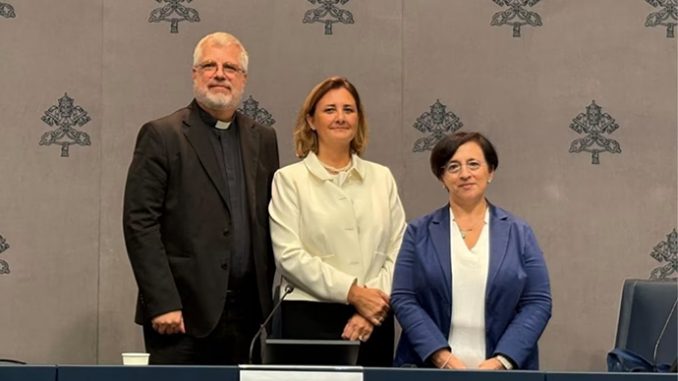
Pope Leo XIV has convened a gathering on the family at the Vatican from Oct. 7–14, during which bishops will listen to the testimony of 11 married couples from five continents.
These families will present to more than 150 bishops the challenges they encounter in passing on the faith in increasingly secularized societies.
The meeting is being organized on the occasion of the 10th anniversary of Amoris Laetitia, the postsynodal apostolic exhortation published by Pope Francis in 2016.
The document sparked intense debate, especially after the bishops of the Buenos Aires Pastoral Region interpreted it as allowing, following a process of accompanied pastoral discernment, access to the sacraments of reconciliation and the Eucharist for some Catholics who are divorced and civilly remarried “when a person judges that he or she would fall into a further fault by harming the children of the new union.”
In 2023, the Dicastery for the Doctrine of the Faith confirmed that this interpretation forms part of the authentic magisterium after being incorporated into the Acta Apostolicae Sedis, the Holy See’s official bulletin.
According to the Dicastery for the Laity, the Family, and Life, participants in the meeting will include the heads of the 15 Eastern Catholic Churches “sui iuris” (14 represented by their patriarchs or highest authorities and one by a delegate), the presidents of the world’s 115 bishops’ conferences (those of Peru, Paraguay, Turkey, and Ethiopia will send delegates), two representatives of bishops from territories without a bishops’ conference, and 22 participants specially chosen by the Holy Father.
In addition, 67 other people will attend, including members of the Dicastery for the Laity, the Family, and Life, the General Secretariat of the Synod, and 26 experts and 16 facilitators.
Not an evaluation of Amoris Laetitia
During a presentation of the gathering at the Vatican, Gabriella Gambino, undersecretary of the Dicastery for the Laity, the Family, and Life since 2017, a laywoman, mother of five, and doctor of bioethics, emphasized that “this is not about evaluating a text but about deepening our understanding of the family and pastoral realities that have received and interpreted this document in different ways, just as the life of the Church is diverse in the various places around the world where it is present and rooted in the one Gospel.”
“The central point on which we must focus our attention is that the Church’s goal is not to see texts applied mechanically and uniformly in every reality, because each one has characteristics that are very different from the others,” she said.
She stated that the central question of the meeting is: “How is the faith transmitted today? How is faith passed on in families today, and how do families contribute to building up the Church?”
“Without families, the Church cannot renew its Christian roots. It is in families that children are born, where faith and values are transmitted, for better or worse, and where vocations arise,” she explained.
To illustrate the scale of the ongoing religious changes, Gambino offered several statistics. In Poland, religious marriages celebrated over the last five years have declined by 45%. In Australia, they have fallen from 88% in 1970 to 16% in 2024. In her view, these are signs that, in different contexts, highlight the urgency of better accompanying couples in their decision to marry and providing stronger support for the transmission of faith within the family.
Orietta Rachele Grazioli, a tenured professor of canon law and comparative family law at the Pontifical John Paul II Theological Institute for Marriage and Family Sciences, and vice coordinator of the expert group, explained that the “methodology chosen by the Holy Father for this gathering is centered on two key words that complement one another: listening and discernment.”
5 major themes
The gathering will be structured around five major themes related to marriage, family life, and the transmission of the faith. Reflection will begin with “Families Today: Reality, Beauty, and Challenges,” dedicated to analyzing the current situation of the family, and will continue with “Young People and the Discovery of the Vocation to Marriage,” “Married Life: The First Years of Marriage, a Decisive Time,” and “In Life’s Difficulties: Accompanying and Supporting,” which will address the accompaniment of engaged and married couples at different stages of their journey.
The meeting will conclude with the theme “Christian Families as Subjects of the Church’s Mission,” focused on the evangelizing role of families and their contribution to ecclesial life.
Father Giacomo Costa, a consultant to the General Secretariat of the Synod, said that “the question is not what Amoris Laetitia says but what we have learned by trying to live it.”
He also recalled that the goal identified by Pope Leo XIV, who will be present at both the opening and closing of the gathering, is “to advance in mutual listening toward a synodal discernment about the steps we must take today to proclaim the Gospel with families. The composition of the assembly itself reflects this objective.”
Before the start of the proceedings, an introductory meditation will be given by Sister Helen Alford, president of the Pontifical Academy of Social Sciences. Each morning will be structured around three types of speeches: family testimonies, contributions from bishops, and reflections from experts.
‘The goal is not to eliminate differences’
“The goal is not to eliminate differences. We do not want to arrive at an artificial consensus,” Costa said. Each day will include a report summarizing the discussions, which will serve as the basis for extensive dialogue and debate sessions in the afternoon. He made clear, however, that “this is not a new synod on the family but a process guided by the synodal method, one that consciously draws upon the experience of the synods and other forums of the Church.”
Regarding the expected outcomes of the gathering, Costa insisted that “nothing has been predetermined.” A final summary will be prepared at the conclusion of the assembly, but no concluding document will be published. The text will be reviewed by a commission tasked with verifying that it faithfully reflects what emerged during the working sessions.
Afterward, the presidents of bishops’ conferences will be invited to promote initiatives in their local Churches aimed at opening new pastoral paths and further developing the proposals that emerge from the gathering.
This story was first published by ACI Prensa, the Spanish-language sister service of EWTN News. It has been translated and adapted by EWTN News English.
If you value the news and views Catholic World Report provides, please consider donating to support our efforts. Your contribution will help us continue to make CWR available to all readers worldwide for free, without a subscription. Thank you for your generosity!
Click here for more information on donating to CWR. Click here to sign up for our newsletter.

Avoiding the errors of Amoralist Latitia will not magically make it more true in practice. All evidence suggests that the pontificate of Pope Leo seeks to sidestep the problems promulgated by his predecessor.
And so, we get more “blah blah blah” as Rome burns. Heteropraxy never leads to the happiness of a clear conscience.
Unless something changes, it will be the privilege of a future pontificate to clean up these abuses.