

 By
By The Kentucky-born author extolled the virtues of simple living and urged Americans to reject modern consumerism and destructive agriculture.
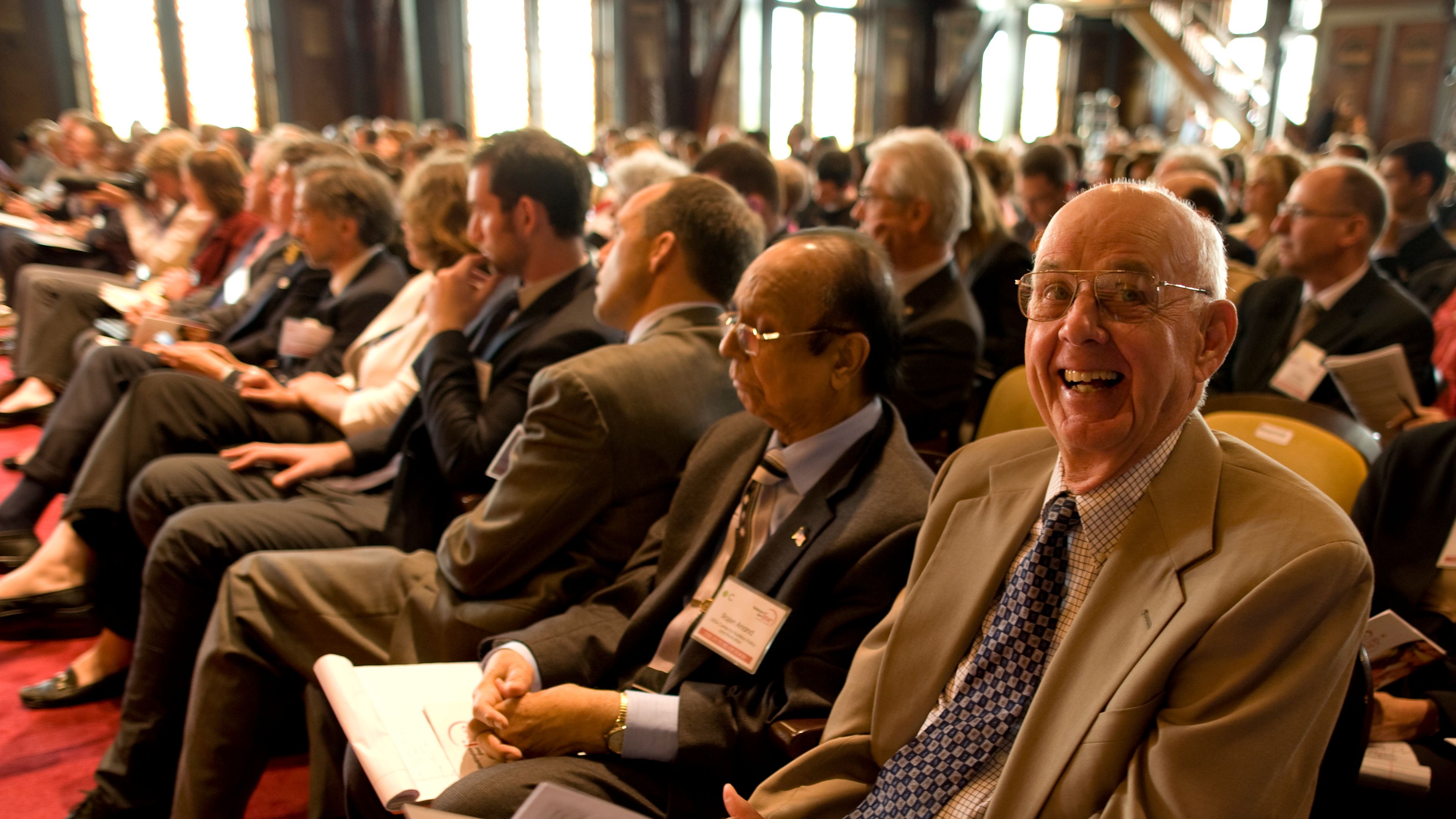
Wendell Berry, the prolific American author whose work spanned decades and who spent his career urging Americans to pursue a simpler, more virtuous life, died on Aug. 31, his family said.
His daughter Mary confirmed his passing via the New York Times. His cause of death was not immediately known; the Kentucky-born writer was 92 years old.
A writer of fiction, poetry, and essays, Berry was known for his advocacy of rural life, for urging readers to develop a close connection to farming and food, and for calling for the care of the environment.
His work united a broad cross-section of the American public from liberal environmentalists to Christian homesteaders to local food advocates to conservative conservationists.
Born in Louisville on Aug. 5, 1934, Berry studied English at the University of Kentucky and writing at Stanford University. He taught English at the University of Kentucky for several years and also taught at New York University.
From 1965 until his death he lived and worked at his farm, Lane’s Landing, in Henry County, Kentucky.
His politics were broad and diverse. He was famously critical of big business and corporations and was a fierce detractor of coal companies. He was opposed to the death penalty, at one point urging his home state to abolish it entirely.
Amid the racial and cultural disputes of 2020, he sued the University of Kentucky in order to prevent the removal of a purportedly racially offensive mural there — though he said he was pained by the knowledge that his ancestors “established themselves here by killing or driving out the original possessors” and that “people were once bought and sold here by my people.” Berry was awarded the National Humanities Medal by President Barack Obama in 2012.
Throughout his career he remained devoted to both the natural world and to the small farm — a philosophy, he said in 2002, that meant he had “spent [his] life on two losing sides.”
He urged advocates to reconcile both the need to preserve the natural world and the need to support the human beings that are an indelible part of the world. “The question we must deal with is not whether the domestic and the wild are separate or can be separated; it is how, in the human economy, their indissoluble and necessary connection can be properly maintained,” he wrote.
Baptized a Baptist, Berry remained distant from organized religion, calling himself at one point a “forest Christian.” Yet his work and his advocacy attracted large numbers of Christians, including Catholics.
Writing in America Magazine in 2017, the Catholic writer Anna Keating said that his unique philosophy “can prove helpful to Catholics, serving as an antidote to the many ills of our time.”
He also briefly partnered with the Catholic St. Catharine College in Springfield, Kentucky, to launch the Berry Farming Program, though the college closed in 2016.
He wrote that he “[took] literally the statement in the Gospel of John that God loves the world.”
“I believe that the world was created and approved by love, that it subsists, coheres, and endures by love, and that, insofar as it is redeemable, it can be redeemed only by love,” he said.
Though well traveled and revered as a national American sage, Berry was a strong proponent of localism. He consistently called on Americans to turn to community and mutual help to address societal problems and conflicts.
He lamented the destruction of much of the rural way of life that he had seen take place over his lifetime, though he expressed optimism for its revitalization. Reflecting in 1988 on the potential “renewal of the rural communities” around the country, he wrote that such a renewal “would have to be a revival accomplished mainly by the community itself.”
“It would have to be done not from the outside by the instruction of visiting experts,” he wrote, “but from the inside by the ancient rule of neighborliness, by the love of precious things, and by the wish to be at home.”
If you value the news and views Catholic World Report provides, please consider donating to support our efforts. Your contribution will help us continue to make CWR available to all readers worldwide for free, without a subscription. Thank you for your generosity!
Click here for more information on donating to CWR. Click here to sign up for our newsletter.

I see no mention that Wendell Berry was Catholic so I have to assume that this piece was written as a political commentary. Since its source is EWTN News, my assumption is likely correct.
I differed with some of Wendell Berry’s views but he was an important figure and influenced many people, including a number of Catholics .
May he rest in peace and rise in glory. 🙏
RIP Sir. Respectful farewell. “I believe that the world was created and approved by love, that it subsists, coheres, and endures by love, and that, insofar as it is redeemable, it can be redeemed only by love” – Wendell Berry
Cheap sentimentality from the ‘hug a tree crowd.’