


 By
By 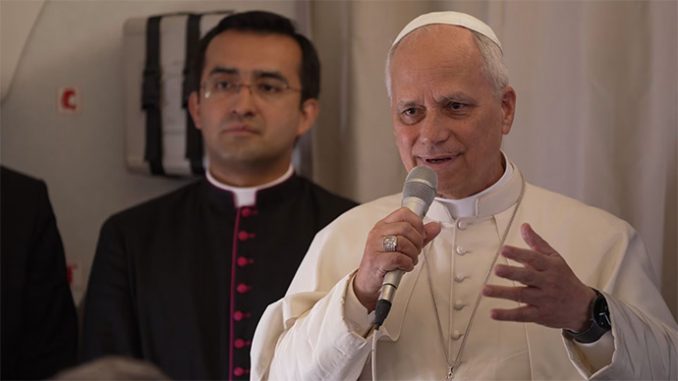
ABOARD THE PAPAL FLIGHT — Pope Leo XIV spoke bluntly about war, migration, same-sex blessings, and the Holy See’s relations with authoritarian governments during a roughly 20-minute in-flight press conference with journalists traveling with him from Malabo, Equatorial Guinea, to Rome after his apostolic journey to Africa.
Before taking questions, the pope stressed that the primary purpose of a papal trip is pastoral rather than political.
“When I make a trip — speaking for myself, but today as pope, bishop of Rome — especially an apostolic, pastoral trip, it is to find, accompany, and come to know the people of God,” he said.
He added that such journeys should be understood above all as “an expression of wanting to announce the Gospel, proclaim the message of Jesus Christ,” and as a way “to draw close to the people in their happiness, in the depth of their faith, but also in their suffering.”
Asked about the chaotic state of negotiations aimed at ending the conflict involving Iran, Israel, and the United States, the pope called for a new mindset rooted in peace rather than violence.
“Certainly, I would like to begin by saying that we need to promote a new attitude, a culture of peace,” he said. “Many times when we evaluate certain situations, the immediate response is that we must enter with violence, with war, by attacking, and we have seen that many innocent people have died.”
Leo said the key question was not simply whether a regime should change but how to defend important values without more innocent victims.
“Regime change or no regime change, the question is how to promote the values in which we believe without the death of so many innocent people,” he said.
Describing the situation as “very complex,” the pope said the back-and-forth of negotiations had created “this chaotic and critical situation for the world economy,” while innocent people in Iran were suffering because of the war.
“Rather, I would encourage the continuation of dialogue for peace,” he said. “As Church, I say again, and as a pastor, I cannot be in favor of war, and I would like to encourage everyone to make every effort to seek responses that come from a culture of peace and not of hatred.”
Later in the exchange, responding to a question about reported executions by the Iranian regime, the pope issued an unequivocal condemnation.
“I condemn all actions that are unjust, I condemn the taking of people’s lives. I condemn capital punishment,” Leo said. “I believe that human life is to be respected, and that all people from conception to natural birth, their lives should be respected and protected. So when a regime, when a country, takes decisions which takes away the lives of other people unjustly, then obviously that is something that should be condemned.”
On migration, a major topic ahead of his next international apostolic journey to Spain, the pope said governments have the right to regulate their borders but insisted that wealthier nations must also address the deeper causes driving people to leave poorer countries.
“Evidently, the issue of migration is very complex and affects many countries, not only Spain, not only Europe, but also the United States; it is a global phenomenon,” he said.
Leo continued: “I personally believe that a state has the right to establish rules at its borders. I do not like the idea that everyone enters as if there were no order, and at times creating even more unjust situations than those they had left behind.”
At the same time, he challenged richer countries and multinational corporations to do more for developing nations, especially in Africa.
“But having said that, I ask: What are we doing in richer countries to change the situation in poorer countries?” he said. Referring to Africa, he added that for many people it is seen as “a place where one can go to take minerals, to take its riches, to enrich others in other countries.”
The pope insisted that migrants must always be treated with dignity.
“When people arrive, they are human beings and they deserve the respect that every human being deserves because of human dignity,” he said. “We need to treat human beings in a humane way and not treat them worse than household pets, animals, etc.”
A French journalist asked Leo how he avoids lending moral legitimacy to authoritarian rulers when he meets them during papal trips. The pope said such encounters can be interpreted in different ways, but he returned to the pastoral purpose of travel and the diplomatic mission of the Holy See.
“Certainly, the presence of a pope with any head of state can be interpreted in different ways,” he said. “I would go back to something I said in my initial remarks about the importance of understanding the primary purpose of the travel that I do, that the pope does to visit the people.”
He also defended the Vatican’s continued diplomatic engagement even with difficult governments.
“We don’t always make great proclamations, criticizing, judging, or condemning,” he said. “But there’s an awful lot of work that goes on behind the scenes to promote justice, to promote humanitarian causes.”
That work, he said, can include efforts to free political prisoners and respond to hunger and sickness. “So the Holy See, by maintaining if you will, a neutrality, and looking for ways to continue our positive diplomatic relationship with so many different countries, we’re actually trying to find a way to apply the Gospel to concrete situations, so that the lives of people can be improved.”
Questioned about the blessing of same-sex couples after a decision by German Cardinal Reinhard Marx in Munich and Freising, Leo said Church unity should not be reduced to sexual ethics.
“First of all, I think it’s very important to understand that the unity or division of the Church should not revolve around sexual matters,” he said. “We tend to think that when the Church is talking about morality, that the only issue of morality is sexual, and in reality, I believe there are much greater and more important issues, such as justice, the equality, freedom of men and women, freedom of religion, that would all take priority before that particular issue.”
Leo said the Holy See had already made clear to the German bishops that it does not agree with the “formalized blessing of couples,” including homosexual couples or couples in irregular situations, beyond what Pope Francis had permitted.
Invoking Francis’ well-known statement of “Tutti, tutti, tutti,” Leo said: “All are welcome, all are invited. All are invited to follow Jesus, and all are invited to look for conversion in their lives.”
“To go beyond that today, I think that the topic can cause more disunity than unity,” he added, “and that we should look for ways to build our unity upon Jesus Christ and what Jesus Christ teaches.”
This story was first published by ACI Stampa, the Italian-language sister service of EWTN News. It has been translated and adapted by EWTN News English.
If you value the news and views Catholic World Report provides, please consider donating to support our efforts. Your contribution will help us continue to make CWR available to all readers worldwide for free, without a subscription. Thank you for your generosity!
Click here for more information on donating to CWR. Click here to sign up for our newsletter.

“First of all, I think it’s very important to understand that the unity or division of the Church should not revolve around sexual matters”.
Although it does in fact revolve around sexual matters that are directly related to the family. Furthermore, it’s insufficient to say “I disagree”, as if my opinion is different from yours. A doctrine is not defended by stating opinions.
We read that all are invited to conversion, but “to go beyond that today” risks disunity.
But, also a lost opportunity to elevate the engineered discourse back to the level of, say, real “families”? And, about “what Jesus Christ teaches” and about which, our ambiguity—this from St. Augustine and others:
FIRST, “Take up and read. Take up and read [….] Not in rioting and drunkenness, not in chambering and impurities, not in strife and envying; but put you on the Lord Jesus Christ, and make not provision for the flesh and in its concupiscences” (Confessions, bk 8, ch. 12:29), and:
“Therefore, it is no monstrous thing partly to will a thing and partly not to will it, but it is a sickness of the mind [!]. Although it is supported by truth, it does not wholly rise up, since it is heavily encumbered by habit. Therefore there are two wills, since one of them is not complete, and what is lacking in one of them is present in the other” (bk 8, ch. 9:21).
SECOND, about the polyglot term “irregular couples”…this discarded clarity of Cardinal Erdo at the 2015 Synod on the Family (synodal!) only eleven years ago [!]: “‘There are absolutely no grounds for considering homosexual unions to be in any way similar or even remotely analogous to God’s plan for marriage and family….” https://www.catholicnewsagency.com/news/32772/full-text-of-cardinal-erdos-introductory-report-for-the-synod-on-the-family
QUESTION: Reluctantly concurring with Pope Leo, perhaps “today” is not quite the right time for the weakened Church to be lured further into a very historic visible rupture and the contrived blame game, even as we continue to be flimflammed by frontman Marx (of der Synodal Weg)…butt, still, the tail (!) wagging the dog?
Catholic Social Teaching (the mentioned justice, equality, freedom, etc.) is based on “moral theology” (Centesimus Annus, n. 55); now with the underlying and universal natural law denatured into sexual “ethics”—and binary/complementary human sexuality marginalized (!) by a euphemistically validated third option—Sentiment Anus?
Feducia Supplicans is a cunning document. Will you tell the German church to stop, Leo? Let your “yes” mean yes and your “no” mean no, Leo. “Anything else is from the evil one” (Matthew 5:28).
“much greater and more important issues, such as justice, the equality, freedom of men and women, freedom of religion, that would all take priority before that particular issue.”
This is a very disheartening remark by the Holy Father.
What could be more important to someone’s eternal salvation than issues surrounding sexuality? Adultery pornography, sodomy, fornication– offenses against the sixth commandment– basically decide one’s eternal fate according to Scripture and Tradition. Abstract applications of justice, equality and freedom are outside the purview of ordinary people.