


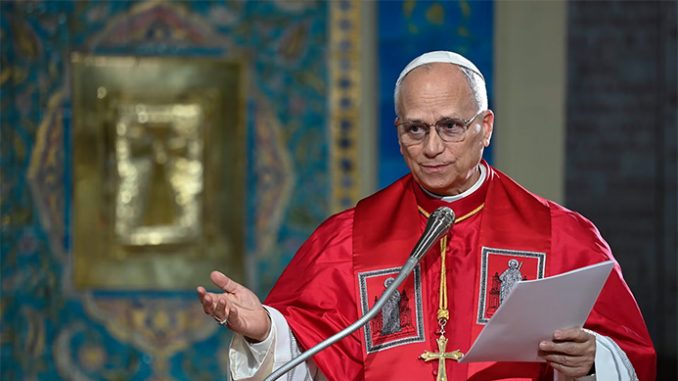
In his maiden visit to Africa, Pope Leo XVI has emphasized peace, justice, and dignity across a continent frequently torn apart by conflict and injustice.
Leo’s first stop was Algeria—the home of one of the Church’s most influential figures, St. Augustine of Hippo. There, he underscored the need not only for an end to global wars but, more importantly, for the promotion of justice and dignity for all mankind.
“God desires peace for every nation: a peace that is not merely an absence of conflict, but an expression of justice and dignity,” the Supreme Pontiff declared, addressing not only the Algerian people but the world at large.
“This peace, which allows us to face the future with a reconciled spirit, is possible only through forgiveness.”
His comments arrived just days after U.S. President Donald Trump criticized the global Catholic leader for questioning the U.S. stance on Iran. Pope Leo had previously deemed Trump’s threats to destroy Iran’s millennia-old civilization “truly unacceptable,” adding that Jesus “does not listen to the prayers of those who wage war.”
Trump responded on social media by labeling the first American Pope “weak on crime” and “terrible on foreign policy,” while insinuating that Pope Leo XVI owed his election to Trump’s own presidency.
“I don’t think he should be getting into politics,” Trump said.
But in Algeria, Pope Leo XVI refused to back down, declaring he would continue to preach the Gospel of Christ and would not be intimidated into silence.
“I have no fear of the Trump administration,” the Pope stated. “I don’t think that the message of the Gospel is meant to be abused in the way that some people are doing.”
“The future belongs to men and women of peace,” Pope Leo said later, standing at the Maqam Echahid Martyrs’ Monument in Algeria, which honors those who died in the Algerian War of Independence from France.
The French-born Archbishop of Algiers, Cardinal Jean-Paul Vesco, O.P., welcomed the Pope at the Monument with words that drew a smile from the Holy Father: “Most Holy Father, quoting Martin Luther King, I might say, ‘I had a dream,’ and that dream was of a pope visiting Algeria to meet the people to whom our Catholic Church knows it has been sent and with whom it shares a bond of life and blood. Today, this people welcome in you a supreme pontiff, a son of St. Augustine and, above all, a brother.”
In his speech, Pope Leo described himself as “a brother” to Algeria’s 48 million inhabitants—a largely Muslim country with a tiny Catholic population of about 10,000 faithful, representing less than 0.1% of the population.
He described the North African nation as “a great country, with a long history, rich in traditions dating back to the time of St. Augustine and well before.”
However, he acknowledged it is also a country with “a painful history, marked by periods of violence.”
He praised the “nobility of spirit” of the Algerian people, explaining that this spirit enabled them to overcome the trials of the War of Independence (1954–62) and the Civil War (1992–2002). True independence, the Pontiff noted, will come only “when peace in our hearts has finally been achieved.”
That peace, he added, is possible only when the spirit of forgiveness sweeps through society.
“I know how difficult it is to forgive. But, as conflicts continue to multiply throughout the world, we cannot add resentment upon resentment, generation after generation. The future belongs to men and women of peace. In the end, justice will always triumph over injustice, just as violence, despite all appearances, will never have the last word.”
Leo cited the Algerian people as an example of faith, observing that their spirit of brotherhood is both “a great gift” and “a sacred duty” to declare that all are “united as brothers and sisters, children of the one God!”
This message resonated with Algerian President Abdelmadjid Tebboune. He hailed the Holy Father as a leading voice for justice “at a time when the gap of economic inequality continues to widen dramatically,” particularly between the North and South, and as “development disparities are growing ever more pronounced, both between nations and within societies.”
President Tebboune went on to describe Leo as “the world’s most eloquent voice for peace” during an era when conflicts are undermining security and stability globally, particularly in the Middle East.
The President praised the Pope’s principled position regarding the tragedy in Gaza, the evolving challenges facing the Palestinian cause, and the crises in the Gulf region. He assured the Holy Father of Algeria’s solidarity, stating that Algerians and all people of conscience stand united with him in the pursuit of justice. This includes a call for immediate humanitarian relief, an end to systemic abuses, and respect for the Palestinian right to a sovereign, independent nation.
He further hailed the Pope as “the worthiest bearer of the torch of universal human and spiritual values: freedom, dialogue, and peaceful coexistence.”
A Pope in the footsteps of St. Augustine
Pope Leo XVI selected Algeria as the inaugural stop of his 11-day, four-nation African tour for a specific reason: it is the homeland of Saint Augustine (354–430). An influential Christian theologian, Augustine laid the foundations for the 13th-century Augustinian Order, to which Pope Leo belongs, having decided in eighth grade to become an Augustinian.
On April 14, the second day of his stay, Leo made a pilgrimage to the archaeological ruins of eastern Algeria. It is here that St. Augustine lived, died, and authored some of the most significant works in Western thought.
The ancient city of Hippo—modern-day Annaba—still retains the paved forum, theatre, market, baths, cisterns, and figurative mosaics that were in place during the time of St. Augustine. These remnants have been preserved alongside several Christian elements from the era, including the Basilica Pacis—where St. Augustine carried out his ministry—and a historic baptistery.
Pope Leo XVI laid a wreath there in honor of St. Augustine and his enduring legacy, before planting an olive tree as a living symbol of peace.
“I am grateful for the mysterious plan of divine providence that has brought me back here as Successor of Peter,” Pope Leo XVI said.
Even before landing in Algeria, the Pope noted that St. Augustine “represents a very important bridge in interreligious dialogue.”
“Having the opportunity to visit the places associated with the life of St. Augustine, where he was Bishop in the city of Hippo, now known as Annaba, is truly a blessing for me personally,” he said.
“I believe it is also a blessing for the Church and for the world, because we must always seek bridges to build peace and reconciliation.”
If you value the news and views Catholic World Report provides, please consider donating to support our efforts. Your contribution will help us continue to make CWR available to all readers worldwide for free, without a subscription. Thank you for your generosity!
Click here for more information on donating to CWR. Click here to sign up for our newsletter.

Here are some excerpts of an article depicting the Pope exemplary trip to Algeria, where he demonstrates the effectiveness of his approach, which emphasizes dialogue and mutual respect for other people’s beliefs:
Pope Leo Refuses to Denounce Islamist Persecution of Algerian Christians
Pontiff’s Homage at Martyrs Memorial Sparks Controversy over Ethnic Cleansing of Catholic Pieds-Noirs
April 15, 2026
Pope Leo XIV has rebuffed efforts by freedom of religion advocates to focus his attention on the state-sanctioned Islamist persecution of Christians during his trip to Algeria on April 13-14, 2026.
The pontiff, who began a ten-day Africa tour with a visit to Algeria, honored Marxist and Muslim revolutionaries at the Martyrs’ Memorial, but did not visit the Tibhirine monastery on the thirtieth anniversary of the Islamist kidnapping and beheading of seven Trappist monks there.
French commentators underscored the irony of the papal genuflection at the Memorial, noting that Algeria’s war of independence resulted in the massacres and expulsion of one million pieds-noirs—mostly Algerian-born French Catholics.
On the eve of Leo’s flight to Algiers, the European Centre for Law and Justice spotlighted the oppression of Christians in Algeria, stating: “According to the Algerian Constitution, Islam is the state religion, leading the former president of the High Islamic Council to declare that ‘an Algerian can only be Muslim’ (2021).”
The pontiff ignored pleas urging him to intercede for religious freedom. “Algeria imposes a single identity, both Arab and Muslim, to the detriment of minorities, particularly Jews, Ahmadis, and Christians. In 2020, freedom of conscience was removed from the Constitution,” the petition, signed by political leaders, human rights experts, philosophers, jurists, writers, and exiled Algerians, warned.
Instead, addressing Algeria’s President Abdelmadjid Tebboune, the pontiff appeared to renew his rhetoric against the United States and Israel, condemning the “constant violations of international law and neocolonial temptations.”
The pope remarked on “opposed dynamics of fundamentalism and secularization” manifesting themselves with “religious symbols and words” becoming “blasphemous languages of violence and oppression,” or “empty signs in the immense marketplace of consumption.”
Leo faced backlash from Catholics after he visited the Grand Mosque of Algiers and used the word “communion” to define ties between Christians and Muslims under the “maternal love” of Mary, a link they argue is fictitious.
Human rights campaigners began pressuring Leo to speak on behalf of Algeria’s Christians after the Vatican announced his trip.
On day one of the pope’s visit, the Alliance for Defending Freedom posted tweets pleading for Pastor Youssef Ourahmane, a Muslim convert and church leader, whom Algeria imprisoned for “illegal worship.”
Highlighting another case, Vatican reporter Arthur Herlin said he asked Leo to plead for the release of journalist Christophe Gleizes, sentenced to seven years in prison. Herlin tweeted: “The pope nodded several times and replied to me: ‘Yes, I know the case of Christophe Gleizes.’”
https://www.meforum.org/mef-observer/pope-leo-refuses-to-denounce-islamist-persecution-of-algerian-christians
Bunch of nonsense. Christ called the Church to proclaim the coming of His Kingdom.
“He said to them, “Go into the whole world and proclaim the gospel to every creature. Whoever believes and is baptized will be saved; whoever does not believe will be condemned.” –Mark 16:16
“Then Jesus approached and said to them, “All power in heaven and on earth has been given to me. Go, therefore, and make disciples of all nations, baptizing them in the name of the Father, and of the Son, and of the holy Spirit, teaching them to observe all that I have commanded you.” –Matthew 28:18-20
Jesus went to the House of the Lord and saw it filled with sellers and money changers. He calmly made a whip from small cords, then overturned their tables and drove them out of the temple. He condemned turning a house of prayer into a place of business.
It’s challenging to reconcile the example of Jesus with that of the Holy Father. Should the priority be fostering unity and harmony, like everyone singing “Kumbaya” together, or focusing on the pursuit of holiness and obedience to God?
It is a Pelagian notion to suggest that man can bring about peace. Peace can only come through Jesus Christ.
Peace and justice are two sides of the same coin. Where there is justice, there is peace. “God desires peace for every nation: a peace that is not merely an absence of conflict, but an expression of justice and dignity” – His Holiness Pope Leo XIV
It is still a Pelagian notion to suggest that man can bring about peace. Peace can only come through Jesus Christ.