


The Roman Martyrology, on April 14th, gives us a feast of an unusual saint, St. Liduina of Schiedam. Schiedam is a small town in the Dutch province of South Holland, not far from the city of Rotterdam. One sees the saint’s name spelled other ways, such as Lidwina or Lydwine, or any of a number of other variations, given that Dutch orthography was not normalized until relatively recently.
She was born on April 18, 1380, which was Palm Sunday, and the day of her birth proved an omen, because her entire life was marked by the Passion of Jesus Christ. (In fact, a possible etymology of her name connects it to the Dutch word for suffering.)
There was little in her early years that presaged what would happen. She was the fourth of nine children born to a pious couple, and the only daughter. Her father worked as the town watchman, and we would likely consider them lower middle class. She grew up helping her mother around the house, had a devotion to Our Lady, and seems (reading a little between the lines of her biography) to have been a special favorite of her father, as was not unlikely, given that she was his only daughter. She grew up to have a reputation for an honest beauty, and several young men spoke to her father asking for her hand in marriage. Yet she had other plans in mind and refused to consent to any match.
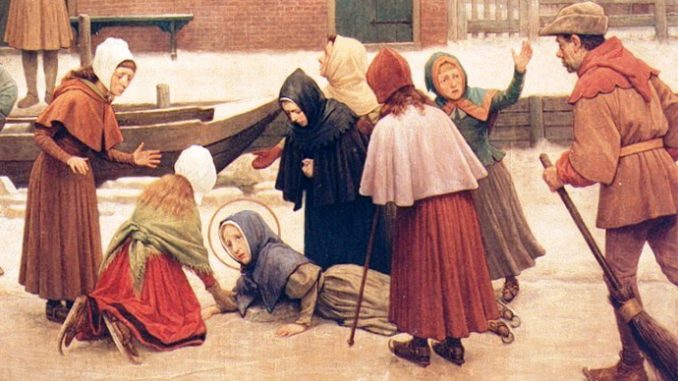
At some point in her teens, her biographers say that she resolved to give herself completely to Jesus, and if her beauty was going to keep her from devoting herself to Christ alone, she prayed to God that He would take it away, and God seems to have granted this prayer, giving her an illness that disfigured her and left her very weak. She was around fifteen years old when this happened and lingered in this condition for several months. As winter came around and the canals of the town froze, some of Liduina’s friends came to her house to take her skating on the ice, arguing that the fresh air and the exercise would be good for her health. She reluctantly joined them. She had hardly started skating when one of her friends crashed into her, sending them both tumbling. Liduina went down hard, and a piece of ice penetrated her ribcage, breaking one of her ribs.
This began a long illness from which she never recovered.
Her parents spent what of their meagre means they could in trying to find a cure for their daughter. Whatever treatments the doctors of the day applied, none helped. Liduina only grew worse and worse. Her modern biographer, the idiosyncratic French novelist of Flemish ancestry, Joris-Karl Huysmans, goes into gruesome detail as to how her body deteriorated. Her condition grew so bad that it seemed her body would fall into three pieces and was held together only by the linen bandages wrapped around her. Infection set in her wounds, and sometimes living parasites feasted. At times, her condition resembled that of a patient suffering from the Black Death or another form of plague. Liduina was in excruciating pain and left to wonder where God was in all this.
Some modern researchers have suggested that Liduina may have suffered from one of the first known instances of multiple sclerosis. Like MS patients today, she gradually lost the use of her limbs until she was confined to her bed. Light began to hurt her eyes, to the point where even the light from a fire in a hearth would cause her eyes to weep blood. Her body refused to keep food down. Even a small sliver of an apple would come back up. Her family despaired of her, yet still she remained alive in constant pain. One of the doctors asked to investigate her condition shook his head at his inability to help her, but seems to have been the first to suggest that this may have been more than just a natural illness running its course. The finger of God was here.
Her local priest was the first to suggest that Liduina learn to unite her sufferings to the sufferings of Christ by meditating on the events of the Passion. This did not prove easy for her at first. Her own physical pains made prayer difficult, and each time she tried to turn her thoughts towards the sufferings of Our Lord, her own pain rose in her mind. The priest was not surprised at this difficulty. He suggested that the focus of her meditations should be not so much the physical aspects of the Passion, as painful as they were, but on why Our Lord underwent such pain: for the salvation of sinners, for the salvation of you and me. In addition to his advice, the priest gave Liduina Holy Communion, which she had no trouble swallowing.
Gradually, step by step, her bed of pain became a school of prayer for Liduina. Though she could do little more than crawl (and eventually lost the ability to do even that), in her prayers she made the Stations of the Cross her primary devotion. The more time she spent contemplating her Savior, the more meaning she saw in her own sufferings. They did not lessen, but they could have a purpose. She could, as St. Paul suggests of himself in his letter to the Colossians, “fill up what is lacking in the sufferings of Christ.”
Liduina became what we would call today a “victim soul,” and perhaps one of the more extreme examples in Christian history. She came even to see her sufferings as a gift, because they could be used to atone for the failings of others, both living and in purgatory.
As rumors of her strange illness spread, people came to gawk and gossip. Many doubted that she could survive on so little food, suggesting that someone smuggled something into her at night. Yet a guard placed on her house for several nights found no evidence of such a deception. Others came to ask Liduina to pray for them, or for a loved one. She prayed to Jesus on their behalf, and often her prayers were heard. Liduina’s reputation spread.
She developed a rhythm of prayer analogous to the Liturgy of the Hours, meditating on the Passion at seven set times throughout the day. And the closer she drew to Jesus, the more He showed special favors to her. She often seemed able to read the conditions of souls, knowing which of her visitors came with honest needs and which came only out of curiosity. She received knowledge of people in other cities that she could only have gotten from God. At times, her guardian angel, in the company of other angels, strengthened her to endure her sufferings, appearing to her in visible form. Our Lord allowed her to see glimpses of Heaven, which she often perceived as an ordered garden where the saints of the Old and New Testaments worshiped the Lamb of God. She very often saw the purification of souls in purgatory, and invariably, upon seeing such a soul, she would ask that her own sufferings could be increased so that their purification could be shortened
The Church at the end of the fourteenth and the beginning of the fifteenth centuries was in a horrible state. Two (and for a time even three) men each claimed to be pope. Supposedly, Christian nations waged easy wars on each other. Plagues like the Black Death ravaged Europe. Strange heresies grew up, leading people astray, and too few bishops and clergy were inclined to stop them. Many of the religious orders grew lax. Confusion abounded. Many of her biographers see in Liduina’s body a kind of parable of the divisions and diseases suffered by Christian Europe at the time. Her sufferings and her prayers kept the wrath of God from being poured out. They brought aid to those willing to be helped. Huysmans uses an example very familiar to her Dutch homeland: Liduina was a dike against evil. Her sufferings, united to the sufferings of Christ, brought aid to her fellow villagers, to her country, and indeed, to the whole world.
This did not, except in rare moments of consolation (usually around Easter), make her sufferings any less painful. But Liduina never lost her resolve to unite her sufferings with those of Christ. She endured pain that can hardly be imagined for over thirty years, cared for by her parents, and later, other relatives and friends. Over the course of life, she lost sections of her skin, pieces of bone, and even parts of her intestines. Some of her nurses noticed a perfume coming from these fragments of her body. She ordered them to be buried so they would not become something squabbled over by those who visited her.
One day in prayer, Our Lord granted her the stigmata, though most of the time these were difficult to see unless one knew they were there, again, so that they did not become another source of curiosity and gossip.
Liduina died on April 14, 1433 (Easter Tuesday that year), just four days shy of her fifty-third birthday. When she was prepared for burial, some of our sources say that the beauty of her youth had been returned to her after her death. Local veneration of her began almost immediately. Among her admirers was Thomas a Kempis, author of The Imitation of Christ, who wrote one of three early lives we have of Liduina. For many years, with the approval of the appropriate local bishop, she was venerated under the title of Blessed. A decree of Leo XIII in 1890 solemnly declared her a saint. She is considered a patron of ice skaters and especially of those chronically ill.
There is a saying popular in some circles that would suggest that saints like St Liduina are to be “admired rather than imitated.” But it’s quite possible that, even if one were to know of her, she might not even be admired. The gruesome nature of the ailments she suffered and the mystical experiences reported by her biographers (on the testimony of the saint’s confessors) both make St Liduina seem too “medieval” or “gothic” to have much to say to the modern age.
We (at least in the West) live in an era disinclined to think of suffering and death. Even our prayer tends to be watered down to therapeutic techniques. The idea that our prayer might cost us something doesn’t fit well into a world where one can buy courses on prayer for $100 (or more) a lesson.
But the point of Liduina’s sufferings is less how extreme they were and more what use she made of them. We might never suffer from such a debilitating degenerative condition, but suffering of one sort or another will come to all of us. The remarkable life of St. Liduina suggests that, if we have eyes to see, suffering can in fact have meaning. It can offer reparation for sins and help others. That was the key for Liduina: for her to lift her eyes from her own pain and to look upon the Crucified. May we imitate her in this, if in nothing else.
If you value the news and views Catholic World Report provides, please consider donating to support our efforts. Your contribution will help us continue to make CWR available to all readers worldwide for free, without a subscription. Thank you for your generosity!
Click here for more information on donating to CWR. Click here to sign up for our newsletter.

A very good profile of a most unusual saint. Lidwina and Christina of Stommlen are the most extreme of medieval Suffering Souls.” One can’t help noticing that her vision of heaven resembles the glorious Ghent Altarpiece, also known as ‘The Adoration of the Mystic Lamb.”
Thank you for this beautiful story of St. Liduina. I read about her many years ago. It was the first time I heard about her and the existence of victim souls. On occasion I pray for our current victim souls in the world to persevere in offering their pains for the salvation of souls and those in Purgatory.
Her witness encourages me to continue to offer my own sufferings for souls and for our brothers and sisters in Purgatory.