


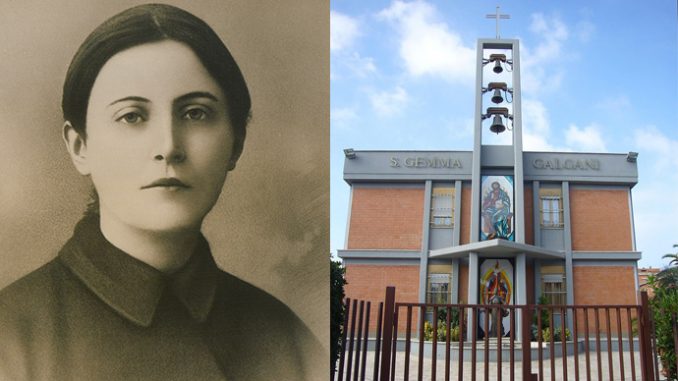
Saint Gemma Galgani (1878-1903) lived in our modern world. She read books, went to school, and got good grades in math class. We have photographs of her as a little girl and a teenager, as well as photos of her large family, the place where she sat at the kitchen table, and the bed on which she died.1
Gemma also claimed to experience supernatural gifts, including the inexplicable flow of blood from her hands, feet, and side, miraculous cures, and visions of Jesus Christ. Could such stories be true? If true, how can we explain that these phenomena occurred to a young woman who constantly talked about her own sinfulness?
Gemma was born in Italy into a large, Catholic family, but it was a family that knew suffering. Gemma’s mother died when she was seven years old, and three siblings also died young. Her father died when she was nineteen years old. Gemma went to live with an aunt and her surviving siblings, and later she moved into the home of a friend. Gemma died at the age of twenty-five.
However, she left behind many writings, which help us understand her interior life. Her confessor ordered her to keep a diary in 1900, and her spiritual director, Fr. Germanus Ruoppolo, a Passionist priest, told her in 1901 to write her autobiography, both of which can be found in this book. Gemma’s personal letters fill two books of their own.2 Fr. Ruoppolo, who knew her for three years, wrote her biography, which was first published about a decade after her death.
From these writings, does it appear that Gemma was delusional or making up these amazing stories? Although she had the writing skills of a typical teenager, not a Nobel laureate, Gemma does not seem mentally unstable, anxious, disturbed, or an attention seeker in her writings. Regarding the stigmata, since she spent her entire life in large households surrounded by many family members, not living alone in a hermitage, it would have been very difficult for her to create fake wounds every week.
No, it appears that Gemma really was a holy young woman, as attested to by her writings and by eyewitnesses, which is why the Catholic Church beatified her in 1933 and canonized her in 1940.
The real mistake that people make when reading the life of Gemma Galgani is that they forget that she was just an ordinary Catholic girl with one extraordinary difference: her passionate love for Jesus Christ. If one reads her writings carefully, it is easy to see that her astonishing mystical experiences did not simply appear out of the blue. Instead, there was a gradual progression as the mystical phenomena in her life became more frequent and more dramatic.
It all started with Gemma’s mother, who was a remarkably devout woman. She patiently accepted a lingering death from tuberculosis and did her best to instill a love of God in all her children. Gemma was apparently the only one who fully received that gift of faith.
Gemma was devout as a child, but also very human. After her mother’s death, she lived with an aunt and uncle who were less observant in their faith, and Gemma began to follow their example and become lukewarm. After she received her First Communion, the nine-year-old was once again inspired, made new resolutions, and began attending daily Mass a few times each week. But gradually her zeal began to fail. When two spiritually minded aunts came to live with her family, they confronted Gemma about some of her faults, moving the girl to tears and contrition.
One of Gemma’s schoolteachers was a devout nun, and she encouraged Gemma to pray more often and to perform small acts of penance. Gemma followed her advice. She even wrote down one of her resolutions during this period: “To make a visit to Jesus in the Blessed Sacrament every day and speak to Him more with the heart than with the tongue”.3
Gemma’s foot became so badly infected when she was eighteen years old that the doctor said it would need to be amputated. Her guardian angel apparently had begun to appear to her by this point, alternately praising and correcting Gemma for her behavior. Gemma was in constant pain from the infection, but also experienced great peace due to her desire to suffer for Jesus and go to heaven. Despite the doctor’s dire prognosis, Gemma’s foot completely healed.
When she was nineteen years old, Gemma’s father died, and she was sent to live with an aunt. Once again, her prayer life gradually faltered. But then she began to suffer severe back pain and headaches, which lasted for more than a year. She was diagnosed with spinal meningitis, which was deemed fatal. As Gemma’s pain increased, her mystical experiences became more pronounced. In addition to visits from her guardian angel, Gemma wrote that “someone” (she doesn’t give the person a name) appeared to her each night and encouraged her to continue a novena. On the final day of the novena, Gemma was, once again, completely cured.
Gemma was twenty-one years old when Jesus appeared to her and told her about a great sacrifice that He was about to ask of her. Gemma, who loved Jesus passionately as her Divine Bridegroom, agreed to the unnamed sacrifice.
On Wednesday of Holy Week in 1899, Gemma was too ill to go to Mass with the rest of her family, so she made a Holy Hour at home. Suddenly, she felt deeply recollected and very weak. Jesus appeared to her, and she was overcome by a sense of horror of sin. On Good Friday, Gemma was still too ill to go to Mass, but she continued to receive visions of our Lord and her guardian angel.
Two months later, on June 8, 1899, Gemma received the stigmata for the first time. Initially, the Blessed Mother appeared to encourage her, and then our Lord appeared with blood flowing from His wounds. The sight of the Crucified Christ apparently caused Gemma to spend the next several hours in a spiritual ecstasy. When she became aware of her surroundings again, she was kneeling on the floor of her room, and blood was flowing from her own hands and feet.
Initially, Gemma tried to hide these wounds. But this pattern of visions and bleeding continued, week after week, every Thursday night through Friday afternoon, for months on end.
Visitandine nuns had cared for Gemma during a previous illness, and she had hoped to enter that order until our Lord informed her that she should follow a more austere way of life. Later, when Gemma tried to enter an order of Passionist nuns in her town, the community refused to accept her. (She famously predicted that the nuns would accept her after her death, which is what happened, although it required the intervention of a pope.) Despite her desire to give herself to God as a nun, Gemma remained a laywoman, living with her family, praying, going to daily Mass, and performing family duties.
And despite receiving the stigmata once a week, Gemma was not perfect. She reported that her guardian angel, the Blessed Mother, and our Lord Himself frequently rebuked her for some of her actions, which she typically attributed to the sin of pride.
The news that Gemma was receiving the stigmata and entering spiritual ecstasies became known throughout the city of Lucca, and Gemma’s family members were not delighted. They mocked her, fought with her, and tried to make her stop. But how does one stop an encounter with Jesus Christ?
Fortunately, a wealthy woman named Cecilia Giannini knew Gemma from daily Mass and recognized her unhappy living situation. Although Signora Giannini had twelve children of her own, she invited Gemma to move into her home, and Gemma accepted.
Gemma was now so hungry for the Eucharist that she had become a daily communicant, and she stopped eating other food, a phenomenon called inedia. Her visions settled into a pattern: Jesus appeared to her every Thursday, she received the stigmata, and our Blessed Mother appeared every Saturday. The devil once appeared to her in the form of a black dog. Brother Gabriel Possenti—a deceased Passionist seminarian who had lived in Lucca and who has now been declared a saint—frequently appeared and spoke to her. Gemma’s sufferings now included the pain caused by Jesus’ Crown of Thorns.
It was at about this point that Fr. Ruoppolo became her spiritual director. Although he was initially skeptical, he could not ignore what he saw with his own eyes: a young woman who received the marks and blood of the stigmata, who sometimes levitated in prayer, who was obedient to his spiritual guidance, who passionately loved the Eucharist, who had to be restrained from performing excessive mortifications, who saw herself as a great sinner, and whose behavior displayed remarkable modesty, patience, and humility.
Over time, Gemma’s stigmata ceased appearing every week. The pains of Christ’s wounds were replaced by the pain of tuberculosis, which ended her life on Holy Saturday, 1903.
In his book, Fr. Ruoppolo describes the many virtues that he noticed in Gemma’s behavior, but her greatest virtue, he said, was simplicity. As he describes it:
She was simple in thought, thinking no evil, and therefore incapable of forming a rash judgment. In her soul there reigned an unalterable serenity. With her mind ever fixed on God, in Him she saw all else, whether good or bad, agreeable or the reverse. She was like a spotless mirror that receives all images and upon which none leaves an impression.4
One is free to recognize Gemma’s holiness but set aside her mystical experiences. However, when one looks at the story of her life—the heartbreaking losses of family members, her painful illnesses, and her personal struggles to persevere in her interior life—it is not so hard to understand why she would be blessed with the stigmata and other extraordinary gifts. Rather than growing more in love with herself, her comfort, her will, and her family members (as most of us do) throughout her life, Saint Gemma Galgani gave more and more of her heart to Jesus Christ each time she was tested. Anyone who loves our Lord with such passion can expect Him to return the favor.
Endnotes:
1 There are a few photographs of Gemma that are in the public domain. Other photographs can be found in the (out-of-print) book by Msgr. Canon J. Bardi, trans. Margherita M. Repton, St. Gemma: Passion Flower (Boston: Daughters of St. Paul, 1946).
2 These letters are currently available only in Italian.
3 Gemma Galgani, The Diary of Saint Gemma (Manchester: Sophia Institute Press, 2022), 30.
4 Fr. Germanus, C.P., The Life of St. Gemma Galgani (Charlotte: TAN Books, 2012), 115.
If you value the news and views Catholic World Report provides, please consider donating to support our efforts. Your contribution will help us continue to make CWR available to all readers worldwide for free, without a subscription. Thank you for your generosity!
Click here for more information on donating to CWR. Click here to sign up for our newsletter.

Leave a Reply