


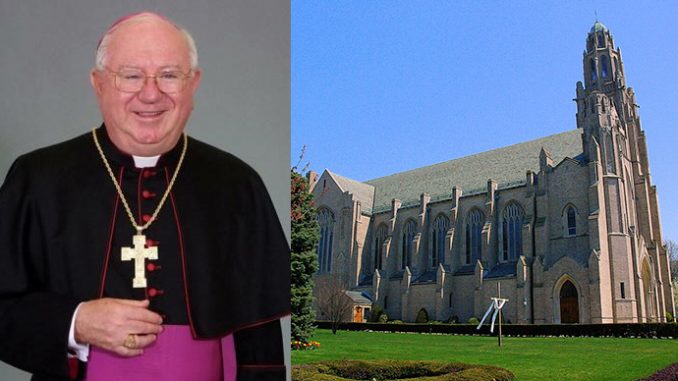
William Francis Murphy, the emeritus bishop of Rockville Centre who died on March 26 at age 85, was not a household name in American Catholicism. He did, however, have a considerable impact on both the universal Church and the Church in the United States. And a case can be made that his life embodied the modern U.S. Catholic experience in a particularly striking way.
Born in Boston on May 14, 1940, young Bill Murphy likely experienced the snobbery characteristic of the WASP-dominated “Hub” of his youth, in which Irish Catholics were disdained as some sort of lower life form. Nonetheless, he spent his high school years at the ancient, prestigious, and Boston Brahmin-heavy Boston Latin School, where he formed a lifelong friendship with another outlier, Neal Kozodoy, later the editor of Commentary and a leading Jewish author and editor. Discerning a vocation to the priesthood, Murphy matriculated at St. John’s Seminary in Brighton before undertaking his pre-ordination theological studies and formation at the Pontifical Gregorian University and the North American College from 1962 to 1965.
Those were the heady years of the Second Vatican Council, and Murphy was an enthusiastic participant in the “Off Broadway” council of lectures, debates, and conferences, many of which revolved around the Centro pro Unione in the Palazzo Doria Pamphili, overlooking Piazza Navona, and the Dutch Documentation Centre. This “Off Broadway” aspect of Vatican II, which had a real effect on the Council’s actual deliberations, was, to use the vulgate, dominantly progressive. And in the fal. of 1964, it was at the Dutch Documentation Center that the first shot in what I have come to call the “War of the Conciliar Succession” was fired by the Flemish Dominican Edward Schillebeeckx, who gave a lecture suggesting that the world had always been in some sense Christian and that divine revelation had simply made that tacit Christianity explicit.
This was too much for the most venerable leader of the Council’s reformist theological advisers, the French Jesuit Henri de Lubac, who told his brother Jesuit, Karl Rahner, that this was a “betrayal of the Gospel.” To make a long story very short, the reformist theologians eventually split into two camps, one associated with the journal Concilium and the other with the journal Communio, the latter being founded by men like de Lubac and Joseph Ratzinger. Decades later, this division—which was not between “progressives” and “traditionalists,” but between two tendencies or orientations within the reformist group of conciliar theologians—would harden into the division between those who read Vatican II as a rupture with the Church’s tradition (which they sometimes called a “paradigm shift”), and those who read the Council as one of development and renewal in continuity with the Deposit of Faith (the defense and proclamation of which was, according to Pope John XXIII, the primary purpose of the Council).
Young Father Murphy, who was ordained in December 1964, was not directly involved in the War of the Conciliar Succession between Concilium and Communio, but he embodied it nonetheless. Murphy, the quondam enthusiast for conciliar progressivism, thought his way through to a more Communio-like position through his doctoral studies in social doctrine and his work at the Pontifical Council for Justice and Peace, which began in 1974. According to Murphy’s mature conviction, the Council was a major achievement, but its renewal of Catholic self-understanding could only be properly understood as John Henry Newman understood such evolutions: as organic developments rooted in a tradition with settled reference points. And that conviction, in turn, led to what then-Monsignor Murphy once told me he would say to St. Peter when asked what he had done with his life.
In the immediate aftermath of the Council and the somewhat naïve ecumenical euphoria of the moment, Rome was urged to join the World Council of Churches (WCC). Pope Paul VI knew that that was quite impossible: the WCC was an organization of denominations, and as the Council had made clear in its Dogmatic Constitution on the Church and its Decree on Ecumenism, the Catholic Church did not think of itself as one (albeit large) star in a galaxy of Christian denominations. So the Catholic Church would not become a member of the WCC. But a compromise of sorts was reached by the creation in 1968 of a new entity: SODEPAX (an acronym for the French Société, Développment, Paix), a joint project of the WCC and the Vatican’s Pontifical Council for Justice and Peace.
Twenty years after its founding in 1948, the WCC had been deeply influenced by the ever-accelerating drift toward the global left of liberal Protestant denominations, even as it had been thoroughly penetrated by East Bloc secret intelligence services, including the Soviet KGB. So SODEPAX—in its self-appointed role as the “social conscience” of world Christianity—took a predictably leftist line on virtually all issues of social development and world peace. Tensions intensified to the point that SODEPAX was terminated in 1980, and it seems that then-Monsignor Murphy, Undersecretary of the Pontifical Council for Justice and Peace, had a hand in that. For one evening in the late 1980s, over a scotch or two, he told me that when he met the one entrusted with the Keys of the Kingdom of Heaven and was asked to plead his cause, he would reply, “St. Peter, I helped kill SODEPAX.”
The modus executionis was not disclosed. But I imagine St. Peter found the outcome to Murphy’s credit.
From 1974 to 1987, Murphy’s Roman home was the Villa Stritch, a residential complex for Americans working in the Roman Curia, and he served as the Stritch’s superior from 1979 to 1986. It was in those years that he became a friend, and in some cases a mentor in navigating the Curia’s distinctive ways to many American clergy who would go on to play important roles in the Church during the ensuing decades, including future nuncio Ambrose De Paoli, future cardinal Daniel DiNardo, future cardinal James Harvey, and future bishop David Malloy. He also formed a close friendship with Cardinal William Baum after the Archbishop of Washington came to Rome in 1979 as Prefect of the Congregation for Catholic Education; their personalities were quite different, but the two were among the Americans who got along easily with the Italian denizens of the Roman Curia. (Thirty-six years later, in Washington, Murphy would help pray Baum into eternity at the Jeanne Jugan Residence of the Little Sisters of the Poor, reciting Evening Prayer of the Liturgy of the Hours aloud as the cardinal lived his last hours on the evening of July 22, 2015.)
Murphy returned to his native Boston in 1987, where he became an auxiliary bishop in 1995 before being named bishop of Rockville Centre, one of the largest dioceses in the country, in 2001. In that capacity, he took an active, if understated, role in the affairs of the United States Conference of Catholic Bishops (USCCB), not least in helping keep the conference’s “foreign ministry” from becoming completely captured by the Catholic left. Most consequentially, however, he was a key figure, and likely the key figure, in the USCCB presidential election of 2010.
The election of Cardinal Francis George as conference vice-president in 2004 and then conference president in 2007 marked the beginning of a break with the liberal hegemony within the conference of the previous decades. But it was hoped, by those who found themselves unhappy with all that, that what they took to be the natural order of things would be restored in 2010 by the election as president of Bishop Gerald Kicanas, then the conference vice-president, following a long-established pattern of succession by the vice-presidential heir apparent. Thus, even Cardinal George, performing his last presidential act by announcing the election results at the USCCB annual meeting in November 2010, seemed stunned when he told the assembly that Bishop Kicanas had been bested by then-Archbishop Timothy Dolan of New York.
It was a decisive turning point in the post-conciliar history of the Church in the United States, the effects of which continue to be seen today: not in the “divided hierarchy” of the National Catholic Reporter’s imagination, but in a conference whose great majority takes its cues from the dynamic orthodoxy of John Paul II and Benedict XVI. And the instigator, mastermind, and chief whip of the quiet but ultimately successful campaign to elect Archbishop Dolan was Bishop William Murphy. Others were involved, of course. But the key man was Bill Murphy.
Bishop Murphy was as Boston Irish-American as Boston Irish-American gets. He also loved Rome, visited frequently after his years of work there, kept up his extensive contacts in the Curia Romana, and was unfailingly loyal to the Holy See. Those two qualities were conjoined in his renovation and restoration of the Cathedral of St. Agnes in Rockville Centre, from which he will be buried on April 7. The cathedral is built in the Gothic revival style, and in 2015-2016 Bishop Murphy led an extensive renovation of the structure, the primary aim of which was to restore the Blessed Sacrament to the center of worshippers’ and visitors’ attention. This was accomplished by relocating the tabernacle to the apse of the cathedral and surmounting it with a magnificent modern baldacchino, reminiscent of many a Roman basilica.
It was in the decoration of the baldacchino, however, that Murphy brought Rome and America together, as the structure features images of saints who embodied the vision of a renewed, evangelical Catholicism for which the Second Vatican Council had called, and who had inspired deep devotion in the United States. Among them: St. Thomas More, ideal of Catholic political leaders like Henry Hyde; St. Gianna Beretta Molla, heroine of the pro-life movement; St. John Paul II, whom Bishop Murphy revered, and who saw in U.S. Catholicism a vibrant model for others; St. Teresa Benedicta of the Cross (Edith Stein), martyr of Auschwitz and bridge between Judaism and Catholicism; St. Maria Faustina Kowalska, apostle of Divine Mercy. And above all of them, the four evangelists, reminders that sanctity is animated by the Gospel in the service of mission.
Shortly after his death, Bishop Bill Murphy was described by one of his fellow bishops as a “great churchman.” It’s not a noun commonly used these days, but it fits Bishop Murphy perfectly. He was a man of the Church in the fullest sense: a man who dedicated his life to the service of Christ’s Body in the world so that the world might come to believe—and thus be saved from its sundry madnesses. He died when the world was experiencing an exceptionally turbulent period of madness, which is all the more reason to mourn his departure from among us and to ask for his intercession at the Throne of Grace.
If you value the news and views Catholic World Report provides, please consider donating to support our efforts. Your contribution will help us continue to make CWR available to all readers worldwide for free, without a subscription. Thank you for your generosity!
Click here for more information on donating to CWR. Click here to sign up for our newsletter.

Leave a Reply