

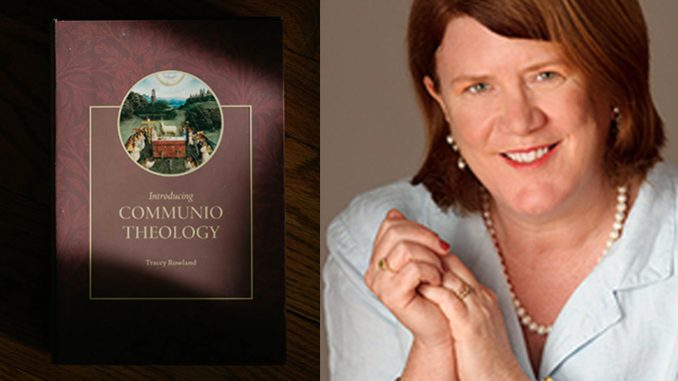
Tracey Rowland holds the St. John Paul II Chair of Theology at the University of Notre Dame (Australia). She received her PhD from the Faculty of Divinity, University of Cambridge, and her STL and STD degrees from the Pontifical Lateran University. She also holds degrees in law and government from the University of Queensland and philosophy from the University of Melbourne. She was a member of the Ninth International Theological Commission and is currently a member of the Pontifical Academy of Social Sciences. In 2020, she won the Ratzinger Prize for Theology. She is the series editor of Joseph Ratzinger: Collected Works.
Her books include Culture and the Thomist Tradition: After Vatican II (Routledge, 2003), Ratzinger’s Faith (Oxford University Press, 2008), Benedict XVI: A Guide for the Perplexed (Bloomsbury, 2010), Catholic Theology (Bloomsbury, 2017), and The Culture of the Incarnation: Essays in Catholic Theology (Emmaus Academic, 2017).
Her new book is Introducing Communio Theology, published by Word on Fire Academic. She recently corresponded with Carl E. Olson about the book.
CWR: Before we talk about the book, can you tell us about when and how you developed an interest in theology? And, specifically, your first encounter with Communio theology? What attracted you to it?
Rowland: I started to read theology when I was in secondary school. My religious education in primary school was excellent. Four out of seven of my grade teachers were holy nuns—kind and intelligent women. The schools over which they presided were little oases of Catholic culture.
But then, in my secondary school years, the whole approach to religious education changed. The spirit of the 1960s arrived. Instead of reading the lives of the saints and learning the faith through them, or reading the classics of Catholic literature, or Conciliar documents—all things with some intellectual content—we were made to sit around coffee tables, hold hands, light candles, and sing pop songs. It was an ordeal for introverts and mind-numbingly boring for everyone.
I survived because I complained to my parish priest, who supplied me with “samizdat” literature, including recordings of homilies by Fulton Sheen that were peppered with Thomistic principles. Bishop Sheen was my gateway drug to other American Catholic scholars. I discovered the books of James V. Schall, SJ, and got myself onto the Ignatius Press mailing list.
In my honours year (1985), I read The Ratzinger Report. Before that time, I was reading a lot of Thomist authors, especially Maritain, but when I read The Ratzinger Report, my theological interests broadened. I started to read everything by Ratzinger I could find and a bit of Balthasar.
When I arrived in Cambridge, the first question my supervisor asked me was: What kind of Catholic are you? Do you prefer Rahner or Balthasar? They were the only options I was given, so I answered Balthasar!
At the time, Fr. Aidan Nichols, OP, was also in Cambridge writing a trilogy he privately called his “Balthasar for Idiots”: The Word Has Been Abroad, No Bloodless Myth, and Say It Is Pentecost. These introductions to Balthasar were for me “the low door in the wall” that led from superficial to deeper understandings of the world of Communio scholarship.
CWR: You state that Communio theology is better understood as “more of a theological sensibility” built on essentials of fundamental theology rather than a school of theology. Why is that, and what are some of the key characteristics of that theological sensibility?
Rowland: Unlike Thomism, which offers a system built upon tightly defined concepts, Communio theology is not typically systematic. Balthasar certainly produced his 15-volume theological triptych, but a lot of what passes under the banner of Communio theology would be described as interventions in the field of fundamental (not systematic) theology.
This is because Communio scholars are often drawn to the project of resolving pastoral crises with theological foundations. They are like theological pathologists, analysing a cancerous growth in some part of the body of the Church and working out how it developed and what needs to be offered as an antidote. This is especially true of the publications of Joseph Ratzinger. They are not trying to build a new system but to fix cracks in old systems or draft plans for small extensions thought to be necessary for some pastoral reason.
CWR: As you note, Fr. Joseph Fessio, SJ, has described as “neo-Cappadocian” the “founding trio” of Communio theology: Hans Urs von Balthasar, Henri de Lubac, and Joseph Ratzinger. How would you summarize the thought and importance of each?
Rowland: Balthasar shows us how to contend with the German philosophy undergirding the cultures of modernity and post-modernity. Any Catholic who has had to deal with Kant, Nietzsche, Hegel, Heidegger, etc., can go to Balthasar for help.
Balthasar also offers a theological framework related to the transcendental properties of beauty, goodness, and truth, in that order. He understood that for many people, the gateway into the faith is first through the portals of beauty or goodness before approaching the portal of truth.
Ratzinger offers several master classes in fundamental theology. He is the absolute master of getting the theological foundations right, and he is the master of scriptural exegesis, showing how one can use the historical-critical method within the horizon of the faith itself.
Lubac is the great pathologist of secularism and the retriever of Patristic insights necessary for the development of an Eucharistic ecclesiology. This is the antidote to the contemporary pathology of treating the Church as if she were some kind of multinational philanthropic corporation to be run according to the latest fads in corporate management theory.
CWR: What was the relationship between the Second Vatican Council and Communio theology/theologians? And how does Communio theology help us better understand the Council and its documents?
Rowland: Lubac and Ratzinger were both theological advisors at the Second Vatican Council, so when they wrote about their interpretations of the documents, they were speaking as men who took part in the debates on the drafting commissions. They are sure guides for understanding what was behind the documents, the ideas, and the pastoral concerns driving them.
As with many documents, legal, political, or theological, the interpretation of Conciliar documents requires the application of a hermeneutical framework. The different interpretations of the Council are due to the application of different frameworks.
For example, it makes a huge difference whether one reads Gaudium et spes through a quasi-Hegelian hermeneutic that views contemporary social movements as the work of the Holy Spirit in history, or as a document that offers what Ratzinger called a daring new theological anthropology, based on a belief that Christology is essential for understanding the human person.
The hermeneutical frameworks applied by Communio scholars are all very Trinitarian and Christocentric, and thus they are said to offer a Trinitarian-Christocentric reading of the Council.
CWR: What has been the approach and work of Communio theology with Scripture scholarship and exegesis? And why is it important after two centuries of scholarship rooted in secular assumptions and the limitations of the historical-critical method?
Rowland: The Communio approach to scriptural exegesis reads the Scriptures within the horizons of the faith itself.
The historical-critical method, though not rejected by the Church, cannot supply all that is needed for a Catholic understanding of the Scriptures. It can be useful but not sufficient. The great Hungarian Cistercian, Denis Farkasfalvy, who was a contributor to both the Hungarian and English-language editions of the Communio journal, famously remarked that ‘excluding the experience of faith from the exegetical process on methodological grounds is like subjecting a musical piece for the judgment of a jury whose members must be deaf, so that their aesthetic experience would not interfere with the unbiased objectivity of their judgment’.
Joseph Ratzinger dealt with this issue in his Erasmus Lecture delivered in New York in 1988. He also presided over the drafting of The Interpretation of the Bible in the Church (1994), a document of the Pontifical Biblical Commission offering guidance on scriptural hermeneutics.
A book that brings these various threads together is Fr. Aaron Pidel’s The Inspiration and Truth of Scripture: Testing the Ratzinger Paradigm (Catholic University of America Press, 2023). I highly recommend it for young Catholic scholars grappling with the problem of how to approach scriptural exegesis.
CWR: In the chapter titled “Christocentric Moral Theology,” you discuss the important relationship between the Trinity, Jesus Christ, and moral truth. What are some insights into that relationship from recent Communio thinkers?
Rowland: The Communio scholars see the moral life as a process whereby people grow into the likeness of Christ by participating in the virtues of Christ.
Holiness is therefore about participating in the life of the Holy Trinity itself. It cannot be separated from sacramental theology and spirituality as a stand-alone moral code, easily comprehended by any rational person. It best makes sense in a Trinitarian context, which explains why some of the Church’s moral teachings, such as those found in Humanae Vitae, are so hard for those outside the Church to comprehend.
Some of the big names associated with Communio moral theology include Livio Melina, Cardinal Marc Ouellet, José Noriega, and José Granados. They argue that what is required is a freely willed participation in the divine law, wherein love and reason coincide.
CWR: Feminism is a contentious topic, and your chapter on the topic dives into some challenging waters. What do you hope readers will garner from that section of your book?
Rowland: My hope is that readers will gain the understanding that Catholics are not Mennonites. It will be a tragedy if young Catholics fall down an Amish-style rabbit hole. In times such as our own, when people can no longer rely on social customs as a guide to what is reasonable, many young people, especially those from broken families, need to work out the basics for themselves.
It is difficult. For many of our youth, the principles of functional family life are something they piece together by looking at what didn’t work for their parents and grandparents. Clearly, feminist ideology is not a good guide for navigating these waters. But the Amish attitude is not the only alternative and certainly not the Catholic alternative.
Understanding masculinity and femininity is an issue of theological anthropology, and we Catholics have our own theological anthropology. We should not be looking to Protestants for guidance here. Moreover, this is an area of Church teaching that was richly developed during the pontificate of St. John Paul II. We need to make certain that young Catholic men and women understand the magisterial teaching in this field; thus, I tried to give at least an overview of it and a list of references to where more material can be found.
CWR: How would you describe the relationship—historically and currently—between Thomistic theology and Communio theology? Do you have a foot in both camps?
Rowland: My short response would be “rocky but stabilising,” and I do feel comfortable in both camps, though most of my work is in the Communio territory because of my focus on Ratzinger.
A longer response would be that I started reading Thomist books when I was in secondary school (part of the haul of samizdat literature I received from my parish priest), and I lapped them up. I especially loved all the Latin maxims.
However, in my undergraduate years, I started to realise that not all those who claimed the “Thomist” label had the same ideas. The more Thomist authors I read, the more it became clear to me that there were different “species” of Thomists, like there are different species of big cats at a zoo. They are all, in a sense, feline, but some have differently coloured spots and stripes from the others. I started to realise that I would need to decide what species of Thomist I was. I was drawn to the Thomism of Alasdair MacIntyre because he was the most history-sensitive of the Thomist “big cats”.
When trying to understand why it was that, after the Council, ecclesial leaders all over the world ditched Catholic high culture for pop culture and sought to market the faith by correlating it to popular culture, I tracked the problem to theologians like Schillebeeckx and Rahner.
Unfortunately, in the immediate post-Conciliar period, Thomism was treated as if it were some kind of garbage recycling plant where any kind of ideology could be fed into it, and then the system was supposed to separate the good bits from the bad bits and then hoover up the good bits. We had a generation trying to synthesise Thomism with all manner of social theories. Even Rahner called this ‘gnoseological concupiscence’! A lot of the garbage was never filtered out.
It was because of my opposition to cultural correlationism and to the post-Conciliar belief of Rahner that we all had to be moderns now that I ended up attracted to Lubac, Balthasar, and Ratzinger, and thus Communio theology. This attraction was not, however, synonymous with any opposition to classical Thomism.
Similarly, I would argue that the “neo-Cappadocian trio” were also never hostile to classical Thomism, but they were hostile to particular appropriations of Thomism, especially Suárezian Thomism or what is sometimes called “baroque Thomism” and to elements of early twentieth century neo-Thomism that were running on a sharp separation of nature and grace and faith and reason, and thus philosophy and theology. In other words, they were opposed to varieties of Thomism that had bought into dualisms fostered by Protestant theologians in the sixteenth century and people like Kant in the eighteenth.
Nonetheless, when Lubac criticised Suárezian Thomism, he found himself opposed by members of his own Jesuit Order and, more overtly, by Reginald Garrigou-Lagrange OP. Today, if one reads Rad-Trad blogs, Garrigou-Lagrange is presented as the superhero who defended the Church from the modernism of the evil Lubac.
If, however, one reads the works of Communio scholars, Lubac was no modernist. He was retrieving what he believed to be the position of St. Thomas. He read St. Thomas through the lens of his Patristic predecessors, rather than reading him backwards, as it were, through the lens of his later commentators, as was the common practice.
Further, in the late 1960s, when the priesthood and the papacy came under attack, and ecclesial leaders were marketing the faith with reference to the cultural tropes of Californian hippies, Lubac and Balthasar were two of the biggest names sounding alarm bells. Balthasar’s The Office of Peter and the Structure of the Church was the strongest defence of the papacy written in that era and perhaps of any era. Moreover, Balthasar was a strong defender of Thomistic metaphysics.
Since the 1940s, a lot of water has flowed under the bridge. A new generation of Thomist scholars has arisen. This generation understands the debates of the 1940s and the different appropriations of Thomist thought, the different sub-species of Thomist “cats” mentioned above. There is now a Thomist Ressourcement. The most successful project of this group has been the large number of publications produced under the banner of “Biblical Thomism”. Biblical Thomists present the Thomist corpus in a non-dualistic manner, keeping the theological and philosophical elements together.
My experience has been that the Thomist Ressourcement types and Communio scholars have no trouble respecting each other’s contributions and working together. Balthasar described truth as “symphonic”. Thomists and Communio scholars are members of the same orchestra, following the same score, but playing different instruments. The Thomists are usually quite gifted at analytical work, while the Communio scholars tend to shine at synthetic and interdisciplinary work. Typically, Communio scholars have a greater interest in history and culture. These descriptions are just sociological generalizations. They are often summarised by the suggestion that Thomists are left-brain dominant and Communio scholars are right-brain dominant.
There are some people who are completely at home in both parts of the orchestra. Aidan Nichols OP is a good example of this. He made the point that one important distinction between Thomists and Balthasar is that Balthasar thought that, to contend with the German philosophy of the past three centuries, he needed to expand the philosophical range of Thomism. I agree with this judgment.
When people ask me, ‘Why do we need Balthasar when we have Thomas?’, my response is ‘because Balthasar understands modern German philosophy, and if we are to do something about the epic disaster that is the Catholic Church in the German-speaking parts of Europe, we need some heavy Balthasarian artillery’. We need the insights of someone who survived the German tertiary education system with his faith intact, someone who knows about Lessing’s “great ugly ditch” and how to get around it. Balthasar and Ratzinger were such men, and both owed much to Lubac.
Finally, I would recommend Matthew Levering’s The Achievement of Hans Urs von Balthasar and Aidan Nichols’ Balthasar for Thomists for those who long for an harmonious alliance – an entente cordiale!
CWR: The final chapter, titled “Geneologies of Secularism,” is an important and fascinating one. You write that “a non-dualistic relational mode of thinking is the frame through which scholars in the Communio circles analyze social pathologies.” Can you unpack that a bit, explaining why this is what we need now?
Rowland: Secularism is not a virus that floats around in the biosphere and comes into the home through the air-conditioning system. It is rather a mental attitude or pattern of thought that develops when the critical couplets of the Catholic intellectual tradition get broken up and separated from their intrinsic relationships to one another.
We have ended up with a secular culture because nature got separated from grace, faith got separated from reason, history got separated from ontology, scripture got separated from tradition, and, in short, humanity got separated from the Holy Trinity. These relationships need to be restored, and their place in the Catholic intellectual tradition explained and highlighted in our ostensibly Catholic educational institutions.
Fortunately, large numbers of Generation Z are so sick of living in a disenchanted, materialist cosmos that they are searching for alternatives. Many have discovered Bishop Barron and his Word on Fire podcasts. At least through watching these podcasts, they can start to discover pieces of the “jigsaw” of a Catholic cosmology where nature and grace, faith and reason, etc., work together in tandem.
(Editor’s note: This interview was first published on the What We Need Now site and is posted here with kind permission.)
If you value the news and views Catholic World Report provides, please consider donating to support our efforts. Your contribution will help us continue to make CWR available to all readers worldwide for free, without a subscription. Thank you for your generosity!
Click here for more information on donating to CWR. Click here to sign up for our newsletter.

Thank you Mr. Olson! Great interview! The woman is a national treasure (or I guess an international treasure!) and all her books are worth reading and she deserves a very very wide audience! She writes with such amazing clarity on difficult topics, and is so incredibly knowledgeable of all the influences, history, details, etc. especially of Communio, Ratzinger/B16, and St. John Paul II. She is also funny, kind, loyal, and all good things!
An immediate question arose when Author Rowland spoke of the virtues of Christ. How do they differ from the natural, inherent virtues of the natural law?
Rowland responds to the question in her sixth response, “It cannot be separated from sacramental theology and spirituality as a stand-alone moral code”. She says it’s Trinitarian.
Her most articulate response is her seventh response to the relationship between Thomistic theology and Communio. Rowland refers to Scholastics Suarez, La Grange the different schools that were shown to offer marked differences in interpretation of what Aquinas actually taught regarding the virtues. As in my research for a doctorate on Aquinas’ moral theology the Angelic Doctor does not compile a moral doctrine in any singular opus. The Summa Theologiae responds to multiple issues besides moral thought.
What is clearly put forward are theologians Rowland speaks to as representative of Communio theology among which two are well known, Balthasar and Ratzinger. Ratzinger my personal choice.
In addition, the initial question I ask is how do the virtues commonly understood in natural law compare with the Virtues of Christ? That is found in large part in Aquinas’ Quaestiones Disputatae De Veritate. Aquinas speaks of virtue that exceeds natural law, since there is nothing in Man, in consequence of the fall from grace by which he can attain salvation. As such, there are virtuous acts that are the gifts of the Holy Spirit that exceed what man by nature can offer. Martyrdom in all its forms is one way of understanding those Trinitarian [involvement of the three Persons] unique acts that imitate Christ’s giving of Himself for our salvation.
We read: “We have ended up with a secular culture because nature got separated from grace, faith got separated from reason, history got separated from ontology, scripture got separated from tradition, and, in short, humanity got separated from the Holy Trinity. These relationships need to be restored, and their place in the Catholic intellectual tradition explained and highlighted in our ostensibly Catholic educational institutions.”
About the overall separation of cerebral doctrine from the incarnational reality of Jesus Christ, what if the Act of Faith is reworded: “[….] I believe these and all the truths which the Holy Catholic Church teaches, because You have revealed YOURSELF [not “them’], who can neither deceive nor be deceived”?
Yes, but. Without propositional truth, man may subject God to distortions of relative truth. God reveals Himself, yes, and has granted authority to the Church to interpret, formulate, and promulgate the truths of Revelation. Don’t the keys to Peter imply this? The words of the Church’s propositions serve the faithful as guidelines or guardrails. Creeds, dogma, and Catholic Church doctrine are as lines drawn through magisterial centuries, indefectible.
Your suggested creedal revision echoes Aquinas’ Truth himself speaks truly, or there’s nothing true.”, Peter.
appreciate the Communio sentiment, but for me, the real sticking point remains the relationship between nature and grace. I also find the contempt many Nouvelle Théologie thinkers held for figures like Garrigou-Lagrange and Gardeil deeply troubling; it’s hard not to feel that 20th-century Catholic theologians broke the Fourth Commandment against their theological fathers.
The concept of two distinct orders—and the absolute gratuity of grace—is so foundational to Catholic theology that it is nearly impossible to avoid. Matthias Scheeben, the great 19th-century German Thomist, argued that we cannot overcome secularism without a clear, absolute distinction between these two realms. He believed this was the only way to preserve the ‘splendor’ and utter gratuity of the supernatural order.
When these orders are confused, the supernatural is inevitably pulled down into the purview of the natural, leading us to judge divine mysteries by human standards. At a symposium on Scheeben, Ratzinger noted that this exact collapse occurred after the Council. I suspect Henri de Lubac’s influence played a significant role in this shift.
While I am not deeply versed in the ‘run-of-the-mill’ theology of the early 20th century—and perhaps the average priest then viewed the distinction as a total separation—that was not the actual Neo-Thomist position that Maurice Blondel and De Lubac attacked. The authentic Thomistic stance is that nature is already inherently ordered toward God, just not according to a supernatural mode. Neo-Thomism never actually proposed a truly ‘autonomous’ nature.
There is also a fascinating inconsistency regarding the politics of this debate. One would expect a ‘two-tier’ Thomist to oppose an integralist vision, while someone like De Lubac—who sees the orders as more aligned—would favor it. In reality, the exact opposite is true.
Ultimately, I suspect the attack on the Neo-Thomist concept of nature and grace was a misdiagnosis of the problem. Scholasticism requires the benign, stabilizing influence of monastic theology. The Church needs a theological framework that is as heavy in sapientia (wisdom) as it is in ratio (reason).
Thank you. “When these orders are confused, the supernatural is inevitably pulled down into the purview of the natural, leading us to judge divine mysteries by human standards.”
Yes. If man’s ‘supernaturalized nature’ is inherently graced, then men may reason that immoral behaviour can not only be permissible but may be commendable…leading to beatitude. They could then ask: What need have we of Baptism, or of the church at all? Reduced to symbol, why bother. Many Catholics today so see the Eucharist. Many today no longer marry. Many today contracept and abort.
Yes, very troubling too was the youthful bright-light ebullient attitude of many a l’enfant terrible toward fellow Catholic theologians. This raised red-flag cautionary notes. The flags rose as rabid incense at LaGrange’s coinage of a certain term. Lubac himself, near his life’s end, alluded to the reality of a screeching banshee type response.
Minerd’s (Ed.) “The Thomistic Response….” and Flynn’s (Ed.) “Ressourcement” offer well-rounded views of many of the main actors.
For fine theological analysis and distinctions:
Jacob Wood’s 2017 “Henri de Lubac, Humani Generis, and the Natural Desire for a Supernatural End” – archive.stpaulcenter.com/11-nv-15-4-wood/
and
Edward Oakes, SJ’s 2011 “The Surnaturel Controversy: A Survey and a Response” — archive.stpaulcenter.com/05-nv-9-3-oakes/