

 By
By The conservative commentator argues that the U.S. Constitution reflects St. Thomas Aquinas’ “mixed regime” and a broader natural law tradition, despite the founders’ Protestant roots.

Speaking as the United States approaches its 250th anniversary, Knowles on March 19 tied the American system to Aquinas’ concept of the “mixed regime,” which combines elements of monarchy, aristocracy, and democracy — a framework that, he noted, is mirrored in the Constitution’s balance of executive, legislative, and judicial powers.
The remarks came during a March 19 fireside chat at The Heritage Foundation, where Knowles appeared alongside Jay W. Richards, the foundation’s William E. Simon senior research fellow in American principles and public policy, for a conference titled “Catholicism and the American Founding.” The event explored the philosophical and religious influences behind the American experiment, highlighting how ideas from classical and Catholic thinkers helped shape the founders’ vision.
“The government that they established,” Knowles said, “is very closely in accord with the ideal regime laid out by St. Thomas Aquinas.” He pointed to the Constitution’s combination of a strong executive, a deliberative Senate, and a more directly representative House as reflecting the “kingly, aristocratic, and democratic” aspect of Aquinas’ model.
Although the founders were largely Protestant and influenced by Enlightenment thought, Knowles emphasized that their ideas were part of a broader intellectual tradition that included Catholic thinkers.
“It’s not that Madison and Jefferson were reading Thomas Aquinas,” he said. “But they were reading him two degrees removed.” He traced that influence through figures such as Francisco Suárez and Robert Bellarmine, whose work shaped Protestant theorists and ultimately informed the American founding generation.
Knowles also highlighted the language of the Declaration of Independence, particularly its appeal to “the laws of nature and of nature’s God,” as evidence of a moral and philosophical tradition extending beyond purely secular Enlightenment reasoning.
“There is something delightful in Providence,” he said, “that this country, founded by a bunch of ardent Calvinists, would end up so beautifully resembling the regime of the common doctor [St. Thomas Aquinas] of the Catholic Church.”
Prayer breakfast speaker
Earlier the same day, Knowles — who is Catholic and host of “The Michael Knowles Show” at The Daily Wire — spoke at the National Catholic Prayer Breakfast, noting the continued influence of Catholicism in the United States.
“Catholics today make up a little over 20% of the U.S. population,” he cited, “but we make up 28% of congressmen, 38% of governors, and at least two-thirds of the Supreme Court … Not only is the sitting vice president Catholic, but every presently viable candidate for president in 2028 of both parties is a baptized Catholic.”
“Not only can a Catholic become president,” he added, “but an American can even be a pope.”
Only a “firm faith in Providence” could have permitted this, he said.
During the Heritage discussion, Knowles reflected briefly on his own return to the faith after falling away as a teenager.
“I noticed the smartest people believe in God,” he said, recalling his time at Yale and the influence of philosophical arguments and Christian writers such as C.S. Lewis and G.K. Chesterton, who ultimately converted to Catholicism.
That experience, he suggested, parallels a broader renewed interest in objective truth and natural law, particularly among younger Americans. “There is a real desire to return to something like objective reality,” he said.
The conversation also touched on the role of religion in public life. Knowles rejected the idea of a formal theocracy but argued that some shared moral framework is unavoidable. “We do have established religion in the country,” he said, noting that cultural norms and public expectations function in practice like a civic creed.
Heritage panelists weigh in
Following the fireside chat, a panel of Catholic scholars — including Elizabeth Edwards Spalding of Pepperdine University, Matthew Mehan of the Van Andel Graduate School of Government at Hillsdale College, and Carson Holloway of the University of Nebraska at Omaha — led by Brenda Hafera of The Heritage Foundation, examined these themes in more detail, particularly the influence of natural law on the American founding.
Mehan described natural law as rooted in “the rule of right reason,” drawing on Aristotle, Cicero, and Aquinas before shaping modern political thought. Spalding highlighted Jefferson’s acknowledgment of a broad intellectual tradition in the Declaration, noting references to both ancient and modern sources.

Panelists debated whether the American founding is compatible with Catholic political thought.
Holloway acknowledged that the United States may not embody the “best regime” in a classical sense but emphasized it as “a regime for which we can be grateful” — one “worth preserving and worth understanding,” especially as it enables the free practice and proclamation of faith.
Spalding stressed that early Americans distinguished between liberty and license, linking freedom to moral responsibility and the common good.
Several speakers also noted that concepts like natural rights predate the Enlightenment, emerging over centuries in classical and theological traditions. “Natural rights are very old … they’re not a creature of the Enlightenment,” Spalding said.
For Knowles, interpreting the founding in this broader philosophical and religious context helps Americans today understand the nation’s enduring principles as it marks its 250th year.
“We can totally grant that these men were not endeavoring to establish a Catholic republic,” he said. “But … what they have done has created a meaning that is very much in line with the natural law tradition.”
The discussion at The Heritage Foundation, Knowles suggested, is not just about historical interpretation but also about how the founding principles might inform contemporary civic life.
“Catholics in America are an improbable community because this country was founded by people who did not take kindly to them,” he told the National Catholic Register, the sister partner of EWTN News. “And yet, paradoxically, Catholics have thrived in America and contributed to America perhaps more distinctly than any other group.”
“This would have shocked many of our forefathers,” he added. “But our most insightful ancestors saw it coming because America, despite her outward appearance, has a profoundly Catholic character.”
This story was first published by the National Catholic Register, the sister partner of EWTN News, and has been adapted by EWTN News.
If you value the news and views Catholic World Report provides, please consider donating to support our efforts. Your contribution will help us continue to make CWR available to all readers worldwide for free, without a subscription. Thank you for your generosity!
Click here for more information on donating to CWR. Click here to sign up for our newsletter.

Pope Leo XIV laments ‘growing deterioration’ of the Amazon’s natural environment
In a video message addressed to the sixth assembly of the Ecclesial Conference of the Amazon, Pope Leo XIV highlighted environmental deterioration, synodality, inculturation, and evangelization. […]
Gaza’s Catholic pastor: Border closures make crisis ‘tragic’
Father Gabriel Romanelli says civilians are exhausted as aid access tightens and basic services collapse. […]
‘I am not ordaining you for an ideal country,’ South Sudanese bishop tells new priests
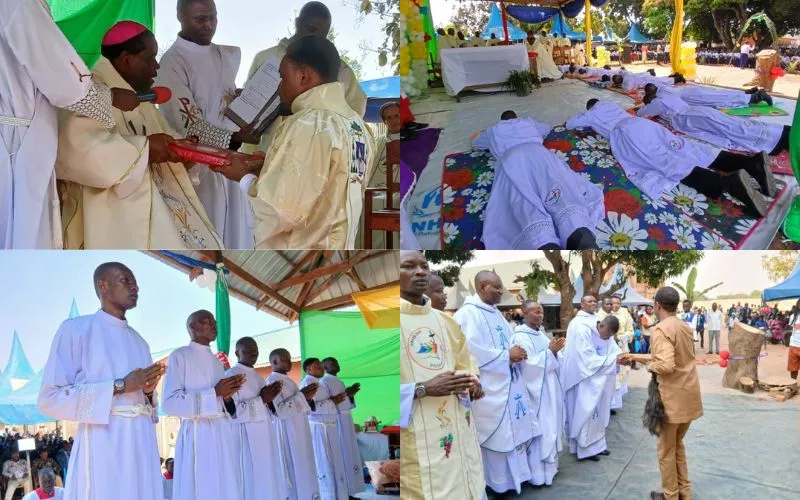 Four new priests and six new deacons were ordained for South Sudan’s Catholic Diocese of Tombura-Yambio on Jan. 4, 2026. | Credit: Ruru Gene News/Sister Laurencila, FSSA
Jan 11, 2026 / 07:00 am (CNA).
The four newly ordained priests and six newly ordained deacons for South Sudan’s Catholic Diocese of Tombura-Yambio have been reminded of the urgency of their mission in the contemporary world, especially in communities wounded by conflict, poverty, and division.
In his Jan. 4 homily during the ordination Mass that coincided with the solemnity of the Epiphany at St. Augustine Parish in the diocese, Bishop Eduardo Hiiboro Kussala reflected on the role of priests in reconciling broken communities, forming consciences through education, restoring dignity among the poor, and remaining steadfast where fear and suffering persist.
“I am not ordaining you for an ideal country,” Hiiboro said and described South Sudan, the world’s youngest nation, as a nation deeply loved by God and in need of committed pastoral leadership.
He noted that the Church sends priests into real situations marked by fragility but also hope.
The bishop, who serves as the president of the Integral Human Development Commission of the Sudan and South Sudan Catholic Bishops’ Conference, further urged those he was ordaining to be stars in guiding others to Jesus Christ in their respective ministries.
Hiiboro reflected on the story of the Magi and reminded the new priests and deacons that ordination does not replace Christ but points others toward him.
Reflecting on the star that guided the three Wise Men from the East to see the infant Jesus, Hiiboro urged the newly ordained deacons and priests to allow their lives to guide people to Jesus through faithfulness and witness.
“As the Magi followed the star and found Christ, you are now sent to be stars, guiding others to Jesus,” the bishop said.
Calling for unity among members of the clergy as one of the most powerful forms of preaching, the South Sudanese bishop encouraged fraternity, shared prayer, and forgiveness, reminding the clergy that love among priests is a visible sign of discipleship.
The bishop cautioned against constant complaint and division among members of the clergy, warning that such attitudes weaken vocation and harm communities.
Instead, he encouraged priests to embrace the cross of Christ, noting that suffering, when embraced with humility, sanctifies — but destroys one who rejects it.
Discouraging a “celebrity mentality” among priests, Hiiboro said the Church is more concerned with “holy shepherds rooted in the daily realities of the people.” Holiness, the bishop explained, is not an escape from life but faithfulness within it.
He urged priests never to abandon prayer, warning that a priest who stops praying gradually loses direction.
The South Sudanese Church leader went on to describe the three evangelical vows — celibacy, obedience, and simplicity/poverty — as paths to inner freedom, not limitations, which help priests overcome ego, attachment, and isolation.
Hiiboro, referencing the words of Pope Francis, urged priests to remain close to the communities they serve, portraying them as agents of peace, defenders of human dignity, promoters of education, and advocates for food security and self-reliance.
He emphasized that such involvement is not political activism but a genuine expression of living the Gospel.
The bishop also cited examples of saints who made a lasting impact on society through faith and service, including St. Benedict of Nursia, St. Daniel Comboni, St. Josephine Bakhita, and St. John Bosco — noting that they demonstrated courage even in challenging and imperfect circumstances.
The bishop also urged those he was ordaining to embrace their priestly identity with confidence, reminding them that their very presence, conduct, and appearance already preach before words are spoken.
This article was originally published by ACI Africa, CNA’s news partner in Africa, and has been adapted for CNA.
Leave a Reply