


 By
By 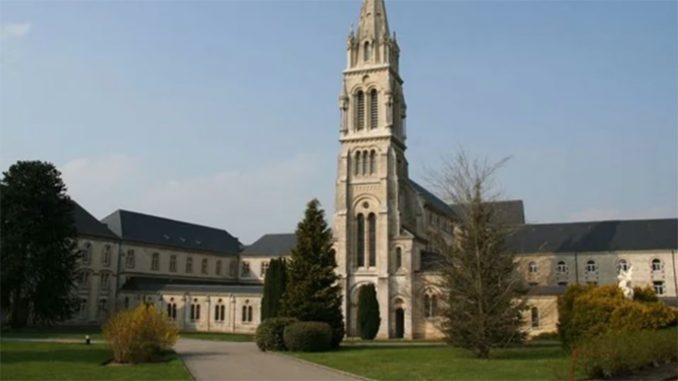
After nearly 900 years, the Trappist monks may be leaving the Abbey of Our Lady of La Trappe in Normandy, France, one of the most iconic symbols of the Cistercian tradition founded in the 12th century.
The monks, who belong to the Cistercian Order of the Strict Observance — also known as the Trappist order, which follows the Rule of St. Benedict — reported that they were considering leaving the monastery around 2028 due to “the shortage of vocations and the increasing burden of owning the land.”
For the approximately 20 brothers who make up the community located in Soligny-la-Trappe in northwestern France, this decision would signify the end of an era, although they emphasized that the abbey will not close its doors nor is it for sale at the moment.
“Discussions are underway with other communities to find more suitable solutions, more economically and spiritually relevant. The situation has been difficult for several decades now, and many other abbeys have already changed hands,” they stated on March 6.
They added that “the departure of the brothers is very trying and is painful; it will undoubtedly be a profound loss for all those connected, sometimes for generations, to the community.”
Faithful to the tradition of the Rule of St. Benedict, the monks have a guesthouse where they receive the faithful “as if they were Christ himself” and welcome them so they can experience a moment of solitude and reflection in an atmosphere of prayer and peace, as stated on their website.
They also maintain a shop where they sell books, religious articles, and regional products handcrafted at the abbey.
‘An ideological secularism that is rotting the soul of the West’
Bishop Robert Barron of the Diocese of Winona-Rochester, Minnesota, expressed his sadness at the possibility that the monks might leave the historic monastery.
The prelate noted that it is the “motherhouse of the Trappist order,” a reform of the Cistercian movement and a “particularly intense form of Benedictine life, famous for its austerity and silence.”
Barron explained that he came to know the abbey through the Trappist monk Thomas Merton, an American theologian and writer, and emphasized that the La Trappe abbey “has survived the Black Death, the Hundred Years’ War, the Protestant Reformation, the French Revolution, and the world wars of the 20th century.”
“That this venerable monastery cannot find enough vocations to keep it alive is, in my judgment, a sign of the spiritual disaster that has befallen Europe in the last hundred years: an ideological secularism that is rotting the soul of the West,” he lamented.
Given this situation, the bishop asked for renewed prayers so that the monks “might find a way to preserve their great abbey. It is needed especially now.”
This story was first published by ACI Prensa, the Spanish-language sister service of EWTN News. It has been translated and adapted by EWTN News English.
If you value the news and views Catholic World Report provides, please consider donating to support our efforts. Your contribution will help us continue to make CWR available to all readers worldwide for free, without a subscription. Thank you for your generosity!
Click here for more information on donating to CWR. Click here to sign up for our newsletter.


Bishop Barron just doesn’t get it. Yes, La Trappe abbey “has survived the Black Death, the Hundred Years’ War, the Protestant Reformation, the French Revolution, and the world wars of the 20th century.” But it could not survive the Novus Ordo and the influence of people like Thomas Merton.
100% agree. Vatican II was the ugly portal that allowed secularism to take over Christian nations.
You are exactly right about the modern influences, especially like Merton, being even more poisonous than past ones. Perhaps more as the end product of the surrounding rot, which has not been resisted, but subsumed to be ‘relevant’.
Merton…Father Louis, was a complex character to be sure. He rose to prominence with his autobiography in the post-war forties, lifting to some degree the veil which concealed Trappist monastic observance and he was a convert to boot in the epoch of grand conversions in protestant American society. He also cultivated a field of study in the Cistercian Fathers which was perhaps less familiar to a Catholic public hungry for spiritual sustenance.
Of course, the conciliar era rather lifted the lid on his personal academic interests among other things.
Decades later he eventually fell off the pedestal for me for no other reason than his trajectory had proved somewhat sterile. The whole “sixties thing” went south not too long after his death in ’68, didn’t it?
I once asked a monk, who shared my lets say “realistic” view of Merton, a monk who entered Gethsemani a few years after Merton’s death, what Merton’s confreres thought of him. I was deeply edified to hear “they loved him.” Not for the publicity he brought them, not even for the vocations he drew, but because he was a really nice generous man, an engaged confrere.
That says everything in community life.
First thoughts were an omen, reflecting Bishop Barron’s impression, A sign of the spiritual disaster that has befallen Europe in the last hundred years: an ideological secularism that is rotting the soul of the West.
Our glorious Missa de Angelis Sanctus 12th century completed 15th originated in Normandy, the home of Abbey of Our Lady of La Trappe. The ethereal beauty of that ancient liturgy is what is lost in the souls of the multitude. Except for a remnant.
For the Church to declare the practice of that sacred liturgy Verboten, as by despotic command speaks to the moral criminality of the authors of the crime. As well as its purveyors.
Post-Vatican II malaise.
There are many thriving religious communities devoted to the Ordinary Form of the Church’s liturgy (Novus Ordo Mass and the Liturgy of the Hours). The possible closing of this community is a tragedy, but the reasons are likely complex. Reducing this tragedy to the liturgy alone seems more like an attempt to promote an agenda than to understand what actually happened.
Here is an example of a solid Trappist community that uses the new liturgy:
https://newclairvaux.org/
Andrew: You’re so convinced of what did NOT cause its demise; now tell what you think ARE the reasons.
DiogenesRedux: Your analysis falls apart when you look at the many thriving communities celebrating the Ordinary Form. Any order that faithfully follows the teachings of the Church as outlined in the Catechism of the Catholic the Church, stays true to its founder’s charism (as Vatican II asked), and “does the red and says the black” in the liturgy will thrive. Proof? Franciscan Friars and Sisters of the Renewal, Sisters of Life, Trappists of Sept-Fons Abbey, Norbertines of St. Michael’s Abbey (CA), Washington Dominicans, Dominican Sisters of Nashville, Discalced Carmelite Friars (St. Joseph Province), Mount Angel Benedictines (OR) —and that’s just scratching the surface. I could go on and on. Please quit bashing the Ordinary Liturgy of the Church. Look up the above communities…you will be edified!
So why is La Trappe struggling? Who knows – but it’s clearly not the Ordinary Form. Likely a mix of factors, maybe even crumbling buildings.
Andrew: You really jumped the gun on this one. Nowhere did I say that religious life went into freefall because of Vatican II or because of the Novus Ordo. I simply positioned this demise in the period AFTER VatiCAN II and not BECAUSE OF Vatican Council II. I am well aware that there are growing religious communities and that these are ones faithful to the FULL teachings of the Church and a reverent praying of the Holy Sacrifice of the Mass. NB: “Post hoc” does not always mean “Propter hoc.”
Andrew is not in fact as “convinced” as you appear to be. He rightly notes that “the reasons are likely complex.” Indeed. They are only simple for either the simple-minded or for those who have a certain agenda to promote.
This is a tragic event. Its my understanding that the five communities in Ireland have consolodated into one. I’m aware of at least two closures here in the United States.
Having been blessed to have been in Trappist formation 25 years ago, I would say the enemy is within. There is within the Trappists, and in all orders and congregations experiencing a dearth of vocations, a split personality. It would not be difficult to apply this diagnosis to the Church as a whole.
During my three years with the community there were at one point eight men in the novitiate. We all had rough edges, including the novice master, but everyone of us could have made it through. Only two did so, one a transfer from another order who had entered that community fifty years earlier, and a diocesan priest of twenty-five years. The other six including me all eventually left. So much more could be said.
We had an abbot who was very proud of being known at the General Chapter as a “left wing brat.” Yes, that is a quote from his own lips. He was the monastic version of the last pontificate. His notions were infallible from his birth and to irk him was to be eliminated.
We are all subject to the same human foibles but we are all, ALL, required to adhere to the same perennial Magisterium.
Our Lord has not stopped calling men and women to His intimate service, the Church is not providing a nurturing environment for those vocations to be cultivated. When the lads wielding authority learn how to exercise it maturely, respectfully, in comformity to the perennial Magisterium, when the Church begins to speak with one voice rather than out of the side of its mouth with a wink and a nod, with authentic conviction, vocations will return.
Attend to Christ. God alone suffices. The zeitgeist is the path to extenction.
Thank you immensely for voicing all of this. I am not in the Orde, but have had a continuous association with them, mostly scholarly, for about the same length of time. I have heard similarly banal, and much more wicked things come out of the mouths of abbots. It was extremely distressing to see them shooting themselves in their own feet, causing their own ruin! Yet there are a few holy souls left, I have even met a couple of them from New Clairvaux. Thank you for speaking up!
And imagine, that remnant of holy monks are in California! Who knew? God is good.
Only 2 out of 8 made it out of the novitiate. Those figures alone suggest that just maybe something was wrong with either the system of induction or with those running it.
Well there is something wrong with the screening process, nothing is ever perfect. If I had to guess it might be that personal rapport or the lack of it between the candidate and the screener[s] can get in the way. But beyond that it is good to remember this. In the sixties I had a Discalced Carmelite prioress tell me that only one in ten candidates make it until death in their monasteries. Was that accurate I can’t say, but I will say that contemplative monastic practice in small communities can be challenging. The Carmelites delibertely have small communities [24 maximum by rule] and now that is rarely achieved except by the more traditional communities. Carmel is in crisis, as are the Trappists who traditionally have had huge communities. Before Vatican II Gethsemani had over 200 if I’m not mistaken, it is how they could establish all their daughter houses — it why they had to! Traditionally the Trappists do agricultural work and manual labor is central to the life and many hands make it happen. Those numbers are no longer existent anywhere, although African houses have a healthy population from what I’ve heard.
The monks and nuns need our prayer. These are rough times for communities facing extinction.
It’s Trump’s fault.
Too good! I recall once the abbot I referenced above, attempting to get at my political leaning, expressing horror that his predessor in office was, of all things, a Republican!
What was lost at Vatican II was the romance of the faith. Not because of Vatican II, perhaps, but at the same time. The notion of being a Trappist Monk is a highly romantic one, but once the romance of the faith was lost, it is hard to see how such vocations could be sustained. And the split between the Novus Ordo and the TLM is precisely one between a utilitarian rite that gets the job done and a romantic rite that enthralled the heart. The bells and smells so derided by the reformers were indeed not necessary to the function of the rite, but they were at the heart of its romance. We didn’t lose the orthodoxy of the church, or the tradition of the apostles, but we lost the romance of the faith.
GM Baker: If your thesis is correct, how do you account for this community (and many like it)? Check out the Abbey of Sept-Fons documentary below.:)
https://www.youtube.com/watch?v=–sOtNl73lg
Oh, the romance is not entirely gone. But it is now counter-cultural, rather than the heart of the culture, which, in itself, involves a different kind of romance, the romance of being counter-cultural. But the ability of this romantic counter-culture to grow or to sustain all of the old institutions just isn’t there, especially because it so often devolves into open rebellion against the mainstream unromantic church.