


As we head toward Laetare Sunday, many of us are feeling rather discouraged by the inconstancy of our Lenten disciplines. We woke up on Ash Wednesday piously determined to pray the Rosary every day, or say the Office each morning, or make it to daily Mass at lunchtime.
Or perhaps we made a firm purpose to abstain from alcohol, tobacco, or superfluous snacks or libations. This year, we said, we are taking fasting seriously, and not merely on Ash Wednesday and Good Friday. Or maybe we made a commitment to visit shut-ins, contribute to St. Vincent de Paul Society, or serve a meal at the local Catholic Worker House.
But after three weeks of Lent, we have fallen well short of our ambitious plans, failing and faltering in what we have done and failed to do. Rather than striding penitently and consistently through Lent, we have stumbled and fumbled, forgetting this prayer intention or failing to find time for that corporal work of mercy. As such, we might feel that our Lent is a failure, regretting that we are not faithful or pious enough even to manage our mild ascetic ambitions. Sincere as our intentions were, once again we have not kept them. We have, we think, failed again.
If this describes you, take heart. It is not a failed Lent. Or it need not be.
If we can incorporate our personal shortcomings into the very liturgical and spiritual purpose of Lent, then perhaps our inconstancy is actually at the service of Lent’s proper purpose. If the purpose of Lent is to teach us anything, it is that we are incapable of sustaining our moral, spiritual, and religious commitments by ourselves. And our failure to keep the letter of our proposed discipline is, in fact, part of the very point of Lent. Discrete failures can be the means toward a very successful Lent, because these failures illustrate our very dependency on God’s unfailing grace and mercy.
Johnny Cash’s simple, lovely song, “I Came to Believe,” captures this idea. In the first of only two verses, the narrator laments,
I couldn’t manage the problems I laid on myself
And it just made it worse when I laid them on somebody else
So I finally surrendered it all brought down in despair
I cried out for help and I felt a warm comforter there
When we feel that we have failed in our Lenten disciplines, the reason is often that we have tried to maintain them by ourselves. We are prone to forget that we cannot even do the things we want to do without the sustenance of God’s grace. Rather than see even our very acts of penance or charity as dependent on God, we implicitly rely on our own autonomous effort. But of course this is to forget that “God is at work within [us], both to will and to work for his good pleasure” (Phil. 2:13).
Ironically, in our sincere efforts to enter into an active penitential season, we tend to forget that we are repenting from the false assertion of autonomy—that is, “self rule”—at the heart of our need for redemption.
In the second chapter of Genesis, God explained to the man and woman in the Garden of Eden—that is, us—that we are not the source of all that is good and that we are not autonomous moral actors. To be sure, we are given a great abundance of good things to use and enjoy. But the tree of the knowledge of good and evil is the symbol of our ultimate dependence upon God for all things. Our moral lives are a participation in the eternal mind of God, as St. Augustine put it. In the third chapter of Genesis, the man and woman (again, read: you and I) rejected that dependence in a declaration of moral autonomy.
We pretend to replace the Creator with the creature. And, of course, the result is that we are shut off from the very paradise in and for which we were meant to enjoy. Expelled and locked out of paradise, we suffer the natural effect of our unnatural assertion of autonomy.
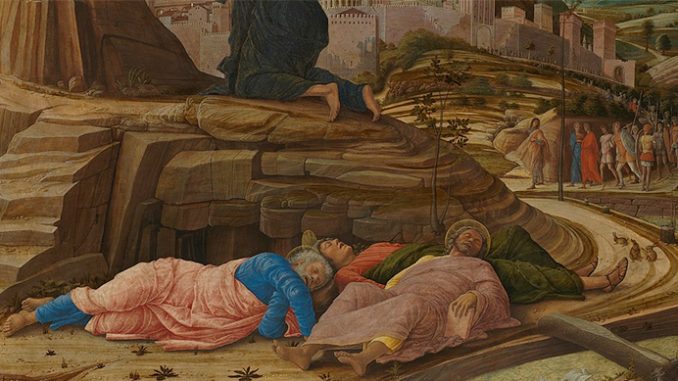
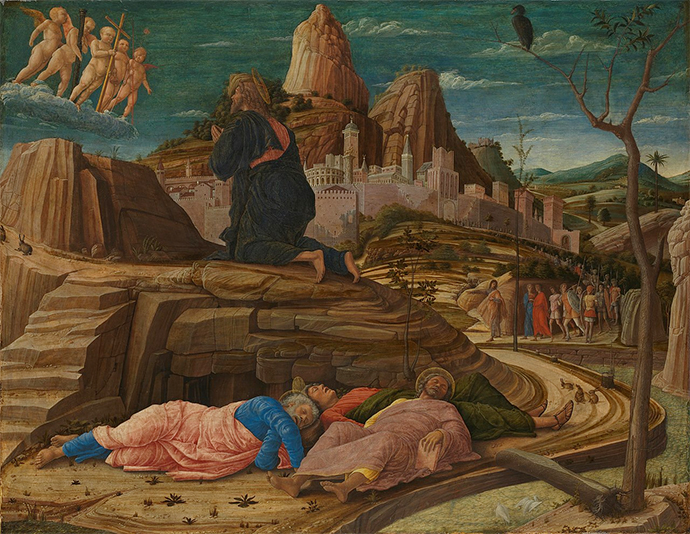
The quest, then, is to return to paradise. But before we can return to Eden, we must go through Gethsemane.
In Eden, the man and woman were granted enormous—indeed nearly limitless—abundance in what they could eat and enjoy. The only caveat was a recognition that they are not self-creators, ontologically, morally, or otherwise. Rather, the Tree of the Knowledge of Good and Evil is the symbol of their dependence on God for all things, most especially moral knowledge. Their moral lives are participations in the eternal mind of God, dependent upon Him as the source of all good. But rather than to affirm that dependency, the man and woman in Eden said No to God. And the result was expulsion from Paradise.
In other words, they chose in the same way that Johnny Cash’s narrator did in the second of the two verses of “I Came to Believe”:
Nothing worked out when I handled it all on my own
And each time I failed it made me feel twice as alone
Then I cried, “Lord there must be a sure and easier way
For it just cannot be that a man should lose hope every day”
Contrast the actions of the man and woman in Eden with the man in Gethsemane. Rather than offer abundance, Jesus was faced with agony. And he had the choice to eschew the cup that had been passed to him. But in contrast to Eden, in this garden the answer was “Not my will but thine.” As the Son of the Father, Jesus is one in the Holy Trinity, perfecting the performance of his will by conformity to God’s eternal plan, disrupted though it was by our choice to assert personal autonomy.
In theology, we call this contrast “type” and “anti-type,” where the Greek-derived prefix “anti” means “in place of,” rather than “against” or “opposed to.” Through one man in Eden (the type), all have fallen in the mistaken view that we are autonomous moral actors. Through one man in Gethsemane (the anti-type), all is restored to its original goodness, and we are offered another opportunity to participate in God’s eternal mind by saying “Yes” with Christ. Put another way, in Eden, the man and woman rejected their moral lives as dependent on God, and declared that they “could handle it all on [their] own.” In Gethsemane, Jesus gives us the opportunity not to assert an autonomous yes, but rather to join our assent to his obedience, “even to death on a cross” (Phil. 2:8).
Or, as Johnny Cash puts it in the closing chorus of “I Came to Believe”:
And I came to believe in a power much higher than I
I came to believe that I needed help to get by
In childlike faith I gave in and gave him a try
And I came to believe in a power much higher than I
It’s ok to slouch through Lent, as long as we make it through Gethsemane.
If you value the news and views Catholic World Report provides, please consider donating to support our efforts. Your contribution will help us continue to make CWR available to all readers worldwide for free, without a subscription. Thank you for your generosity!
Click here for more information on donating to CWR. Click here to sign up for our newsletter.

Great. Now we’re quoting a drug-addled man who left his wife for somebody else’s and declared himself “saved”. Whiskey Tango?
Thank you so much. I love Johnny Cash.
I find that if you fail to make Lenten sacrifices or mess up about what you’d intended to sacrifice, God will bring you just what you need as far as sacrifices. Never seems to fail.
🙂