

 By
By 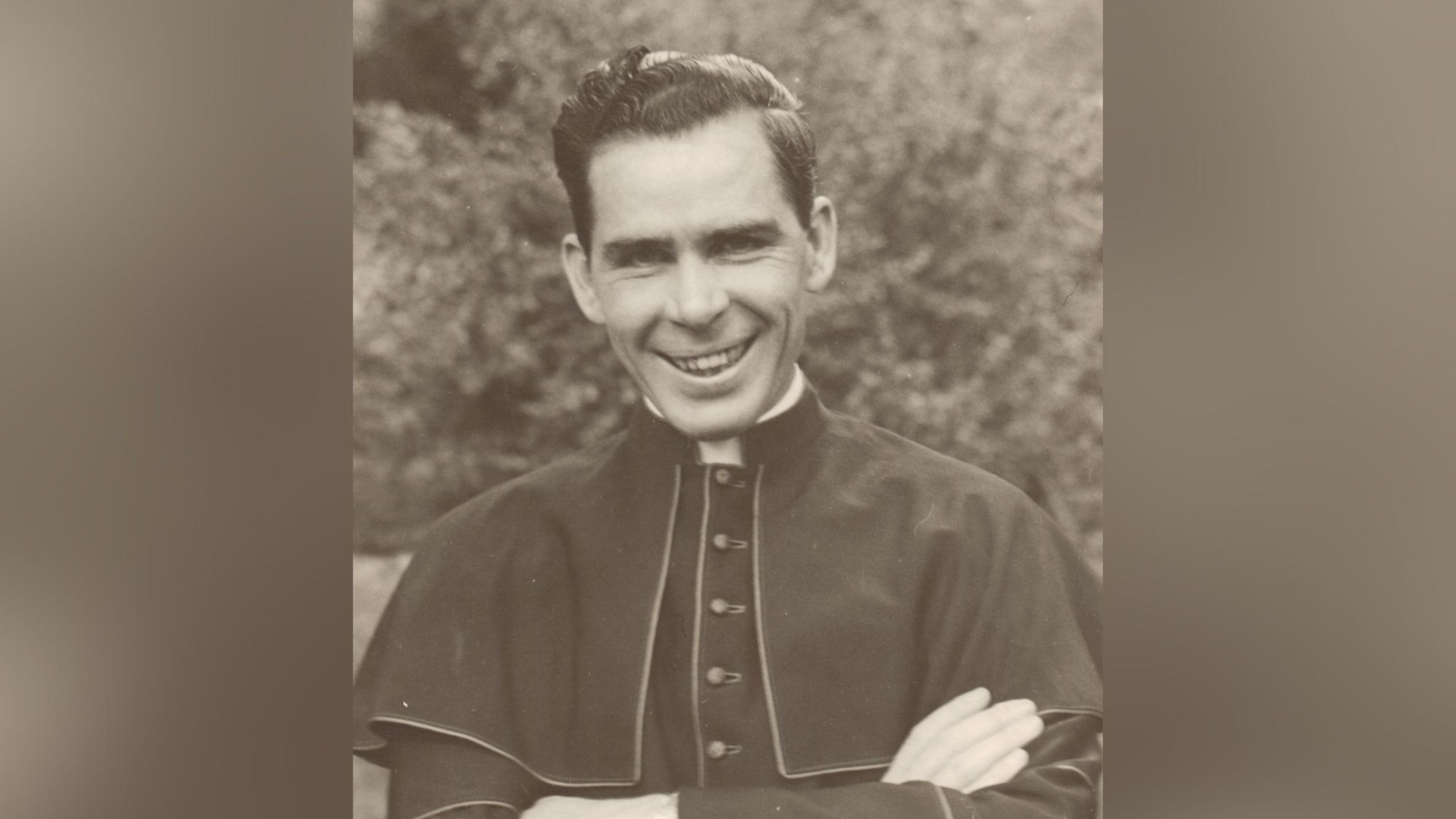
Venerable Archbishop Fulton Sheen (1895–1979) was an award-winning radio and television personality who, amid fame and success, kept Christ at the center of his life.
Now, he’s on the path to sainthood, with the Vatican recently announcing that his beatification — the second of three major steps in the canonization process — will be moving forward following a six-year delay.
A theologian who explained heady ideas in practical language to millions of listeners, Sheen had a mission: “to know what the modern world was thinking and how to answer its problems using the teaching of St. Thomas Aquinas,” according to Sheen expert Peter Howard, founder and president of the Fulton Sheen Institute and Fulton Sheen Movement.
“Sheen was a modern-day St. Thomas Aquinas,” Howard told EWTN News.
Fulton Sheen was born to a family of farmers in El Paso, Illinois. Christened Peter John, he later became known by his mother’s maiden name, “Fulton.” After studying at parochial schools in Peoria and attending St. Viator’s College in Kankakee, Illinois, Sheen was ordained a priest at St. Mary’s Cathedral in the Diocese of Peoria, Illinois, in 1919. He then studied at The Catholic University of America in Washington, D.C., and graduated as an associate professor of philosophy in 1925 from the University of Louvain in Belgium.
For more than 20 years, from 1927 until 1950, Sheen taught theology and philosophy at The Catholic University of America — the only pontifical university in the U.S. He wrote more than 60 books, more than half of which were published during his time as a professor.
In 1951, Sheen was appointed an auxiliary bishop of the Archdiocese of New York, then later became bishop of Rochester, New York, in 1966, and was named archbishop of the Titular See of Newport Wales in 1969.
‘Our modern world needs Sheen’
Monsignor Jason Gray, executive director of The Archbishop Fulton John Sheen Foundation, called Sheen “the most powerful and effective evangelizer in the United States.”
“His television program, ‘Life Is Worth Living,’ reached 30 million viewers during its run in the 1950s,” Gray said. “However, more important than his fame or his telegenic personality, Sheen had a personal connection with Jesus Christ and a deep faith that radiated through his preaching.”
His media career began in 1930 with the Sunday evening “Catholic Hour” on NBC, which drew 4 million listeners. On Easter Sunday on March 24, 1940, he appeared in the world’s first television broadcast of a Catholic religious service.
“Much like Jesus’ use of parables, Sheen drew his audience in by common experience and then connected them to the divine,” Gray said. “However, Sheen was courageous in preaching countercultural truths as well.”

“Our modern world needs Sheen, and today’s preachers who are inspired by Sheen, to answer the questions posed by our modern culture with the timeless truth of the Gospel,” Gray continued.
Sheen is credited with making anti-Catholicism mostly a thing of the past in American culture, thanks to his widespread audience, which reached not only Catholics but also Protestants and Jews.
“Archbishop Sheen contributed to overcoming an anti-Catholic bias present during his lifetime since his television program was so popular,” Gray said. “His ‘indirect approach,’ as he called it, spoke about eternal truths by approaching them through common experiences.
When Sheen became auxiliary bishop of New York in 1951, he transitioned from radio to television.
“In this way, Sheen’s ‘Life Is Worth Living’ was considered must-see TV by many Catholics, but also by Protestants and Jews, among whom Sheen was very popular,” Gray continued.
Sheen vocally opposed communism while also advocating for social justice.
“He was extremely relevant when he was in his prime on Catholic radio and television through most of the 20th century,” Howard said. “But as time has proven, he was ahead of his times as his teachings and cultural forecasts for the world and for the Church have proven to be remarkably on target.”
“He understood the philosophical foundations for the modern world that were anti-God, anti-family, anti-human,” Howard continued.
Sheen participated in the Second Vatican Council on the Commission on Missions and helped implement Vatican II’s reforms as bishop of Rochester.
“Sheen was a man of the Church and stood in the middle at a time when factions after the council were pulling the Church in different directions,” Gray said.

During his time as bishop of Rochester from 1966 to 1969, he “worked to implement the authentic teaching of the Second Vatican Council,” Gray said.
“However, he was not liberal enough for the liberals or conservative enough for the conservatives,” he said.
This principle also applied to Sheen’s politics. While Sheen was outspoken against socialism, he also “warned about the dangers of capitalism if the value of a human person was reduced to the value of what he or she could produce,” according to Gray.
“Sheen recognized the merits of the positions of the left and right and found harmonization by elevating them to the divine,” he continued.
“Sheen had a third way, a higher way, which favored neither the left nor the right. He went up to God,” Gray said.
Sheen’s ‘secret’
Behind the fame, the thousands of letters from fans, and even the 1953 Primetime Emmy Award for Most Outstanding Personality, was a man who dedicated himself to Christ in prayer every day.
Sheen prayed before Jesus in the Eucharist for at least an hour each day. He contributed his entire salary to missionary activity in the Church. Sheen also had a deep connection to Mary.
Sheen’s mother consecrated him to Mary after his baptism, and he dedicated himself to her at his first Communion. He had a devotion to Mary for the rest of his life and made great theological contributions to the study of Mary.
“Fulton Sheen’s relationship with Mary was one of a little child with his mother,” Howard said.
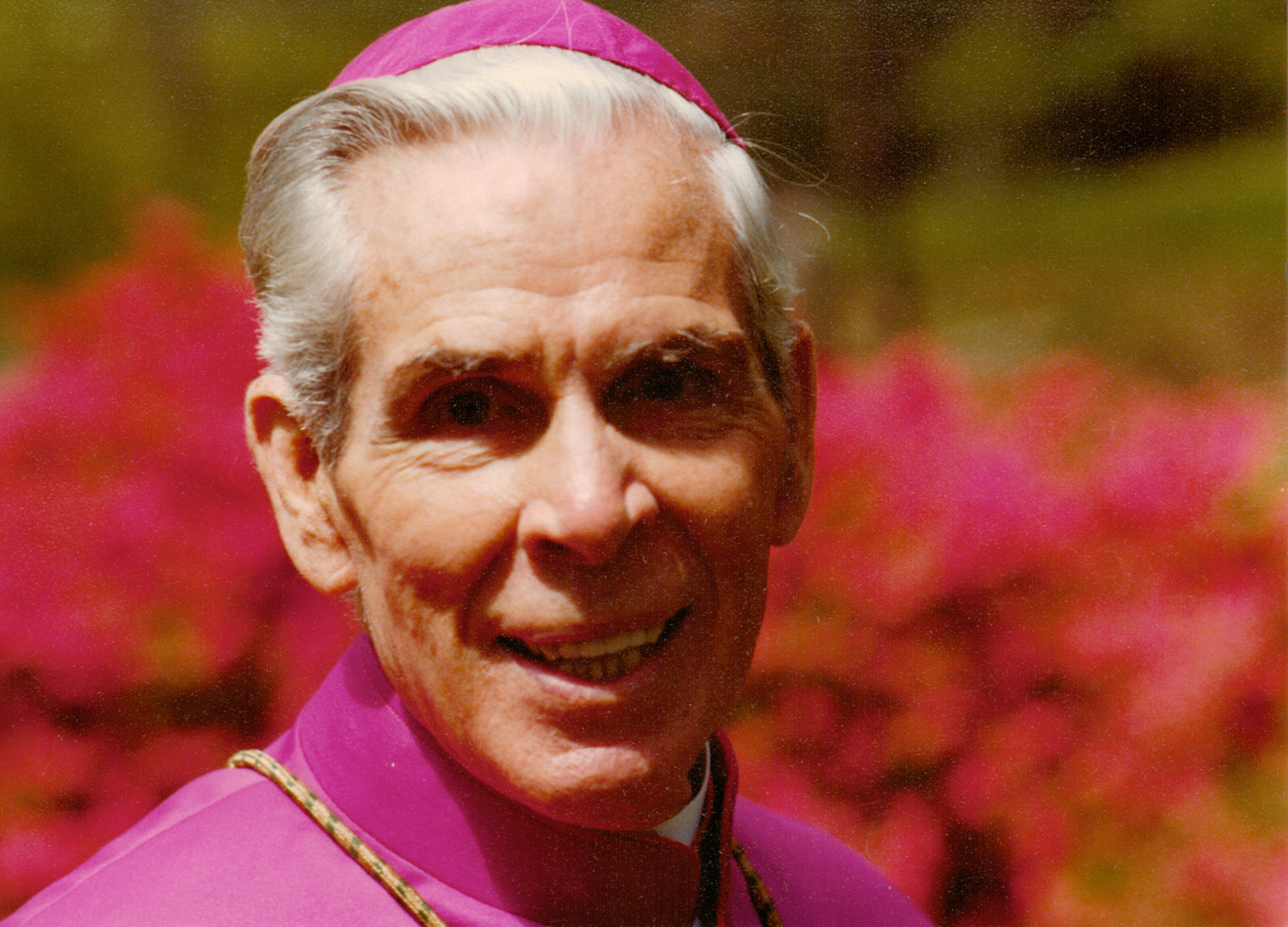
“His contributions to unveiling the mystery of Mary are among the most profound and complete as is presented in his masterwork on Mary, ‘The World’s First Love,’” said Howard, who is a Mariologist.
Howard and Gray credit Sheen’s time in prayer for the success of his work.
“The secret to Sheen’s immediate and lasting impact through his work in the secular media was his unbroken promise and commitment to making a daily Holy Hour before Our Lord in the Blessed Sacrament,” Howard said.
“Because he spent so much time looking at Jesus, he was able to keep perspective and not become preoccupied by his media success,” Gray added. “His prayer life also helped him keep a spiritual focus by preaching the Gospel of the kingdom of God and not the gospel of the world.”
“Those who preach the gospel of the world attempt to win people over by telling them what they want to hear,” Gray said. “Sheen preached what people needed to hear.”
Howard described Sheen as “America’s saint.”
If canonized, the former televangelist will become one of the few saints born in the U.S.; he would join Sts. Elizabeth Ann Seton, Katharine Drexel, and Kateri Tekakwitha.
In front of the Eucharist, in his private chapel while in prayer, Sheen died at the age of 84 on Dec. 9 after a long struggle with heart disease.
If you value the news and views Catholic World Report provides, please consider donating to support our efforts. Your contribution will help us continue to make CWR available to all readers worldwide for free, without a subscription. Thank you for your generosity!
Click here for more information on donating to CWR. Click here to sign up for our newsletter.
Leave a Reply