

 By
By The removal of the doors to the Holy Sepulchre for restoration work provides an opportunity to look into the fascinating history of the church that encloses the site of Jesus’ death and resurrection.
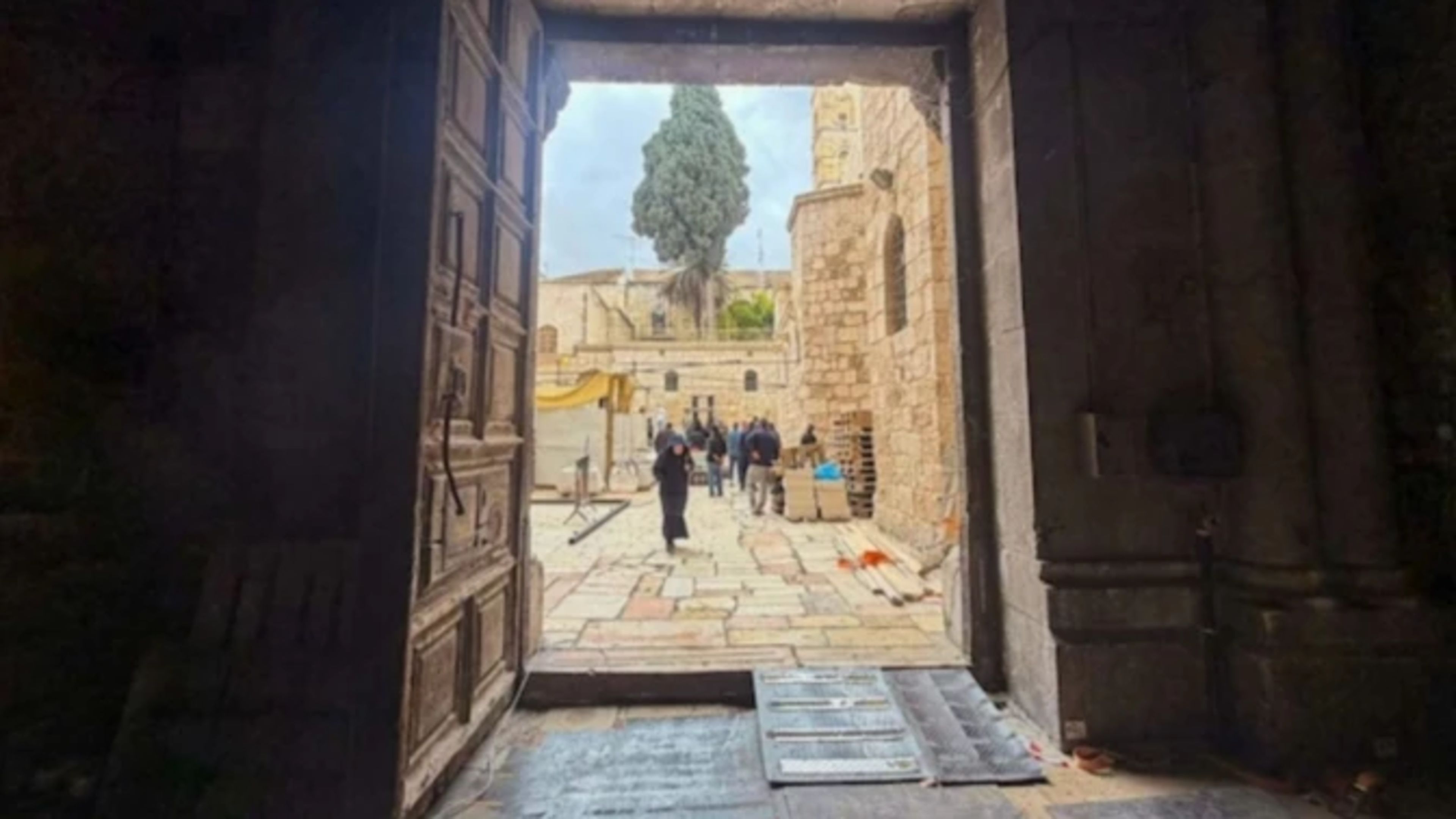
The monumental wooden doors at the entrance of the Basilica of the Holy Sepulchre in Jerusalem, one of the holiest sites for Christians of all denominations, were removed from their hinges on Feb. 19 by workers restoring the basilica’s floor and will undergo a restoration process.
The work is part of the ongoing restoration of the church’s flooring and, like all decisions concerning the building, was adopted by consensus among the several Christian communities that share its ownership and use.
Representatives of the Roman Catholic Church, the Greek Orthodox Patriarchate, and the Armenian, Coptic, Syriac Orthodox, and Ethiopian Orthodox Churches share the use of the Holy Sepulchre. These communities had noted that the doors showed clear structural deterioration, according to the magazine Terre Sainte.
The restoration of the doors will be their first repairs in more than two centuries. The last documented repairs date back to 1810 and were commissioned by the Greek Orthodox Church after a fire damaged the church.
While the work is underway, the entrance has been covered with temporary panels displaying photographic reproductions of the original doors in order to preserve the familiar appearance of the church’s entrance.
It remains to be determined how the work of the Muslim families historically responsible for opening and closing the doors and keeping the key will be carried out during this period. Descendants of the Nusseibeh and Joudeh families were entrusted this responsibility in 1246 by Sultan Saladin.
Taxes and walled-up doors
The magazine Terre Sainte recounts some interesting historical facts from the basilica’s turbulent past.
For example, there are “twin doors,” now behind walls, that are to the immediate right of the existing entrance. The magazine also explains that after Saladin’s conquest of Jerusalem in 1187, all the doors of the Crusader basilica were walled up, as were the windows of the rotunda, in order to prevent access.
During this period, Christians had to pay a tax to enter and pray. Many pilgrims, who had already endured long journeys and paid fees to enter the city, did not have sufficient resources to pay yet another tax. Those who could afford it had to wait for the single daily opening of the doors around 3 p.m. Once inside, the doors were closed behind them and were not reopened until the following morning.
Religious take up residence to ensure prayer
At the beginning of the 14th century, religious of various denominations chose to remain locked inside the church to ensure the continuous celebration of worship.
“Only in this way could they guarantee prayer in the most important church in Christendom,” the article from Terre Sainte explains.
To be able to deliver food to the religious inside, a small hatch was installed in the right wooden door.

Until the recent removal of the doors, this hatch, among other functions, allowed a ladder to be passed through it so that those in charge of opening and closing the doors could access the lock, which was situated higher up and out of reach.
In 1832 Muhammad Ali of Egypt, who ruled in the Holy Land, allowed the door to be opened daily and abolished the entrance tax.
More recently, the doors have also been the site of tensions. In 2018, the Catholic, Greek Orthodox, and Armenian leaders agreed to close the church in protest against tax measures they considered discriminatory. They also remained closed during the COVID-19 pandemic by order of the civil authorities.
This story was first published by ACI Prensa, the Spanish-language sister service of EWTN News. It has been translated and adapted by EWTN News English.
If you value the news and views Catholic World Report provides, please consider donating to support our efforts. Your contribution will help us continue to make CWR available to all readers worldwide for free, without a subscription. Thank you for your generosity!
Click here for more information on donating to CWR. Click here to sign up for our newsletter.
Leave a Reply