

 By
By The brief Ash Wednesday walk between two hilltop basilicas marks the start of Lent in Rome.
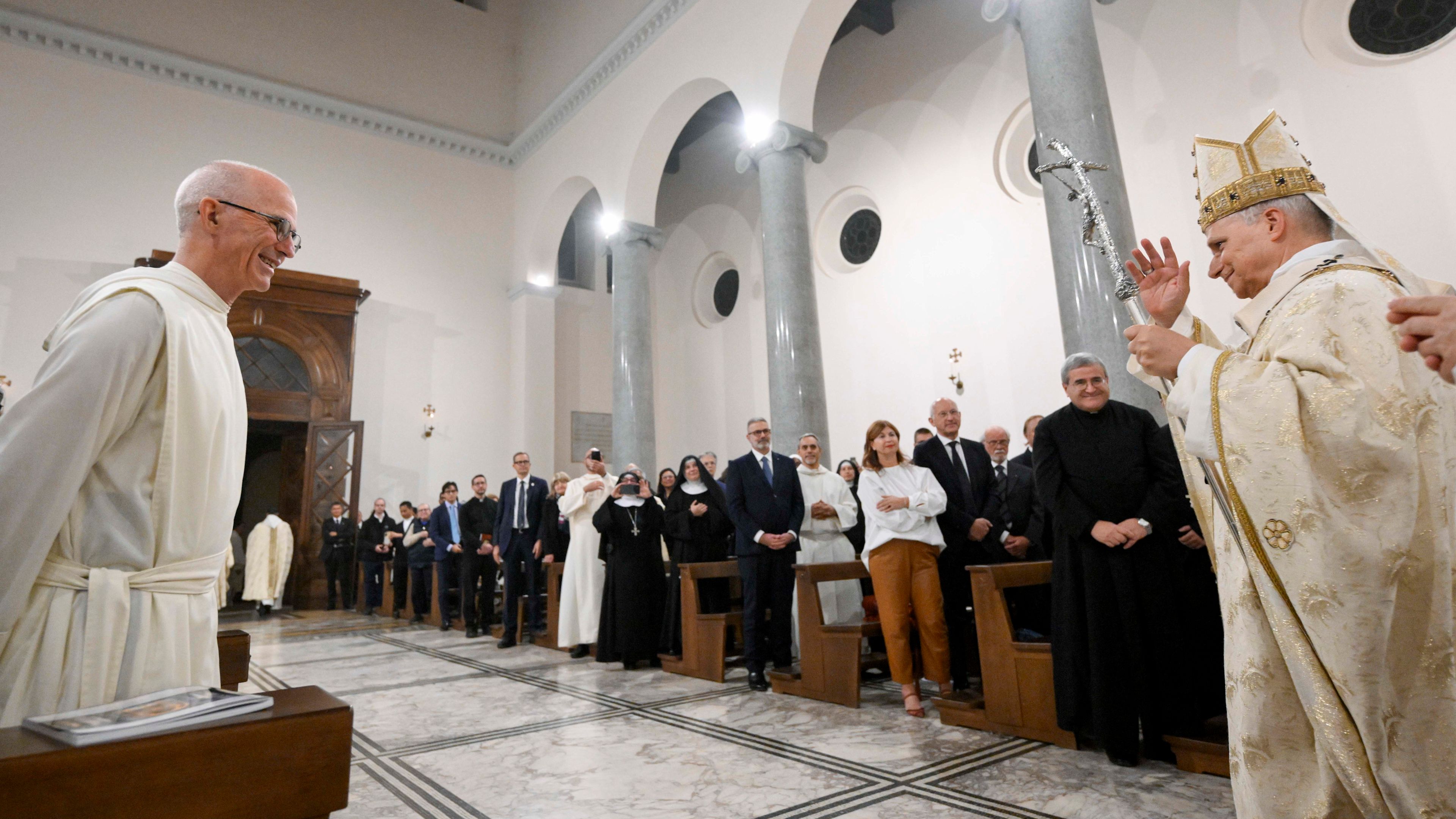
Each Ash Wednesday, dozens of people crowd the doors of the Church of Sant’Anselmo, perched on the Aventine — one of Rome’s seven hills — to witness the penitential procession that moves solemnly along the roughly 200 meters (656 feet) separating it from Santa Sabina.
This year, the tradition of the Station Churches, rooted in the first centuries of Christianity, takes on special significance: It will be the first time Pope Leo XIV presides over it.
It lasts less than five minutes, but it is not a mere ceremonial transfer. The short route liturgically marks the beginning of Lent and underscores the Aventine’s strong monastic presence: the Benedictines at Sant’Anselmo and the Dominicans at Santa Sabina.
“The penitential character of Lent allows us to explore the spiritual dimension of these centuries-old stational liturgies. Lent is marked by themes of baptism and conversion: reorienting our lives toward Christ, making his life fruitful in ours, and striving to imitate him,” Father Stefan Geiger, president of the Pontifical Liturgical Institute, told EWTN News.
Martyrs as models of life
Along that path, martyrs occupy a privileged place because, Geiger said, they “serve as exceptional models of this way of life.”
“The method of the early Church was not based on theoretical instruction but on the concrete example of a life lived for Christ, offering an invitation to realign one’s life completely with him,” he added.
Santa Sabina’s role as the destination is no accident. It is a “Station Church,” a key concept in the Roman Church’s tradition.
“It is the church the pope goes to on a specific occasion to celebrate the liturgy with the faithful,” the Benedictine priest explained.
The practice goes back to the early Church, when Christianity began organizing public worship in Rome. After the Edict of Milan in 313, when the emperor Constantine granted freedom of worship, Christian communities grew quickly, leading to a multiplication of places for Sunday celebrations known as “tituli” — early parish-like churches.
“These ‘titular churches’ represented their respective parishes, dividing the growing number of faithful into smaller units,” Geiger said.
But this expansion in urban contexts posed a theological and pastoral challenge, he said: “From very early on, there was concern about how to maintain and visibly express the unity of the local Church. At that time, the ideal of the local Church was still the community gathered around its bishop. However, this became increasingly difficult to sustain, especially in urban settings, and it threatened to obscure visible unity.”
Stational liturgies arose in the fourth century
In that context, stational liturgies emerged in the fourth century as a tangible sign of ecclesial communion. The pope, as bishop of Rome, would regularly “station” at a specific titular church, preside over the liturgy there, and in doing so confer upon it a “precedence over other liturgies,” Geiger explained.
A century later, the Roman tradition added a decisive element: the penitential procession.
“In the fifth century, a uniquely Roman custom developed: a penitential procession toward the stational church, which began at a gathering church — the ‘collecta’ — where penitential antiphons and the Litany of the Saints were sung,” he said.
The route culminated in a triple invocation of the “Kyrie eleison” (“Lord, have mercy”) — one of Christianity’s oldest and most fundamental liturgical prayers — and an intense silent prayer before the altar, during which clergy prostrated themselves.
“It is a gesture we still see today in the liturgy of Good Friday. The procession concluded with a silent prayer and a prostration of the clergy before the final prayer, since the Kyrie had been sung during the litanies,” he added.
From medieval solemnity to modern eclipse
During the early Middle Ages, this pattern was adopted and enriched with an ever more solemn ceremonial.
“The pope traveled on horseback from St. John Lateran — then the papal residence — and was received ceremonially at the Station Church, vested in liturgical garments. Then he entered the church accompanied by acolytes carrying seven torches, and only then did the celebration begin,” Geiger recalled.
At the end of the liturgy, the deacon solemnly announced the next Station Church and, if applicable, the church of the collecta, to which the faithful responded with “Deo gratias.”
Over time, however, the tradition weakened. During the period when seven popes resided in Avignon, France (1309–1377), it virtually disappeared from Rome.
After the capture of Rome in 1870 — the final milestone of the Italian Risorgimento, when troops of the Kingdom of Italy breached the Aurelian Walls near Porta Pia — stational liturgies were officially prohibited in 1870 as part of a general decree banning all processions.
Contemporary recovery
The revival of the tradition came after the Lateran Pacts, the 1929 concordat defining civil and religious relations between the government and the Church in Italy.
The Pontifical Academy of Martyrs — which seeks to keep alive the legacy of the early witnesses of the Christian faith — promoted the restoration of stational liturgies, especially through its first director, Carlo Respighi.
“Even today, the academy is responsible for overseeing these celebrations, and its website lists the Station Churches of Lent,” Geiger said.
In any case, the president of the Pontifical Liturgical Institute noted that today the pope generally presides over only two stational liturgies: Ash Wednesday at Santa Sabina and Holy Thursday at St. John Lateran.
“Before the liturgical reform, the Missal listed about 89 stational liturgies in 42 Station Churches. The origins of each of the ‘titular churches’ are no longer known, but they are closely linked to the martyrs, who have a special significance in the memory of the city of Rome,” he said.
As every year, the Benedictine community of Sant’Anselmo is preparing carefully for the event. The occasion takes on added meaning as it will be the pontiff’s second visit there during his first year in office: The monks previously welcomed Leo XIV on Nov. 11, 2025, on the feast of their church’s dedication.
This story was first published by ACI Prensa, the Spanish-language sister service of EWTN News. It has been translated and adapted by EWTN News English.
If you value the news and views Catholic World Report provides, please consider donating to support our efforts. Your contribution will help us continue to make CWR available to all readers worldwide for free, without a subscription. Thank you for your generosity!
Click here for more information on donating to CWR. Click here to sign up for our newsletter.

Leave a Reply