

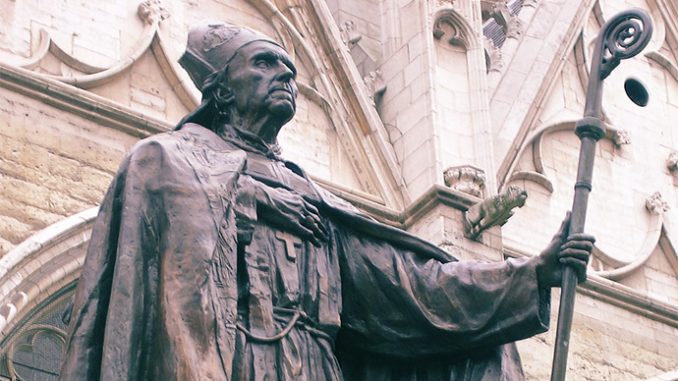
This year marks the centenary of the death of Cardinal Désiré-Joseph Mercier of Belgium, who died on January 23, 1926.
Priest, Archbishop, Cardinal
Born in 1851 in the French-speaking region of Brabant, Belgium, Mercier entered the diocesan seminary in 1868 and was ordained a priest in 1874. After higher studies at the Catholic University of Louvain, he began teaching philosophy at the minor seminary in Malines in 1877. Pope Leo XIII’s 1879 encyclical, Aeterni Patris, provided papal support for the revival of Thomism, and in 1882 Mercier was appointed a professor of Thomistic philosophy at the Catholic University of Louvain. With the support of Leo XIII, Mercier established the Institut Supérieur de Philosophie at Louvain, and in 1894, he inaugurated the journal, Revue Néo-scolastique, which sought to relate scholastic philosophy to modern science and thought. Mercier was an important figure in the Neo-Thomist revival, and he authored books in metaphysics, logic, psychology, and epistemology.
In 1906, Pius X appointed Mercier as the archbishop of Malines (Mechelen in Flemish), Belgium. By this appointment, he became the primate of Belgium and the shepherd of some 2.3 million Catholics and 3,000 priests. In terms of numbers, the Archdiocese of Malines was at that time the second largest in the world after Milan.
In 1907, Mercier was made a cardinal, and he soon joined Pius X in resisting Catholic Modernism. Even though Mercier opposed the Modernists, he was open to dialogue with thinkers accused of Modernism, such as Maurice Blondel and Marie-Joseph Lagrange, O.P. He also reached out to the modernist and suspended Jesuit priest, George Tyrrell. Mercier invited Tyrrell into his archdiocese on the condition that he was willing to submit all his writings for review and approval. Tyrrell rejected this condition, and he criticized the Belgian cardinal as a representative of outdated “ultramontane” views that suppress theological discussion.
During World War I, Mercier resisted the German occupation of Belgium and was eventually placed under house arrest. His 1914 Christmas pastoral letter, Patriotisme et Endurance, was received with enthusiasm not only in Belgium but also in the USA, England, France, and other countries. The German bishops were not pleased, and they accused Mercier of violating the Vatican’s position of neutrality. Benedict XV, however, admired Mercier, and he supported the liberation of Belgium as a condition for peace. After the war, Mercier received multiple honors for his heroic resistance to German occupation. Regarded as “the Pope of the North,” he accepted invitations to lecture in France, Spain, Austria, England, the U.S., and Canada. He received honorary degrees from, inter alia, Harvard, Princeton, and Yale, and he took part in a 1919 victory parade in New York along with King Albert of Belgium.
Mercier is also remembered for his encouragement of the ecumenical discussions with the Anglicans known as the Malines Conversations. Supported by Lord Halifax of England, these theological discussions took place in Cardinal Mercier’s residence between 1921 and 1925. Although these conversations were friendly, agreements could not be reached on the meaning of papal primacy and other issues. Pope Benedict XV (r. 1914–1922) was aware of the Malines Conversations. He never criticized them, but he never gave them approval. Pius XI (r. 1922–1939) was also aware of these ecumenical discussions. Because of his admiration for Mercier, he waited until after the Cardinal’s death in 1926 to put an end to them. In his 1928 encyclical, Mortalium Animos, Pius XI reaffirmed the Catholic understanding of papal primacy and cautioned against ecumenical discussions that might relativize Catholic doctrine.
Cardinal Mercier’s Mariology
In the eyes of many, Cardinal Mercier is best remembered for his support for a papal definition of the Virgin Mary as the Mediatrix of all graces. Although he was always Marian, Mercier’s commitment to a dogmatic proclamation of Mary as the Mediatrix of all graces can be traced to his 1906 meeting with Mother Madeleine of Jesus (1862–1946), the superior of the Carmel in Uccle (near Brussels). Mother Madeleine told Archbishop Mercier that “the Divine Master” had revealed to her in prayer that He desired a dogmatic definition of Mary’s universal mediation of grace. At first, Mercier said he would think about this, but soon he became convinced that God was calling him to petition the pope to proclaim this dogma.
The belief in Mary as the universal Mediatrix of grace—with and under her divine Son—was not something new. Eastern Fathers of the Church such as St. Germanus of Constantinople (c. 635–733), St. Andrew of Crete (c. 660–740), and St. John of Damascus (c. 675–749) all supported Mary’s universal mediation of grace.1 In the Middle Ages, St. Bernard of Clairvaux (1090–1153), St. Bonaventure (c. 1217/1221–1274), and St. Bernardine of Siena (1380–1444) affirmed Mary as the Mediatrix of all graces as did later Catholic authors such as St. Robert Bellarmine (1542–1621), Francisco Suárez (1548–1617), Maria of Ágreda (1602–1665), St. Louis de Montfort (1673–1716), and St. Alphonsus Liguori (1696–1787).2
Prior to Mercier’s 1906 appointment as Archbishop of Malines, Mary’s universal mediation of grace had already received papal support from Benedict XIV (in 1748), Pius VII (in 1806), Pius IX (in 1849), Leo XIII (in 1891), and Pius X (in 1904).3 It was also affirmed by Cardinal Victor-Auguste Dechamps (1810–1883), the Archbishop of Malines, who ordained Mercier a priest in 1874.
Even though Mary as the Mediatrix of all graces had received papal support, it was not a defined dogma. Proposals for a dogmatic definition of Mary’s universal mediation of grace were made by René-Marie de La Briose, S.J. (in 1896) and François Xavier Godts, C.Ss.R. (in 1904). Because of his standing as a cardinal, Mercier’s appeals for the dogmatic definition had more significance. His work for this dogma began in 1906 and continued until his death in 1926.
There are three excellent books that detail Cardinal Mercier’s efforts for the dogma: Fr. Manfred Hauke, Mary, Mediatress of Grace (New Bedford, MA: Academy of the Immaculate, 2004); Gloria Falcão Dodd, The Mediatrix of All Grace: History and Theology of the Virgin Mary: Movement for a Dogmatic Definition from 1896 to 1964 (New Bedford, MA: Academy of the Immaculate, 2012); and Sr. Florence Coomans, Marie Médiatrice de Toutes Grậces Dans La Commission Pontificale Instituée par Pie XI (1922): Éclairages et perspectives théologiques (Lugano: Cantagalli EU Press FTL, 2025). These three books detail Mercier’s commitment to the new dogma, the obstacles he faced, and the partial success of his work.
Debate over dogmatic definition
In 1906, Mercier made an informal request to Pius X for the dogma. Pius X believed Mary was the Mediatrix of all graces, but he did not pursue a dogmatic definition—perhaps because of his preoccupation with Modernism and other matters. Mercier continued to promote Mary as the universal Mediatrix of grace, and others began to support the doctrine. In 1913, the Fourth Breton Marian Congress approved a petition to Pius X for a dogmatic definition of Mary’s motherhood of grace. In 1914, Mercier made a public vow to petition the pope for a feast in honor of Mary, the Mediatrix of all humanity. In 1915, he organized four petitions that were sent to Rome requesting a dogmatic definition of Mary as Mediatrix of all graces: one from the theological faculty of the Catholic University of Louvain; one from the religious superiors of Belgium; one from the bishops of Belgium; and another from the clergy of the Archdiocese of Malines.
Fr. Alberto Lepidi, O.P. (1838–1922), the Master of the Sacred Palace and consultor to the Holy Office, was asked to examine the four petitions and submit a judgment. In July 1916, he submitted a negative votum. He rejected the title Co-redemptrix, which was present in the petitions, on the basis of a 1747 rejection by the Holy Office of a petition by the bishop of Ascoli, Italy, to use the title in prayers for the Stations of the Cross. Fr. Lepidi seemed unaware that on July 18, 1885, Pope Leo XIII had approved some praises (laudes) to Jesus and Mary, which in the Italian version refer to Mary as corredentrice del mondo, “the Co-redemptrix of the world.” (Acta Sanctae Sedis [ASS] 18 [1885] p. 93). During the pontificate of Pius X, the Holy See three times gave approval to prayers invoking Mary as Co-redemptrix (cf. Acta Sanctae Sedis [ASS] 41 [1908], p. 409); Acta Apostolicae Sedis [AAS] 5 [1913], p. 364; AAS 6 [1914], pp. 108–109). The 1908 approval came from the Sacred Congregation of Rites. The ones from 1913 and 1914 were from the Holy Office with partial indulgences attached to the recitation of these prayers.
Fr. Lepidi also opposed calling Mary the Mediatrix of all graces. He considered this title to be “only a contrivance of the mind, lacking a solid theology.”4 It seems Fr. Lepidi was unaware of the support for Mary’s universal mediation of grace going back to Church fathers, medieval authors, and popes since Benedict XIV. In his 1806 apostolic constitution, Quod Divino afflata Spiritu, Pius VII explicitly refers to Mary as the “Dispensatrix of all graces” (gratiarum omnium dispensatricem),5 which is the equivalent of Mediatrix of all graces.”
Based on Fr. Lepidi’s assessment, the Holy Office decided against the Belgian petitions for the new dogma, and Benedict XV confirmed this decision on November 23, 1916. Cardinal Mercier did not let this negative decision deter his efforts. He decided to turn his attention to the approval of a feast of Mary, Mediatrix of All Graces. Benedict XV, who was sympathetic to Mercier’s Mariology, approved the feast on January 12, 1921, along with the office and texts. The feast would be celebrated on May 31, and it was available to all the dioceses of Belgium and any other bishops or religious communities that requested it. By the end of 1921, 38 bishops were given permission to celebrate the feast in their dioceses, as well as the Jesuits, the Marianists, the Belgian Redemptorists, and the Sisters of the Sacred Heart of Jesus. The feast was eventually moved to May 8 in the 1962 liturgical calendar approved by John XXIII. It is still available as an optional feast for Catholic communities that follow that calendar.
After the death of Benedict XV on January 22, 1922, Mercier turned his attention to Pius XI, who became pope on February 6th of that year. Through contacts with friends in Rome, Mercier was able to persuade Pius XI to set up a papal commission to examine the definability of Mary as the Mediatrix of all graces. In December 1922, Pius XI agreed to set up this commission, which would meet in three places: Belgium, Spain, and Rome. By the end of 1923, the members of the Belgian, Spanish, and Roman commissions had been appointed, and their deliberations had begun.
The Belgian and Spanish commissions produced over 2,000 pages in support of the definability of the dogma, but the Holy See did not grant permission to publish these texts. In 1985, Fr. Giuseppe M. Besutti, O.S.M. published what seem to be summary reports of the Belgian and Spanish commissions.6 These reports manifest support for the definability of the proposed dogma. We only know the opinion of one member of the Roman commission: that of Fr. Reginald Garrigou-Lagrange, O.P., who supported the definability of the dogma.7 It’s quite possible that the Roman commission was also in favor of the definability of the dogma,8 but we don’t know for sure. Apparently, the results of the three commissions were evaluated by a special ad hoc commission of the Holy Office, which ultimately decided against the definition.9 On the advice of this special commission, Pius XI did not define Mary as the Mediatrix of all graces. Nevertheless, he himself supported the title. In his 1932 encyclical, Caritate Christi Compulsi, he refers to the Virgin Mother of God, “the Mediatrix of all graces” (Virginis Deiparae, omnium gratiarum Mediatricis; AAS 24 (1932), p.192).
Death and legacy
Cardinal Mercier died in 1926 without succeeding in his efforts to have Mary defined as the Mediatrix of all graces. He was, though, successful in obtaining approval of the Office and Mass of the Blessed Virgin Mary “Mediatrix of All Graces.” The approval of this Feast is acknowledged in footnote 46 of the November 4, 2025, document of the Dicastery for the Doctrine of the Faith [DDF] entitled Mater Populi Fidelis. Unfortunately, the DDF does not mention the three papal commissions set up by Pius XI to explore the possibility of defining the dogma of Mary as the Mediatrix of all graces. Mercier’s affirmation of Mary as the universal Mediatrix of all the graces obtained by her divine Son continued to enjoy papal support after his death. Pius XII referred to Mary as Mediatrix of all graces on multiple occasions.10 In the antepreparatory phase of Vatican II (1959–1961) there were 2,150 written opinions or vota from bishops expressing their wishes for the council.11 A total of 482 vota of the bishops relate to Mary, and “nearly all of them pertain to doctrine.”12 Of these, 380 express a desire for a definition of Mary’s universal mediation.13
Although Vatican II did not wish to define any new Marian dogmas, it allowed theologians to retain opinions on Mary that had not been fully clarified (see Lumen Gentium, 54). This, no doubt, was a reference to teachings on Mary as Co-redemptrix and Mediatrix of all graces. As is well known, John Paul II referred to Mary as Co-redemptrix on at least seven occasions,14 and he referred to Mary as the “Mediatrix of all graces” explicitly at least seven times and five other times with equivalent expressions.15 Both Benedict XVI and Pope Francis have also referred to Mary as the Mediatrix of all graces.16
Mercier’s desire for the definition did not die after Vatican II. In 1992, Cardinal Édouard Gagnon revealed to Dr. Mark Miravalle that he had personally forwarded petitions from Catholic bishops to John Paul II requesting a dogmatic definition of Mary as Co-redemptrix and/or Mediatrix of all graces. Cardinal Gagnon encouraged Dr. Miravalle to begin a movement that would revive Cardinal Mercier’s efforts for a papal dogmatic definition. This encouragement led to the creation of Vox Populi Mariae Mediatrici (Voice of the People for Mary Mediatrix), which, by 1996, had gathered support from 800 bishops and 8 million other members of the faithful for a papal definition of Mary as Co-redemptrix, Mediatrix of all graces, and Advocate. These petitions, like those of Cardinal Mercier, were taken seriously by the Holy See. As Mater Populi Fidelis, no 19 reveals, the Congregation for the Doctrine of the Faith under Cardinal Ratzinger decided on Feb. 21, 1996, that the titles contained in the proposed dogma were not clear and the doctrine contained in them was not mature.
The life of Cardinal Mercier is instructive for us today. He was highly regarded as a Thomist philosopher and a Cardinal who stood up for his country during the German occupation of Belgium in World War I. His ecumenical efforts with the Anglicans failed, as did his petitions for a dogmatic definition of Mary as Mediatrix of all graces. These, though, were noble failures. In their own way, they contributed to further ecumenical and Mariological developments. Cardinal Mercier’s courage and persistence in the face of challenges and disappointments are cause for admiring and celebrating his life during the centenary of his death. Let us hope that this great “Pope of the North” is praying for us today.
Endnotes:
1Fr. Alessandro M. Appolonio, F.I., “Mary Mediatrix of All Graces,” in Mariology: A Guide for Priests, Deacons, Seminarians, and Consecrated Persons, ed. Mark Miravalle (Goleta, CA: Queenship Publishing, 2007), 440–441
2Appolonio, 442–443.
3Appolonio, 444–447.
4Gloria Falcão Dodd, The Mediatrix of All Grace: History and Theology of the Virgin Mary: Movement for a Dogmatic Definition from 1896 to 1964 (New Bedford, MA: Academy of the Immaculate, 2012), 89.
5Pope Pius VII, Ampliatio privilegiorum ecclesiae B.M. Virginis (Florentiae: 1806), § 1.
6See Marianum 47 (1985), pages 42–78 for the Commissio Hispanica. Theologiae disquisitio de universali b. Mariae V. mediatio and pages 79–174 for the Commissio Belgica. De definibilitate mediationis b. V. Mariae tribuenda disquisitio et vota. In the same issue, see also G.M. Besutti, O.S.M., “mediazione di Maria secondo gli studi di due commissioni instituite da Pio XI” (pages 37–41).
7This February, 1925 Latin text of Garrigou-Lagrange is published by Fr. Manfred Hauke on pages 137–156 of his book, Mary, Mediatress of Grace (New Bedford, MA: Academy of the Immaculate, 2004). Fr. Hauke provides a translation of two important pages of this text on pages 114–116.
8See Sr. Florence Coomans, Marie Médiatrice de Toutes Grậces Dans La Commission Pontificale Instituée par Pie XI (1922): Éclairages et perspectives théologiques (Lugano: Cantagalli EU Press FTL, 2025), 155.
9See Dodd, 183–184 and Coomans, 154–156.
10See Apollonio, 449–450.
11Laurie Olsen, Mary & the Church at Vatican II: The Untold Story of Lumen Gentium VIII (Steubenville, OH: Emmaus Road, 2024), 11.
12Olsen, 11.
13Olsen, 11..
14See footnote 36 in the Doctrinal Note, Mater Populi Fidelis of the Dicastery for the Doctrine of the Faith (Nov. 4, 2025).
15Apollonio, 458–459.
16 See Pope Benedict XVI’s January 10, 2013, Letter to Archbishop Sigismundo Zimowski and Pope Francis’s May 13, 2023, Message to Archbishop Gian Franco Saba of Sassari, Sardinia, Italy.
If you value the news and views Catholic World Report provides, please consider donating to support our efforts. Your contribution will help us continue to make CWR available to all readers worldwide for free, without a subscription. Thank you for your generosity!
Click here for more information on donating to CWR. Click here to sign up for our newsletter.

What’s lacking in defining Mary as Mediatrix of All Graces is a strong theological argument that establishes its necessity.
Consequently, the proposition depends on the de congruo premise, Christ’s love for his Mother. And words spoken by pontiffs and saints outside of formal declarations that may be considered sentiment. Are there historical, cultural features that reflect such a devotion to Our Blessed Mother.
Yes. France. We find in France an extremely beautiful, refined assimilation of the feminine to the strong German Gothic architecture in Reims cathedral, Chartres, Notre Dame among many magnificently spiritual, beautiful churches spread throughout the landscape of France.
Joan of Arc’s battle standard was Jhesus Maria. She is never omitted in French liturgical art, the very spirit that combines heroism and beauty. Then there’s Joan’s other battle standard, De par le Roy du Ciel. At the Command of the King of Heaven. It speaks to the two venues, theological and sentiment – not that sentiment is absent from the theological as Aquinas would assert, that Man expresses the spiritual, which in essence is love by sentiment and passion.
As an opinion this writer agrees with others who hold that while there may be truth to the title, it would be best not to promote it lest it be misunderstood as deification.
Please forgive my lack of understanding; I was only admitted to the Church at Easter 2022. If I understand correctly, one of the points being argued is for our Blessed Mother to be considered Co-redemptrix with her son, our Lord Jesus Christ. My first question would be how that would fit into the Trinity and the fact that Father sent His only begotten Son into the world that the world might be Saved through Him (the Son). Also, Jesus states I and the Father are one. One could cite line after line whereby Jesus clearly and unequivocably states his unique status with the Father. Consider the cross: Other than giving Mary to St. John as his mother, the Evangelist at the foot of the cross, and by implication to the whole Church, I cannot name any other time Christ set his mother apart. One could rationally argue that he gave he over to St. John because as a widow with no surviving child she would need someone to care for her. I just cannot follow any reasoning for the argument of Co-Redemptrix, despite her terrible sufferings.
“Co” as in simply cooperating, as in Mary’s “fiat.” To reverence Mary for her role in no way diminishes the uniquely salvific action of Christ. The translation into English also does not help.
Getting in the way of our simply honoring Mary is our zero-sum spatial imagination—that by showing our appreciation for a created person much like ourselves (but the singular Immaculate Conception in person)), we are somehow cutting into the infinite Divinity of the Creator. Instead, it is because of the infinity of God that Christ is not diminished by our honoring the mystery of Mary’s motherhood as His portal into the created realm which He in turn sustains in being.
“What’s lacking in defining Mary as Mediatrix of All Graces is a strong theological argument that establishes its necessity.”
“Behold, your Mother.” -Christ On The Cross
Just a thought, perhaps that strong theological argument will become clear when a validly elected Pope, and those Bishops in communion with him, Consecrate Russia to Our Blessed Mother’s Immaculate Heart, exactly as Our Blessed Mother requested, visibly separating the True Church of Christ from those who deny The Unity Of The Holy Ghost.
If you want to heal a schism, you must begin at the beginning. The denial of The Unity Of The Holy Ghost, The Spirit Of Perfect Divine Eternal Infinite Love Between The Father And His Only Begotten Son, Jesus The Christ, and thus the denial of The Divinity Of The Blessed Trinity, Father, Son, And Holy Ghost, Is The Source Of All Heresy, including the heresy of modernism.
https://www.lifesitenews.com/opinion/open-letter-to-pope-leo-xiv-the-heresy-of-modernism-lives-on-through-vatican-ii/
“The Syllabus of Errors (1864) and both Apostolic Constitutions: Dei Filius, and Pastor Aeternus, written at the first Vatican Council (1869-1870) anathematized all that was embraced by the Second Vatican Council 100 years later. Those are the FACTS.- William Jude — Wed, Jan 14 2026”
The irony here is that Vatican II , by its uncharitable anathema of Vatican I, did away with Christ’s Charitable Anathema.
“You cannot be My Disciples if you do not Abide In My Word.” -The Charitable Anathema Of Jesus The Christ, Existing For The Salvation Of Souls.
Vigano got excommunicated for rejecting VATICAN II. I pray for him daily.
VATICAN II is not just about continuity as Ratzinger positioned it; the Council is the way to amplify all that went before, in the Pauline formula – through the Church; in its own compaction alike the Annunciation, the Church magnifies the Lord and rejoices in her Saviour.
Modernism is affecting everything including the previous Councils and the very substance of the deposit of faith, it aims to subjugate parts and whole to extemporizations (eg. the 4 “principles” in EG). It is not the fault of VATICAN II nor the “particular susceptibility of the Council”.
Those hierarchs who sacrifice on the altar of Modernism – reader, listen, pay better attention: it is this Council that has gotten them to expose themselves completely. There is no sub rosa in the Council, it is the Council that has demasked the sub rosa.
I hope LIFESITE does not go and get itself excommunicated. The Church is not a sub-project of any Government or or secular program/programming with or without sub rosa.
“Those hierarchs who sacrifice on the altar of Modernism – reader, listen, pay better attention: it is this Council that has gotten them to expose themselves completely. There is no sub rosa in the Council, it is the Council that has demasked the sub rosa.”
One could argue, It is Our Blessed Mother, Mary, Who Has Lifted The Veil, revealing that for sometime now, Baptized Catholics, who no longer desired to fulfill their Baptismal Promises because they no longer desire to profess that God, The Most Holy Blessed Trinity, In The Unity Of The Holy Ghost, Is The Author Of Love, Of Life, And Of Marriage, have created a counterfeit magisterium, in direct conflict with The Magisterium of Christ’s One, Holy, Catholic, And Apostolic Church, because they desire to render onto Caesar or themselves, what belongs to God. In no way, shape, or form, can this counterfeit magisterium possibly subsist within The One Body Of Christ because in Christ, The Truth Of Love Is Perfect, Divine, Eternal, And Infinite, In Christ, The Truth Of Love Is Not a means between two extremes.
I have so many things to pray for, I put them in batches and pray the batches. One batch is called The Vexatious Things and I place Vigano and Altman and others in it. In so many words, they themselves are in a battle with vexing questions that everyone is visited with not just them and we all clamour -we all must clamour for- the Divine Assistance and Providence to resolve them.
Some intentions can need to be in more than one batch, meaning they get prayed up a lot. The thing with Vigano is, he went “beyond Lefebvre” and denies the Council. So where it is I am hopeful that Lefebvre will be rehabilitated and have argued for it, Vigano makes his stubbornness on the Council issue plain and makes it so as it would stick, distinctly contrasting Lefebvre.
Lefebvre would have reconciled through the Council. And his “outlawed” consecrations remain a lasting gift to the Church ever prodigious.
Rebecca, Mary is not related to the Trinity in substance, meaning in being. Except that her unique role as the prefigured woman who gives birth to the Savior, who is God, unites her by association. That is why the supreme title she rightly holds is Theotokos, or Mother of God. Because Jesus, who is the divine second person of the Trinity was born ‘from’ her.
The consensus is that it is not required. Why is it necessary? Because it is true and the truth should be proclaimed. The image of its truth is when the last ounce of blood and water left the body of Jesus it did not drop to the ground. Our very salvation was in the hands of Mary our Queen.
The most amazing thing about this article is that Harvard, Princeton and Yale greeted the Cardinal with arms wide open based on the respective news reports. What a different age!
“That is why the supreme title she rightly holds is Theotokos, or Mother of God. Because Jesus, who is the divine second person of the Trinity was born ‘from’ her.”
Rebecca, this will help to further clarify Father’s statement:
https://www.catholic.com/qa/isnt-calling-mary-the-mediatrix-of-all-graces-contrary-to-the-doctrine-that-jesus-is-the-sole
God Bless🙏