



Jan 2, 2026 / 18:05 pm
John Bergsma grew up convinced that the Catholic Mass was not merely mistaken but “abominable idolatry.”
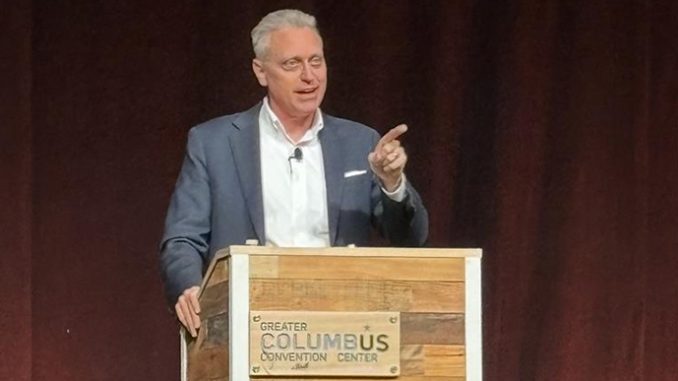
Speaking Jan. 2 to thousands of college students and young adults at SEEK 2026 in Columbus, Ohio, the former Calvinist pastor described how that belief slowly unraveled, leading him into the Catholic Church. Some 26,000 attendees have gathered through Jan. 5 in Columbus, Denver, and Fort Worth, Texas, for the SEEK 2026 conference organized by FOCUS.
Bergsma, a senior biblical scholar at the St. Paul Center for Biblical Theology, titled his talk “Mass Conversion: How I Discovered the Eucharist and the Catholic Church.” His story, he said, begins in a Dutch Calvinist upbringing that was “ethnically Dutch, theologically Protestant,” rooted in the teachings of John Calvin.
“In our doctrinal documents, there was a section on what we rejected,” Bergsma said. “And in particular, we rejected the Catholic Mass.”
He explained that he was taught Catholics committed idolatry by worshipping bread and wine as God. “If you worship the creature as the Creator,” he said, “that is idolatry.”
Following in the footsteps of his father, a U.S. Navy chaplain, Bergsma became a Protestant pastor in western Michigan in his early 20s. But it was there, he told the SEEK audience, that cracks began to form in the theological framework he had always defended — especially the Reformation principle of sola fide, or salvation by faith alone.
While participating in door-to-door evangelization with an older pastor, Bergsma used a popular method known as “the Roman Road,” a series of biblical verses meant to present salvation through faith alone.
One afternoon, the men visited a woman who welcomed them into her apartment and responded to their message positively. They prayed with her, and Bergsma recalled feeling a “real sense of peace and the presence of the Holy Spirit.”
Then, he said, the conversation took an unexpected turn.
“My mentor asked her, ‘If you go out tomorrow, rob a bank, and skip town, will you still go to heaven?” Bergsma recounted.
When the woman hesitated and answered no, the pastor corrected her. According to the logic of salvation by faith alone, he insisted, she would still be saved — “once saved, always saved.”
“At that moment, I agreed with the woman,” Bergsma said.
Scripture immediately came to mind, he explained, including Christ’s warning that “not everyone who says to me, ‘Lord, Lord,’ will enter the kingdom of heaven,” and Jesus’ call to take up the cross daily. “It didn’t fit,” he said.
The encounter forced Bergsma to confront what he actually meant by “faith alone.” After four years of study — examining Scripture, Protestant confessions, and the Catholic catechism — he concluded that either sola fide was incorrect, or it required so many qualifications that it ultimately converged with the Catholic understanding of salvation.
Bergsma’s doubts deepened as he wrestled with sola scriptura, the belief that Scripture alone serves as the ultimate authority for Christians. While ministering in a single neighborhood, he observed at least six struggling Protestant congregations, all professing the same principle but disagreeing on core teachings ranging from baptism and the Eucharist to marriage and morality.
A decisive shift came when a Catholic graduate student encouraged him to read the writings of the early Church Fathers. Bergsma began with St. Ignatius of Antioch, a disciple of the Apostle John, whose letters spoke unmistakably of episcopal authority and the Eucharist as “the flesh of our savior Jesus Christ.”
“There was no symbolic way around that,” Bergsma said.
After months of resistance, he entered the Catholic Church in February 2001. Now a Catholic theologian addressing SEEK, Bergsma said his journey ultimately hinged on the Eucharist — the doctrine he had once condemned. His testimony resonated with the conference’s young adult audience, many of whom are navigating questions of faith, authority, and conversion.
“There’s a lot of young people who are on the back end of a cultural disaster and growing up in cultural chaos,” Bergsma said after his keynote address. “They’re looking for something solid and lasting that can give them hope for the future.”
Referencing the number of young converts in various dioceses across the country, he added: “They’re coming back to the Catholic Church specifically because the Church has remained steady during that whole time, and that’s a real testament that we’re on the right track.”
“We’re getting a revival of interest in tradition and in something stable amid the instability and chaos of the modern world,” Bergsma said. “Young people are saying, ‘I want to get married. I want to have a family. I want to have a future. So, what am I going to build on?’”
The answer to that question, Bergsma emphasized in reflecting on his own journey of conversion, is the Catholic Church.
If you value the news and views Catholic World Report provides, please consider donating to support our efforts. Your contribution will help us continue to make CWR available to all readers worldwide for free, without a subscription. Thank you for your generosity!
Click here for more information on donating to CWR. Click here to sign up for our newsletter.

Dr. Bergsma can also be seen on Matt Fradd’s Pints with Aquinas.
Lay converts and reverts are more credible witnesses and voices for the Truth than our hierarchical leadership.
This requires making a very careful selection of converts and reverts, and also a very careful selection of clergy. Not all converts and reverts remain in the Church past 2 years, and there are some very good bishops out there, including among those that do not speak publicly.
seems that way. For all of us we have to be willing to speak up when the truth is under attack.
He who remains silent is understood to consent.
I disagree with the idea that the Church has remained “steady” as stated by Bergsma. I am pained by the leadership of Pope Francis and Pope Leo, whose actions have done the opposite. Francis acted imperiously, effectively ignoring the ship’s stability altogether (from the Pachamama incident to ‘Who am I to judge?’), while Pope Leo simply refuses to act. Their collective actions have destabilized the Body of Christ and actively hinders individual conversion. The Eucharist and the Rosary are strong draws for the wayward, but it is disheartening when they eventually come face-to-face with Popes who seem to have turned their backs on Tradition.
Once saved always saved a return to Luther’s salvation by faith alone. That led to abrogations of justice that ‘justified’ mass slaughter by Nazi Germans. Recalled is John Turturro in Brother Where Art Thou, one of three escaped criminals who jumps of a truck after spotting a river baptism crowd and is dunked under coming up shouting I’m saved!
Bergsma simply had the intelligence to see that, but intelligence ignited with the gift of faith. Other very intelligent folks refuse to accept ‘works’ banking on their misinterpretation of the Apostle’s words on the Law v faith in Christ. Although faith in Christ cannot be distinguished from becoming like Christ in his teaching. Parables are an anomaly.
When the Apostles asked why does he speak in parables when he explains all to his disciples. His answer baffles the mind, his response that he refrains lest they understand and be saved. The answer would seem that the majority would interpret these riddles as revelations of the Law. Which indeed they are. Although it’s by faith in him, who defines the Law as a response of love – Christ the source of love itself. Meaning to love God in spirit and in truth. Consequently, the crucifixion reveals the mystery.
Our intellect can allow us to ponder variable descriptions of the Eucharist, and how it should be presented and maintained. But in simplicity, it is the body of Christ, and the absolute essence of the Catholic Mass, and of our faith. At my last duty station in the Navy, I finally became Catholic. My first communion was sort of a miracle in a sense. My Navy duty watches were draining: two eve watches (4PM-12AM), 8 hours later, two day watches (8AM-4PM), 8 hours later, two midnight watches (12AM-8AM). My last midnight watch ended on a Sunday (I was baptized between my two eve watches), and now I was eligible to receive the Eucharist at Mass. However, the last midnight watch was the most frantic, and hectic watch I ever served. We detected 13 Soviet submarines, 18 miles offshore; up and down the East coast (each submarine had 19 nuclear armed missiles). In the Mediterranean, three Soviet ships deliberately bumped into our ships. And China suddenly had 3 army divisions situated at their closest land point to Taiwan. And my duty station was handling and forwarding a ton of messages concerning these specific issues. When the shift was over, I just wanted to get a ton of sleep. But I also wanted to attend Mass. At Mass, I was quite dreary and drained. When it came time for Communion, I dragged myself up to receive the Eucharist. After I received the Eucharist, I took 3 steps, and then suddenly every cell in my body exploded with energy. So after Mass, I drove the 3 hour drive to my parent’s house. I entered the foyer, closed the door, and then suddenly, every ounce of energy left me. I was confused, and wondered what happened. Then I remembered that this all started when I received the Eucharist. At that point, Jesus spoke directly to me: “IT IS my body, always treat it with reverence and respect”. It wasn’t something in my mind, but what I physically heard with my ears. The Eucharist is simply a miracle every time we receive it. That is really the only concern we should have about it.
As St. John Henry Newman, one of the Church’s more famous converts, said, “[t]o be deep in history is to cease to be Protestant”.
Re Amanda above (9:30 a.m.) – Wise cautions on both accounts.
Especially on the bishops, who come in for a fair bit of broad-brush criticism on this site. There are some very fine courageous and articulate American bishops, no doubt including some who are working quietly in the vineyard.