



On December 31, 2022—three years ago today—the world lost one of the greatest Catholic leaders of the past century: Pope Benedict XVI. But, in addition to his many pastoral roles as priest, bishop, prefect of doctrine, pope, and pope emeritus, Joseph Ratzinger also served the Church as a brilliant and prolific theologian.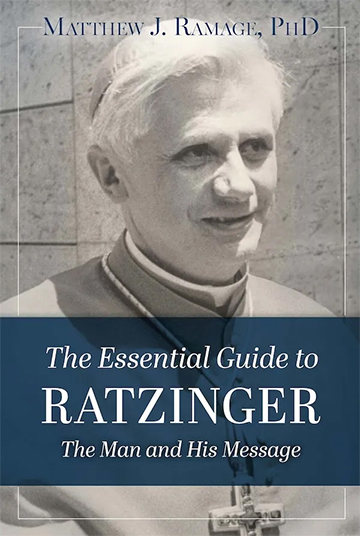
Since the late 1970s, most of the many books, addresses, and interviews of Joseph Cardinal Ratzinger/Pope Benedict XVI have been published by Ignatius Press. And his Collected Works, which will be available in English over the coming years through Word on Fire Academic, totals twenty-five volumes.
For those looking for a more immediate one-stop shop of Ratzinger’s thought, Our Sunday Visitor has released a helpful new primer from Benedictine College theologian Matthew J. Ramage: The Essential Guide to Ratzinger: The Man and His Message.
Ramage, who is a regular contributor to CWR, opens the book with an epigraph from Ratzinger summarizing his own theological project: “My basic impulse,” he explained, “was always to free up the authentic kernel of the faith from encrustations and to give this kernel strength and dynamism. This impulse is the constant of my life.”
What is that “authentic kernel” of Catholicism precisely? What, for Ratzinger, is the essence of what it means to be a disciple of Christ and a member of the Church—the essence he wanted to purify and reinvigorate his whole life long?
Ramage suggests a few overarching themes in the opening chapter, but the most fundamental and conspicuous throughout the course of the book seems to be a penchant for synthesizing “domains that are often separated.”
“Ratzinger’s entire life and ministry,” he writes, “enshrined the Catholic ‘both-and’ principle.” Indeed, in 2007, Benedict XVI referred to Catholicism as “the religion of the great ‘et et’ [and-and],” concluding: “The exact meaning of ‘Catholic’ is ‘synthesis.’”
We even see this both-and principle incarnated in Ratzinger’s long service to the Church. As Ratzinger’s successor would later observe, the “pastoral” and the “theological” are themselves often divided from one another, “as though they were two opposing, separated realities.” Yet the two are fundamentally united and mutually implicative—a truth that Ratzinger incarnated in his very person: He was both a great pastor and a great theologian—two interlocking and interdependent movements toward God.
Throughout the course of this Essential Guide, Ramage—a studied disciple of Ratzinger’s substance and style—gives a tour that’s both comprehensive and clear, distilling deep research into manageable summaries on a host of subjects. We encounter in twelve chapters Ratzinger’s perspective on Scripture and its interpretation, Jesus of Nazareth, Christian faith in an age of unbelief, and the Church in the public square—just to name a few.
Again and again, Ratzinger’s both/and wisdom shines. Ramage explains how his thought harmonizes faith and reason in general, and creation and evolution in particular; truth and love, or logos and agape; divine causation and creaturely causation; the Christ of faith and the historical Jesus; divine law and human freedom; the divinization of man and the transformation of the cosmos; unity and variety in the Church; the vertical and the horizontal in the liturgy; and more.
“Christian spirituality,” Ramage reflects at one point, “is a balancing act”—and Ratzinger, he shows time and time again, had exquisite balance. On any given polarity, he was always careful to harness the strengths of both sides while avoiding the weaknesses of each without the other.
One especially prominent both-and—one whose importance has only increased in the intervening years—is the union of the old and the new in the life of the Church. Ratzinger celebrated tradition but also embraced authentic progress; he resisted an ossified traditionalism with no feet to move, but also pushed back against an open-ended progressivism with no sense of place.
As Ramage shows, this old-new unity manifests in Ratzinger in different ways, including his writings on Vatican II (both deep preconciliar roots and legitimate postconciliar developments), Scripture (both the patristic-medieval and historical-critical approaches), science (both biblical teaching and scientific discovery), and liturgy (both ancient and modern expressions of worship).
And the golden thread uniting all of them is a desire to, as Christ himself teaches, bring out of the Church’s treasury both “what is new and what is old” (Matt. 13:52)—not, as so many Catholics do, choose new at the expense of the old, or vice versa.
To read Joseph Ratzinger is to spend time with a great teacher. He’s thoughtful yet accessible, careful yet compelling, gentle yet directional—and, like all great teachers, he stoops to conquer, conveying his own understanding of and care for his subject precisely to draw you into that same understanding and care. The man never gets in the way of his message, nor does he simply convey it like some lifeless object; instead, he facilitates an encounter with truth.
And that message, that truth, is nothing other than the very Logos of God become man—the communio of heaven and earth in Christ, and in his Body, the Church, “the fullness of him who fills all in all” (Eph. 1:23). This is the heart of Benedict’s Catholic wisdom: the Christ who is both divine and human and both Head and Body—the “Total Christ,” as Saint Augustine, one of the great inspirations of both Benedict XVI and Leo XIV, put it.
“All not-at-one-ness, all division,” Ratzinger proclaimed in his beloved Introduction to Christianity: “rests on a concealed lack of real Christliness.”
With this guide to one of the modern Church’s keenest and kindliest guides, Matthew Ramage offers a wonderful addition to the library of anyone seeking to better understand Ratzinger, the Catholic Church, or the divine Wisdom that governs both.
The Essential Guide to Ratzinger: The Man and His Message
By Matthew J. Ramage
Our Sunday Visitor, 2025
Paperback, 256 pages
If you value the news and views Catholic World Report provides, please consider donating to support our efforts. Your contribution will help us continue to make CWR available to all readers worldwide for free, without a subscription. Thank you for your generosity!
Click here for more information on donating to CWR. Click here to sign up for our newsletter.

“My basic impulse, he explained, was always to free up the authentic kernel of the faith”. Ramage asks the question, What is the authentic kernel?
For 2 millenia we, as a Church have grown with that deposit of our faith guided by Apostolic tradition, great councils from Nicaea to Trent. Was there more that wasn’t explicit? That we didn’t regard?
Joseph Ratzinger, intellectual, man of faith finds validity in encrustations. That which adhered to dogma through the years, additions in various forms that tended to restrict the power of the Word. While there’s validity, there’s danger. Is theology and pastorate a balancing act as Ramage transcribes Ratzinger’s ‘synthesis’?
“Ratzinger celebrated tradition but also embraced authentic progress; he resisted an ossified traditionalism”. Traditionalism is of course a double edged sword at the heart of the disunity we presently suffer. At its heart in conciliar terms is Vatican 2. John Paul II, Benedict XVI represented the best of our tradition in their espousal of V 2. Francis I did not I should dare to say without qualms because he fostered the idea, better said ideology [ironically a term he often misused regarding legitimate tradition] of a new paradigm.
For Jorge Bergoglio to effect this paradigmatic course he was obliged to deconstruct both legacy and its institutions that the kernel might sprout into its full potential of embracing Mankind. Were, then, the legacy of his two predecessors incrustations? Who is to say? The Church.
TLM, the rigid adherence to rules were the ‘rust’, one might presume, that had to be removed for the kernel to be fully realized. Although the Council did not presume so. Latin was to remain [the TLM wrongly oppressed later restored by Benedict XVI], the vernacular used sparingly. Doctrinal adherence remained rigid within its legitimate parameters; the balance between theology and doctrine tempered within our knowledge of the human condition. But not dismissed as we find in Amoris Laetitia.
Reunion of East and West as well as Left and Right can be achieved with intelligent, faithful, strong leadership.
Insofar as the contested issue of a balance between theology and practice, the lynchpin is what has been revealed theologically must be evident in what is practiced, unless there are conditions that grace cannot resolve.
It is grace and the required effort to resist sin and seek justice in our actions that fall under the cardinal virtue fortitude that is absent in Amoris Laetitia. Catholic Christianity is distinguished by the rule to become as perfect as God is perfect. To reach that level of goodness consistent with our nature created in God’s image.
Fr. Peter, well stated