



Washington, D.C. Newsroom, Dec 18, 2025 / 17:48 pm
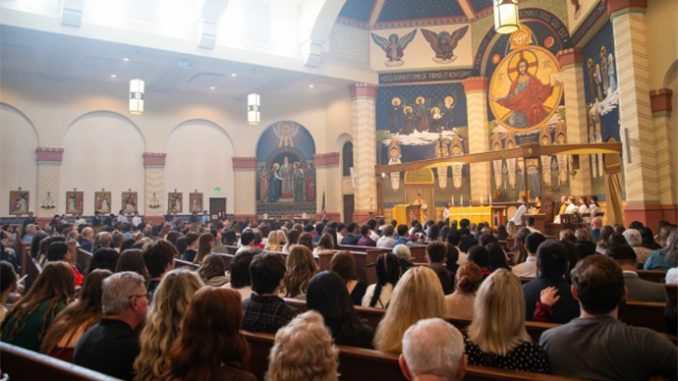
Encouraging participation in Mass and making the sacraments more accessible can deepen fulfillment among Catholics and therefore help to keep Catholics in the faith, experts say.
A recent Pew Research Center report, “Why Do Some Americans Leave Their Religion While Others Stay?”, examined the religious switching of U.S. adults. It looked into the reasons why people stay or leave their childhood faith.
The report revealed many U.S. adults (35%) have left the religion they grew up in, but the majority of Americans (56%) still identify with their childhood religion. The survey reported that Catholics specifically continue to identify with the faith because “their religion fulfills their spiritual needs” (54%) and “they believe in the religion’s teachings” (53%).
To better understand why Catholicism fulfills spiritual needs and which teachings are most important in that process, “it’s crucial that we pay attention to what’s working,” Tom Nash, a contributing apologist for Catholic Answers, told CNA.
He highlighted a June Pew study that found practicing Catholics believe “having a personal relationship with Jesus Christ” (90%) and “receiving the Eucharist” (83%) are the most essential aspects of their faith.
The study “tracks with the Church’s teaching that the sacrifice of the Mass is ‘the source and summit of the Christian life’ (Catechism of the Catholic Church, 1324), and provides insight regarding how the Church best fulfills someone’s spiritual needs and, relatedly, which teachings are most important,” Nash said.
“Through his one paschal sacrifice of Calvary — which encompasses his passion, death, resurrection, and ascension into heaven — Jesus has redeemed the world. In addition, Jesus enables us to offer anew sacramentally and partake of his one sacrifice in the Mass, which is the New Covenant Passover Communion sacrifice,” Nash said.
Receiving the sacraments
Since the majority of Catholics say the faith fulfills their spiritual needs and they believe in the religion’s teachings, it’s “best” to highlight what meets those aspects, Nash said. Specifically, he suggested making the sacraments accessible to Catholics.
“When we make sacramental encounters more available with Our Lord Jesus Christ, an increase in Sunday Mass participation will follow accordingly,” Nash said.
Not only is receiving the Eucharist at Mass “fundamental,” but so is “communing with our Eucharist Lord Jesus spiritually through Eucharistic adoration,” Nash said. This allows Catholics to have “a deep relationship with Our Lord; and they thus form the bedrock of Catholic belief, because they enable us to have increasing divine intimacy with Jesus, and through him with the Father and the Holy Spirit.”
“For practicing Catholics, those who are not participating in weekly Mass, and people in general to whom Christ’s Great Commission is also addressed, we need to ‘Open the doors wide to Christ. To his saving power,’” as St. John Paul II said in his inauguration Mass.
The best and most convenient way to “open the doors” is “to give Catholics and non-Catholics alike the opportunity to draw near to our Eucharistic Lord Jesus in Eucharistic adoration,” Nash said. “With the help of parish deacons and laymen, every parish in the country can open its doors for adoration several nights a week for two to three hours.”
This will allow people to “draw near to the Lord in intimate spiritual communion, whether with our Eucharistic Lord exposed in a monstrance or reposed in the tabernacle. And also open the doors on a morning or two to accommodate those who work evenings.”
“A lot of people — inactive Catholics and non-Catholics alike — are not likely to come to Mass. But if you give them an opportunity to quietly spend time with Jesus in the Blessed Sacrament when it’s more convenient for them, they will draw near,” he said.
The sacrament of confession is also necessary. Nash suggests making confession “available five to 10 hours every week at every parish.”
“It’s not by accident that two of the most demonically oppressed priests in the last two centuries are renowned priest confessors: St. John Vianney and St. Padre Pio,” Nash said. “The devil knows the power of this great sacrament and acts accordingly in opposing it. In this way, we can ironically take a lesson from Lucifer, who despite his being ‘the father of lies’ (Jn 8:44) can’t help but tell the true in expressing his unvarnished hatred of Our Lord Jesus Christ and his Catholic Church.”
Catholics must be ‘equipped’ and ‘formed’
Among all former Catholics whom the new study looked at, it found “the most commonly cited reasons for leaving include no longer believing in the religion’s teachings, scandals involving clergy or religious leaders, or being unhappy about the religion’s teachings about social and political issues,” said Becka Alper, senior researcher at Pew Research Center, in a Dec. 17 interview with “EWTN News Nightly.”
The study reported that most former Catholics are now Protestants. They reported they switched because they stopped believing in the Church’s teachings (46%), “assuming they understand them well to begin with, and because they now believe in the distinctive teachings of Protestantism of one type or another,” Nash said.
If Catholics are equipped “to explain the faith well in a joyful manner, we can stanch the hemorrhaging from the Church,” Nash said. This will also help “remove stumbling blocks for former Catholics and never-Catholic Christians regarding the nature of the Mass, Christ’s real presence in the Eucharist, and that he also provides us to encounter him in his merciful love through the sacrament of confession.”
If you value the news and views Catholic World Report provides, please consider donating to support our efforts. Your contribution will help us continue to make CWR available to all readers worldwide for free, without a subscription. Thank you for your generosity!
Click here for more information on donating to CWR. Click here to sign up for our newsletter.
The wording as “the source and summit of the Christian life (Catechism of the Catholic Church, 1324)” is accurate, but falls too far short of CCC 1374 on the sacramental Real Presence:
“The mode of Christ’s presence under the Eucharistic species is unique. It raises the Eucharist above all the sacraments as ‘the perfection of the spiritual life and the end to which all the sacraments tend.’ In the most blessed sacrament of the Eucharist ‘the body and blood, together with the soul and divinity, of our Lord Jesus Christ and, therefore, THE WHOLE CHRIST IS TRULY, REALLY, AND SUBSTANTIALLY CONTAINED [italics].’ ‘This presence is called ‘real’ – by which is not intended to exclude the other types of presence as if they could not be ‘real’ too, but because it is presence in the fullest sense: that is to say, it is a SUBSTANTIAL presence by which Christ, God and man, makes himself wholly and entirely present’.”
Why, it’s almost as if the Church, itself, is Eucharistic rather than, say, sorta congregational with some sacramental symbolism added in the mix. So, yes, to the Sacrament of Penance and to Eucharistic Adoration…
It’s almost as if in receiving the consecrated host of the Eucharist we become literally and personally incorporated into the “Mystical Body of Christ.” A stunning reality ever ancient—and forever new until fully face to face with the unveiled Glory of God (say what!) in the Beatific Vision—well above and beyond any lesser spiritual need.
St. Augustine was onto something when he remarked of the Real Presence: “I am the food of grown men. Grow, and you shall feed upon me. You will not change me into yourself, as you change food into your flesh, but you will be changed into me” (Confessions, Book 7, Ch. 2:16).
I like this and would only add: increase the available time for liturgical prayer outside Mass, eg parish lauds and vespers. By scheduling the Divine Office for ordinary Catholics and Christians in general to pray with the clergy, we are likely to see increased church attendance. Yes, some are going to come for vespers only and not Mass, but that’s a start and it’s truly a liturgy, so the person who has failed his Sunday Mass obligation by attending Mass is at least darkening the doorway of a parish and encountering the Eucharistic Lord and praying a liturgy. It’s a start! Then, if we believe that the liturgy is real, we can hope that grace will move the believer to return to regular Mass attendance and for the uninitiated to enter full communion with the Church. Of course we used to hear: if a priest leaves ministry, ask him when he stopped praying his breviary. By adding sung vespers and other offices, the laity is renewed and priests will see that laypeople love the Church. And ordinary Catholics who otherwise have never heard of this prayer will rejoice that Catholics have more than only the Mass for prayer. Especially sung vespers invites the people to a deeper Eucharistic faith because of the incensation and a deeper Marian piety because the incensation is during the Magnificat. As this article rightly points out, we already have all the tools necessary for renewal. Just be Catholic.
“Encouraging participation in Mass and making the sacraments more accessible can deepen fulfillment among Catholics and therefore help to keep Catholics in the faith, experts say.”
So, how does suppressing TLM encourage participation in the Mass? Seems to me that participation is being discouraged. (Spoiler alert: I have not attended TLM since 1965).
For every church in every diocese, we need a report card on how many total hours priests hear confessions. That, along with WEEKLY Mass attendance needs to be reported.