
Vatican City, May 17, 2018 / 12:20 pm (CNA/EWTN News).- Two Vatican offices called Thursday for the development of new forms of economy and finance with regulations directed to the common good and respect for human dignity.
“It is especially necessary to provide an ethical reflection on certain aspects of financial transactions which, when operating without the necessary anthropological and moral foundations, have not only produced manifest abuses and injustice, but also demonstrated a capacity to create systemic and worldwide economic crisis,” read Oeconomicae et pecuniariae quaestiones, (Economic and financial issues), a document of the Congregation for the Doctrine of the Faith and of the Dicastery for Promoting Integral Human Development presented May 17.
The document, signed Jan. 6, presents considerations for an ethical discernment of economics and finances, and argues that profit should not be an end in itself, but must be pursued with the goal of achieving greater solidarity and a more equitable distribution of wealth.
It presents fundamental considerations, such as the need for ethics for the economy to function correctly, and treats at length of specific ethical issues in financial and economic markets.
It was presented during a press conference by Archbishop Luis Ladaria, prefect of the Congregation for the Doctrine of the Faith, and Cardinal Peter Turkson, prefect of the Dicastery for Promoting Integral Human Development.
Sitting alongside the prefects were professors Leonardo Becchetti from Rome’s Tor Vergata University and Lorenzo Caprio, from the Catholic University of Milan.
Archbishop Ladaria said the aim of the document is to provide a correct anthropological vision for the current market, since “the common good has disappeared” from many areas of economics and finance.
According to Becchetti, the document also identifies a major problem in the global economy: “we have a growing global wealth, which is a good thing, but we have a huge problem of distribution.”
“Regulation is key” to bringing more balance, he said, citing the need to be attentive to a growing dependence on technology while also ensuring people have work. The main problem, he said, “is fiscal,” and he stressed the need to give attention to areas with fewer resources.
The document frequently cites Pope Francis and Benedict XVI, but also includes citations from Pius XI, the Second Vatican Council, and the subsequent magisterium.
Oeconomicae et pecuniariae quaestiones cites the growing influence of financial markets, saying there is a need for “appropriate regulation of the dynamics of the markets and, on the other hand, a clear ethical foundation that assures a well-being realized through the quality of human relationships; rather than merely economic mechanisms, which by themselves cannot attain it.”
The recent global financial crisis, the text read, is an invitation to “develop a new economy, more attentive to ethical principles, and a new regulation of financial activities that would neutralize predatory and speculative tendencies and acknowledge the value of the actual economy. ”
What is at stake is the well-being of men and women throughout the planet who risk being excluded and marginalized from true well-being, while a small minority, “indifferent to the condition of the majority, exploits and reserves for itself substantial resources and wealth.”
The document said the time has come to begin recovering “what is authentically human,” and to expand minds and hearts to they recognize what is both true and good, “without which no social, political and economic system could avoid bankruptcy, failure, and, in the long term, collapse.”
Competent and responsible authorities, the text read, have the duty “to develop new forms of economy and of finance, with rules and regulations directed towards the enlargement of the common good and respect for human dignity along the lines indicated by the social teachings of the Church.”
The text flagged erroneous and misguided approaches to the economic and financial markets such as consumerism, materialism, and an over-emphasis on profit, citing them as mentalities which endanger the common good and increase inequalities throughout the world.
“Our contemporary age has shown itself to have a limited vision of the human person, as the person is understood individualistically and predominantly as a consumer, whose profit consists above all in the optimization of his or her monetary income. The human person, however, actually possesses a uniquely relational nature and has a sense for the perennial search for gains and well-being that may be more comprehensive, and not reducible either to a logic of consumption or to the economic aspects of life.”
“No profit is in fact legitimate when it falls short of the objective of the integral promotion of the human person, the universal destination of goods, and the preferential option for the poor,” the text said, stressing that a legitimate economic system “thrives not merely through the quantitative development of exchange but rather by its capacity to promote the development of the entire person and of every person.”
On this basis, the document urged that universities and business schools provide as a foundation an education by which students will “understand economics and finance in the light of a vision of the totality of the human person”, avoiding “a reductionism that sees only some dimensions of the person.”
Well-being has to be measured by more than just Gross Domestic Product but must also take into account safety and security and “the quality of human relationships and of work. Profit should be pursued but not ‘at any cost’, nor as a totalizing objective for economic action.”
Profit and solidarity “are no longer antagonists,” the document said. However, “where egoism and vested interests prevail, it is difficult for the human person to to grasp the fruitful interchange between profit and gift, as sin tends to tarnish and rupture this relationship.”
“It is impossible to ignore the fact that the financial industry, because of its pervasiveness … is a place where selfishness and the abuse of power have an enormous potential to harm the community.”
The documented lamented that “Capital annuity can trap and supplant the income from work, which is often confined to the margins of the principal interests of the economic system. Consequently, work itself, together with its dignity, is increasingly at risk of losing its value as a ‘good’ for the human person and becoming merely a means of exchange within asymmetrical social relations.”
It pointed out an inversion between means and ends, in which work has become an instrument, and money an end.
Oeconomicae et pecuniariae quaestiones said that credit has an “irreplaceable social function,” but that “applying excessively high interest rates, really beyond the range of the borrowers of funds, represents a transaction not only ethically illegitimate, but also harmful to the health of the economic system. As always, such practices, along with usurious activities, have been recognized by human conscience as iniquitous and by the economic system as contrary to its good functioning.”
Instead, financial activities are called to serve the real economy, “to create value with morally licit means, and to favour a dispersion of capital for the purpose of producing a principled circulation of wealth.”
“What is morally unacceptable is not simply to profit, but rather to avail oneself of an inequality for one’s own advantage, in order to create enormous profits that are damaging to others; or to exploit one’s dominant position in order to profit by unjustly disadvantaging others, or to make oneself rich through harming and disrupting the collective common good.”
The text then highlights the need for greater communion, collaboration, and solidarity in the market, and offers suggestions for ways in which these can be implemented.
In a healthy market “it is easier to respect and promote the dignity of the human person and the common good,” the Vatican offices wrote.
The experience of recent decades has demonstrated the need for both ethics and regulation, the document states.
With an increased globalization of financial markets, the system “requires a stable, clear and effective coordination among various national regulatory authorities,” allowing them to share binding decisions when necessary, especially when it comes to threats against the common good.
“Where massive deregulation is practiced, the evident result is a regulatory and institutional vacuum that creates space not only for moral risk and embezzlement, but also for the rise of the irrational exuberance of the markets, followed first by speculative bubbles, and then by sudden, destructive collapse, and systemic crises,” Oeconomicae et pecuniariae quaestiones states.
The text condemned the tendency of business managers to establish policies which aim “not at increasing the economic health of the companies that they serve, but at the mere profits of the shareholders, damaging therefore the legitimate interests of those who are bearing all of the work and service benefiting the same company, as well as the consumers and the various local communities (stakeholders).”
The document suggested that ethical committees be established in banks to support the administration, and to help cushion them from the impact of losses.
The text then pointed to financial instruments such as derivatives and credit default swaps, which going unchecked, can lead to “unacceptable” consequences from an ethical point of view, essentially gambling with a person’s future.
Use of offshore accounts as tax havens was also condemned, though it was noted that tax systems throughout the world are not always equal, which can damage weaker parties in favor of wealthier ones.
Despite the fact that more nations are cracking down on offshore accounts, penalties have not been enforced and norms have either not been applied or they have not proved effective due to the political powers pulling the strings.
All of these problems are “not only the work of an entity that operates out of our control,” but are “in the sphere of our responsibilities.”
Oeconomicae et pecuniariae quaestiones states that it is “therefore quite evident how important a critical and responsible exercise of consumption and savings actually is.”
As an example, the text said shopping is a daily task by which we can choose to avoid purchasing products produced by chains which violate “the most elementary human rights,” such as sweat-shops.
“Through the gesture, apparently banal, of consumption, we actually express an ethics and are called to take a stand in front of what is good or bad for the actual human person.”
Likewise, persons are called to direct their savings to “those enterprises that operate with clear criteria inspired by an ethics respectful of the entire human person, and of every particular person, within the horizon of social responsibility.”
“Each one is called to cultivate procedures of producing wealth that may be consistent with our relational nature and tend towards an integral development of the human person.”
The document concludes with a call to hope in light of the challenges of the economy, saying, “every one of us can do so much, especially if one does not remain alone.”
“Today as never before we are all called, as sentinels, to watch over genuine life and to make ourselves catalysts of a new social behavior, shaping our actions to the search for the common good, and establishing it on the sound principles of solidarity and subsidiarity.”
 […]
[…]




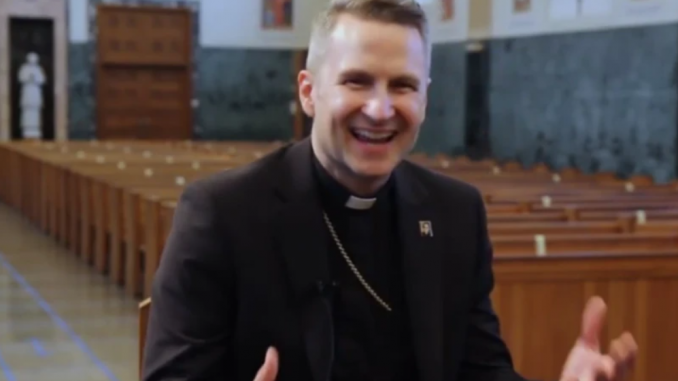


This appears good. I presume Leo knows Hicks and has a good sense of his character and abilities.
This appears disappointing. Another capitulation to the sexual depravity agenda given his support for special gay Masses. Yes, Leo probably does know his soft on doctrine character.
He is solidly pro-life, is friendly to the Vetus Ordo, and has regularly offered communion on the tongue. I respect Leo and will trust his judgment until there’s good reason to think otherwise.
He held a Mass that was supposed to be welcoming to the gay and lesbian community. Are they not welcome in the Church?
We are all welcome, but with that welcome comes the expectation that we follow Church teaching & obey the rules.
Everyone is welcome, but any implicit endorsement of a committed, often defiant sinful way of life without repentance is not.
Another Chicago boy? Is he Cubs or White Sox?
Cubs.
“He returned to Chicago in 2010 to serve as dean of formation at Mundelein Seminary before Cardinal Blase Cupich of Chicago appointed him vicar general of the archdiocese on Jan. 1, 2015.”
Uh huh.
Bishop Barron, the evangelist/communicator extraordinaire, lodged in the middle of nowhere, 1100 miles from the communication capital of the world.
The more things change, the more they stay the same. They did the same thing to no less than Venerable Fulton Sheen by shipping him off to Rochester, NY. It starts to look more like a badge of honor than anything else. But at least I read some good things about Bishop Hicks and the TLM, which is encouraging.
The similarity did not escape me either. And we need pray that the injustice of depriving us of Archbishop Sheen’s beatification be very soon rectified.
As a resident of “nowhere” I am happy to have him here.
I went to college in the middle of nowhere about 200 miles north of you. It is, albeit frigid this time of year, is very beautiful.
And you are blessed as well to have Bishop Barron for your temporal shepherd.
Bishop Barron and Father Schmitz have robust ministries reaching the world from Minnesota. Bishop Hicks in Mamdani’s New York: If Hicks is a true shepherd in persona Christi, he will find numerous lost sheep and hell fire. I hope he has the spiritual strength to carry the crosses ahead of him.
It is good to see name of Bishop Barron! Outstanding intellect and servant of Christ.
Perhaps the Pope feels Bp Barron can effectively reach more people for Christ through his ministry, no matter where it’s based, (as you indicated by your description of his ministsry despite it’s physical base) than he would by being Archbishop of one of the largest dioeceses in the US, which also would limit his time and availability to continue his most powerful ministry…
I pray for his ministry as shepherd for the good Catholics of the NY Archdiocese.
Bishop Barron could’ve gone to NY, it is true, but perhaps a return to Chicago will be better, for he has styled himself as straight down the middle, neither a liberal nor a conservative, though I’ve always leaned on Chesterton’s reminder that the Catholic doesn’t follow the Via Media. Midwest HQ, Chicago needs episcopal leadership and Cupich will turn 77 March 19th. Dolan hits 76 February 6th. Let’s be fair, meet and just.
Hmmmm…Leo and Cupich are quite speedily showing Cardinal Dolan the door even though he only turned 75 earlier this year. It’s called getting “Chaputed”! They’re not on the ” team” (and I’m not referring to a baseball team), so they’re quickly out. “Team” members are left in place till they’re 80.
Cardinal Dolan, whatever his shortcomings, didn’t support the takeover of the USCCB a few years ago by Cupuch, McElroy, and Newark Tobin. He didn’t bravely speak up at the time like Chaput did, but still yet he didn’t support the “team”.
So the “team” shifted their focus from being the day to day team manager to being the General Manager – selecting the players who get to be on the team as opposed to picking daily lineups and choosing what reliever to bring in in the 8th.
So General Manager Cupich had himself installed by his like-minded souls in the Vatican as the gatekeeper of who exactly will be in the seats in the future at those Baltimore USCCB meetings.
So now we have McElroy taking over DC and another Cupich acolyte taking over NYC, Cupich in Chicago, Tobin in Newark, etc, etc.
Everything appears to be rolling along smoothly for the “team” to take the Pennant!
“Everything appears to be rolling along smoothly for the “team” to take the Pennant!”
Except that (1) they’re running out of managers and coaches who’ll go by the general manager’s playbook and (2) the players (priests) are hardly on board with the playbook either. We’re setting up for the possibility of major conflict between the old guard and the new guard. Apart from that, I too note with concern the relatively rapid acceptance of Cardinal Dolan’s resignation while Cupich’s sits on the Pope’s desk.
May God bless him, and may he keep humble, holy, and be a good shepherd.
Amen.
Sounds like another minion of Cardinal Cupich. Probably not a good sign of things to come.
Could be, but over at The Pillar we also read that Bishop Hicks is a good administrator, was close to Cardinal Francis George, and that the Archdiocese of New York needs a kick-start since it boasts only 18 seminarians out of a Catholic population of 2.5 million.
My hope is that Bishop Hicks remembers those “seven counties to the north” (as you described us but we do have names) and not only attends to NYC area. Under Cardinal Dolan, the ONLY Catholic school in Sullivan County was closed. This school was significant in the community as it provided not only a good education to the children but also a safe, affordable preschool for families. Sullivan is a poor county. Parishes in the outer areas of the county are being closed even though they were financially okay and the distance to a church is now too far for many Catholics. In my home county of Orange, parishes are being closed while we are funding non Catholic children in NYC Catholic schools. My husband and I stopped contributing (and we were generous in the thousands of dollars) to the NY Cardinal’s Appeal because the money has been NYC area centered.
From what I can tell, it seems like he won’t differ from Cardinal Dolan in any substantive way. He seems to be in the “conservative” two-thirds of American episcopate, while clearly adhering to the dreary USCCB/Vatican agenda on the politcal issues like immigration and climate change. He doesn’t have an aversion to The Latin Mass, but probably won’t do much to promote it. He’ll say the right things on abortion and perverted sex, but probably won’t discipline lay or clerical dissenters, like the notorious Jesuit who operates in the Archdiocese of New York.
He’ll also start out $300M poorer as a result of the sex abuse settlement just announced. Who knows where all that money will be going and how much of it is justified. Plenty of scammers and their lawyers likely will get a juicy windfall while a smaller number of genuine victims will get nothing, if everything holds true to form.
I am not only Disappointed but also deeply saddened by the Negative Energy disposed by many commentators political views towards Your new Archbishop. Not being disparaging, but I truly Believe in the Power of Prayer and for me I offer uplifting Blessings from God to Help each of you to discern your discontent . All Praise, Glory and Honor to the Lord our God. May His Peace be always upon us . Amen Sweet Jesus !!!