


ACI Stampa, Dec 6, 2025 / 07:00 am (CNA).
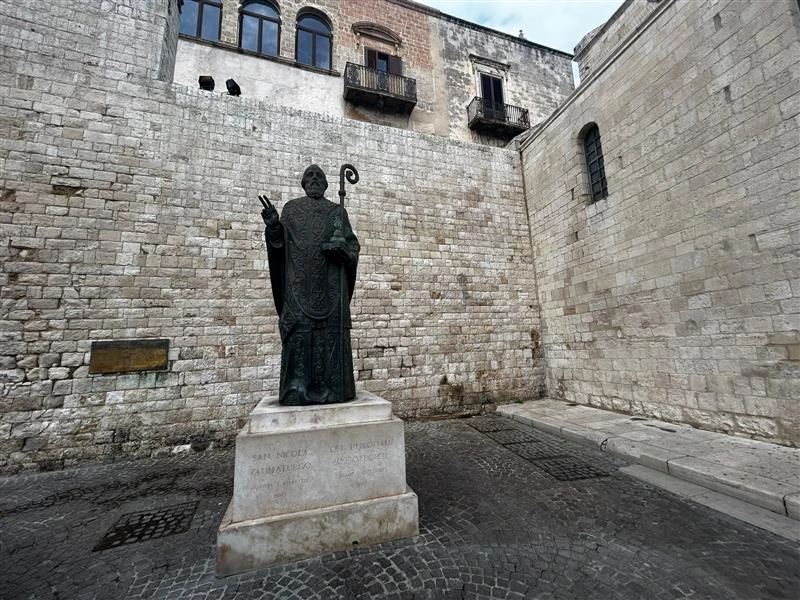
The people of Bari, a city in southern Italy, have a deep devotion to St. Nicholas, their patron saint and beloved protector.
“How can you not love St. Nicholas? And how can you not feel loved by St. Nicholas?” Father Giovanni Distante, the rector of Bari’s Pontifical Basilica of St. Nicholas, told ACI Stampa, CNA’s Italian-language news partner.
“The relationship between the people of Bari and St. Nicholas is one of love,” the rector continued, “a relationship that began in 1087 and continues to this day.”

It all began in 1087 when 62 brave sailors managed to rescue the relics of St. Nicholas, bringing them from the city of Myra in Asia, St. Nicholas’ hometown, to their beloved city in southern Italy, Bari, in Puglia. The Basilica of St. Nicholas was built to hold the relics, which it still does today. Every year, countless pilgrims continue to pay homage at the tomb of St. Nicholas, the saint of Christmas, who is loved by adults and children alike.
St. Nicholas is also an important figure in ecumenical dialogue, uniting Catholics, Orthodox Christians, and Protestants.
“St. Nicholas, as bishop of Myra, naturally influenced millions of faithful in the East and West, not only as bishop of Myra but also as patron, if we may say so, of Eastern and Western Christianity. So much so that St. Nicholas is venerated as the ‘Saint of Ecumenism,’ because he manages to unite the two realities, the two Christian traditions, both Eastern and Western,” Distante said.
St. Nicholas occupies a special place in everyone’s hearts in December. Considered the saint of Christmas and remembered for his care for children, he was much loved for the protection he offered them. Many miracles are attributed to his intercession, particularly for the benefit of young women and children.
“St. Nicholas intervenes where concrete action is needed in love, practicality, justice, and, of course, sharing,” Distante explained.
St. Nicholas is celebrated twice a year in Bari: on Dec. 6 and on May 9.
“Dec. 6 is the liturgical feast of the saint, commemorating the day of his death, which becomes the new birth of St. Nicholas in heaven,” the rector of the Basilica of St. Nicholas explained.
On May 9, he continued, “we celebrate the event of the transfer of St. Nicholas’ relics to Bari with a large procession by sea.”
On Dec. 6, Bari is filled with “illuminations,” a choreographed display of lights in the narrow streets of the city that are lit up for the feast of St. Nicholas and also for Christmas. This year’s program is once again full of events and celebrations.

The Pontifical Basilica of St. Nicholas in Bari opened at 4 a.m. on Dec. 6. At 5 a.m., the first Mass was celebrated, presided over by Distante, and followed by five more Masses throughout the morning.
The start of the first Mass was preceded, at 4:30 a.m., by the sounding of reveille and the arrival of the St. Nicholas torchlight procession. In the early hours of the day, a group of bagpipers will enliven the alleys of the old town around the basilica. At 6 p.m., there will be a solemn Mass celebrated by Archbishop Giuseppe Baturi of Cagliari and Archbishop Giuseppe Satriano of Bari-Bitonto. At the end of Mass, the procession with a statue of the saint will pass through the streets of the old town. In the evening, at 8:30 p.m., there will be a fireworks display from the Sant’Antonio pier.

One of the essential customs of the feast of St. Nicholas for the people of Bari is hot chocolate, enjoyed in the alleys of old Bari to warm up after Mass in the basilica.
This story was first published by ACI Stampa, CNA’s Italian-language news partner. It has been translated and adapted by CNA.
If you value the news and views Catholic World Report provides, please consider donating to support our efforts. Your contribution will help us continue to make CWR available to all readers worldwide for free, without a subscription. Thank you for your generosity!
Click here for more information on donating to CWR. Click here to sign up for our newsletter.

Leave a Reply