


Washington, D.C., Dec 3, 2025 / 13:50 pm
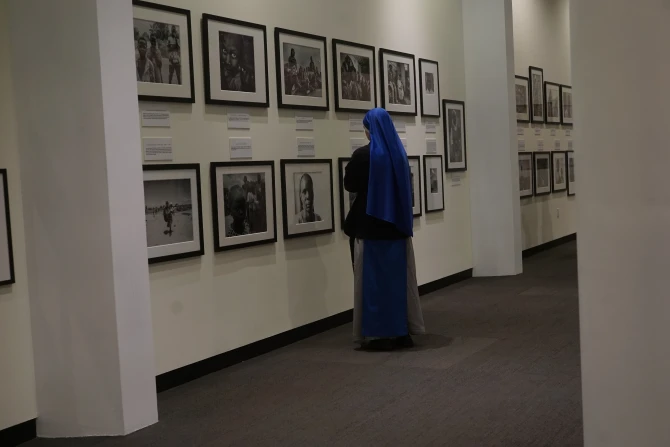
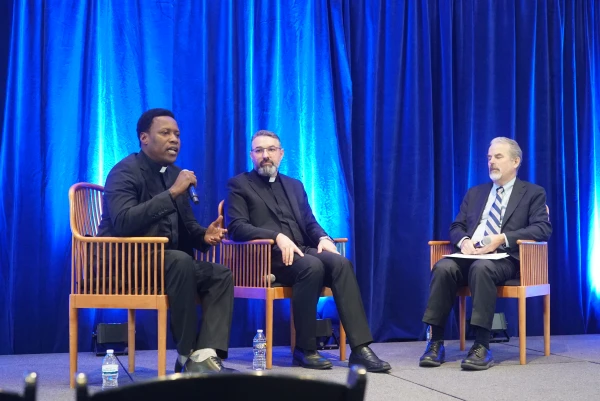
A discussion featuring Father Atta Barkindo and Father Karam Shamasha breathed life into a photo exhibit featuring the “forgotten faces” of persecuted Christians in Nigeria and Iraq on Tuesday.
The photo display can be seen at the Saint John Paul II National Shrine in Washington, D.C., until Feb. 8, 2026. Stephen Rasche, a professor of theology at the Franciscan University of Steubenville and senior fellow at the Religious Freedom Institute, who spent years serving persecuted Christians in Iraq and Nigeria, said he hopes people will see “the spark of human dignity” in his photographs of Iraqi and Nigerian Christians on display.
The Dec. 2 discussion, titled “Seeing the Persecuted and Displaced: Experts Tell Their Stories,” organized in part by the Knights of Columbus, comes amid calls for the U.S. to take concrete action toward the Nigerian government after President Donald Trump announced his decision to designate Nigeria as a country of particular concern (CPC).
Rasche was a founding member of the Catholic University in Erbil in 2014. According to his bio, he has served as an official representative to the Vatican Dicastery on Refugees and Migrants, and belongs officially to the historical commission to the Vatican postulator in the cause of Father Ragheed Ganni, a servant of God, and three Iraqi deacons who were murdered in June 2007.
Alongside Rasche’s photos of Nigerian Christians, Barkindo said the persecution of his community in Nigeria is happening on two levels. “The first level is the level of government policy,” he said, “and the second level is the physical violence that we have seen and continue to see in Nigeria.”
Barkindo said before Nigeria became a country, there were two existing Islamic caliphates in the north: the Kanem Borno Empire and the Sokoto Caliphate, both of which had diplomatic relationships with the Ottoman Empire and “were fully established as a pure Islamic territory.” After the British destroyed these empires and installed constitutional democracy, he said, “the grief that followed the dismantling of the Islamic empires actually never left northern Nigeria.”
On a policy level, he said, the government then established sharia law, shuttered Christian mission schools and other institutions, and made it “increasingly difficult” for Christians in the north to participate in civilian life.
“The ideology was very established, and that was what now led to the physical violence that we now see in Nigeria,” Barkindo said.
“The most important thing is that the violence evolved over time,” he said. “It evolved because there was a complete and massive failure of the government to deal with the insecurity and the situation.”
As director of The Kukah Centre, Barkindo has led grassroots efforts to bolster security in Nigeria. He holds a licentiate degree in political Islam and interreligious dialogue from the Pontifical Institute for Arabic and Islamic Studies in Rome and a doctorate from the SOAS University of London.
In an interview with CNA, Barkindo described his efforts with The Kukah Centre to promote peace throughout Nigeria’s 36 states. “We have the National Peace Committee that mediates in elections, but they don’t have the gift of bilocation,” he said, explaining how the center goes to states where the Peace Committee cannot reach and trains its civilians in mediation and data collection on early warning and early response for security threats.
“If they observe serious issues and collect intelligence, they can flag that with us at the national level. We reach out to the government and they’re able to mitigate the situation before it turns into crisis,” he said. The Kukah Centre has done this in 23 states so far and hopes to expand its reach to all 36 states before next year’s elections.
Reflecting on the evening’s discussion, Barkindo said “the willingness of the American people to just listen” had struck him.
“America, I don’t want to sound too political, is such a significant country right now globally: When Trump spoke, the whole of Nigeria shook,” he said with emotion. “It’s like for the first time Christians now have somewhere to run to because we have been shouting and speaking for years.”
Persecution in Iraq
During his testimony, Shamasha also noted the deeply engrained presence of Islamist ideology in Iraq, where he said “we are not dying in the streets today as it was in 2014, but our persecution is different today … there is a lot of discrimination against Christians in this land.”
Shamasha recounted his experience of persecution, which began in 2003 while at a seminary in Baghdad, which closed several times while he was a student. He was eventually forced to leave in 2005 for Erbil, the Kurdish region of Iraq. He became a parish priest in the Nineveh Plains, then fled once more to Erbil in 2014 with the invasion of ISIS.
It was during this time that the Catholic University of Erbil was founded. While the Knights of Columbus helped to support and feed the Iraqi Christian community, Shamasha said, the university sought to help young people to not only survive but also “to live with dignity” and eventually become leaders, he said.
“Thanks to God, we are still there,” the Iraqi priest said. “We are fighting to remain not just numbers in these countries, but we are fighting to, in fact, be a real member that can shine, that can give light to all the people that they are.”
Shamasha holds a doctorate and master’s degree in moral theology from the Pontifical Alphonsian Academy in Rome as well as degrees in canon law, interreligious studies, and priestly formation from the Gregorian University, Lateran University, and the Congregation for the Clergy.
If you value the news and views Catholic World Report provides, please consider donating to support our efforts. Your contribution will help us continue to make CWR available to all readers worldwide for free, without a subscription. Thank you for your generosity!
Click here for more information on donating to CWR. Click here to sign up for our newsletter.

Leave a Reply